international SEO strategy
AI Growth Engine

International SEO for B2B: Reach the Right Global Buyers.

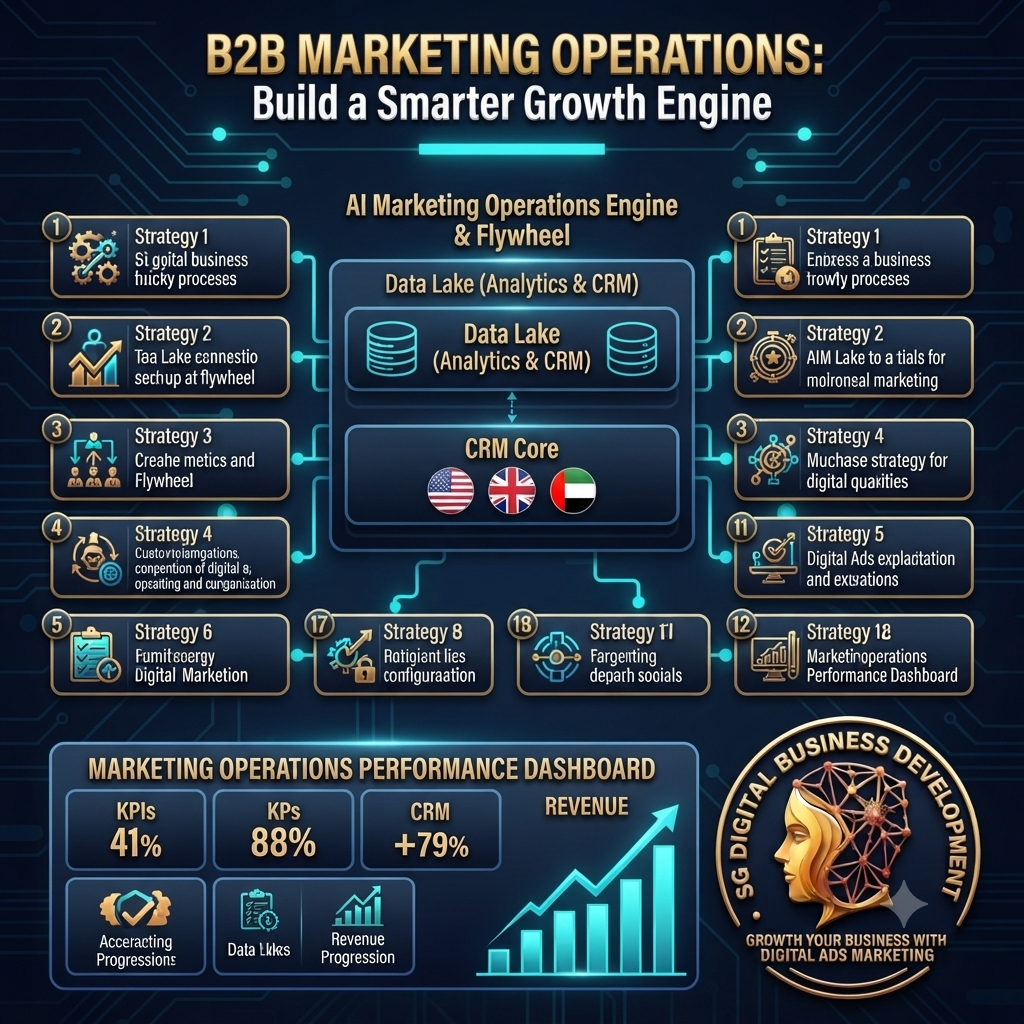
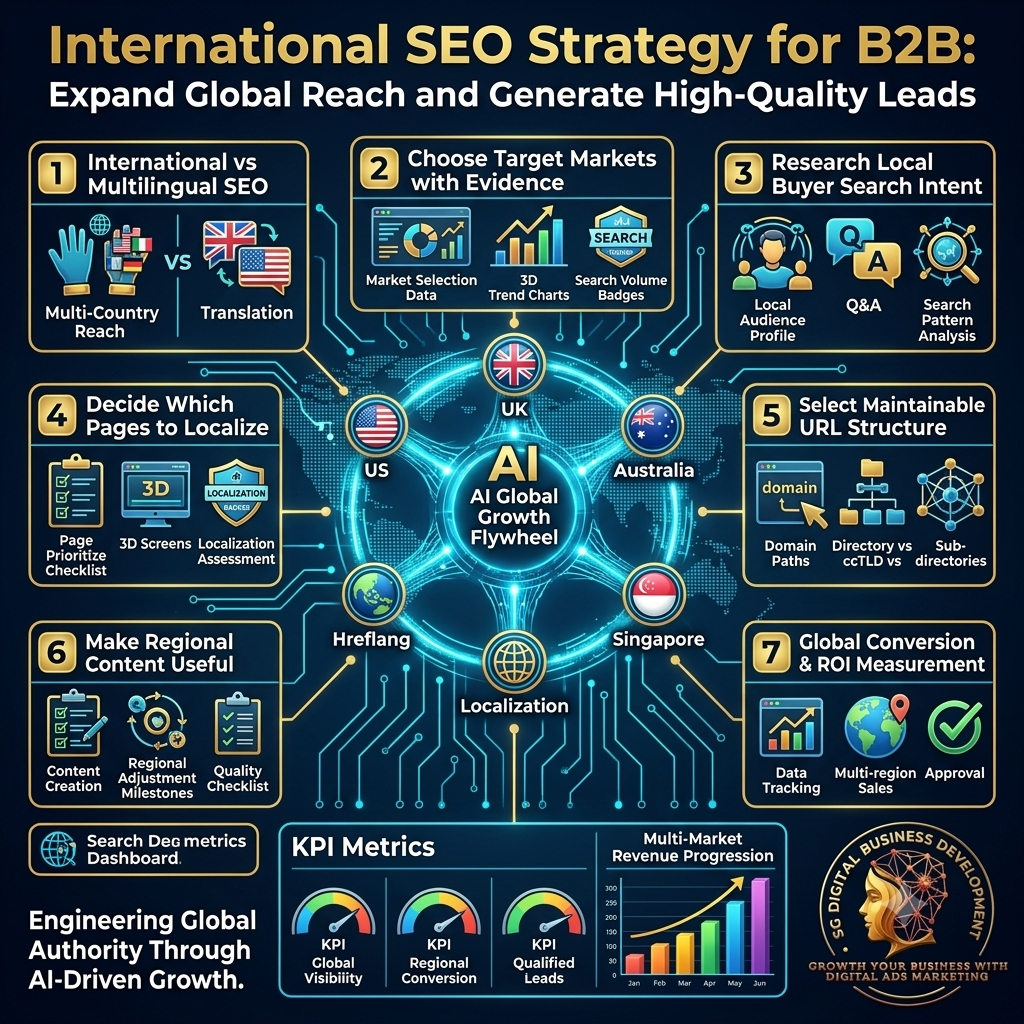
International SEO Strategy for B2B. Introduction Selling to customers in more than one country creates a search challenge that is easy to underestimate. A business may have a strong website, useful service pages, and steady organic visibility in its home market, yet remain difficult to discover among buyers in the United States, United Kingdom, Australia, Singapore, or other target regions. The reason is rarely a single technical setting. International growth depends on understanding where demand exists, how buyers describe their problems, which pages deserve to be localized, and how search engines can identify the right version of each page. An effective international SEO strategy connects market research, search intent, website architecture, localized content, technical signals, and conversion experience. It does not mean translating every page or creating a country folder for every place on a map. It means choosing markets deliberately and building pages that genuinely help the people in those markets evaluate a supplier. For B2B companies, the decision is especially important because buying journeys are often longer and involve several stakeholders. A procurement manager, technical evaluator, founder, and finance lead may all search differently before a conversation begins. A global search plan should therefore support discovery, evaluation, and enquiry—not just impressions. This guide explains how to plan that work, what to check before expanding, how to avoid common technical mistakes, and how to measure whether international organic visibility is creating relevant business opportunities. 1. Understand the difference between international and multilingual SEO International SEO is the broader practice of making a website relevant and accessible to audiences in different countries or regions. Multilingual SEO focuses on serving content in more than one language. These activities can overlap, but they are not identical. A company based in India may target buyers in the United States and United Kingdom using English-language pages. That is international targeting without necessarily being multilingual. A company may also serve English- and German-speaking customers in several countries. That is multilingual, and it may also be multi-regional if the offer, pricing, compliance details, or customer experience differs by market. The distinction matters because language alone does not define a market. Two countries can use English but have different terminology, regulations, expectations, currencies, buying processes, and proof requirements. Conversely, a single language may be used across several markets without requiring separate versions of every page. An international SEO strategy begins by identifying the audience and business purpose behind each target market. Ask whether the goal is to attract leads, support distributors, sell subscriptions, recruit partners, or help existing customers. The answer determines which pages need regional relevance and which can remain global. Avoid creating separate country pages simply because a country is commercially attractive. First establish that the company can serve buyers there and that the page can provide meaningful local information. An international SEO strategy maps buyer intent to useful pages. A sound international SEO strategy avoids creating thin country pages. International SEO strategy needs focus. 2. Choose target markets using evidence Market selection should combine commercial feasibility with search opportunity. A country with large search demand may not be a good priority if the company cannot deliver there, support local time zones, meet relevant requirements, or compete on price. A smaller market may be more attractive if the service is specialized and the company already has strong customer fit. Start with first-party evidence. Review enquiry locations, customer records, sales conversations, existing contracts, and website analytics. Search Console can reveal the countries generating impressions and clicks, but those figures should be interpreted carefully. Impressions do not prove that visitors are qualified, and a small number of relevant enquiries may be more valuable than a large volume of low-intent visits. Next, assess market fit. Consider the size and maturity of the target industry, the language used by decision-makers, local competitors, service delivery requirements, payment preferences, and the credibility signals buyers expect. Speak with sales and delivery teams before selecting the first markets. Build a simple prioritization model. Score each market for customer fit, achievable delivery, search demand, competition, expected deal value, and available proof. Use consistent criteria rather than choosing markets based on assumptions or one keyword tool estimate. The purpose of an international SEO strategy is not to target as many countries as possible. It is to focus resources on markets where the business can provide a strong solution and where search visibility can support a realistic commercial objective. The international SEO strategy needs a URL structure the team can maintain. A maintainable international SEO strategy has clear technical ownership. 3. Research how buyers search in each market Keyword research should reflect the words customers actually use. Direct translation is not enough. A phrase that sounds natural in one country may be uncommon, overly broad, or commercially misleading in another. Even within English-speaking markets, terms can differ by industry, role, and buying stage. Build research around problems, services, use cases, and decision questions. For each target market, collect phrases that describe the category, the problem, the desired outcome, and the type of provider being considered. Include informational searches such as definitions and guides, comparison searches such as alternatives and provider evaluations, and commercial searches that indicate readiness to speak with a supplier. Use Search Console data, keyword research platforms, customer interviews, sales call notes, competitor pages, and search result reviews. Examine the actual results for each query. If the results show local directories, government resources, comparison sites, or product pages, that reveals something about search intent and the type of page likely to be useful. Do not assume that a high-volume phrase is automatically the best target. A specialized B2B term may have limited volume but stronger relevance to the company’s offer. Review the language used by local competitors, but do not copy their claims or structure without evaluating accuracy. An international SEO strategy should map each keyword group to one suitable page. This reduces overlap and helps teams decide whether a global page needs adaptation or a genuinely different local page. An international SEO

B2B Sales Negotiation Strategy
AI Growth Engine

B2B Sales Negotiation Strategy: Protect Value and Win Better Deals.

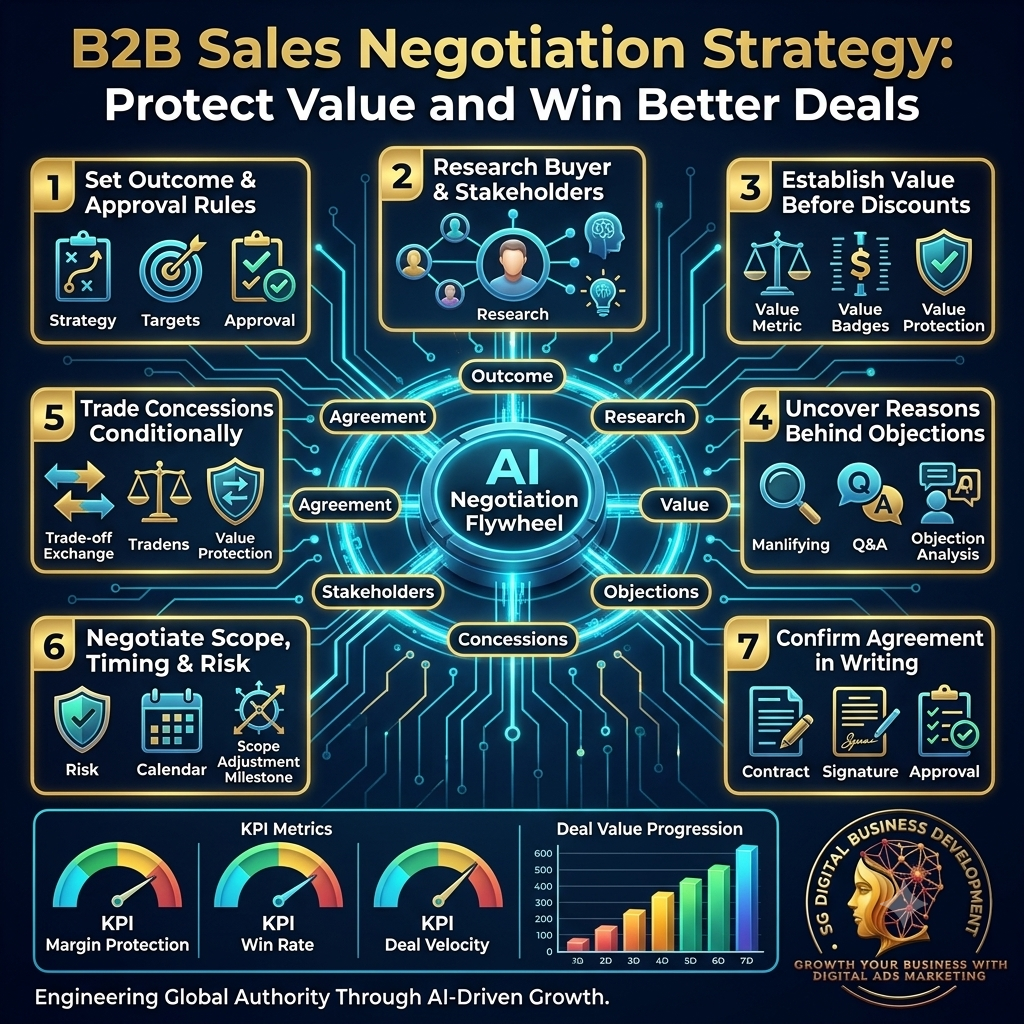
B2B Sales Negotiation Strategy: Protect Value and Win Better Deals Introduction A promising B2B opportunity can lose momentum when commercial discussions begin. The buyer may ask for a discount, request additional services, challenge the timeline, compare competing proposals, or seek contract terms that shift too much risk to the supplier. Sales teams that respond without preparation can reduce margins, create delivery problems, or agree to commitments that the business cannot sustain. A B2B Sales Negotiation Strategy gives the team a disciplined way to prepare, understand buyer priorities, communicate value, trade concessions, and reach agreements that work for both sides. A B2B Sales Negotiation Strategy sets measurable standards. It is not about winning every point or pressuring a buyer into a quick signature. It is about discovering what matters, protecting the value of the offer, managing risk, and creating a commercial relationship that can succeed after the contract is signed. B2B negotiations often involve several stakeholders, longer decision cycles, technical requirements, procurement processes, budgets, and legal review. A discussion about price may actually be a discussion about risk, internal approval, implementation confidence, or cash flow. Strong negotiators look beneath the first request and ask what problem the buyer is trying to solve. This guide explains how to prepare, conduct, and review B2B negotiations. A B2B Sales Negotiation Strategy connects each stage. It covers value, pricing, concessions, stakeholder alignment, contract terms, communication, and practical steps that help sales teams negotiate with clarity and confidence. 1. Set the outcome before the conversation Start by defining what a successful agreement should achieve for both parties. Identify the commercial objective, minimum acceptable terms, preferred outcome, and issues that require approval. Consider revenue, margin, payment timing, delivery effort, implementation risk, customer fit, and long-term potential. A deal that looks attractive on headline value may become unprofitable if it includes excessive support, unrealistic deadlines, or unlimited revisions. A B2B Sales Negotiation Strategy tests the full economics. A useful B2B Sales Negotiation Strategy separates essential requirements from preferences. Essential requirements might include a minimum margin, data protection obligations, payment security, or a delivery scope the team can realistically fulfill. Preferences may include a particular start date, contract length, or payment schedule that can be adjusted in exchange for something valuable. Write down the objective in plain language. For example: secure a profitable engagement with an agreed scope, realistic milestones, and payment terms that support delivery. This gives the team a reference point when discussions become difficult. Without a defined outcome, negotiators can become focused on closing the deal rather than deciding whether the deal is worth accepting. A B2B Sales Negotiation Strategy keeps the decision grounded. 2. Research the buyer and buying environment Preparation begins with understanding the organization, its goals, constraints, and decision process. Review the buyer’s industry, business model, current priorities, existing suppliers, recent changes, and the problem that created the opportunity. Use discovery notes, public information, previous conversations, and relevant customer feedback. Distinguish confirmed facts from assumptions. A B2B Sales Negotiation Strategy depends on reliable preparation. Identify the stakeholders involved. A business sponsor may care about outcomes, procurement may focus on process and comparability, finance may examine budget and payment terms, and technical teams may assess feasibility or security. Each person may use different language to describe the same concern. Map their influence and identify who can approve scope, price, risk, and contract terms. A B2B Sales Negotiation Strategy should also consider the buyer’s alternatives. They may choose another supplier, use an internal team, delay the project, reduce the scope, or do nothing. Understanding these alternatives helps the seller assess urgency and explain differentiated value without making unsupported claims about competitors. A B2B Sales Negotiation Strategy must respect buyer choice. 3. Establish value before discussing discounts Price is easier to defend when the buyer understands what the offer is intended to achieve. Connect services, products, and deliverables to the buyer’s stated priorities. Explain the process, expertise, resources, risk reduction, and support included. Use evidence such as relevant examples, documented capabilities, transparent methods, and realistic performance measures. Do not promise a specific financial result unless there is reliable evidence and the conditions are clear. If outcomes depend on customer participation, market conditions, data quality, or implementation decisions, explain those dependencies. Credibility is more valuable than an impressive but unsupported forecast. A B2B Sales Negotiation Strategy must stay evidence-led. A B2B Sales Negotiation Strategy should make value concrete. Instead of saying a service is high quality, explain what quality means in the engagement: defined deliverables, experienced staff, review checkpoints, response expectations, reporting, or documented acceptance criteria. Help the buyer compare the full offer rather than one line in a price table. A B2B Sales Negotiation Strategy makes value easier to assess. 4. Understand the reason behind an objection A request for a lower price may signal a real budget limit, a procurement benchmark, uncertainty about value, a desire to test flexibility, or a mismatch between scope and expectations. Do not assume the reason. Ask open questions and listen carefully before proposing a response. Useful questions include: “Which part of the investment is hardest to justify internally?”, “Is the concern the total budget or the timing of payment?”, and “What would need to be clearer for your team to approve the proposal?” These questions reveal whether the issue is price, risk, scope, timing, or internal alignment. The B2B Sales Negotiation Strategy should treat objections as information. A buyer who asks for a discount may accept a phased scope, a different start date, or a shorter initial commitment if the real constraint is cash flow or approval timing. A buyer who is unsure about implementation may need a clearer plan rather than a lower price. A B2B Sales Negotiation Strategy asks before it answers. 5. Prepare a negotiation range and approval rules Before the meeting, identify the preferred commercial position, acceptable range, and walk-away conditions. The range should reflect cost to deliver, required margin, market positioning, strategic value, and risk. Avoid inventing a precise floor simply to create

B2B Sales Pipeline Management
AI Growth Engine

Best B2B Sales Pipeline Management: Build a Healthier Pipeline and Close More Deals.

B2B Sales Pipeline Management: Build a Healthier Pipeline and Close More Deals. Introduction A busy sales team can have hundreds of contacts, dozens of open opportunities, and a full calendar without having a dependable path to revenue. Activity is not the same as progress. Some deals are poorly qualified, others have no confirmed next step, and many remain in the forecast long after the buyer has stopped engaging. The result is an unpredictable pipeline that makes planning difficult and wastes time that should be spent with suitable prospects. B2B Sales Pipeline Management gives a business a consistent way to organize opportunities from first qualification through decision and handover. It combines clear stages, useful customer information, realistic exit criteria, disciplined follow-up, and regular review. The purpose is not to pressure buyers or make every deal move faster. It is to understand where each opportunity stands, identify what the buyer needs next, and focus effort where there is a credible path to a good commercial outcome. A reliable process helps marketing, sales, leadership, and delivery teams work from shared definitions. It can reveal whether the business needs more qualified demand, better discovery, stronger proposals, improved follow-up, or a different offer. This guide explains how to build that process, measure it responsibly, and improve it without turning selling into an administrative exercise. B2B Sales Pipeline Management starts with evidence. What Is B2B Sales Pipeline Management? B2B Sales Pipeline Management is the practice of defining, monitoring, and improving the stages that business opportunities move through before becoming customers. A pipeline is a structured view of potential deals, not simply a list of names. Each opportunity should have a business problem, an identifiable buying group, an estimated value, a realistic decision process, a current stage, and an agreed next action. The exact stages differ by company. A simple model might include new enquiry, qualified, discovery, solution evaluation, proposal, negotiation, closed won, and closed lost. A complex enterprise sale may require additional stages for technical validation, security review, procurement, legal approval, or executive sponsorship. The right model reflects how customers actually buy rather than how a CRM happens to label its default stages. B2B Sales Pipeline Management needs shared rules. Pipeline management also includes the operating rules around the stages. Teams need to know what evidence allows an opportunity to enter or leave a stage, who owns the next action, how stale deals are handled, and how values and close dates are estimated. Without these rules, reports can look precise while describing inconsistent opinions. Why a Well-Managed Pipeline Matters A healthy pipeline improves focus. Salespeople can distinguish active buying projects from early research, prioritize accounts with a real need, and plan follow-up around the buyer’s decision process. Managers can spot bottlenecks before a quarter ends rather than discovering too late that several large opportunities have stalled. It also improves coordination. Marketing can see which sources produce opportunities that progress, not just form submissions. Sales can explain which segments are a good fit and where prospects struggle to understand the offer. Delivery teams can prepare for likely demand without treating an unqualified enquiry as guaranteed work. B2B Sales Pipeline Management reflects buyer progress. Good B2B Sales Pipeline Management supports more credible forecasting, but it does not eliminate uncertainty. Buyers change priorities, budgets move, competitors enter, and approvals take longer than expected. A disciplined process makes assumptions visible so leaders can respond to new evidence instead of relying on optimism. B2B Sales Pipeline Management improves team focus. 1. Define Your Ideal Customer Profile Start by describing the organizations that are most likely to benefit from your product or service. Consider industry, company size, geography, operating model, technology, growth stage, budget range, and the problems that create a reason to act. Include disqualifiers such as unsupported requirements, unrealistic timeframes, or needs that sit outside your delivery capability. Use actual customer evidence. Review profitable accounts, successful projects, retention, referrals, sales-cycle length, and reasons deals were lost. Ask which customers understood the value, had access to decision-makers, supplied information on time, and achieved outcomes that your business can repeat. Do not assume that the largest account or highest contract value represents the best fit. An ideal customer profile should guide qualification, messaging, and prioritization. It should not become a rigid rule that prevents a salesperson from exploring a promising exception. Record why an exception is worth pursuing and review the result later. B2B Sales Pipeline Management makes risks visible. 2. Create Clear Pipeline Stages Each stage should describe a meaningful change in the buyer’s progress. Avoid labels that simply record salesperson activity, such as “sent email” or “called twice.” Those are tasks, not evidence that an opportunity has advanced. Write a short definition for every stage. For example, an opportunity may be considered qualified when the company fits the target profile, a relevant problem has been confirmed, a contact is willing to explore a solution, and there is a plausible path to a decision. A proposal stage may require an agreed scope, known evaluation criteria, and confirmation that the proposal will be reviewed. B2B Sales Pipeline Management becomes more consistent when stage entry and exit rules are visible to everyone. Keep the model simple enough that salespeople can use it during real conversations. Add a stage only when it represents a distinct buyer milestone or a decision that requires different management attention. B2B Sales Pipeline Management needs customer context. 3. Qualify Need, Fit, Timing, and Access A useful qualification framework examines four areas. Need asks whether a meaningful problem exists. Fit asks whether your offer and delivery model can address it. Timing asks whether there is a reason to act within a realistic period. Access asks whether the team can engage the people and process required to make a decision. Qualification is not a one-time gate. Circumstances change as more stakeholders join, budgets are reviewed, or the project scope becomes clearer. Update the opportunity when new evidence changes the assessment. B2B Sales Pipeline Management supports relevant follow-up. Use a consistent

B2B pricing strategy
AI Growth Engine

B2B Pricing Strategy: Price for Value and Profit.

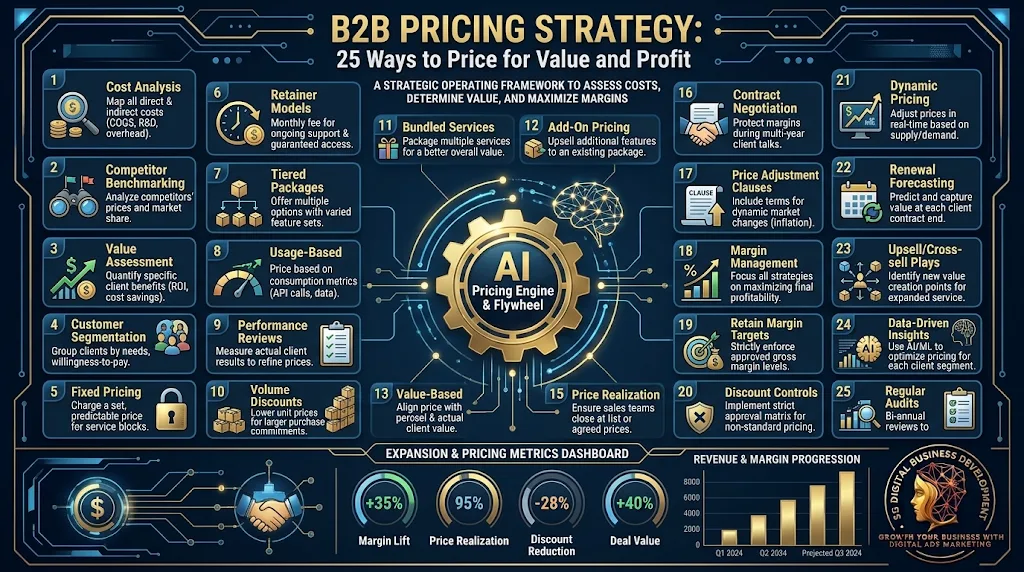
Introduction: Make Pricing a Strategic Business Decision Pricing influences far more than the number printed on a proposal. It shapes how buyers understand value, which customers choose your company, how much work your team can deliver sustainably, and whether growth produces a healthy margin. A business may have a strong service, experienced people, and a steady flow of enquiries yet struggle financially because its prices do not reflect the effort, risk, expertise, and outcomes involved. A B2B pricing strategy should begin with customer evidence. A B2B pricing strategy gives a company a deliberate way to set, explain, test, and improve its prices. It connects customer value, market position, delivery costs, commercial objectives, and buyer expectations. It also helps sales teams discuss price with confidence instead of improvising discounts whenever a prospect raises an objection. A B2B pricing strategy clarifies the value being exchanged. This guide explains how to assess costs, understand customer value, choose a pricing model, package services, communicate price, manage discounts, and review performance. It is designed for B2B service firms and companies selling complex solutions, but the principles can also support software providers, consultants, agencies, and specialist suppliers. What Is a B2B Pricing Strategy? A B2B pricing strategy is a structured approach to deciding how a company charges business customers for its products or services. It defines the pricing model, package structure, value proposition, commercial terms, discount rules, and review process. It should support both customer decision-making and the company’s financial goals. This B2B pricing strategy must reflect delivery realities consistently. Pricing is not simply a calculation of costs plus a margin. Costs establish an important boundary, but buyers also consider the problem being solved, the alternatives available, the risk of changing providers, the expected result, and the confidence they have in the supplier. A sustainable approach balances these factors instead of relying on one number or competitor comparison. A B2B pricing strategy protects margin without hiding trade-offs. A useful strategy answers several questions: Who is the offer designed for? What outcome does the customer value? What is included? How is the service delivered? Which pricing structure fits the buying process? What margin does the company need? What evidence supports the price? How will exceptions be approved? Your B2B pricing strategy should reflect distinct buyer segments. Why B2B Pricing Deserves Strategic Attention It determines the quality of growth Revenue growth does not always create healthy growth. A company can win more contracts while accepting low-margin work, excessive customization, or delivery commitments that exceed its capacity. The sales team may celebrate bookings while operations absorbs unplanned effort. Reviewing price alongside scope and delivery cost helps management understand whether new business is commercially sustainable. A B2B pricing strategy starts with actual cost data. It communicates positioning Price influences how buyers interpret a service. A low price may signal accessibility, but it can also raise questions about depth, support, or quality in a complex engagement. A premium price can communicate specialist expertise only when the offer, proof, and customer experience support that position. Price alone cannot create differentiation. A B2B pricing strategy also accounts for indirect effort. It reduces avoidable negotiation When packages, scope, assumptions, and terms are unclear, prospects may compare offers that are not equivalent. Sales representatives then spend time explaining inconsistencies or making concessions. A clear B2B pricing strategy gives the team a consistent framework for discussing options and trade-offs. This B2B pricing strategy should separate setup from recurring costs. It supports better resource allocation Different customers require different levels of support, integration, customization, and account management. Pricing should reflect meaningful differences in delivery requirements. This does not mean charging arbitrary amounts to similar buyers; it means understanding the cost and value drivers behind each offer. A B2B pricing strategy needs evidence about buyer priorities. Start With the Business Model and Customer Segment Before choosing a pricing method, define what you sell and to whom. A company offering a standardized monthly service may need a different model from a consultancy delivering a complex transformation project. A software provider may price by user, usage, feature tier, or contract value. A specialist agency may combine an initial project fee with a recurring retainer. A B2B pricing strategy should test assumptions against behavior. Segment customers by factors that affect value and delivery. These may include company size, industry, complexity, geography, service requirements, urgency, buying process, and expected support. Avoid creating too many segments. Each segment should represent a meaningful difference in needs or economics that justifies a different offer or commercial approach. Interview current customers and review won and lost opportunities. Ask what triggered the purchase, what alternatives were considered, which outcomes mattered, and what created concern about the price. Sales notes can help, but validate patterns with customers where possible. The aim is to understand how buyers evaluate value, not simply to ask whether they want a lower fee. This B2B pricing strategy can combine several pricing models. A clear segment definition makes a B2B pricing strategy easier to apply consistently. It also helps marketing and sales describe the offer to the right audience instead of attracting prospects whose requirements do not match the service. A B2B pricing strategy should make package differences meaningful. Understand Costs Before Setting a Price Cost analysis is the financial foundation of pricing. Identify direct delivery costs, such as employee time, contractors, software licenses, hosting, materials, payment fees, travel, and third-party services. Then consider indirect costs, including management, administration, sales, marketing, facilities, training, and ongoing support. This B2B pricing strategy helps buyers compare suitable options. For service businesses, staff time is often underestimated. A project may include discovery, planning, meetings, revisions, reporting, account management, quality assurance, and handover in addition to the visible deliverable. If these activities are not included in estimates, the apparent margin may be misleading. A B2B pricing strategy should explain exclusions before signing. Calculate the expected delivery effort for a typical engagement and identify the assumptions behind it. Use actual project records to compare estimated and recorded time. Separate

revenue operations
AI Growth Engine

B2B Revenue Operations: Align Sales, Marketing & Growth.

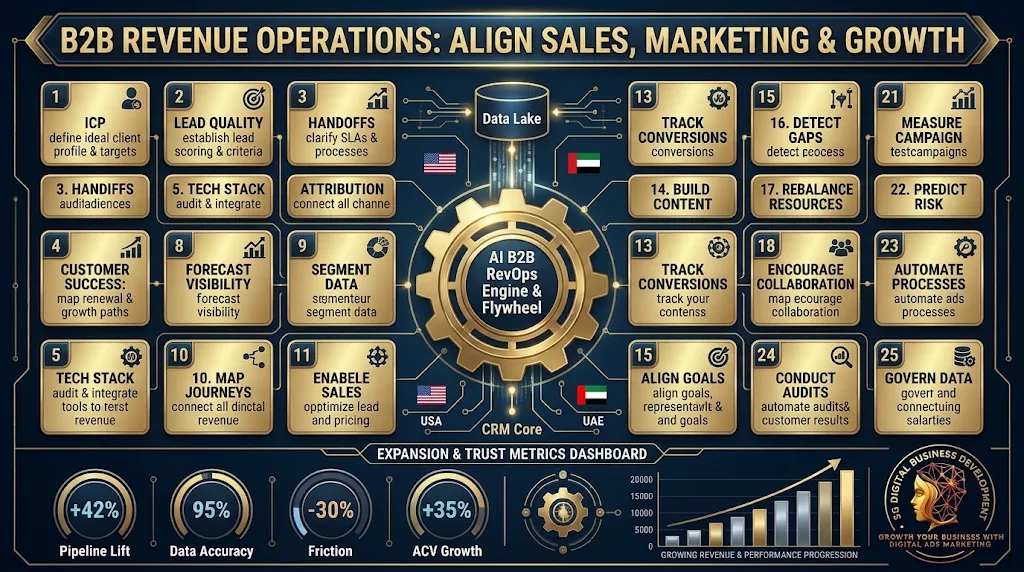
Introduction: Why Revenue Growth Needs One Connected Operating System B2B growth rarely depends on one department. Marketing creates demand, sales develops opportunities, customer success protects and expands accounts, finance validates commercial performance, and leadership sets direction. Each revenue operations function can perform well in isolation while the overall business still struggles to produce predictable results. The problem is often not a lack of activity. It is a lack of coordination. Leads may arrive without the context sales needs. Sales stages may mean different things to different teams. Forecasts may rely on inconsistent CRM updates. Customer success may identify expansion potential that never reaches account executives. Marketing may report conversions without knowing which leads become real opportunities. Revenue operations provides a way to connect these activities. It aligns people, processes, data, technology, and measurement around the complete customer and revenue lifecycle. Instead of optimizing separate departmental dashboards, an organization builds shared operating practices that make commercial performance easier to understand and improve across all commercial teams. This guide explains what revenue operations means, how it differs from traditional sales or marketing operations, how to build a practical model, which metrics matter, where AI can help, and how to implement improvements without creating unnecessary complexity. What Is Revenue Operations? Revenue operations, often shortened to RevOps, is the coordinated management of the revenue operations systems and processes that support revenue creation, conversion, retention, and expansion. It brings commercial teams together around common definitions, reliable information, clear ownership, and repeatable workflows. The revenue operations model usually connects marketing operations, sales operations, customer success operations, and relevant finance or business systems. The exact structure depends on company size. A small company may have one operations leader coordinating several functions. A larger organization may have specialist teams responsible for analytics, systems, enablement, planning, and process governance. The central idea is broader than putting several teams under one manager. Revenue operations creates a shared way to manage the revenue operations journey from first interaction to renewal and growth. It clarifies how a lead becomes an opportunity, how an opportunity is qualified, how a customer is onboarded, how renewal risk is identified, and how results are measured. A useful operating principle is simple: every team should understand how its work affects the next stage of the customer journey. Marketing should know what happens after a lead is handed to sales. Sales should understand what customer success needs during handover. Customer success should have a way to communicate renewal and expansion signals. Leadership should see a consistent view of performance. Why Department-Based Operations Create Friction Traditional organizations often build separate systems around each revenue operations function. Marketing tracks campaign performance, sales tracks pipeline, and customer success tracks adoption or retention. These systems can be individually useful, but disconnected definitions and workflows create blind spots. Different definitions of the same stage Marketing may define a qualified lead by engagement. Sales may define qualification by a confirmed business need and buying process. If both teams use the same label for different conditions, reports become difficult to interpret and handoffs become contentious. Slow or incomplete handoffs A lead can be routed without its source, content history, account context, or stated problem. Sales then repeats questions the prospect has already answered. Conversely, a sales team may close a deal without recording implementation expectations that customer success needs. Inconsistent data Duplicate accounts, missing fields, outdated opportunity dates, and inconsistent naming conventions reduce confidence in reporting. Teams compensate by maintaining spreadsheets, which create another layer of conflicting information. Local optimization A campaign can generate many form submissions but few sales-accepted leads. A sales team can improve bookings by offering discounts that reduce margin or create renewal problems. A customer success team can protect retention while missing opportunities to expand product adoption. Each revenue operations function may hit its own target while the business outcome remains weak. Unclear accountability When a revenue operations process crosses departments, ownership can become ambiguous. No one is sure who should fix lead routing, update a revenue operations lifecycle definition, investigate a stalled deal, or resolve a customer handover issue. A coordinated operating model assigns responsibility for the revenue operations process, not only for individual departmental tasks. The Core Components of a Strong RevOps Model A sustainable revenue operations model rests on several connected components. Organizations should build them in a sensible order rather than buying software first and hoping the revenue operations process will follow. 1. Shared revenue strategy and goals Start with the business outcome. Leadership should define the customer segments, growth priorities, revenue targets, margin expectations, retention goals, and time horizon. The commercial teams then translate those priorities into operating plans. Shared goals do not mean every department receives the same target. Marketing may own qualified demand, sales may own new bookings, and customer success may own adoption and renewal outcomes. The measures should connect, however, so that one team is not rewarded for producing volume that creates avoidable work for another. A practical planning session should answer four questions: which customers matter most, which problems the company solves best, where growth is expected to come from, and what constraints could prevent the revenue operations plan from succeeding. These decisions provide the foundation for prioritization across teams. 2. A clear ideal customer profile An ideal customer profile describes the types of organizations most likely to receive value from the company’s offer and become successful, sustainable customers. It should be based on evidence from profitable customers, retention patterns, product fit, service requirements, and sales experience. Useful dimensions may include industry, organization size, geography, business model, technology environment, operational maturity, buying triggers, and typical use cases. Avoid defining the profile only by company size or job title. Two organizations of similar size may have very different needs, budgets, urgency, and implementation complexity. The profile should guide targeting, qualification, territory planning, content, and account prioritization. Review it when market conditions change or when customer outcomes reveal that the current definition is too broad. 3. A mapped customer and revenue lifecycle

customer journey mapping
AI Growth Engine

B2B Customer Journey Mapping: Turn Buyers Into Clients.

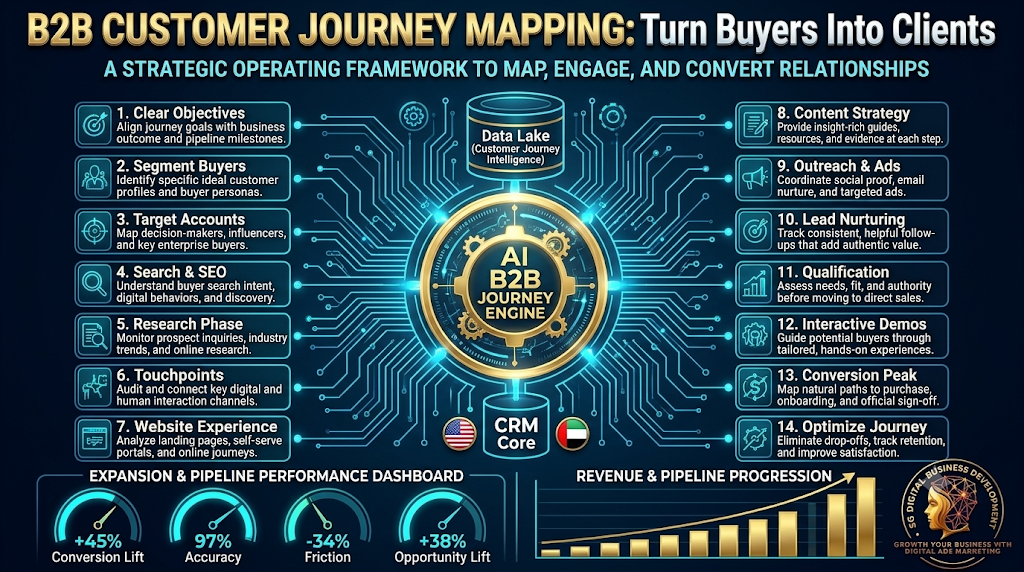
B2B Customer Journey Mapping: Turn Buyers Into Clients Introduction: Understand the Journey Behind Every Decision A B2B buyer rarely moves from discovering a company to signing a contract in one step. The journey may include a search, a recommendation, a website visit, a comparison, an internal discussion, a sales call, a proposal, and several rounds of approval. Each interaction shapes the buyer’s confidence. When those interactions feel disconnected, even a strong product or service can be overlooked. B2B customer journey mapping helps a business understand this process from the buyer’s point of view. It makes visible the questions people ask, the information they need, the barriers they encounter, and the moments when they are ready for a conversation. Instead of treating marketing, sales, and customer service as separate activities, a journey map connects them around the experience of the customer. The purpose is not to create a complicated diagram and leave it in a presentation. A useful map guides decisions about content, website structure, campaigns, sales follow-up, onboarding, and measurement. This guide explains how to build one that supports better customer experiences and more consistent commercial outcomes. 1. Start With a Clear Business Objective Before collecting touchpoints, decide what the map needs to improve. A company trying to strengthen organic search visibility needs a different view from one trying to shorten a long sales cycle or reduce customer churn. A map without a defined purpose can become an attractive inventory of interactions without helping anyone make a decision. Customer journey mapping connects teams around buyers. Choose one primary objective and a small number of supporting measures. Examples include improving the proportion of website enquiries that meet sales criteria, reducing the time between first contact and a qualified meeting, increasing proposal acceptance, or improving customer activation after purchase. Record the current baseline where reliable data exists. If the baseline is unknown, make establishing it part of the project rather than inventing a target. B2B customer journey mapping is most effective when it is linked to a business question. Write that question in plain language, such as: “Where do suitable prospects lose confidence before requesting a consultation?” This keeps research focused and helps stakeholders judge whether the final map is useful. Customer journey mapping highlights unanswered buyer questions. 2. Define the Customer Segment You Are Mapping There is rarely one universal journey for every customer. A small business buying a relatively simple service may make a decision quickly, while an enterprise purchase can involve security reviews, procurement, finance, legal teams, and senior leadership. Existing customers may follow a different path when buying an additional service. Select a segment with enough commercial importance and enough evidence to study. Describe its industry, organization size, geography, business model, typical need, and buying context. Avoid relying only on broad labels such as “business owners” or “decision-makers.” Those descriptions do not explain the situation that causes someone to search for a solution. Customer journey mapping identifies friction before purchase. Then identify the buying group. The person who experiences the problem may be different from the person who controls the budget. Technical evaluators, end users, procurement specialists, and executive sponsors may each need different evidence. Document their responsibilities and likely concerns. Do not assume that one contact represents the views of an entire organization. Customer journey mapping makes handoffs easier to inspect. A focused segment makes B2B customer journey mapping practical. You can create additional maps later for other segments rather than combining different buying behaviours into one confusing picture. 3. Research What Buyers Actually Do A journey map should be based on evidence, not internal assumptions. Start with conversations with recent customers, lost prospects, sales representatives, account managers, and support staff. Ask people to describe what happened, what they were trying to achieve, what information they looked for, and what made the decision easier or harder. Customer journey mapping links evidence with action. Useful questions include: What first made the problem important? Where did you look for information? Which alternatives did you consider? What nearly stopped you from proceeding? Who else was involved? What proof did you need? Which interaction felt most helpful? What happened after the purchase? Ask for specific examples rather than general opinions. Review available digital evidence as well. Website analytics can show common entry pages, navigation paths, and form abandonment. Search data can reveal the language people use when researching a problem. CRM records may show time between stages, reasons for lost opportunities, and recurring objections. Support tickets and onboarding notes can expose issues that marketing teams never see. Customer journey mapping improves the relevance of content. B2B customer journey mapping becomes more reliable when qualitative and quantitative evidence are considered together. Analytics can indicate where a drop-off occurs, while interviews can explain why it happens. Neither source should be treated as complete on its own. Be transparent about sample size, missing information, and assumptions. Customer journey mapping supports clearer website decisions. 4. Separate Stages by Buyer Need, Not Company Department A common mistake is to build a journey around the organization’s internal structure: marketing, sales, delivery, and support. Those teams matter, but buyers do not experience the business in the same way an organization chart is arranged. They experience questions, decisions, expectations, and outcomes. A practical B2B journey may include these stages: Not every purchase follows this sequence neatly. Some stages overlap, repeat, or happen offline. A buyer may return to research after a proposal, or involve a new stakeholder late in the process. Show loops and delays where evidence supports them. Do not force a linear funnel onto a complex buying process. Customer journey mapping helps teams prioritize improvements. 5. Record Buyer Questions at Every Stage For each stage, document the questions a buyer is likely to ask. During problem recognition, a prospect may wonder whether the issue is serious enough to address. During exploration, they may ask which approaches are available. During evaluation, they may need to compare providers, understand implementation, or assess risk. After purchase, they may need

LinkedIn lead generation
AI Growth Engine

Best 5 LinkedIn Lead Generation: Turn Connections Into Clients.

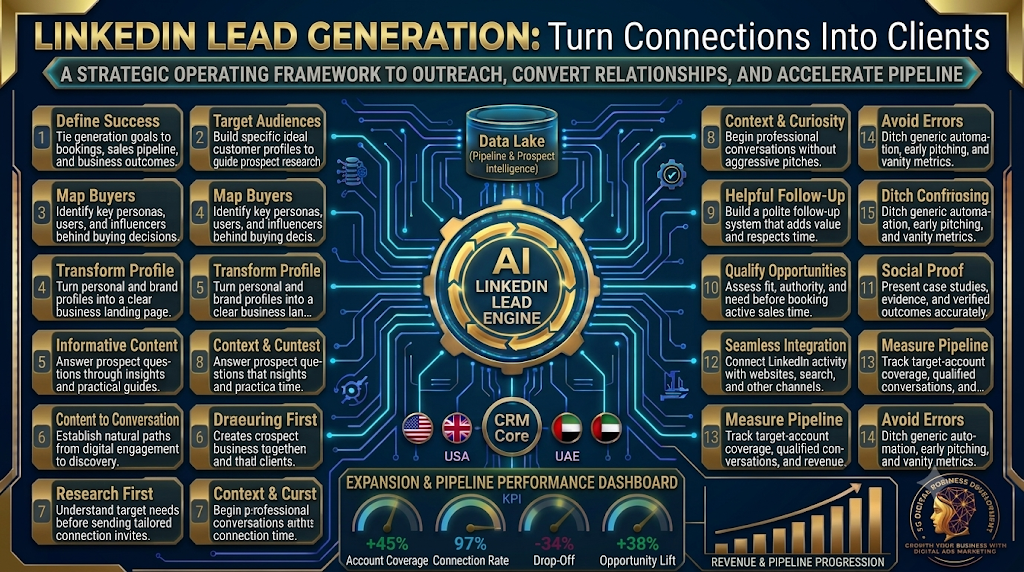
LinkedIn Lead Generation: Turn Connections Into Clients. Introduction: Stop Collecting Connections and Start Creating Opportunities A large LinkedIn network can look impressive, but connections do not automatically create business. LinkedIn lead generation turns relevant professional attention into useful conversations when it connects the right audience with a real problem, useful information, and an appropriate next step. It works best when its activity is connected to a useful website, clear positioning, relevant content, disciplined follow-up, and measurement of actual business outcomes. This guide explains how to build that system step by step. 1. Define the Business Outcome Before You Start The first step is not writing a post or purchasing a sales tool. It is deciding what a successful result should look like. Different businesses need different outcomes. A software company may want product demonstrations with operations leaders. A consultancy may want discovery calls with founders. A specialist service provider may need conversations with procurement managers in a narrow industry. Treat LinkedIn lead generation as a relationship process, not a volume contest. Good LinkedIn lead generation starts by defining a measurable business outcome. 2. Build an Ideal Customer Profile You Can Actually Use An ideal customer profile (ICP) describes the type of organization most likely to benefit from your product or service and become a good customer. It should be specific enough to guide prospect research, but not so narrow that it excludes every realistic opportunity. Strong LinkedIn lead generation begins with a specific customer profile. Next, map the buying group. In B2B purchases, the person who experiences a problem may not control the budget, and the budget owner may not evaluate the technical details. Identify likely users, influencers, decision-makers, and commercial approvers. Your outreach should reflect each person’s responsibilities rather than sending the same pitch to everyone in the company. For effective LinkedIn lead generation, a focused list of well-matched accounts is usually more useful than a large list built from broad job-title searches. Revisit the ICP when sales conversations reveal that a different segment has stronger needs or a better fit. Use LinkedIn lead generation to reach roles connected to the buying problem. 3. Identify the People Behind the Buying Decision Once the target organizations are clear, identify the people whose responsibilities connect to the problem you solve. Job titles are a starting point, not a complete qualification method. The same title can mean different things across industries and company sizes, while people with different titles may influence the same purchase. Effective LinkedIn lead generation requires research beyond job-title matching. Build a small set of buyer personas. For each persona, document their priorities, common objections, information needs, and the business outcomes they are measured against. A finance leader may care about cost, risk, and return. A marketing director may focus on pipeline quality, channel performance, and team capacity. A technical leader may prioritize integration, reliability, security, and support. Your profile should support LinkedIn lead generation with clear proof, and your value proposition should be easy to understand. 4. Turn Your Profile Into a Clear Business Landing Page Before you approach prospects, review the profile they will see after receiving your invitation. A profile should make it easy to understand who you help, what problem you address, and why your perspective is worth considering. It is not simply an online CV. Use the About section to explain the problems you work on, the types of organizations you support, your approach, and the next step a relevant visitor can take. Keep paragraphs readable. Use concrete language rather than a long list of buzzwords. If you have credible case studies, client outcomes, certifications, or relevant experience, present them accurately and with appropriate context. Plan LinkedIn lead generation content around the prospect journey. A profile cannot replace a strong website. It should create a coherent path from discovery to evaluation. Make sure your website explains your services, target audience, process, evidence, and contact options. For guidance on connected search visibility, see our AI SEO strategy resource. The goal is to make the transition from professional network to business website feel natural and trustworthy. Useful examples make LinkedIn lead generation more credible. 5. Create Content Around Buyer Questions Content gives prospects a reason to notice your expertise before a direct sales conversation begins. Consistent LinkedIn lead generation content answers real buyer questions. The most useful posts are not necessarily the most entertaining or the most frequent. They help a specific audience understand a problem, assess an option, avoid a mistake, or make a better decision. Connect LinkedIn lead generation posts to relevant resources and next steps. Use a balanced content mix. LinkedIn lead generation content should teach before it sells. Educational content explains a problem and its causes. Practical content offers a framework or checklist. Evidence-led content shares a case study or lesson, with permission and accurate context. Point-of-view content explains how you approach a common challenge. Commercial content describes a service and who it is designed to help. A consistent mix is more credible than publishing a sales pitch every day. LinkedIn lead generation works better when each post has one purpose. Personalized LinkedIn lead generation begins with genuine context. 6. Use a Content-to-Conversation Path Publishing is only one part of the process. Decide what a relevant reader should do after finding a post. Some readers may follow your profile. Others may visit a resource, ask a question, or send a message. Not every post needs a meeting request. Early-stage readers often need useful information before they are ready to speak with a provider. Use LinkedIn lead generation invitations to open relevant professional relationships. Make the next action proportionate to the reader’s level of interest. “Read the guide” is a lighter commitment than “Book a strategy call.” Use a direct consultation CTA when the post addresses a high-intent problem and the service fit is clear. Avoid hiding the commercial purpose behind misleading language. For LinkedIn lead generation, avoid pretending that generic templates are personal. This content-to-conversation path makes LinkedIn lead generation more

B2B Marketing Operations
AI Growth Engine

B2B Marketing Operations: Build a Smarter Growth Engine.

B2B Marketing Operations: Build a Smarter Growth Engine Introduction Many B2B companies invest in SEO, paid advertising, content, email, events, websites, and sales development, yet struggle to understand how these activities work together. Teams may use different tools, maintain separate spreadsheets, define leads differently, and report results in formats that cannot be compared. Campaigns launch without clear ownership, follow-up is inconsistent, and useful data remains trapped in disconnected systems. The problem is not always a lack of marketing activity. Often, the operating system behind that activity is unclear. B2B Marketing Operations is the discipline of designing, coordinating, measuring, and improving the processes, technology, data, and governance that help marketing work effectively with sales and the wider business. It turns individual campaigns into a connected system. It clarifies who does what, how information moves, which metrics matter, and how teams learn from results. The purpose is not to add unnecessary meetings or software. It is to make work easier to execute, easier to measure, and more closely connected to commercial outcomes. This guide explains how to build a practical operating model that supports reliable execution, better decisions, and sustainable growth. B2B Marketing Operations creates clarity across teams. B2B Marketing Operations works best with shared definitions. Define the Operating Model Start by documenting how marketing work currently moves from an idea to a business result. Map planning, audience research, campaign approval, content production, publishing, lead capture, qualification, sales handoff, reporting, and improvement. Identify the people involved, the systems they use, and the decisions they make at each stage. B2B Marketing Operations should begin with business requirements, not a software demonstration. Ask where work gets delayed, where information is repeated, where ownership is unclear, and where reporting cannot answer management questions. A team that struggles with unclear campaign priorities may not need another automation platform. It may need a shared planning process and clear decision rights. Create a simple operating model that defines responsibilities, inputs, outputs, approval points, and service expectations. Keep the first version practical. A process that people can follow is more valuable than a complicated diagram that nobody updates. Review it with marketing, sales, finance, and delivery teams before making major technology decisions. B2B Marketing Operations connects activity with outcomes. B2B Marketing Operations requires regular process reviews. Align Goals With Revenue Marketing goals should connect to commercial priorities. Website sessions, social engagement, email opens, and content downloads can provide useful diagnostic information, but they do not automatically demonstrate business impact. Leadership needs to understand whether marketing is creating relevant demand, helping sales progress opportunities, and contributing to profitable customer growth. Translate broad objectives into measurable outcomes. If the business wants to enter a new market, define the target segment, relevant offer, required evidence, expected sales cycle, and indicators of progress. If the goal is to improve pipeline quality, agree on qualification criteria and a feedback process with sales. Build a measurement hierarchy. At the top, define outcomes such as revenue, pipeline, acquisition cost, retention, or market expansion. Beneath them, identify leading indicators such as qualified enquiries, meetings, opportunity creation, and conversion rates. Use channel metrics to diagnose performance, not as substitutes for business results. B2B Marketing Operations needs practical ownership rules. B2B Marketing Operations should fit team capacity. Clarify Roles and Ownership Unclear ownership creates duplicated work and missed deadlines. One person may assume that sales will follow up with a lead, while sales expects marketing to qualify it first. A campaign may wait for approval because nobody knows who has final authority. These problems are often process problems rather than individual performance issues. Use a responsibility matrix for recurring activities. Identify who completes the work, who is accountable for the outcome, who should be consulted, and who needs to be informed. Avoid adding unnecessary approvers. The aim is to protect quality while allowing teams to move at a reasonable pace. B2B Marketing Operations improves campaign coordination. B2B Marketing Operations can start with simple tools. Standardize Campaign Planning A campaign brief should explain the business objective, audience, problem, offer, message, channel mix, budget, owner, timeline, and success measures. It should also describe what happens after someone responds. This prevents campaigns from being judged only by impressions or clicks when the real objective is qualified conversations. Use a common brief and a visible calendar. The calendar should show launch dates, dependencies, content deadlines, approvals, campaign owners, and important sales activities. Teams should be able to see conflicts before they become urgent. Prioritize campaigns according to business value, audience relevance, effort, and available capacity. Do not launch every idea at once. A smaller number of well-executed campaigns with clear measurement can produce more useful learning than a crowded calendar with weak follow-through. B2B Marketing Operations makes handoffs more dependable. B2B Marketing Operations makes responsibilities visible. Improve Lead Handoffs Marketing and sales must agree on what a lead represents. A form submission, newsletter subscriber, event attendee, and active buying project are not interchangeable. Define the stages used by your organization and the evidence required to move a contact from one stage to another. Document how leads are captured, enriched, scored where appropriate, assigned, accepted, rejected, and returned for further nurturing. Agree on response expectations and the information sales needs before making contact. Include a clear reason code when a lead is rejected so marketing can improve targeting. Review handoff performance regularly. Measure how quickly leads receive attention, how many are accepted, how many become opportunities, and which sources produce suitable conversations. If sales repeatedly rejects leads for the same reason, investigate the audience, offer, form, or qualification criteria rather than simply increasing lead volume. B2B Marketing Operations relies on trustworthy records. B2B Marketing Operations helps teams learn faster. Build Reliable Data Decisions are only as useful as the information behind them. Duplicate records, inconsistent company names, missing source details, outdated contact information, and unclear campaign tags make reporting unreliable. Data quality should be managed as an operating responsibility, not a one-time cleanup exercise. Establish rules for required fields, naming conventions, data ownership,

marketing attribution
AI Growth Engine

Marketing Attribution: Track What Drives Growth.

Marketing Attribution: How to Measure What Really Drives Business Growth. Businesses invest in search engine optimisation, paid advertising, social media, email, content, partnerships and sales activity to attract customers. Yet when a new customer arrives, one important question often remains unanswered: which marketing activity actually influenced the decision? A prospect might first discover a company through a Google search, read an article a few days later, click a LinkedIn post, return through a paid advertisement and finally submit an enquiry after receiving an email. If the business credits only the final click, it may undervalue earlier interactions that helped build awareness and trust. Marketing attribution provides a framework for understanding how different marketing touchpoints contribute to a conversion. It helps businesses examine the customer journey, interpret channel performance and make more informed budget decisions. It is not a formula that proves exactly why every customer bought. It is a way to organise evidence, make assumptions visible and improve decisions over time. For companies operating in India and international markets, this discipline is useful when customers use several devices, channels and research sources before contacting a business. A sound marketing attribution approach connects campaign activity with enquiries, qualified opportunities and revenue instead of treating clicks and impressions as the final business outcome. This guide covers marketing attribution models, reliable data, analytics, common mistakes and a practical measurement process. What Is Marketing Attribution? Marketing attribution is the process of assigning credit or analytical value to marketing interactions that occur before a desired action. That action may be a purchase, lead submission, consultation booking, app installation, subscription or another business outcome. A touchpoint is an interaction between a potential customer and a business. Examples include an organic search visit, paid search click, social media engagement, email click, webinar attendance, referral visit or sales conversation. Marketing attribution helps answer questions such as: The answers depend on tracking quality, the model, the conversion definition and available data. A report may show that a channel appeared in a customer journey, but that does not automatically prove the channel caused the purchase. A useful marketing attribution programme combines quantitative reporting with business context. It should help decision-makers understand patterns, not create false certainty. Why Marketing Attribution Matters to Business Decisions Without a consistent measurement approach, companies can make budget decisions using incomplete evidence. A campaign that generates the final click may receive all the credit, while channels that introduced or educated the customer appear less valuable. Budget is allocated using incomplete information If a business evaluates channels only by last-click conversions, it may repeatedly fund channels that capture existing demand while reducing investment in activities that create awareness or consideration. Neither type of activity is automatically better. The right mix depends on the business objective and customer journey. Teams report different versions of success Marketing may report leads, sales may report accepted opportunities and finance may report revenue. If these teams use different definitions and reporting periods, leadership cannot easily connect campaign activity with commercial results. Customer journeys remain unclear A customer may interact with multiple channels before buying. Looking at one session or one click can hide the sequence of interactions that preceded the conversion. Optimisation focuses on easy metrics Clicks, impressions and low-cost traffic are useful diagnostic measures, but they are not substitutes for qualified enquiries, sales or profit. A measurement framework should connect activity to outcomes that matter to the organisation. Marketing attribution gives teams a shared structure for discussing these questions. It does not replace judgement, experimentation or financial analysis. Understand the Main Marketing Attribution Models A marketing attribution model is a rule or method used to distribute credit across touchpoints. Different models answer different questions. No single model is universally correct for every organisation. First-click marketing attribution First-click marketing attribution assigns all conversion credit to the first recorded marketing interaction in the journey. This model can help identify channels that introduce people to a brand. If a prospect first arrives through an organic search article and later converts through a paid campaign, first-click reporting gives the initial organic interaction the credit. Its limitation is that it ignores everything that happened afterwards. It can overstate the importance of the first recorded interaction and miss the work done by later channels. Last-click marketing attribution Last-click marketing attribution assigns all credit to the final recorded interaction before conversion, subject to the platform’s rules and tracking scope. It is easy to understand and can be useful when evaluating channels that capture immediate intent. However, it may undervalue earlier interactions such as educational content, social engagement or brand discovery. A business using only last-click reporting should not interpret the result as a complete account of how demand was created. Linear marketing attribution Linear marketing attribution distributes credit equally across the recorded touchpoints in a journey. If four interactions are included, each receives one quarter of the credit. This is simple and recognises that more than one interaction occurred. However, equal credit is an assumption. The first visit, a detailed product demonstration and a brief reminder advertisement may not have contributed equally to the decision. Time-decay marketing attribution Time-decay marketing attribution gives more credit to interactions closer to the conversion, according to a defined decay rule. This can be useful for journeys where recent interactions are believed to have a stronger relationship with the final decision. It still relies on an assumption about how influence changes over time. Position-based marketing attribution A position-based model gives greater weight to selected points in the journey, often the first and final interactions, with the remaining credit distributed among interactions in between. This approach recognises both discovery and conversion activity. Its limitation is that the selected weighting is a rule, not proof that those touchpoints had that exact level of influence. Data-driven marketing attribution Data-driven approaches use available interaction and conversion data to estimate how different touchpoints relate to outcomes. The implementation and eligibility rules depend on the analytics or advertising platform. A data-driven model can be more flexible than a

website conversion rate
AI Growth Engine

Website conversion rate : Turn Website Visits Into More Leads.

How to Improve Your Website Conversion Rate and Generate More Qualified Leads A business website should do more than display information. It should help potential customers understand your services, evaluate your business and take a useful next step. Yet many companies invest in search engine optimisation, social media and paid advertising without checking whether their websites turn visitors into enquiries. Track the website conversion rate consistently. A visitor may arrive, read a headline and leave because the offer is unclear. Another may be interested but abandon a long contact form. Someone else may trust the service but struggle to find pricing information, proof of experience or a working phone number. These are conversion problems, not necessarily traffic problems. Your website conversion rate helps you understand how effectively your website turns visitors into people who complete an important action. That action might be a purchase, a consultation request, a quotation enquiry, a phone call or a product demonstration booking. The right measurement depends on your business model. For companies serving customers in India and international markets, improving the visitor experience can make existing marketing investments more productive. Rather than relying only on more traffic, businesses can remove obstacles that stop interested people from making contact. Measure the website conversion rate carefully. This guide explains how to measure performance, improve important pages, build trust, simplify enquiries and create a practical optimisation plan. 1. Understand What a Conversion Means A conversion is an action that has value to your business. An online store may count a completed order. A consulting firm may count a qualified discovery-call request. A software company may measure demo bookings or trial registrations. A local service provider may count calls or appointment requests. The basic calculation is: Conversion rate = (number of conversions ÷ number of visitors) × 100 For example, if a website receives 4,000 visitors in a month and 80 submit an enquiry form, the calculation is (80 ÷ 4,000) × 100, which equals 2%. Review the website conversion rate every month. Define the action and measurement unit before comparing results. Some platforms report conversions per user, while others report them per session. A form submission, a purchase and a newsletter signup should not be treated as identical business outcomes. A useful website conversion rate also needs context. A page may generate many enquiries, but if most are irrelevant, outside your service area or unable to afford the service, the business result may still be poor. Track lead quality and sales progression alongside the headline percentage. Your website conversion rate reflects visitor decisions. 2. Find Out Why Visitors Leave Before redesigning a website, identify where the visitor journey becomes difficult. Common barriers include unclear messaging, confusing navigation, weak calls to action, missing trust information, slow pages and forms that ask for too much. Unclear messaging A visitor should understand what your company offers and whom it serves without decoding vague slogans. Replace broad statements such as “Solutions for a better tomorrow” with a specific explanation of the service and its benefit. Confusing navigation Use familiar menu labels and organise pages logically. Visitors should be able to find services, company information, useful resources and contact details without opening several unrelated menus. A reliable website conversion rate needs context. Weak calls to action A page should tell visitors what to do next. “Request a consultation”, “Discuss your project” and “Ask for a quotation” are clearer than a button that simply says “Click here”. Missing trust signals People may hesitate when a website provides no evidence of experience or a clear explanation of how the company works. Genuine testimonials, relevant case studies, transparent service details and accessible contact information can reduce uncertainty. Technical friction Broken links, slow loading, layout problems and malfunctioning forms interrupt the journey. Test important pages on desktop and mobile devices, and complete your own enquiry form to confirm that submissions reach the right team. Compare the website conversion rate across channels. 3. Make the Homepage Immediately Understandable Your homepage often introduces the business to a first-time visitor. The first screen should explain what you do, who you help and where the visitor can go next. Write a specific headline A useful headline describes the business rather than making an unsupported promise. For example: “Digital Marketing and Business Development Services for Growing Companies.” The supporting paragraph can explain the main services and the types of customers you work with. Keep the message focused Do not attempt to explain every service, industry and benefit in one paragraph. Present the main offer first, then provide links to dedicated pages for visitors who want more detail. Check the website conversion rate for key pages. Make the next step visible Place a relevant action near the headline. Use a primary button such as “Contact Our Team” or “Request a Consultation”. If you offer several ways to get in touch, make the options clear without giving every button equal visual importance. Show the route to key information The homepage should guide visitors towards service descriptions, company information, useful articles and contact details. A clear structure supports a stronger website conversion rate because people can find relevant information with less effort. Your website conversion rate depends on clear messaging. 4. Build Service Pages Around Customer Questions A service page should answer the questions a potential customer is likely to ask before making contact. A list of features is rarely enough. Explain the problem, the service, the process and what the customer can expect. A useful structure includes: For example, a website development page can explain the types of websites you build, the planning process, available functionality, content requirements and post-launch support. A digital marketing page can explain the channels covered, how campaigns are planned and how performance is reviewed. Avoid copying the same generic paragraph across every service page. Each page should offer information specific to the service. This helps visitors decide whether the service fits their requirements and can improve the website conversion rate without relying on exaggerated claims. Improve the

Scroll to Top