
Introduction: Why Revenue Growth Needs One Connected Operating System
B2B growth rarely depends on one department. Marketing creates demand, sales develops opportunities, customer success protects and expands accounts, finance validates commercial performance, and leadership sets direction. Each revenue operations function can perform well in isolation while the overall business still struggles to produce predictable results.
The problem is often not a lack of activity. It is a lack of coordination. Leads may arrive without the context sales needs. Sales stages may mean different things to different teams. Forecasts may rely on inconsistent CRM updates. Customer success may identify expansion potential that never reaches account executives. Marketing may report conversions without knowing which leads become real opportunities.
Revenue operations provides a way to connect these activities. It aligns people, processes, data, technology, and measurement around the complete customer and revenue lifecycle. Instead of optimizing separate departmental dashboards, an organization builds shared operating practices that make commercial performance easier to understand and improve across all commercial teams.
This guide explains what revenue operations means, how it differs from traditional sales or marketing operations, how to build a practical model, which metrics matter, where AI can help, and how to implement improvements without creating unnecessary complexity.
What Is Revenue Operations?
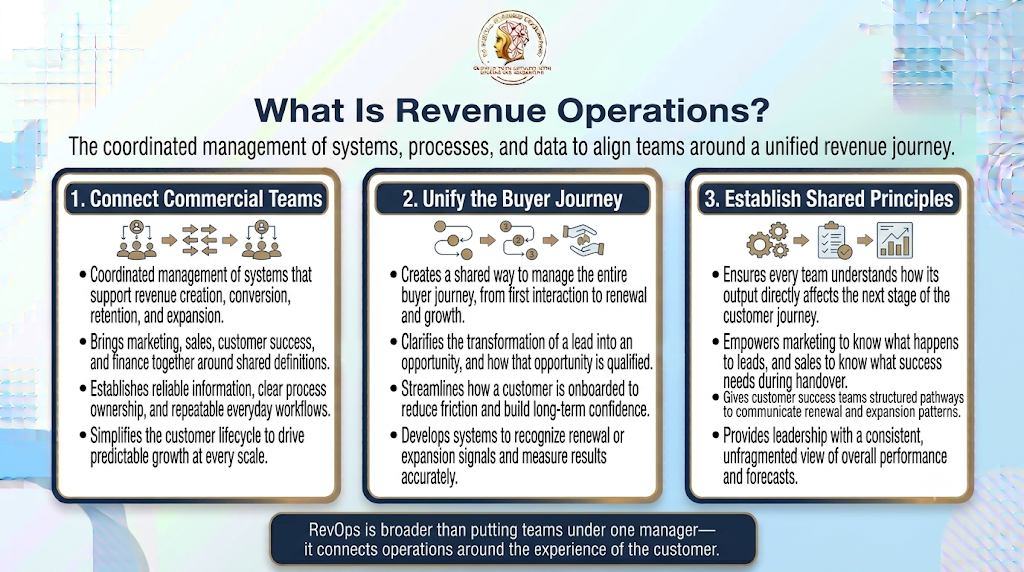
Revenue operations, often shortened to RevOps, is the coordinated management of the revenue operations systems and processes that support revenue creation, conversion, retention, and expansion. It brings commercial teams together around common definitions, reliable information, clear ownership, and repeatable workflows.
The revenue operations model usually connects marketing operations, sales operations, customer success operations, and relevant finance or business systems. The exact structure depends on company size. A small company may have one operations leader coordinating several functions. A larger organization may have specialist teams responsible for analytics, systems, enablement, planning, and process governance.
The central idea is broader than putting several teams under one manager. Revenue operations creates a shared way to manage the revenue operations journey from first interaction to renewal and growth. It clarifies how a lead becomes an opportunity, how an opportunity is qualified, how a customer is onboarded, how renewal risk is identified, and how results are measured.
A useful operating principle is simple: every team should understand how its work affects the next stage of the customer journey. Marketing should know what happens after a lead is handed to sales. Sales should understand what customer success needs during handover. Customer success should have a way to communicate renewal and expansion signals. Leadership should see a consistent view of performance.
Why Department-Based Operations Create Friction
Traditional organizations often build separate systems around each revenue operations function. Marketing tracks campaign performance, sales tracks pipeline, and customer success tracks adoption or retention. These systems can be individually useful, but disconnected definitions and workflows create blind spots.
Different definitions of the same stage
Marketing may define a qualified lead by engagement. Sales may define qualification by a confirmed business need and buying process. If both teams use the same label for different conditions, reports become difficult to interpret and handoffs become contentious.
Slow or incomplete handoffs
A lead can be routed without its source, content history, account context, or stated problem. Sales then repeats questions the prospect has already answered. Conversely, a sales team may close a deal without recording implementation expectations that customer success needs.
Inconsistent data
Duplicate accounts, missing fields, outdated opportunity dates, and inconsistent naming conventions reduce confidence in reporting. Teams compensate by maintaining spreadsheets, which create another layer of conflicting information.
Local optimization
A campaign can generate many form submissions but few sales-accepted leads. A sales team can improve bookings by offering discounts that reduce margin or create renewal problems. A customer success team can protect retention while missing opportunities to expand product adoption. Each revenue operations function may hit its own target while the business outcome remains weak.
Unclear accountability
When a revenue operations process crosses departments, ownership can become ambiguous. No one is sure who should fix lead routing, update a revenue operations lifecycle definition, investigate a stalled deal, or resolve a customer handover issue. A coordinated operating model assigns responsibility for the revenue operations process, not only for individual departmental tasks.
The Core Components of a Strong RevOps Model
A sustainable revenue operations model rests on several connected components. Organizations should build them in a sensible order rather than buying software first and hoping the revenue operations process will follow.
1. Shared revenue strategy and goals
Start with the business outcome. Leadership should define the customer segments, growth priorities, revenue targets, margin expectations, retention goals, and time horizon. The commercial teams then translate those priorities into operating plans.
Shared goals do not mean every department receives the same target. Marketing may own qualified demand, sales may own new bookings, and customer success may own adoption and renewal outcomes. The measures should connect, however, so that one team is not rewarded for producing volume that creates avoidable work for another.
A practical planning session should answer four questions: which customers matter most, which problems the company solves best, where growth is expected to come from, and what constraints could prevent the revenue operations plan from succeeding. These decisions provide the foundation for prioritization across teams.
2. A clear ideal customer profile
An ideal customer profile describes the types of organizations most likely to receive value from the company’s offer and become successful, sustainable customers. It should be based on evidence from profitable customers, retention patterns, product fit, service requirements, and sales experience.
Useful dimensions may include industry, organization size, geography, business model, technology environment, operational maturity, buying triggers, and typical use cases. Avoid defining the profile only by company size or job title. Two organizations of similar size may have very different needs, budgets, urgency, and implementation complexity.
The profile should guide targeting, qualification, territory planning, content, and account prioritization. Review it when market conditions change or when customer outcomes reveal that the current definition is too broad.
3. A mapped customer and revenue lifecycle
Document the revenue operations journey from initial awareness through evaluation, purchase, onboarding, adoption, renewal, and expansion. For each stage, describe the entry criteria, required information, owner, exit criteria, and next action.
This map exposes gaps that departmental diagrams may hide. For example, a signed contract is not a complete handoff if the delivery team lacks agreed objectives, stakeholders, scope, or success criteria. Similarly, a renewal date is not a retention plan unless risk signals and customer outcomes are reviewed in advance.
Keep the map practical. A revenue operations process that nobody can explain or follow will not improve performance. Start with the most important customer journeys and expand only when teams can maintain the information.
4. Consistent lifecycle definitions
Agree on what terms such as inquiry, marketing-qualified lead, sales-accepted lead, opportunity, customer, renewal, churn, and expansion mean. Write down the rules and make them visible to everyone who uses the CRM or reports.
Definitions should be operational, not decorative. If a lead becomes sales-accepted only after a seller confirms fit and a relevant need, record that condition. If an opportunity requires a defined problem, stakeholder, estimated value, and next step, make those fields part of the stage criteria.
Review definitions when teams repeatedly disagree about status or when reports cannot be reconciled. Consistency matters more than using fashionable terminology.
5. Process ownership and service-level agreements
Every cross-functional workflow needs a named owner. Lead routing, account assignment, opportunity creation, sales-to-customer-success handover, renewal escalation, and data-quality management should each have clear accountability.
Service-level agreements can define response expectations. For example, a high-intent inbound request may require prompt review during business hours, while a lower-intent content download may enter a nurture path. The exact timing should reflect team capacity, customer expectations, and the value of the request.
An SLA is useful only if performance is measured and exceptions are handled. Track whether the agreed action occurred, why it failed when it did not, and who is responsible for resolving recurring problems.
Aligning Marketing, Sales, and Customer Success
Alignment is built through shared workflows, not occasional meetings. Teams need a common understanding of what information moves between them and what action should follow.
Marketing and sales alignment
Marketing should understand which leads become accepted, qualified opportunities, and customers. Sales should have access to campaign source, content interactions, stated interests, account history, and relevant qualification notes. Feedback should move in both directions: sales explains lead quality and objections, while marketing shares patterns in audience response and demand.
Agree on qualification criteria before changing lead scoring or routing rules. Then review a sample of accepted and rejected leads together. This makes the criteria concrete and helps teams distinguish poor targeting from slow follow-up or incomplete CRM data.
Sales and customer success alignment
The revenue operations handover should include the customer’s goals, purchased products or services, commercial commitments, key stakeholders, implementation requirements, known risks, and promised outcomes. Customer success should be able to confirm that the revenue operations handover is complete and raise missing information before onboarding begins.
Sales should also receive structured feedback about adoption, satisfaction, renewal risk, and expansion opportunities. This does not mean every customer conversation becomes a sales pitch. It means customer insight is available to the people responsible for account planning.
Customer success and finance alignment
Renewal forecasts depend on more than contract dates. Adoption, service delivery, usage, outstanding issues, payment status, and commercial terms can all influence the outcome. Customer success and finance should agree on how renewal status and risk are recorded, when escalation is required, and how changes to contract value are reflected.
Building a Reliable Revenue Data Foundation
Data quality is an operating discipline. A sophisticated dashboard cannot compensate for duplicate records, missing ownership, inconsistent stage dates, or disconnected customer identifiers.
Begin by identifying the revenue operations systems that hold important commercial information. These may include CRM, marketing automation, website analytics, billing, contract management, customer support, product usage, and finance platforms. Decide which system is authoritative for each data type and how updates should be synchronized.
Create basic governance rules. Define required fields, valid values, naming conventions, duplicate-management procedures, access permissions, retention practices, and ownership for corrections. Do not make every field mandatory simply because a CRM allows it. Require information that supports a real decision or workflow.
A useful data-quality review looks at completeness, accuracy, consistency, freshness, duplication, and accessibility. Sample records manually as well as using automated checks. A field can be populated and still be wrong, so completeness alone is not proof of quality.
Choosing Technology Without Creating Tool Sprawl
Technology should support an agreed process. It should not be used to disguise a revenue operations process that has not been designed. Before purchasing another platform, map the current workflow, identify the failure point, and determine whether the issue is caused by capability, configuration, adoption, or unclear ownership.
A typical stack may include a CRM, marketing automation, sales engagement, customer support, billing, analytics, and integration tools. Some businesses can manage these functions in a consolidated platform; others need specialist systems. The right architecture depends on complexity, security, budget, scale, and integration requirements.
Evaluate tools against practical criteria: data portability, integration reliability, permissions, audit history, reporting flexibility, usability, implementation effort, total cost, and vendor support. Assign an owner to every system and document which workflows depend on it.
Avoid automating a broken process. First remove unnecessary steps, clarify decision rules, and test the improved workflow with a small group. Then automate the stable version and monitor exceptions.
Metrics That Show Whether the Revenue Operations System Is Working
A useful measurement framework connects operational activity to customer and financial outcomes. It should not become a wall of numbers that nobody uses to make decisions.
Demand and qualification
Track qualified lead volume, sales acceptance rate, lead response time, conversion by source, target-account engagement, and the proportion of leads that progress to opportunity. Segment results by market, campaign, product, and customer profile where sample sizes allow meaningful interpretation.
Pipeline and sales execution
Monitor pipeline creation, stage conversion, opportunity age, stage duration, win rate, average deal size, sales cycle, discounting, and pipeline coverage. Review the quality of the underlying records before treating a revenue operations forecast as reliable. A large pipeline with weak qualification or stale close dates can create false confidence.
Customer outcomes
Measure onboarding completion, time to first value, adoption, customer health, renewal rate, gross revenue retention, net revenue retention, churn, and expansion. Interpret these metrics in the context of contract type, cohort, customer segment, and product usage.
Operational effectiveness
Measure routing accuracy, SLA compliance, data completeness, duplicate rates, workflow failure rates, forecast variance, and time spent on manual administration. These indicators help identify whether the operating model is becoming easier to run.
Financial contribution
Where data quality permits, connect acquisition cost, gross margin, customer lifetime value, expansion, and revenue by segment or channel. Attribution is rarely perfect in a complex B2B journey. Be transparent about the revenue operations model and avoid presenting correlation as proof that one touchpoint caused a sale.
Forecasting and Revenue Reviews
Forecasting should be a disciplined process rather than a last-minute request for optimistic updates. Establish common categories, evidence requirements, and review dates. A revenue operations forecast conversation should examine buyer commitment, stakeholder access, business need, commercial fit, procurement steps, competition, risks, and the next verifiable action.
Separate committed deals from best-case possibilities and early pipeline. Compare forecast assumptions with historical conversion and cycle patterns, but do not let historical averages override current deal evidence. Large or unusual opportunities may need a separate review.
A regular revenue review should focus on decisions. Which deals need executive support? Which lead sources are producing qualified pipeline? Which customer accounts show renewal risk? Where are handoffs failing? Which data or system issue is distorting the revenue operations forecast? Record actions, owners, and due dates so the meeting produces operational change.
Where AI Can Improve Revenue Operations
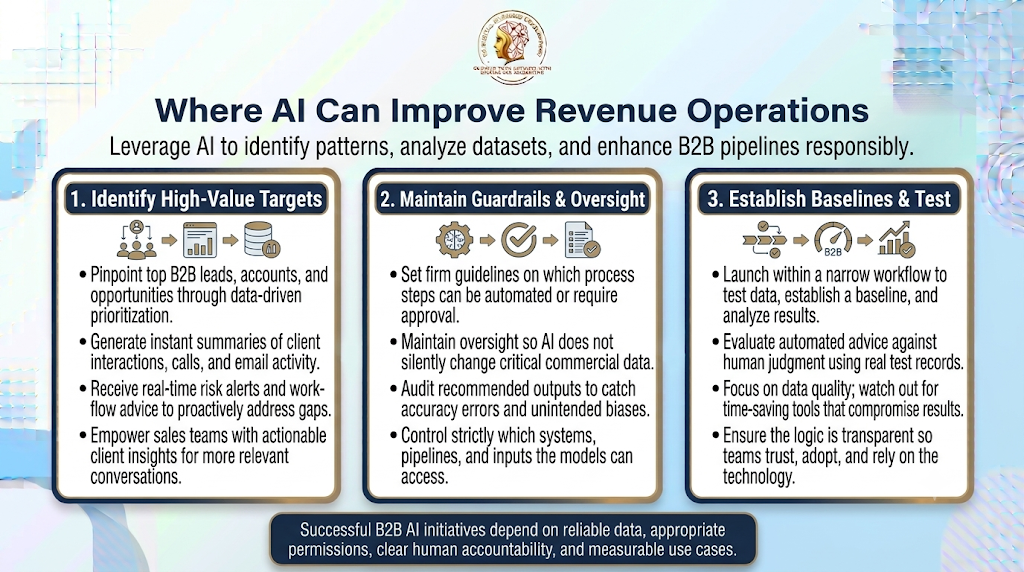
AI can help teams analyze large volumes of commercial information, identify patterns, summarize conversations, detect anomalies, and recommend next actions. Its value depends on reliable data, appropriate permissions, clear human accountability, and a measurable use case.
Potential applications include lead and account prioritization, call summarization, opportunity-risk signals, forecast scenario analysis, renewal-risk detection, routing recommendations, data enrichment, and workflow assistance. For example, an AI assistant may summarize recent account activity and highlight that several stakeholders have asked about implementation timing. A seller can use that context to prepare a more relevant conversation.
AI should not silently change high-impact commercial records or make consequential customer decisions without suitable controls. Define which actions can be automated, which require approval, what information the revenue operations model may access, and how outputs are logged. Review recommendations for accuracy and bias, especially when they influence account prioritization or customer treatment.
Start with a narrow workflow. Establish a baseline, test the tool with representative records, compare recommendations with human judgment, and measure the result. If the revenue operations system saves time but reduces qualification quality, it has not delivered a useful improvement. If it improves prioritization but cannot explain why, adoption may remain low.
Common Implementation Mistakes
Buying software before agreeing on the revenue operations process
A new platform cannot resolve disagreements about lifecycle stages, ownership, or qualification. Define the revenue operations process first and select technology against the actual requirements.
Measuring every activity
More dashboards do not automatically create better decisions. Select a limited set of measures linked to strategic goals and give each metric a clear owner and definition.
Treating CRM cleanup as a one-time project
Data quality declines when ownership is unclear and workflows encourage incomplete records. Build validation, monitoring, training, and correction into daily operations.
Ignoring customer success
A revenue operations model focused only on new bookings misses adoption, retention, and expansion. Include the post-sale journey from the beginning so the business manages the full customer lifecycle.
Automating without governance
Uncontrolled automation can route leads incorrectly, overwrite important information, or create confusing customer communications. Use permissions, testing, approval thresholds, audit logs, and rollback procedures.
Expecting immediate transformation
Changing definitions, systems, and team behavior takes time. Start with a few high-impact workflows, demonstrate improvement, and expand based on evidence rather than launching a company-wide redesign all at once.
A Practical 90-Day Implementation Roadmap
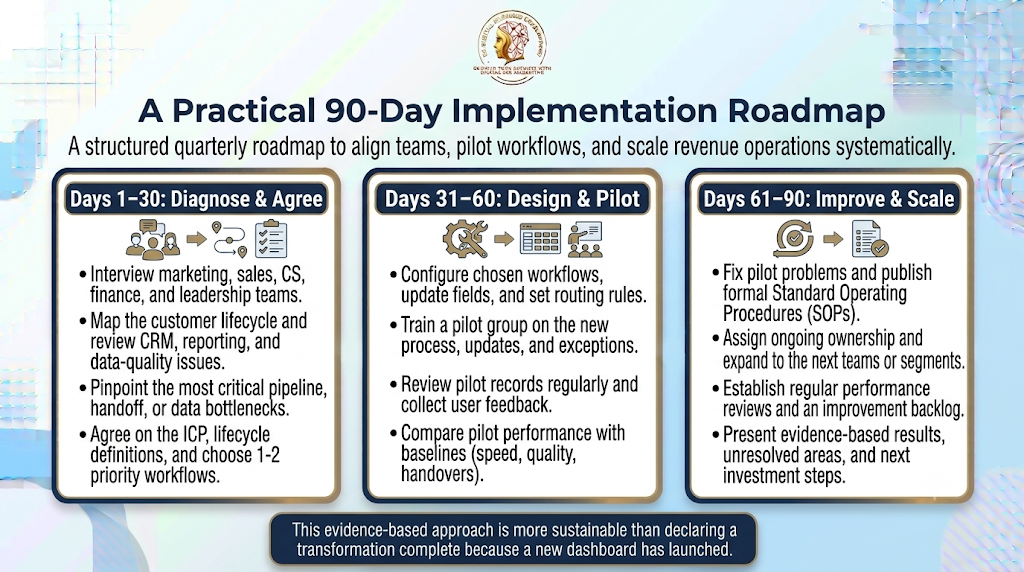
A focused 90-day plan can establish the foundations without pretending that every system or team can be transformed in one quarter.
Days 1–30: Diagnose and agree
Interview marketing, sales, customer success, finance, and leadership. Map the customer lifecycle and the most important handoffs. Review the CRM structure, reporting definitions, system integrations, and data-quality issues. Identify a small number of problems that materially affect pipeline, customer experience, or forecast confidence.
Agree on the target customer profile, lifecycle definitions, ownership, and baseline measures. Choose one or two workflows for improvement, such as inbound lead routing or the sales-to-customer-success handover. Document the current process and the intended change.
Days 31–60: Design and pilot
Configure the selected workflow, update required fields, create clear routing rules, and prepare simple reports. Train a pilot group and explain what changes, why they matter, and how exceptions should be handled. Review records regularly and collect feedback from the people using the revenue operations process.
Compare pilot performance with the baseline. Look for changes in response time, acceptance, missing information, handover quality, or manual effort. Investigate unintended effects before expanding the revenue operations workflow.
Days 61–90: Improve and scale carefully
Fix problems found during the pilot, publish the operating procedure, assign ongoing ownership, and expand to the next suitable team or segment. Establish a regular performance review and a backlog for further improvements. Keep the first version manageable; add complexity only when there is a clear business reason.
At the end of the period, leadership should be able to explain what changed, what improved, what remains unresolved, and which investment is justified next. This evidence-based approach is more sustainable than declaring a transformation complete because a new dashboard has launched.
How SG Digital Business Development Can Support Growth Operations
SG Digital Business Development works across digital growth, SEO, paid acquisition, AI-enabled workflows, and business development. These activities can contribute to a connected commercial system when they are planned around shared customer and revenue outcomes.
For a business reviewing its operating model, useful starting points may include improving how marketing performance connects to qualified enquiries, strengthening the information available to sales, clarifying conversion paths, and creating more useful reporting. Our B2B lead generation strategy explains how demand generation can be connected to lead quality and business outcomes. Our AI SEO strategy discusses the role of search visibility in a wider acquisition system, while AI-powered Google Ads campaigns covers paid acquisition and campaign optimization.
The appropriate starting point depends on the company’s current systems, team capacity, data maturity, and commercial priorities. A useful engagement begins with diagnosis rather than assumptions: understand the customer journey, identify the bottlenecks, agree on success measures, and prioritize improvements that can be implemented and evaluated.
If your business wants to improve the connection between marketing activity, sales execution, customer experience, and measurable growth, contact SG Digital Business Development to discuss your objectives and current challenges.
Frequently Asked Questions
What does RevOps mean?
RevOps is short for revenue operations. It is a revenue operations approach to coordinating the people, processes, data, and technology that support the full revenue lifecycle, from demand generation through sales, onboarding, retention, and expansion.
Is revenue operations the same as sales operations?
No. Sales operations generally focuses on the revenue operations systems and processes that help the sales organization perform. Revenue operations has a wider scope and connects marketing, sales, customer success, and other functions involved in commercial outcomes.
Who should lead the revenue operations function?
The revenue operations structure depends on company size and complexity. A dedicated leader may coordinate specialist teams in a larger business, while a smaller organization may assign the responsibility to an operations manager or commercial leader. The important requirement is clear authority and cross-functional access.
Which metrics should a company track?
Start with a small set that connects demand, pipeline, sales execution, customer outcomes, and financial performance. Common measures include sales acceptance, opportunity conversion, win rate, sales cycle, forecast variance, renewal, retention, expansion, and data quality.
Does a company need a dedicated RevOps team?
Not always. Smaller businesses can begin with shared definitions, documented workflows, named owners, and a consistent review process. A dedicated team becomes more useful as the number of products, markets, systems, and customer journeys grows.
What technology is required?
There is no universal tool stack. Most organizations need a reliable CRM and may also use marketing automation, analytics, customer support, billing, and integration tools. Choose systems based on process requirements, data governance, security, and total cost.
How long does implementation take?
Foundational improvements can begin within weeks, but broader change is ongoing. A 90-day pilot can improve a defined workflow and establish measurement. More complex integrations, data governance, and organizational changes may take longer.
Can AI replace revenue operations professionals?
No. AI can assist with analysis, summaries, pattern detection, and workflow recommendations, but people remain responsible for strategy, process design, governance, exceptions, and customer-sensitive decisions.
How does it improve customer retention?
It creates clearer handoffs and shared visibility into customer goals, adoption, service issues, renewal timing, and expansion signals. Teams can identify risk earlier and coordinate appropriate action rather than relying on disconnected records.
What is the first step for a business starting from scratch?
Map the customer lifecycle, agree on stage definitions, identify the most costly handoff problems, and assign process owners. Then establish baseline measures and improve one high-impact workflow before adding more tools or automation.
Conclusion: Make Revenue Performance a Shared Responsibility
Predictable growth depends on more than generating leads or closing individual deals. It requires a connected system that helps teams understand the customer, share reliable information, act at the right time, and learn from commercial outcomes.
Revenue operations provides the structure for that coordination. Its strongest foundations are shared goals, clear customer definitions, mapped lifecycle stages, accountable handoffs, governed data, appropriate technology, and metrics that connect activity to business results. AI can strengthen selected workflows, but it should support a well-designed operating model rather than substitute for one.
Start with the problems that create the greatest friction for customers and teams. Agree on the process, establish a baseline, test improvements, and expand only when the evidence supports it. When marketing, sales, customer success, and leadership work from a common view of the revenue lifecycle, the organization is better equipped to make informed decisions and build sustainable growth.
Let’s build your digital future together. Contact SG Digital Business Development today and let’s engineer your global authority!