AI sales process optimization
AI Growth Engine

AI Sales Process Optimization: 7 Powerful Ways to Improve B2B Sales Performance.

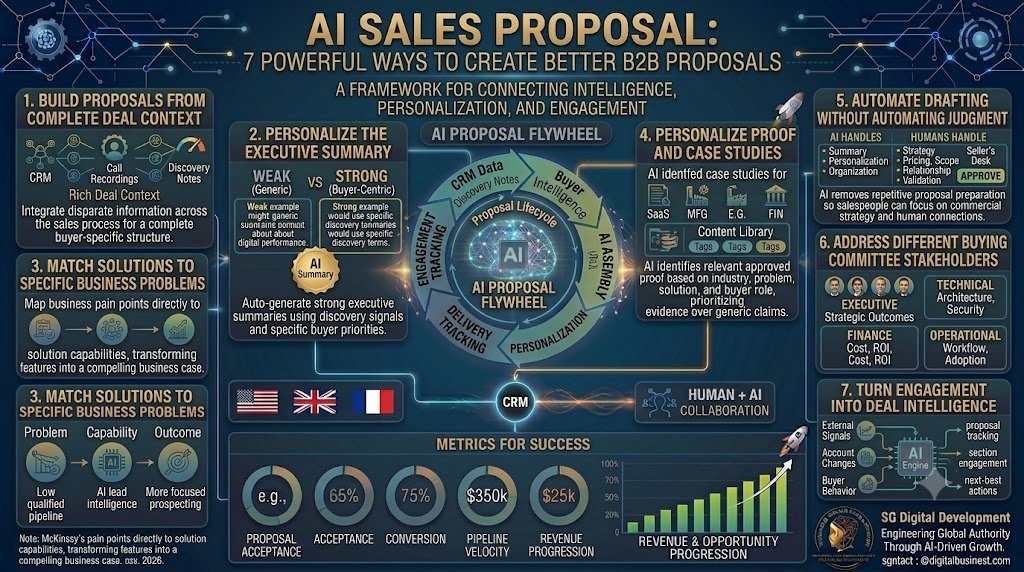
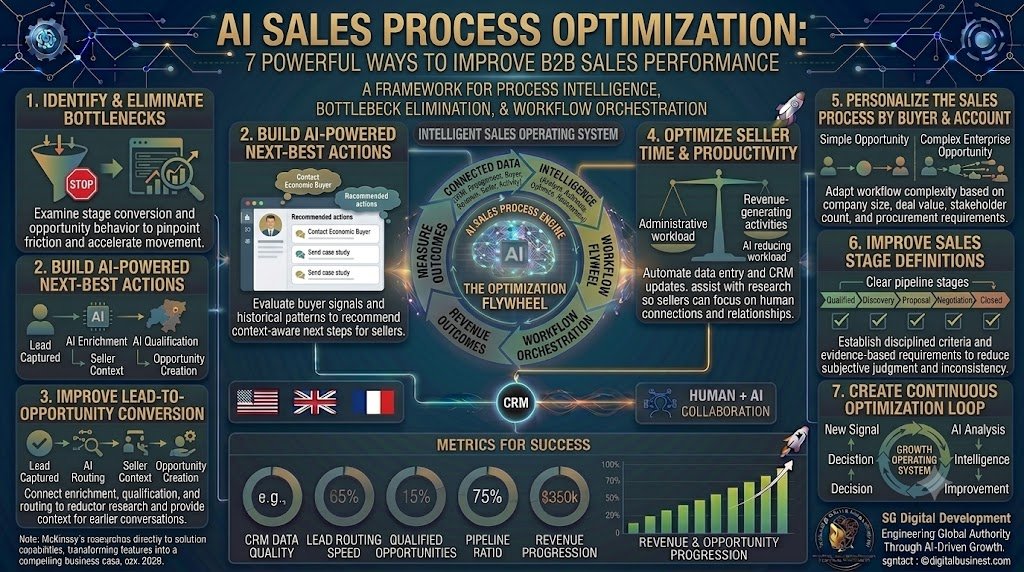
AI Sales Process Optimization: 7 Powerful Ways to Improve B2B Sales Performance. Introduction B2B sales processes often become complicated long before companies realize they have a process problem. A typical sales organization may have separate workflows for: Each workflow may work reasonably well on its own. The problem appears when they do not work well together. A lead may be qualified but routed slowly. A salesperson may have a qualified opportunity but lack the information required for the next conversation. A proposal may be created efficiently but fail to address the buyer’s actual priorities. A deal may look healthy in the CRM while important buyer signals are being missed. Sales representatives can spend hours performing administrative tasks while high-value selling activities receive less attention. This is where AI sales process optimization becomes strategically important. Rather than adding another isolated AI tool, businesses can use AI to examine the entire sales process, identify friction, automate repetitive work, surface important signals and recommend better actions. The goal is not simply to make salespeople work faster. The goal is to make the sales process itself more intelligent. A modern AI sales process optimization strategy can connect: Lead → Qualification → Routing → Engagement → Discovery → Opportunity → Proposal → Negotiation → Close AI can then help determine what should happen at each stage. The most effective systems combine automation with human judgment. AI can analyze data, identify patterns and recommend actions. Sales professionals can then use those insights to build relationships, handle complex conversations and make strategic decisions. This article explores seven powerful ways businesses can use AI sales process optimization to improve B2B sales performance. What Is AI Sales Process Optimization? AI sales process optimization is the use of artificial intelligence, automation, analytics and sales intelligence to improve the way a B2B sales organization moves prospects from initial interest to revenue. Traditional sales process optimization usually involves: AI adds another layer. It can continuously analyze large volumes of sales information and identify patterns that may be difficult to detect manually. For example, AI can analyze: This creates a more dynamic approach to process improvement. Instead of reviewing the sales process once per quarter, organizations can create a continuous optimization loop. Data → Analysis → Recommendation → Action → Outcome → Learning That is the foundation of AI sales process optimization. Why AI Sales Process Optimization Matters A sales process can become inefficient in many different ways. Consider a company generating hundreds of B2B leads each month. Marketing produces demand. Sales receives the leads. But then: The company may believe it has a lead-generation problem. The actual problem may be process friction. AI sales process optimization helps organizations look across the complete system rather than optimizing one isolated activity. The objective is to answer questions such as: This changes the conversation from: “How can we give salespeople more tools?” to: “How can we build a better sales system?” AI Sales Process Optimization vs AI Sales Automation These concepts are closely related but not identical. AI sales automation focuses primarily on automating tasks. Examples include: AI sales process optimization goes further. It examines whether the workflow itself is designed effectively. For example: Automation asks: “Can we automate this follow-up?” Optimization asks: “Should this follow-up happen at all, when should it happen, which buyer should receive it, and what should trigger the next step?” Automation improves execution. Optimization improves the system. The strongest B2B sales organizations use both. 7 Powerful Ways to Use AI Sales Process Optimization 1. Identify and Eliminate Sales Process Bottlenecks One of the most valuable applications of AI sales process optimization is identifying where opportunities slow down. A sales funnel may appear healthy at a high level. But detailed analysis may reveal problems. For example: Lead → Meeting: strong Meeting → Opportunity: strong Opportunity → Proposal: weak Proposal → Negotiation: strong Negotiation → Close: weak The organization now knows where to investigate. AI can examine factors associated with those slowdowns. Possible signals include: This creates a much more granular view of the sales process. Instead of saying: “Our sales cycle is too long.” sales leaders can ask: “Which stage creates the largest amount of avoidable delay, and what conditions are associated with that delay?” That is a much more actionable question. Example Suppose a company discovers that opportunities frequently stall after the initial proposal. AI analysis may reveal that stalled opportunities commonly have: The solution may not be another automated email. The solution may be a multi-threading workflow and stronger proposal process. That is process optimization. 2. Build AI-Powered Next-Best Actions Salespeople constantly make decisions. Should I call this prospect? Should I follow up today? Should I involve an executive? Should I send a case study? Should I schedule another discovery meeting? Should I introduce pricing? Should I move this opportunity forward? Traditional CRM systems mostly record what has already happened. AI can help recommend what should happen next. This is a major component of AI sales process optimization. A next-best-action system can evaluate: It can then recommend an action. For example: “Contact the economic buyer.” Or: “Send the implementation case study before the next meeting.” Or: “Opportunity has not progressed for 14 days. Review decision process.” Or: “Buyer engagement has increased. Schedule a discovery follow-up.” The objective is not to remove seller judgment. It is to reduce the amount of time salespeople spend figuring out what deserves attention. 3. Improve Lead-to-Opportunity Conversion The transition from lead to opportunity is one of the most important parts of the B2B sales process. Poor conversion can happen because: AI sales process optimization can connect these activities. A modern workflow might look like: Lead captured ↓ AI enrichment ↓ AI qualification ↓ AI routing ↓ Seller context briefing ↓ Personalized outreach ↓ Buyer engagement ↓ Opportunity creation Each step provides information to the next. For example, AI can summarize: The salesperson begins the conversation with context rather than starting from zero. That can reduce unnecessary research and improve consistency. 4. Optimize Seller
AI lead routing
AI Growth Engine

AI Lead Routing: 7 Powerful Ways to Route B2B Leads to the Right Sales Rep.

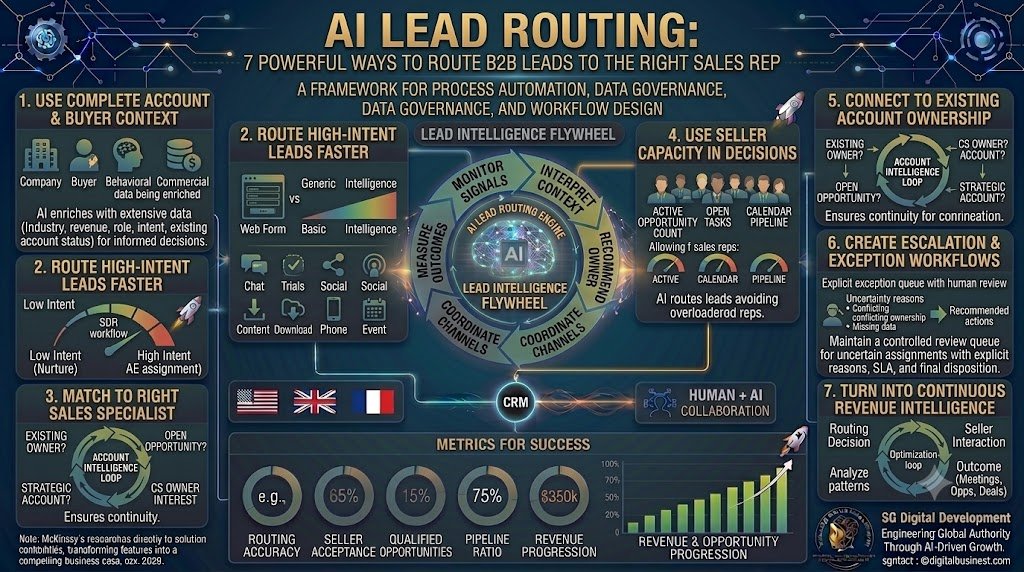
AI Lead Routing: 7 Powerful Ways to Route B2B Leads to the Right Sales Rep. Introduction Generating a B2B lead is only the beginning of the sales process. What happens immediately after the lead arrives can have a major impact on whether that lead becomes a conversation, an opportunity or a lost record inside the CRM. A lead may need to be: When those steps are handled manually, delays and ownership problems can appear quickly. A high-value enterprise prospect may enter the CRM and wait in a general queue. A lead from an existing account may be assigned to the wrong salesperson. A prospect in a specialized industry may reach a representative without the relevant expertise. A high-intent buyer may receive the same response process as a low-intent inquiry. This is where AI lead routing becomes strategically important. AI lead routing uses artificial intelligence, customer data, account intelligence, behavioral signals, business rules and sales capacity information to determine where an incoming lead should go and what should happen next. Instead of simply asking: “Which salesperson gets the next lead?” a modern routing system can evaluate: That makes AI lead routing much more than an automated round-robin system. It becomes part of the organization’s revenue infrastructure. Recent 2026 guidance on AI lead routing emphasizes that routing should combine ownership rules, approved enrichment, CRM evidence, capacity and clear exception handling rather than turning assignment into an unexplained AI decision. This guide explains seven powerful ways businesses can use AI lead routing to improve B2B lead distribution, seller productivity, speed-to-lead and revenue execution. What Is AI Lead Routing? AI lead routing is the use of artificial intelligence and automated decision logic to determine which salesperson, sales team, territory or workflow should receive an incoming lead. Traditional lead routing usually relies on static rules. For example: If the lead is located in California, assign it to Salesperson A. Or: If company size is above 500 employees, assign it to the enterprise team. Or: Send every new lead to the next salesperson in a round-robin queue. These rules can work when the sales organization is simple. But B2B organizations often have much more complex requirements. A lead may need to be routed according to: AI lead routing can analyze multiple signals simultaneously. The goal is not simply to route leads faster. The goal is to route the right lead to the right owner with the right context at the right time. Why AI Lead Routing Matters in 2026 B2B buyers increasingly interact with companies across multiple digital channels. A lead might arrive through: Each source can provide different information. A website demo request may contain explicit buying intent. A content download may indicate early research. A partner referral may already have a relationship attached to it. An existing customer inquiry may need to remain with the account owner rather than entering a new-business queue. Static routing systems often struggle with this complexity. Modern AI lead routing can use the available context to determine which workflow should apply. The 2026 routing landscape increasingly emphasizes enrichment before routing, account-level ownership, capacity-aware assignment and auditable decisions. This creates a more intelligent connection between marketing activity and sales execution. AI Lead Routing vs Traditional Lead Routing Traditional routing usually follows predefined rules. For example: Lead enters CRM ↓ Check geography ↓ Check company size ↓ Assign representative That approach is predictable, but it can be limited. AI-enabled routing can introduce additional layers. Lead enters CRM ↓ Enrich account ↓ Identify existing ownership ↓ Analyze intent ↓ Evaluate account value ↓ Evaluate seller fit ↓ Evaluate capacity ↓ Apply routing policy ↓ Assign owner ↓ Trigger next-best action The difference is not simply automation. It is the amount of context used to make the decision. Traditional rules remain useful. In fact, critical ownership and compliance rules should often remain deterministic. AI is most valuable where interpretation and prioritization are required. That combination can create a more reliable routing architecture. 7 Powerful Ways to Use AI Lead Routing 1. Route Leads Using Complete Account and Buyer Context The first major application of AI lead routing is using more than the information submitted through the lead form. A typical form may contain: That is useful, but incomplete. AI can help enrich the lead with additional information. For example: Company Information Buyer Information Behavioral Information Commercial Information The routing system can then make a more informed decision. For example: A VP of Marketing from a 2,000-person SaaS company has visited the pricing page three times, downloaded an enterprise guide and belongs to an account with an existing opportunity. That lead should probably not enter the same workflow as an anonymous early-stage content download. Context changes routing. This is one of the central advantages of AI lead routing. 2. Route High-Intent Leads Faster Speed matters when a buyer has actively raised their hand. Not every lead requires the same response speed. Consider three leads. Lead A Downloads a general industry report. Lead B Requests a product comparison. Lead C Requests a pricing discussion and mentions an implementation timeline. All three are leads. But they represent different levels of buying intent. AI can analyze available signals and place leads into different routing paths. Low Intent Automated nurture ↓ Medium Intent Sales development workflow ↓ High Intent Immediate sales assignment This allows sales teams to prioritize attention. The purpose of AI lead routing is not necessarily to send every lead to a salesperson instantly. It is to determine which leads deserve which level of sales attention. That distinction helps prevent sales teams from becoming overwhelmed by low-value inbound volume. 3. Match Leads to the Right Sales Representative The “right salesperson” is not always the person who happens to be next in a round-robin queue. B2B sales teams often have different specializations. A company may have representatives focused on: A lead should ideally reach someone capable of understanding the buyer’s situation. AI can evaluate: This creates a fit-based routing model. For example: A healthcare enterprise lead

AI sales quota planning
AI Growth Engine

AI Sales Quota Planning: 7 Powerful Ways to Set Smarter B2B Sales Quotas.

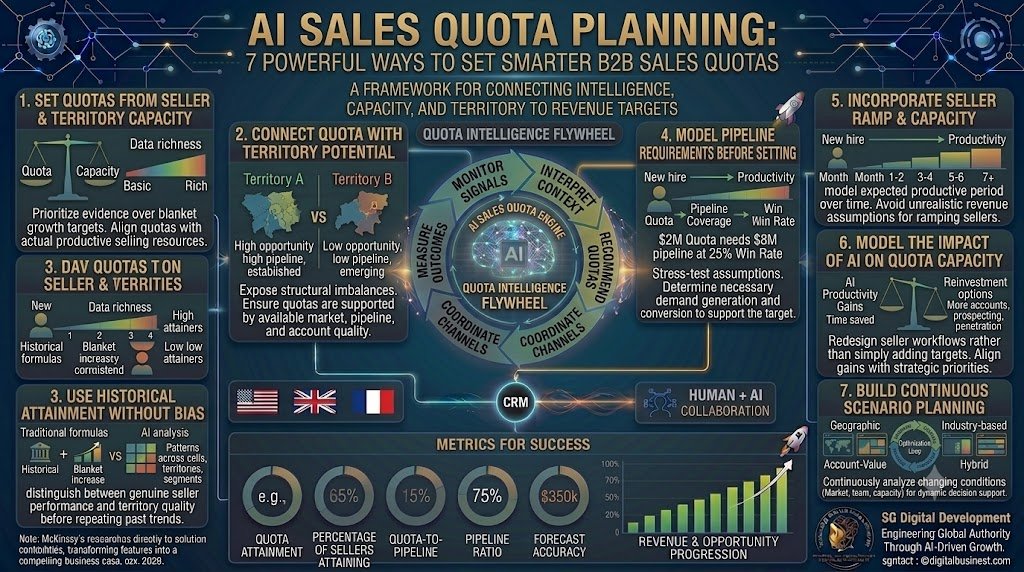
AI Sales Quota Planning: 7 Powerful Ways to Set Smarter B2B Sales Quotas. Introduction Sales quotas sit at the center of the B2B revenue organization. They influence seller behavior, hiring plans, territory design, compensation, forecasting and ultimately the company’s revenue expectations. Yet quota setting is often still treated as a top-down financial exercise. Leadership establishes a revenue target. That target is divided across regions. Regions are divided across teams. Teams are divided across sellers. The result becomes an individual quota. The problem is that mathematical allocation does not automatically create an achievable sales target. A quota can be numerically correct while being commercially unrealistic. One seller may receive a territory with substantial market opportunity, strong pipeline and high-value accounts. Another may receive a territory with limited opportunity, longer sales cycles and fewer qualified prospects. Both sellers could receive identical quotas. That is where AI sales quota planning becomes increasingly valuable. AI can help revenue organizations evaluate quota decisions using a broader set of variables, including: Instead of asking only: “How should we divide the corporate revenue target?” sales leaders can ask: These questions turn quota planning from a simple allocation exercise into a revenue planning discipline. Gartner’s September 2026 guidance specifically argues that hunter quotas should be tested against seller capacity and that organizations should incorporate AI gains when computing capacity. This guide explains seven powerful ways businesses can use AI sales quota planning to create more evidence-based, transparent and adaptable quota structures. What Is AI Sales Quota Planning? AI sales quota planning is the use of artificial intelligence, predictive analytics, machine learning and connected sales data to help organizations establish, distribute, evaluate and adjust sales quotas. Traditional quota planning often starts with a company-level revenue target. For example: Annual revenue target: $50 million The organization might then allocate: Those numbers are then distributed across teams and sellers. The process may appear logical. But it does not necessarily answer whether the assigned quotas are supported by: AI can help introduce those variables into the planning process. An AI-assisted quota model might evaluate: Seller Data Territory Data Pipeline Data Revenue Data Productivity Data This creates a more complete view of quota feasibility. Why Traditional Quota Planning Can Fail Quota planning becomes difficult when organizations confuse revenue ambition with seller capacity. Suppose a company wants 25% revenue growth. Leadership may increase every seller’s quota by 25%. That is simple. But what if the market opportunity has not increased by 25%? What if the territories are already highly penetrated? What if sellers are overloaded? What if new hires require six months to ramp? What if the sales cycle has increased? What if win rates have declined? What if AI has changed seller productivity? A blanket quota increase does not answer these questions. The result can be quotas that look reasonable at the corporate level but are difficult to support at the seller level. Gartner’s 2026 research highlights this issue by emphasizing capacity-based quota setting rather than simply allocating corporate growth targets downward. The underlying principle is straightforward: A revenue target should be connected to the capacity and opportunity required to produce it. AI Sales Quota Planning vs Traditional Quota Planning Traditional quota planning commonly uses: AI sales quota planning can incorporate these variables plus: This does not mean AI automatically determines the quota. Instead, AI can provide a richer analytical foundation for leadership decisions. The final quota still depends on business strategy. For example, leadership may intentionally assign an aggressive quota because the company wants to expand into a new market. AI can help model what would need to happen for that quota to become achievable. That is more useful than simply labeling the quota as aggressive. 7 Powerful Ways to Use AI Sales Quota Planning 1. Set Quotas From Seller and Territory Capacity The first major application of AI sales quota planning is connecting quotas with actual selling capacity. Consider two sellers. Seller A Seller B Giving both sellers identical quotas may not reflect their actual commercial circumstances. AI can evaluate: The result can be a more evidence-based quota recommendation. This does not mean every seller must receive a different quota. Organizations may deliberately maintain quota consistency within roles. But AI can test whether the underlying opportunity supports that consistency. 2. Connect Quota With Territory Potential Quota planning and territory planning should not operate independently. A territory represents the market opportunity available to a seller. The quota represents the revenue expectation placed on that opportunity. If those two variables are disconnected, quota planning becomes fragile. For example: Territory A Territory B Assigning the same quota to both territories creates a structural imbalance. AI sales quota planning can analyze territory potential and determine how quota assumptions compare with the available opportunity. This can also help identify whether a quota problem is actually a territory problem. If the quota appears too high, the organization may need to ask: Quota planning therefore becomes part of a broader commercial architecture. 3. Use Historical Attainment Without Repeating Historical Bias Historical attainment is useful. But it should not be copied blindly into future quotas. Suppose a seller consistently achieved 110% of quota. That could indicate: Similarly, a seller consistently achieving 70% could reflect: AI can analyze multiple variables to distinguish these possibilities. Instead of simply saying: “This seller achieved 110%, so increase the quota.” the organization can investigate why. This is an important principle of AI sales quota planning: Historical performance should be evidence, not an automatic formula. AI can identify patterns across: That creates a more contextual view of attainment. 4. Model Pipeline Requirements Before Setting the Quota A quota should have a pipeline logic behind it. Suppose a seller receives a $2 million annual quota. The next question should be: “How much qualified pipeline is required to support that target?” The answer depends on factors such as: For example, if the organization historically requires approximately 4x qualified pipeline coverage, a $2 million quota may require roughly $8 million of qualified pipeline. But if win rates

AI sales capacity planning
AI Growth Engine

AI Sales Capacity Planning: 7 Powerful Ways to Optimize B2B Sales Capacity.

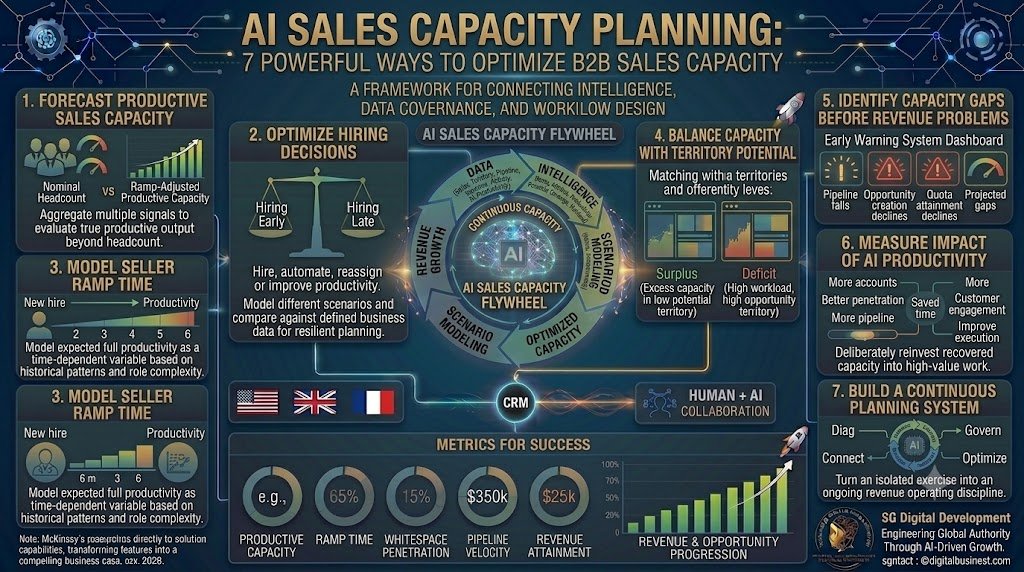
AI Sales Capacity Planning: 7 Powerful Ways to Optimize B2B Sales Capacity. Introduction Every B2B revenue target eventually creates the same question: Does the sales organization have enough productive capacity to achieve it? Hiring more salespeople is an obvious answer, but it is not always the right answer. A company can add headcount and still miss its revenue target. Why? Because sales capacity is influenced by far more than the number of people on the team. It depends on: This is why AI sales capacity planning is becoming increasingly important for modern B2B organizations. Traditional capacity planning often depends on spreadsheets, historical assumptions and annual headcount exercises. AI can make the process more dynamic. Instead of asking only: “How many salespeople do we need?” sales leaders can ask: These questions turn sales capacity planning into a strategic revenue discipline. Modern sales planning increasingly connects capacity, territory, quota and scenario modeling rather than treating each as an isolated exercise. Gartner’s 2026 sales performance management research identifies sales capacity planning, quota planning and territory optimization as connected capabilities. AI can help companies analyze those relationships continuously. This guide explains seven powerful ways organizations can use AI sales capacity planning to build a more productive, scalable and predictable B2B sales organization. What Is AI Sales Capacity Planning? AI sales capacity planning is the use of artificial intelligence, predictive analytics, machine learning and connected sales data to estimate, manage and optimize the productive capacity of a sales organization. Traditional sales capacity planning may calculate capacity using a simplified formula: Number of sellers × quota × expected attainment That can provide a starting point. But it leaves out important variables. A more realistic model may need to consider: AI sales capacity planning can bring these variables together. Instead of looking at capacity as a single number, companies can model capacity across time, roles, territories and scenarios. For example: Q1 New hires rampingExisting sellers productivePipeline developing ↓ Q2 New hires approaching productivityPipeline increasingCapacity expanding ↓ Q3 Full productivityPotential attritionMarket changes ↓ Q4 Revenue targetCapacity requirementsHiring or reallocation decisions This creates a more realistic view of what the sales organization can actually produce. Why Traditional Sales Capacity Planning Is Becoming Less Reliable Traditional models often make several assumptions. For example: These assumptions can create problems. A new salesperson may require six months to reach meaningful productivity. An experienced enterprise seller may generate substantially more revenue than a newly hired representative. A territory may contain insufficient opportunity to support its assigned quota. Another territory may contain more demand than its seller can effectively cover. And AI can change how much time sellers spend on research, administrative tasks, prospecting preparation and proposal work. Recent 2026 sales-planning analysis highlights this issue: AI may reduce friction in seller workflows, but organizations still need to determine whether those productivity gains should translate into more accounts, stronger account penetration, different staffing levels or other uses of capacity. The key is to model capacity rather than assume it. AI Sales Capacity Planning vs Traditional Capacity Planning Traditional planning often answers: “How many sellers do we need?” AI-powered planning can answer a broader set of questions: “How much productive capacity will we have, where will it exist, when will it become available, and what revenue can it realistically support?” That difference is significant. Traditional planning may use: AI sales capacity planning can incorporate: The result is a more dynamic capacity model. 7 Powerful Ways to Use AI Sales Capacity Planning 1. Forecast Productive Sales Capacity The first major application of AI sales capacity planning is forecasting how much productive capacity the organization will actually have. Headcount alone is not capacity. Consider a company with 20 sales representatives. If five are new hires, three are ramping, two are expected to leave and several experienced sellers are carrying overloaded territories, the organization does not truly have the same productive capacity as 20 fully productive representatives. AI can analyze historical performance and current conditions to estimate: This helps leadership distinguish between nominal headcount and productive capacity. That distinction is critical. A company may have enough employees on paper but still have a capacity shortage. 2. Optimize Hiring and Headcount Decisions Hiring is one of the most expensive decisions in sales. Hiring too early creates unnecessary cost. Hiring too late creates capacity gaps. AI sales capacity planning can help model both scenarios. Suppose a company expects to add $10 million in new annual revenue. Leadership could evaluate: Scenario A Hire 10 representatives immediately. Scenario B Hire 5 representatives now and 5 later. Scenario C Improve seller productivity before adding headcount. Scenario D Reallocate existing capacity across territories. Scenario E Use AI automation to reduce administrative workload and reinvest seller time into revenue-generating activities. AI can compare these scenarios using available business data. Potential variables include: This helps companies avoid treating headcount as the automatic solution to every capacity problem. 3. Model Seller Ramp Time New sellers do not become fully productive on day one. Ramp time can significantly affect revenue planning. Consider a new salesperson with a six-month ramp. If the company hires that person in January, the full-year revenue contribution may be substantially lower than the quota assigned to a fully ramped seller. AI sales capacity planning can incorporate: AI can then model expected productivity over time. For example: Month 1 Low productivity ↓ Month 2 Early pipeline development ↓ Month 3 Increasing opportunity creation ↓ Month 4 Growing conversion ↓ Month 5 Higher productive capacity ↓ Month 6+ Expected full productivity The exact pattern will vary by organization. The important point is that capacity should be modeled as a time-dependent variable. 4. Balance Capacity With Territory Potential Capacity cannot be evaluated independently from territory design. A seller may have significant capacity but insufficient market opportunity. Another seller may have more opportunity than they can realistically manage. This creates two different problems. Capacity surplus The seller has more available capacity than the territory requires. Capacity deficit The territory contains more opportunity than the seller can reasonably cover.

AI sales territory planning
AI Growth Engine

AI Sales Territory Planning: 7 Powerful Ways to Optimize B2B Sales Territories.

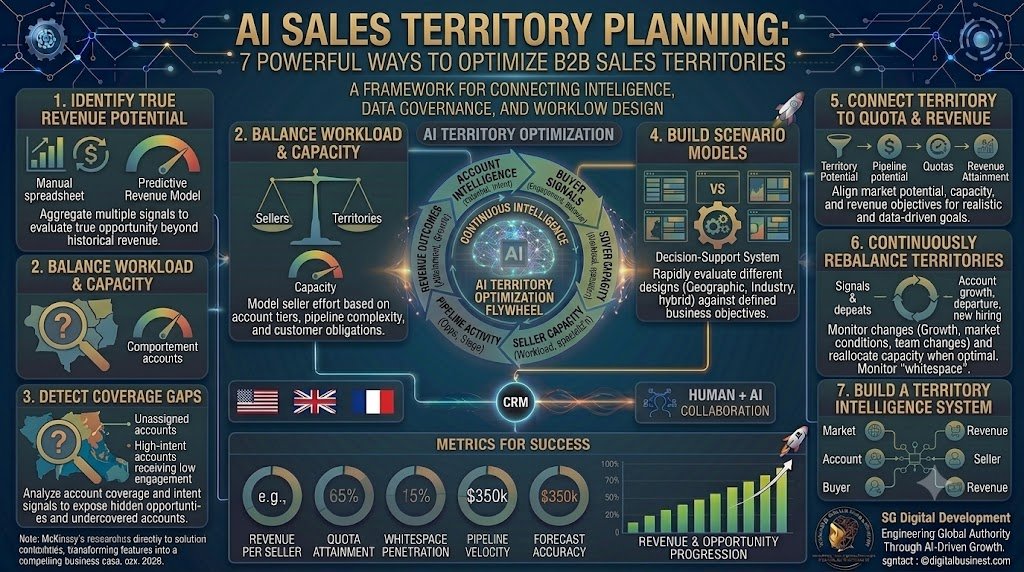
AI Sales Territory Planning: 7 Powerful Ways to Optimize B2B Sales Territories. Introduction Sales territory planning has traditionally been treated as an annual spreadsheet exercise. Sales leaders divide accounts by geography, industry, company size, named-account lists, or existing relationships. Sales operations teams then assign representatives, calculate quotas, review account coverage, and make adjustments when problems become obvious. That model is becoming increasingly difficult to manage. B2B markets change continuously. New accounts enter the market. Existing accounts grow or contract. Buyer intent changes. Sales representatives join or leave. Territories become overloaded. Some accounts receive too much attention while valuable opportunities remain untouched. At the same time, AI is giving sales organizations the ability to analyze far more signals than traditional territory planning processes can handle manually. AI sales territory planning uses account data, market potential, buyer intent, historical performance, seller capacity, pipeline activity, customer characteristics and other business signals to help sales leaders design and continuously evaluate territories. Instead of asking only: “How many accounts should each salesperson receive?” sales leaders can ask: This changes territory planning from a static administrative process into an ongoing revenue optimization discipline. For B2B companies, the objective is not simply to distribute accounts evenly. The objective is to create a territory structure that aligns market opportunity, account coverage, seller capacity, revenue potential and sales execution. This guide explains seven powerful ways companies can use AI sales territory planning to build more intelligent and adaptable sales coverage. What Is AI Sales Territory Planning? AI sales territory planning is the use of artificial intelligence, machine learning, predictive analytics and connected sales data to help organizations design, evaluate and optimize sales territories. A traditional territory model might primarily consider: AI can introduce a much broader set of variables. For example, an AI-assisted territory planning system could analyze: The result is not simply an automated territory map. It is a decision-support system that helps revenue leaders understand whether their current sales coverage matches the opportunity available in the market. Modern territory planning is increasingly connected to quota planning and capacity planning as well. Salesforce, for example, describes account targets as a data-driven baseline for quota planning and emphasizes evaluating whether assigned quota is supported by the potential of the accounts within a territory. That relationship is important. A territory can look balanced by account count while being extremely unbalanced by revenue potential. Ten small accounts do not necessarily equal ten enterprise accounts. Likewise, two territories with the same number of opportunities may require completely different amounts of seller effort. AI sales territory planning helps expose these differences. Why Traditional Sales Territory Planning Is Becoming More Difficult The problem with traditional territory planning is not that spreadsheets are inherently bad. The problem is that the underlying market is dynamic. A territory designed six months ago may no longer represent current opportunity. Accounts grow. Markets contract. Competitors enter. New products launch. Buyer behavior changes. Salespeople change roles. Pipeline moves. Customer relationships develop. Intent signals appear. And new accounts continuously enter the addressable market. Gartner’s 2026 guidance on sales operations emphasizes the need to continuously evaluate processes, technology, workforce requirements and operational risks as AI changes how sales organizations operate. AI sales territory planning fits into this broader transformation. Instead of treating territory design as a once-a-year project, companies can create an operating system for continuously evaluating: Opportunity → Coverage → Capacity → Ownership → Performance That creates a more responsive sales organization. AI Sales Territory Planning vs Traditional Territory Planning Traditional territory planning often relies on predefined rules. For example: Territory A Territory B The structure may look balanced. But the underlying opportunity might not be. Territory A could contain: Meanwhile, Territory B could contain more accounts but less commercial potential. AI sales territory planning allows companies to evaluate the territory using multiple dimensions rather than account count alone. The question becomes: “How much opportunity and workload does each territory actually contain?” That is a much more useful question for revenue planning. 7 Powerful Ways to Use AI Sales Territory Planning 1. Identify the True Revenue Potential of Every Territory The first major application of AI sales territory planning is understanding territory potential. Many organizations evaluate territories using historical revenue. That can be misleading. A territory that generated low revenue last year may contain significant untapped potential. Likewise, a territory that historically generated high revenue may be approaching saturation. AI can evaluate multiple variables simultaneously to estimate opportunity. These variables can include: This creates a more complete picture of territory potential. Example Imagine two sales territories. Territory A Territory B A traditional model may view Territory B as larger because it contains more accounts. An AI-powered model may identify Territory A as significantly more valuable because the commercial potential is greater. This distinction matters when allocating sellers. The objective is not to make account counts equal. The objective is to align sales capacity with opportunity. 2. Balance Territory Workload and Seller Capacity A territory can become problematic when the amount of work required exceeds the seller’s realistic capacity. Consider a territory containing: Another territory might contain: Both territories could have one salesperson. But their workloads are completely different. AI can help sales operations evaluate territory workload based on more than account volume. Potential inputs include: This creates a more realistic capacity model. The objective is not to give every seller exactly the same number of accounts. The objective is to give each seller a manageable territory with enough commercial opportunity to justify the assigned capacity. 3. Detect Territory Coverage Gaps One of the most valuable applications of AI sales territory planning is identifying accounts that are not receiving enough sales attention. Coverage gaps can happen for many reasons. A company may have: These problems can remain hidden inside a CRM. AI can analyze account coverage patterns and identify anomalies. For example, an AI system might identify: “Thirty-seven high-potential accounts have received no meaningful sales engagement during the past 60 days.” That insight can trigger a territory review. The sales organization

AI sales operations
AI Growth Engine

AI Sales Operations: 7 Powerful Ways to Transform B2B Sales Operations.

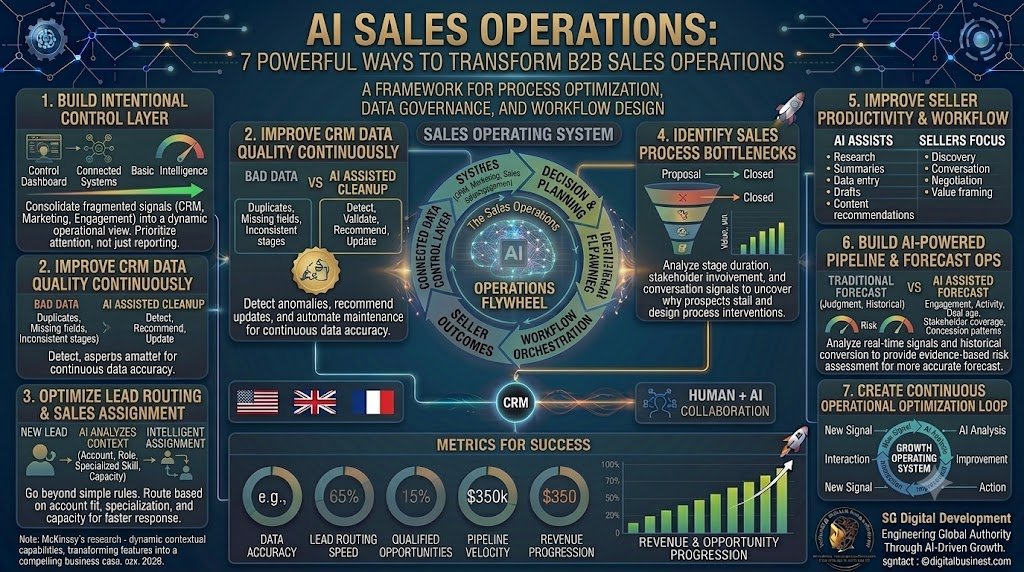
AI Sales Operations: 7 Powerful Ways to Transform B2B Sales Operations. Introduction Sales operations has traditionally been the infrastructure behind the sales organization. While sales representatives focus on prospects, customers and deals, sales operations teams manage many of the systems and processes that make selling possible. They may be responsible for: As B2B sales becomes more complex, these responsibilities are becoming increasingly difficult to manage manually. Sales organizations now operate across more channels, more data sources and more technology systems than before. At the same time, buyers are using AI to research vendors, compare solutions and move through buying journeys differently. This creates a new challenge. Sales operations can no longer simply maintain the existing sales process. It increasingly needs to help redesign how the sales organization works. This is where AI sales operations becomes important. An effective AI sales operations strategy uses artificial intelligence, automation, analytics, CRM data and workflow intelligence to improve the infrastructure supporting the sales organization. The objective is not simply to automate administrative tasks. It is to create a sales operating system that can: Gartner’s 2026 research describes sales operations as needing to evolve around AI-driven growth, process optimization, technology planning, workforce capabilities and operational risk management. Gartner has also reported that AI can save sellers substantial time, but that organizations need to deliberately reinvest that capacity into higher-value activities rather than assuming efficiency automatically produces revenue. That distinction is central to modern AI sales operations. The goal is not: Automate more work. The goal is: Design better sales operations. This article explains seven powerful ways businesses can use AI sales operations to build a more efficient, intelligent and scalable B2B sales organization. What Is AI Sales Operations? AI sales operations is the use of artificial intelligence, automation, analytics and connected business data to improve the processes, systems, workflows and decision support that enable a B2B sales organization. Traditional sales operations often relies on: These systems can work. But they can become difficult to scale as sales complexity increases. An AI sales operations system adds an intelligence layer. Instead of simply recording: Opportunity has been inactive for 14 days. The system may identify: This opportunity has exceeded the typical activity interval for its stage, has no recent buyer engagement and is approaching its expected close date. The first is a data point. The second is an operational insight. That distinction is important. AI sales operations is not about replacing the CRM. It is about making the information inside the CRM and other business systems more useful. Why AI Sales Operations Matters in 2026 Sales organizations are increasingly dealing with fragmented systems. A typical B2B organization may use: Each platform may contain useful information. The challenge is connecting that information into an operating model. McKinsey’s 2026 B2B research identifies fragmented data, weak insights, manual processes and disconnected teams as barriers to capturing value from AI. Its research argues that companies making stronger use of AI are increasingly redesigning workflows rather than simply adding AI tools on top of existing processes. This is exactly where AI sales operations can create value. Instead of adding another isolated AI tool, companies can use AI to connect: Data → Process → Workflow → Decision → Action → Measurement That creates a more intelligent sales operating system. 7 Powerful Ways to Use AI Sales Operations 1. Build an Intelligent Sales Operations Control Layer The first opportunity is to create a centralized intelligence layer across the sales organization. A sales operations team may currently need to check several systems to understand what is happening. For example: This creates operational fragmentation. An AI sales operations layer can help bring relevant signals together. Example A sales manager asks: Which opportunities need attention this week? Instead of manually reviewing hundreds of CRM records, the system can analyze: It can then surface a prioritized operational view. For example: High-priority opportunities Watchlist Healthy The AI is not making the final sales decision. It is helping sales operations identify where human attention is most valuable. This creates a fundamental shift: From reporting what happened to identifying what needs attention next. 2. Improve CRM Data Quality With AI CRM data is one of the foundations of sales operations. But CRM systems often contain: This creates downstream problems. Bad data affects: An AI sales operations system can help identify data-quality problems continuously. AI can detect: For example: 27 opportunities have remained in “Proposal” stage for more than twice the normal duration. That is more useful than simply reporting the number of opportunities in the proposal stage. AI-assisted CRM cleanup A practical workflow can be: Detect → Validate → Recommend → Human approve → Update For low-risk fields, some updates may be automated. For commercially important fields, human approval can remain necessary. The objective is not to allow AI to modify the CRM without control. The objective is to make CRM maintenance continuous rather than an occasional cleanup exercise. 3. Optimize Lead Routing and Sales Assignment Lead routing is one of the most important operational processes in B2B sales. A lead may need to be assigned based on: Traditional routing may use fixed rules. For example: US lead → US sales team. Rules remain useful. But AI can introduce more context. An AI sales operations system could consider: This can make assignment more intelligent. Example Two sales representatives both cover the same region. Representative A specializes in enterprise SaaS. Representative B specializes in SMB technology companies. A large enterprise SaaS opportunity may be better routed to A. The AI does not need to replace the company’s routing rules. It can operate within them while adding additional intelligence. Lead routing workflow New lead ↓ AI analyzes account ↓ Determine fit ↓ Check ownership ↓ Evaluate seller specialization ↓ Check capacity ↓ Assign ↓ Notify seller ↓ Track response This creates a more responsive operating system. 4. Identify Sales Process Bottlenecks Sales operations exists partly to identify where the sales process is breaking down. Traditional reporting may show: Lead → Opportunity →

AI sales negotiation
AI Growth Engine

AI Sales Negotiation: 7 Powerful Ways to Improve B2B Deal Negotiation.

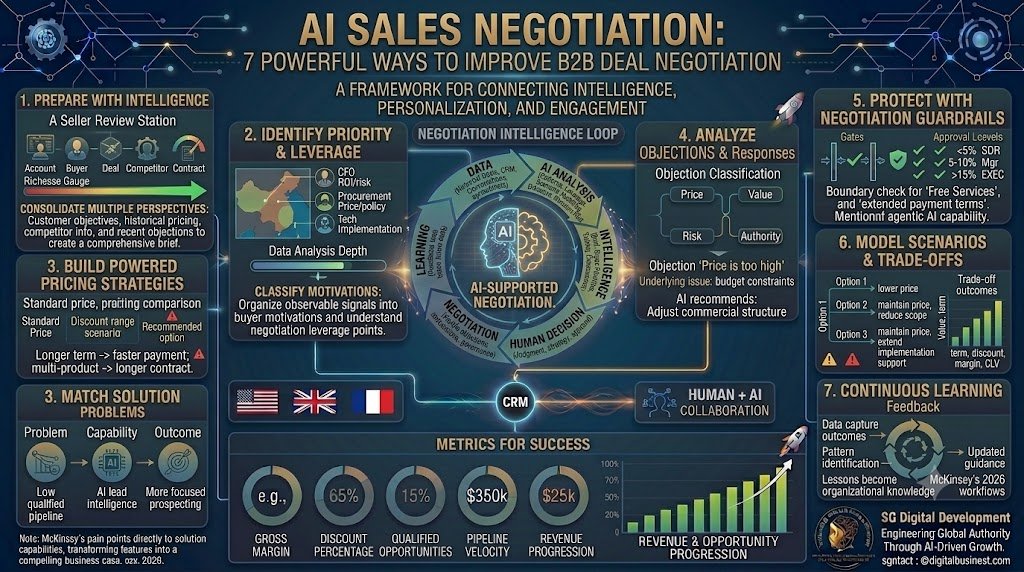
AI Sales Negotiation: 7 Powerful Ways to Improve B2B Deal Negotiation. Introduction B2B sales negotiations have traditionally depended heavily on the experience, preparation and judgment of individual sales representatives. A seller enters a negotiation with information about the customer, the opportunity, the product, the competition and the expected commercial terms. But much of that information is often fragmented. Some of it sits in the CRM. Some is contained in previous sales conversations. Some is buried in emails. Some exists in pricing spreadsheets. Some is known only by the account executive. And some is based on the seller’s personal experience negotiating similar deals. This creates a problem. Two sales representatives can negotiate similar opportunities and reach very different commercial outcomes. One may recognize that a buyer has strong urgency and limited alternatives. Another may offer a discount too early. One may understand the customer’s real buying criteria. Another may negotiate primarily around price. One may know exactly which concessions are acceptable. Another may give away value without receiving anything meaningful in return. An AI sales negotiation strategy can help reduce these inconsistencies by giving sales teams better intelligence before and during important commercial conversations. AI can analyze historical transactions, customer characteristics, deal context, pricing information, buyer signals and competitive factors to help sellers prepare for negotiations. It can help identify: The purpose is not to let AI make every negotiation decision. The more practical model is human-led negotiation supported by AI intelligence. That distinction is important. Current 2026 research from McKinsey describes AI applications across pricing and negotiation, including deal scoring, discount guidance, pricing recommendations and negotiation support. McKinsey also emphasizes human oversight for higher-risk commercial decisions. The result is a new approach to B2B negotiation: Better intelligence → Better preparation → Better decisions → Better commercial outcomes This article explores seven powerful ways businesses can use an AI sales negotiation strategy to improve preparation, pricing, objection handling, concessions, deal governance and negotiation performance. What Is AI Sales Negotiation? AI sales negotiation is the use of artificial intelligence, sales data, pricing intelligence and buyer information to help sales teams prepare for, manage and improve B2B commercial negotiations. Traditional negotiation preparation might involve: An AI-assisted process can bring these activities together. The system can analyze: It can then provide the seller with a structured negotiation brief. For example: Opportunity Enterprise SaaS prospect Deal value $180,000 annual contract Primary buyer priority Implementation speed Major concern Internal adoption Competitive pressure Two competing vendors Historical pricing benchmark Similar accounts typically receive 8–12% discount Recommended negotiation position Protect implementation and service value; avoid discounting those components without reciprocal commitment Potential concession Additional onboarding support in exchange for longer contract term This type of intelligence does not replace the salesperson. It gives the salesperson a stronger foundation for the conversation. Why AI Sales Negotiation Matters for B2B Companies Negotiation is one of the areas where small decisions can have significant financial consequences. A modest discount may appear harmless on one deal. Across hundreds of deals, however, unnecessary discounting can create substantial revenue and margin leakage. The same applies to: The problem is not that concessions are always bad. Concessions can be strategically useful. The problem is making concessions without understanding their value. An effective AI sales negotiation system can help sales teams distinguish between: Necessary concessions and avoidable concessions This is one reason AI-powered pricing and negotiation is receiving increasing attention. McKinsey’s 2026 research on B2B pricing found that organizations are increasingly exploring generative AI and agentic AI for pricing activities, including configuration, quoting, deal pricing, discount approval and negotiation-related workflows. The broader opportunity is to move from: Negotiation based primarily on individual judgment to: Negotiation supported by structured commercial intelligence. 7 Powerful Ways to Use AI Sales Negotiation 1. Use AI to Prepare for Every Negotiation Preparation is one of the strongest use cases for AI. Before a negotiation, the seller needs to understand the opportunity from multiple perspectives. An AI system can consolidate the information required to create a negotiation brief. The brief can include: Instead of spending an hour searching through different systems, the seller can begin with a structured summary. Example Suppose a technology company is negotiating a three-year agreement. The buyer has requested a 20% discount. A simple sales process might respond: We can probably offer 15% if you sign this month. An AI-supported preparation process could provide more context: The salesperson now has a much better foundation. The negotiation is no longer simply: “How much discount can we give?” It becomes: “What does the buyer value, what does the seller need, and what should each concession be worth?” Build a negotiation intelligence brief SG Digital could structure this into an AI Negotiation Brief containing: Deal summary Buyer priorities Commercial objectives Negotiation risks Pricing benchmark Likely objections Recommended responses Concession options Approval requirements Next-best actions This can become a repeatable component of the AI-powered sales process. 2. Identify Buyer Priorities and Negotiation Leverage Not every buyer negotiates for the same reason. A procurement team may prioritize price. A technical stakeholder may prioritize implementation risk. An executive may prioritize strategic outcomes. A finance leader may prioritize total cost. An operational buyer may prioritize speed. Understanding the underlying motivation is essential. An AI sales negotiation system can analyze available buyer information to identify likely priorities. The system can use: The goal is not to guess hidden psychological characteristics. The goal is to organize observable business signals into useful negotiation context. Example A buyer repeatedly asks about: The seller may conclude that implementation risk is more important than headline price. That creates another negotiation possibility. Instead of immediately reducing price, the seller might offer: in exchange for: The negotiation becomes value-based rather than discount-based. The AI leverage map A useful AI-generated framework can include: Area Buyer Signal Seller Consideration Price Requests discount Protect target margin Timing Urgent deployment Potential urgency leverage Implementation High concern Offer structured support Competition Multiple vendors Strengthen differentiation Contract Wants flexibility Trade flexibility for commitment Scope Requests additional work Define

AI sales proposal
AI Growth Engine

AI Sales Proposal: 7 Powerful Ways to Create Better B2B Proposals.

AI Sales Proposal: 7 Powerful Ways to Create Better B2B Proposals. Introduction A B2B sales proposal is more than a document explaining what a company sells. It is often the point where a prospect decides whether the solution actually fits their business, whether the expected outcome justifies the investment, and whether the next step feels low-risk enough to take. Yet many sales teams still create proposals manually. Sales representatives gather discovery notes, search through old documents, copy product information, update pricing, rewrite sections for the prospect, insert case studies, format the document and send it for internal approval. The result can be a proposal that takes hours to produce but still feels generic to the buyer. An AI sales proposal workflow changes this process. Instead of starting with a blank document, sales teams can use CRM information, discovery notes, account intelligence, buyer intelligence, opportunity data, product information, pricing rules and approved sales content to create a proposal tailored to the specific opportunity. The goal is not simply to let AI write sales documents. The goal is to build a system that helps sales teams transform deal intelligence into buyer-specific commercial communication. An effective AI sales proposal can help a B2B sales team: Research and industry guidance published in 2026 increasingly describes AI proposal workflows as systems that combine CRM data, discovery information, templates, content libraries and generative AI rather than simple document generators. This article explains seven ways businesses can use an AI sales proposal strategy to improve B2B proposal creation and strengthen the connection between sales conversations and commercial outcomes. What Is an AI Sales Proposal? An AI sales proposal is a buyer-specific sales proposal created or enhanced with artificial intelligence using structured business information, customer context and approved sales content. Traditional proposal creation often looks like this: Sales representative → Word document → Copy and paste → Edit → Format → Review → Send An AI-powered process can look more like: CRM data → Discovery notes → Buyer intelligence → Deal context → AI generation → Human review → Proposal → Buyer engagement The difference is important. AI should not independently determine pricing, contractual terms, legal commitments or business claims. Instead, it can help assemble and personalize information that sales teams have already approved. For example, an AI system could analyze: It can then help create sections such as: The value comes from connecting these components. A generic AI writer may produce fluent text. A properly designed AI sales proposal system uses business context to produce relevant commercial communication. Why B2B Sales Proposals Need to Become More Intelligent B2B buyers rarely evaluate a proposal in isolation. The proposal usually comes after multiple interactions. A buyer may have already: The proposal therefore needs to reflect what happened before it. If a prospect spent the entire discovery process discussing implementation risk, but the proposal contains five pages about product features and only two sentences about implementation, the document is disconnected from the buying process. An effective AI sales proposal can help bridge that gap. The system can take the information gathered during the sales process and translate it into a buyer-specific narrative. This is where AI becomes more valuable than basic automation. Automation can insert a company name. AI can potentially interpret context and reorganize approved information around the buyer’s situation. That distinction matters. 7 Powerful Ways to Use AI Sales Proposal Systems 1. Build Proposals From Complete Deal Context The first major opportunity is using AI to combine information from across the sales process. Most sales teams already have valuable information. The problem is that the information is distributed across different systems. A CRM may contain: Sales calls may contain: Emails may contain: Marketing systems may contain: An AI sales proposal workflow can bring these signals together before the proposal is created. Instead of asking a salesperson to remember everything discussed across several meetings, the system can create a structured deal context. For example: Account: B2B SaaS company Primary challenge: Low enterprise lead conversion Business objective: Increase qualified opportunities Key stakeholder: VP Marketing Secondary stakeholder: Revenue Operations Major concern: Implementation complexity Buying timeline: Next quarter Evaluation criteria: ROI, integration, implementation support Competitive concern: Existing agency relationship The proposal can then be structured around these specific factors. Why this matters A proposal that reflects the buyer’s actual situation feels more relevant than a document that simply describes the seller’s capabilities. The proposal becomes an extension of the discovery process rather than a generic marketing document. What SG Digital can build around this SG Digital can position this as an AI-powered proposal intelligence layer that connects: CRM → Buyer Intelligence → Opportunity Intelligence → AI Sales Proposal → Sales Engagement → Deal Conversion This also connects naturally with the broader AI sales infrastructure being developed across the SG Digital content ecosystem. 2. Personalize the Executive Summary Around the Buyer The executive summary is one of the most important sections of a B2B proposal. Unfortunately, it is frequently generic. A weak executive summary might say: We help businesses improve their digital performance through innovative technology and strategic solutions. It could apply to hundreds of companies. A stronger version reflects the actual conversation. For example: Your current growth model is generating traffic and inbound interest, but the sales team needs stronger qualification, clearer buyer intent signals and a more consistent process for converting high-value opportunities. The second version immediately demonstrates understanding. An AI sales proposal workflow can use discovery notes, buyer intelligence and opportunity information to generate a more relevant executive summary. The AI can identify: This creates a more buyer-centric document. From company-centric to buyer-centric Traditional proposal: About us → Our services → Our features → Our capabilities → Our pricing AI-assisted proposal: Your situation → Your objectives → Recommended solution → Expected outcomes → Implementation → Investment → Next step The second structure is generally more aligned with how complex B2B decisions are evaluated. AI should not invent customer problems. The underlying information should come from actual discovery, account research

AI sales engagement
AI Growth Engine

AI Sales Engagement: 7 Powerful Ways to Engage B2B Buyers at Scale.

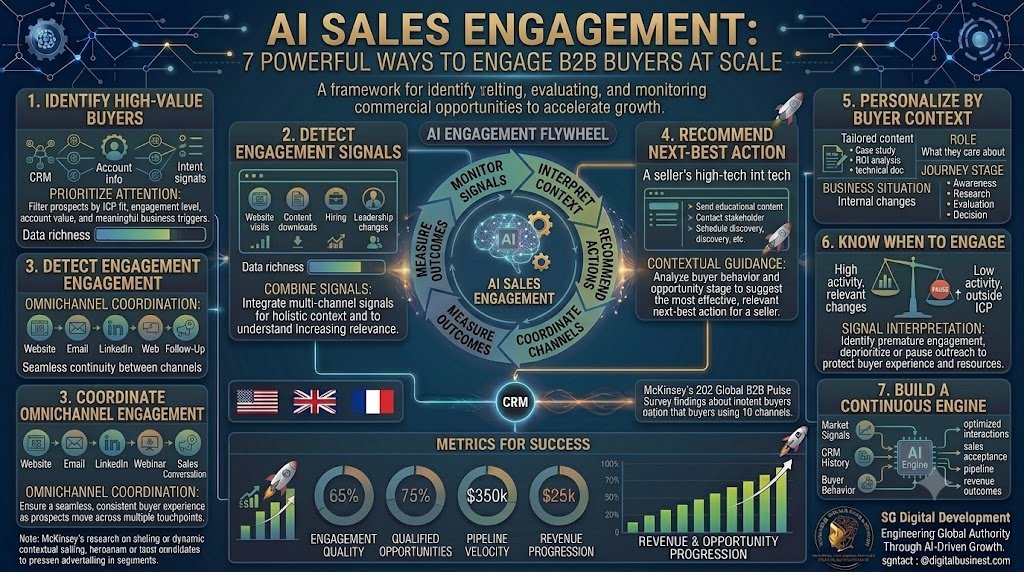
AI Sales Engagement: 7 Powerful Ways to Engage B2B Buyers at Scale. Introduction B2B sales engagement has changed. Buyers can research vendors without speaking to sales. They can compare products through search engines. They can ask AI systems for recommendations. They can read reviews, analyst reports and customer experiences. They can visit websites anonymously. They can interact with multiple digital channels before ever responding to a salesperson. At the same time, sales teams are under pressure to generate more pipeline with fewer resources. This creates a difficult problem. Businesses need to engage buyers more effectively without simply increasing the number of messages they send. That is where AI sales engagement becomes important. AI sales engagement uses artificial intelligence to help sales teams understand buyer context, identify meaningful signals, coordinate interactions, recommend next-best actions and engage prospects across relevant channels. The objective is not: More outreach. The objective is: More relevant engagement. A modern B2B engagement system can connect: Buyer Signals → Context → Next Best Action → Engagement → Conversation → Opportunity → Revenue This is increasingly important because modern B2B buyers use multiple channels throughout the purchase journey. McKinsey’s 2026 Global B2B Pulse Survey found that buyers use an average of ten channels during the purchasing journey and expect a seamless experience across those channels. McKinsey also identifies AI-enabled workflows, hyperpersonalization and next-best opportunity identification among the capabilities reshaping B2B commercial operations. Gartner’s 2026 research similarly found that B2B buyers increasingly prefer digital and self-service experiences, while still relying on sales representatives for validation, confidence and decision support at important moments. The implication is significant. Sales engagement should no longer mean: “How many prospects can we contact?” It should mean: “Where can we create useful buyer engagement at the right moment?” This article explores seven powerful AI sales engagement strategies that can help B2B companies identify buyer signals, coordinate interactions, improve relevance, support sellers and build a scalable revenue engine. What Is AI Sales Engagement? AI sales engagement is the use of artificial intelligence to improve how sales teams identify, prioritize, coordinate and manage interactions with potential and existing buyers. Traditional sales engagement often involves: These processes remain useful. The problem is that they can become disconnected. A seller may know: But not necessarily: AI sales engagement adds an intelligence layer. It can connect: Account Intelligence Buyer Intelligence Opportunity Intelligence Intent Signals Sales History = More Contextual Engagement The result is a move from activity-based selling toward intelligence-driven engagement. AI Sales Engagement vs AI Sales Automation These concepts are related but different. AI Sales Automation Focuses primarily on automating repeatable processes. Examples include: AI Sales Engagement Focuses on the quality and coordination of buyer interactions. Examples include: A simple way to understand the difference is: Automation executes. Engagement coordinates. AI sales engagement can therefore use automation, but it is not limited to automation. AI Sales Engagement vs AI Sales Personalization The distinction is also important. AI sales personalization answers: What should we say to this buyer? AI sales engagement answers: How, when, where and through which interaction should we engage this buyer? For example: AI sales personalization might recommend messaging focused on pipeline visibility. AI sales engagement might determine that: Personalization creates relevance. Engagement creates the interaction strategy. Why AI Sales Engagement Matters in 2026 The modern B2B buyer journey is increasingly fragmented. Buyers may use: Gartner reported in May 2026 that surveyed B2B buyers used an average of seven information sources during a recent purchase, with 45% saying they used generative AI. The same research found that 69% preferred to validate AI-generated insights with sales representatives. This creates an interesting tension. Buyers want independence. But they still want human support when uncertainty matters. That means sales engagement needs to become more selective. A seller may not need to contact a buyer during every stage. The seller needs to appear when human interaction adds value. Gartner’s 2026 research describes this changing role as sellers moving from being primarily information providers toward providing validation, confidence and decision support. AI can help identify those moments. 7 Powerful AI Sales Engagement Strategies 1. Identify the Buyers Most Worth Engaging Not every prospect deserves equal sales attention. A large database might contain: But sales capacity is limited. AI can help prioritize buyers using multiple signals. These may include: Consider two accounts. Account A Account B Account B may warrant closer attention. The important point is that AI sales engagement should not simply identify more people to contact. It should identify which interactions are worth creating. Gartner’s research found that organizations providing sellers with AI-enabled next-best actions were 2.6 times more likely to report commercial growth in its survey of chief sales officers. Gartner also identifies account research, personalized messaging, signal monitoring and next-best actions as areas where AI can support sellers. 2. Detect Engagement Signals Before Reaching Out A buyer can generate many signals before becoming an active opportunity. Examples include: Individually, these signals may not mean much. Together, they may indicate increasing relevance. AI can combine them. For example: Signal 1 A company visits a service page. Signal 2 A second stakeholder reads an implementation guide. Signal 3 The company hires a relevant executive. Signal 4 A third stakeholder attends a webinar. The combined pattern may justify sales investigation. The system can then recommend: Investigate the account and determine whether a relevant sales engagement is appropriate. This is better than triggering an automatic message after every single interaction. Signal interpretation matters. 3. Coordinate Engagement Across Multiple Channels Modern buyers do not necessarily follow a single channel. An engagement journey might include: Website ↓ Email ↓ LinkedIn ↓ Webinar ↓ Sales Conversation ↓ Follow-Up The challenge is maintaining consistency. A buyer who receives one message through email and a completely unrelated message through another channel may experience the company as fragmented. AI can help coordinate engagement context. For example: Website interaction Buyer researches a specific problem. Email Sales shares relevant educational content. Webinar Buyer attends a related session. Sales conversation Representative addresses

AI sales personalization
AI Growth Engine

AI Sales Personalization: 7 Powerful Ways to Personalize B2B Sales at Scale.

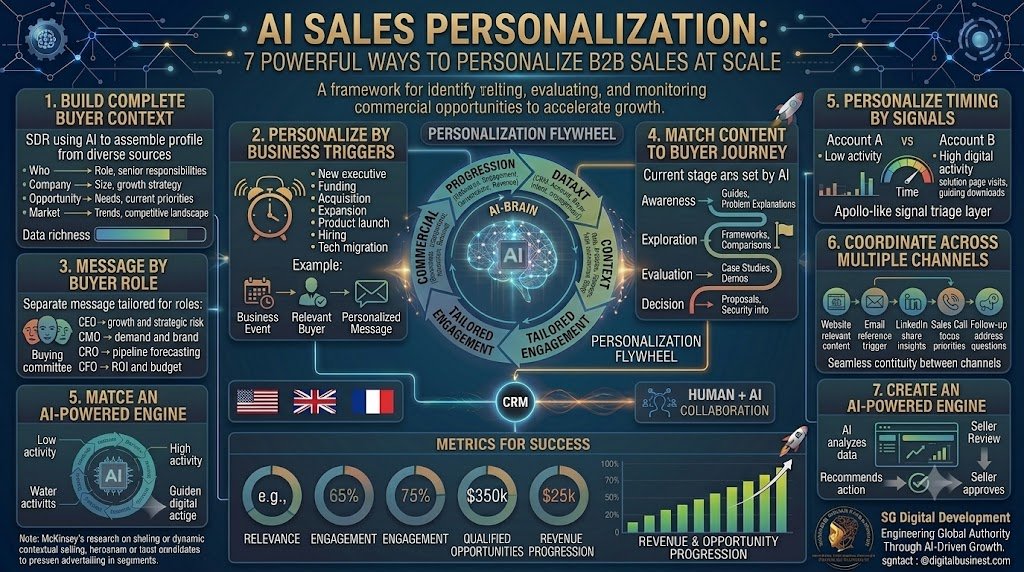
AI Sales Personalization: 7 Powerful Ways to Personalize B2B Sales at Scale. Introduction B2B buyers are surrounded by sales messages. Email. LinkedIn outreach. Cold calls. Retargeting. Sales sequences. Webinars. Product demonstrations. AI-generated content. The problem is not that buyers receive too little information. They often receive too much. A generic message such as: “Hi John, I noticed your company is growing. Would you be available for a quick call?” may be technically personalized. But it is not necessarily relevant. True personalization requires understanding why the buyer might care now. That means understanding: This is where AI sales personalization becomes valuable. AI sales personalization uses artificial intelligence to analyze customer, account, buyer, intent and engagement data and use those insights to tailor sales messaging, content, timing, channels and recommendations. The goal is not simply to produce more personalized emails. The goal is to make sales interactions more relevant to the buyer’s actual business context. The progression is: Data → Context → Personalization → Engagement → Conversation → Revenue Modern B2B buying makes this increasingly important. Gartner reported in 2026 that B2B buyers use an average of seven information sources during a purchase, with 45% reporting use of generative AI during their research. Gartner also found that buyers still turn to sales representatives to validate information and support decisions at important moments. That creates a new role for sales teams. The seller does not necessarily need to provide every piece of information. The seller needs to provide the right context, validation and guidance at the right moment. AI can help make that possible at scale. This article explores seven powerful AI sales personalization strategies that B2B companies can use to create more relevant outreach, improve buyer engagement, strengthen sales conversations and build scalable personalized selling systems. What Is AI Sales Personalization? AI sales personalization is the use of artificial intelligence to tailor sales interactions according to the individual buyer, account, business situation, buying signals and stage of the sales journey. Traditional personalization might use: AI sales personalization can go much further. It can incorporate: For example, instead of sending: “We help B2B companies improve sales performance.” an AI-assisted system might determine that: The sales message can then address the relevant business context. That is a much more meaningful form of personalization. AI Sales Personalization vs Traditional Personalization The difference can be summarized simply. Traditional personalization “Hi Sarah, I saw that you work at ABC Company.” Contextual personalization “Your sales organization has expanded significantly over the past year, and your recent revenue operations hiring suggests that forecasting and pipeline visibility may now be larger priorities.” The second approach requires substantially more intelligence. It connects: Who → What → Why → When This is the foundation of effective AI sales personalization. Why AI Sales Personalization Matters in 2026 B2B buyers increasingly research independently. They can use: That means sellers increasingly enter conversations after buyers have already developed some understanding of the problem. Gartner’s 2026 research found that 67% of surveyed B2B buyers preferred a sales-rep-free experience and 70% preferred completely digital self-service buying experiences. At the same time, sales representatives remained important when buyers needed validation, decision support and confidence. This creates a more selective role for sales. Instead of maximizing the number of interactions, businesses need to improve the relevance of each interaction. AI can help sales teams determine: That is where personalization becomes a commercial capability rather than a copywriting tactic. 7 Powerful AI Sales Personalization Strategies 1. Build a Complete Buyer Context Profile The first step is understanding the buyer. A basic CRM record might contain: That is contact data. A useful personalization system needs context. AI can combine information about: The buyer The account The opportunity The market The result is a richer buyer context profile. For example: Buyer: VP of Sales Company: B2B SaaS Current situation: Rapid sales-team expansion Trigger: New CRO appointed Potential priority: Forecasting and pipeline visibility Engagement: Recently viewed sales forecasting content Sales implication: Discuss forecasting and pipeline management rather than generic sales automation. The difference is substantial. AI is not merely personalizing the words. It is personalizing the reason for the conversation. 2. Personalize Outreach Around Business Triggers One of the strongest personalization signals is a recent business event. Examples include: A trigger gives the seller a reason to contact the account. Example Suppose a company announces expansion into the United Kingdom. A generic outreach message might discuss the seller’s services. A trigger-based message could address: The trigger provides context. The seller then connects the trigger to a legitimate business problem. The workflow becomes: Business Event ↓ Potential Business Need ↓ Relevant Buyer ↓ Personalized Message ↓ Human Conversation This is more meaningful than inserting a company name into a template. 3. Personalize Messaging by Buyer Role Different stakeholders care about different outcomes. A CEO may care about: A CMO may care about: A CRO may care about: A RevOps leader may care about: A sales representative may care about: The underlying solution may be identical. The message should not be. AI can use role and context to adapt: This creates persona-aware personalization. But role alone is not enough. The strongest personalization combines: Role + Business Situation + Trigger + Need 4. Personalize Content Around the Buyer’s Journey A buyer who has just discovered a problem should not receive the same message as a buyer comparing vendors. The buying journey may include: Awareness The buyer is trying to understand the problem. Useful content: Exploration The buyer is researching potential approaches. Useful content: Evaluation The buyer is comparing vendors or solutions. Useful content: Decision The buyer is validating the purchase. Useful content: AI can infer the likely stage from: The sales message can then match the buying context. This reduces a common sales problem: sending the right information at the wrong time. 5. Personalize Outreach Timing Using Signals Personalization is not only about what you say. It is also about when you say it. Consider two prospects. Prospect A Prospect B The second account may

Scroll to Top