
How to Improve Your Website Conversion Rate and Generate More Qualified Leads
A business website should do more than display information. It should help potential customers understand your services, evaluate your business and take a useful next step. Yet many companies invest in search engine optimisation, social media and paid advertising without checking whether their websites turn visitors into enquiries. Track the website conversion rate consistently.
A visitor may arrive, read a headline and leave because the offer is unclear. Another may be interested but abandon a long contact form. Someone else may trust the service but struggle to find pricing information, proof of experience or a working phone number. These are conversion problems, not necessarily traffic problems.
Your website conversion rate helps you understand how effectively your website turns visitors into people who complete an important action. That action might be a purchase, a consultation request, a quotation enquiry, a phone call or a product demonstration booking. The right measurement depends on your business model.
For companies serving customers in India and international markets, improving the visitor experience can make existing marketing investments more productive. Rather than relying only on more traffic, businesses can remove obstacles that stop interested people from making contact. Measure the website conversion rate carefully.
This guide explains how to measure performance, improve important pages, build trust, simplify enquiries and create a practical optimisation plan.
1. Understand What a Conversion Means
A conversion is an action that has value to your business. An online store may count a completed order. A consulting firm may count a qualified discovery-call request. A software company may measure demo bookings or trial registrations. A local service provider may count calls or appointment requests.
The basic calculation is:
Conversion rate = (number of conversions ÷ number of visitors) × 100
For example, if a website receives 4,000 visitors in a month and 80 submit an enquiry form, the calculation is (80 ÷ 4,000) × 100, which equals 2%. Review the website conversion rate every month.
Define the action and measurement unit before comparing results. Some platforms report conversions per user, while others report them per session. A form submission, a purchase and a newsletter signup should not be treated as identical business outcomes.
A useful website conversion rate also needs context. A page may generate many enquiries, but if most are irrelevant, outside your service area or unable to afford the service, the business result may still be poor. Track lead quality and sales progression alongside the headline percentage. Your website conversion rate reflects visitor decisions.
2. Find Out Why Visitors Leave
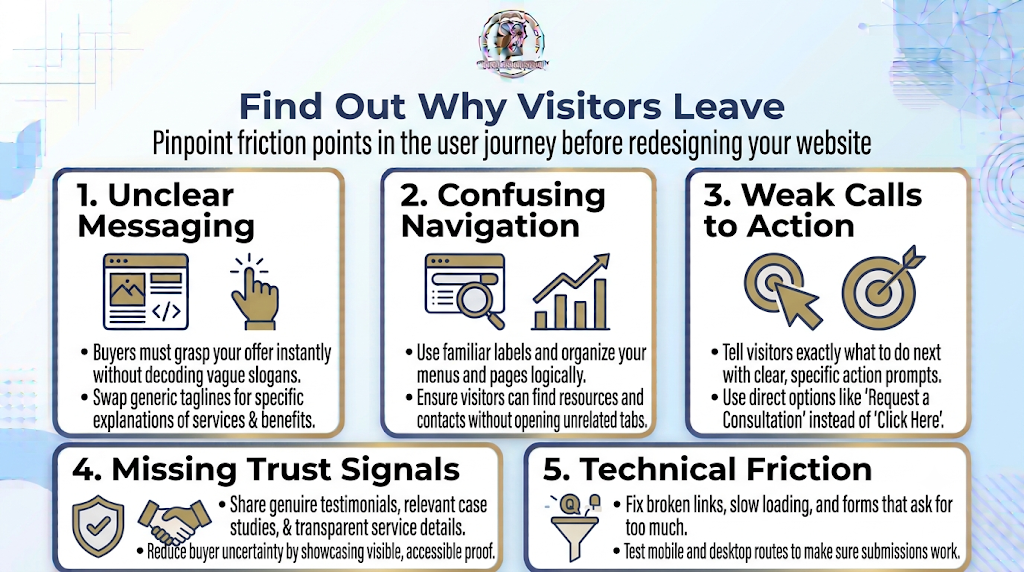
Before redesigning a website, identify where the visitor journey becomes difficult. Common barriers include unclear messaging, confusing navigation, weak calls to action, missing trust information, slow pages and forms that ask for too much.
Unclear messaging
A visitor should understand what your company offers and whom it serves without decoding vague slogans. Replace broad statements such as “Solutions for a better tomorrow” with a specific explanation of the service and its benefit.
Confusing navigation
Use familiar menu labels and organise pages logically. Visitors should be able to find services, company information, useful resources and contact details without opening several unrelated menus. A reliable website conversion rate needs context.
Weak calls to action
A page should tell visitors what to do next. “Request a consultation”, “Discuss your project” and “Ask for a quotation” are clearer than a button that simply says “Click here”.
Missing trust signals
People may hesitate when a website provides no evidence of experience or a clear explanation of how the company works. Genuine testimonials, relevant case studies, transparent service details and accessible contact information can reduce uncertainty.
Technical friction
Broken links, slow loading, layout problems and malfunctioning forms interrupt the journey. Test important pages on desktop and mobile devices, and complete your own enquiry form to confirm that submissions reach the right team. Compare the website conversion rate across channels.
3. Make the Homepage Immediately Understandable
Your homepage often introduces the business to a first-time visitor. The first screen should explain what you do, who you help and where the visitor can go next.
Write a specific headline
A useful headline describes the business rather than making an unsupported promise. For example: “Digital Marketing and Business Development Services for Growing Companies.” The supporting paragraph can explain the main services and the types of customers you work with.
Keep the message focused
Do not attempt to explain every service, industry and benefit in one paragraph. Present the main offer first, then provide links to dedicated pages for visitors who want more detail. Check the website conversion rate for key pages.
Make the next step visible
Place a relevant action near the headline. Use a primary button such as “Contact Our Team” or “Request a Consultation”. If you offer several ways to get in touch, make the options clear without giving every button equal visual importance.
Show the route to key information
The homepage should guide visitors towards service descriptions, company information, useful articles and contact details. A clear structure supports a stronger website conversion rate because people can find relevant information with less effort. Your website conversion rate depends on clear messaging.
4. Build Service Pages Around Customer Questions
A service page should answer the questions a potential customer is likely to ask before making contact. A list of features is rarely enough. Explain the problem, the service, the process and what the customer can expect.
A useful structure includes:
- A clear service heading and concise introduction.
- The customer problem the service addresses.
- A description of what is included.
- The working process and likely stages.
- Relevant examples, qualifications or case studies.
- Answers to common questions.
- A clear next step for interested visitors.
For example, a website development page can explain the types of websites you build, the planning process, available functionality, content requirements and post-launch support. A digital marketing page can explain the channels covered, how campaigns are planned and how performance is reviewed.
Avoid copying the same generic paragraph across every service page. Each page should offer information specific to the service. This helps visitors decide whether the service fits their requirements and can improve the website conversion rate without relying on exaggerated claims. Improve the website conversion rate by removing friction.
5. Simplify Contact Forms
Contact forms are often the point where interest becomes a measurable enquiry. They should collect enough information for a useful response without making the visitor complete an unnecessary questionnaire.
For an initial enquiry, a service business may need a name, business email, a phone number where appropriate, the service required and a short description of the project. Additional details can be requested later when the team understands the requirement.
Use clear field labels instead of relying only on placeholder text. Explain which fields are required and show helpful error messages. Make the submit button descriptive, such as “Send My Enquiry” or “Request a Discussion”. A useful website conversion rate starts with defined goals.
Track your website conversion rate regularly. Explain that the enquiry has been received and what happens next. Only promise a response time that your team can consistently meet.
Review the form on a mobile phone. Fields should be easy to select, text should be readable and the submit button should be easy to tap. If a form fails silently or sends enquiries to an unattended inbox, even a well-designed page will not deliver useful results.
6. Build Trust With Evidence
Trust is especially important when customers are considering a significant investment or a long-term service relationship. Your website should help visitors assess the company using accurate, relevant information. Monitor the website conversion rate after page updates.
Use genuine testimonials
Publish real customer feedback only when you have permission. Do not invent names, company logos, quotations or ratings. A short, specific comment is more useful than a collection of vague claims.
Explain your experience
An About page can describe the business, its approach, relevant experience and the people involved. Keep the information factual and current. The website conversion rate can reveal usability problems.
Publish useful case studies
A case study can explain the customer’s original challenge, the work completed, the approach taken and the outcome. Use measurable results only when they can be supported, and provide context so readers understand what the figures represent.
Be transparent about services
Explain what is included, what depends on project scope and what information is needed to prepare an estimate. If pricing varies, describe the factors that influence the cost rather than hiding all practical details.
Trust-building information can support a better website conversion rate because it helps visitors evaluate the business before sharing their details. Review the website conversion rate alongside lead quality.
7. Improve Speed and Technical Reliability.
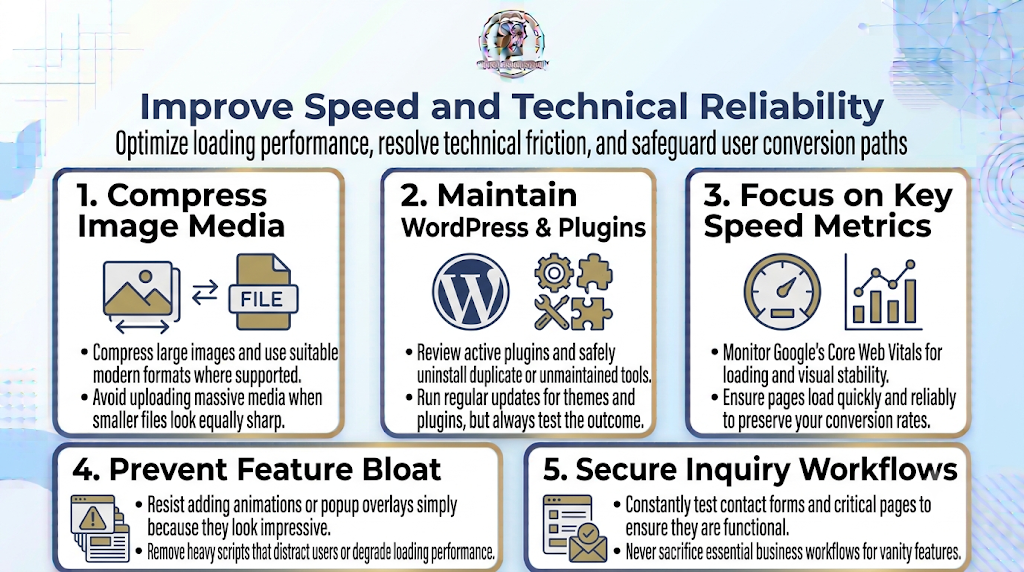
A slow or unstable website creates friction. Review page loading, server response, image sizes, unnecessary scripts, broken links and form functionality.
Compress large images and use suitable modern formats where supported. Avoid uploading huge images when a smaller version will look equally clear. Review plugins on WordPress websites and remove tools that are unnecessary, duplicated or no longer maintained.
Keep WordPress, themes and plugins updated, but test important functionality after updates. A change that improves one technical measure but breaks the enquiry form is not an improvement for the business. Your website conversion rate should reflect meaningful actions.
Google’s Core Web Vitals provide useful measurements related to loading performance, interactivity and visual stability. Use them as part of a wider review that also considers actual visitor feedback and business outcomes.
Do not add features simply because they look impressive. Animation, pop-ups and third-party scripts should have a clear purpose. If they distract visitors or slow the page, they may do more harm than good.
8. Design for Mobile Visitors
Many customers discover businesses through phones. Your pages should adapt to smaller screens without making information difficult to read or actions difficult to complete. Measure the website conversion rate for each campaign.
Check that headings wrap naturally, body text is readable, buttons have enough space around them and menus are easy to operate. Forms should not require awkward horizontal scrolling. Phone numbers and email addresses should be usable links where appropriate.
Put important information in a sensible order. A mobile visitor should not have to scroll through several decorative sections before finding the service description or contact option.
Test the complete customer journey on more than one device if possible. Open the page, navigate to a service, complete the form and confirm that the submission works. A mobile-friendly layout is not enough if the final action fails. A changing website conversion rate deserves investigation.
9. Match Landing Pages to Campaigns
A visitor who clicks an advertisement for SEO services should land on a page that explains SEO services, not a generic homepage covering every business activity.
A campaign landing page should match the advertisement’s promise and provide the information needed to make a decision. Include a relevant headline, a clear description of the offer, useful details, genuine trust information and a simple enquiry route. Use evidence to improve the website conversion rate.
Avoid adding unrelated offers that distract from the campaign. Make sure the destination page works on mobile and that tracking records the intended action accurately.
10. Use Content to Answer Buying Questions
Useful content can attract people who are researching a problem, comparing providers or preparing to make a decision. Articles should answer real questions rather than exist only to repeat search phrases.
Consider publishing practical guides, service comparisons, explanations of common mistakes, project-planning advice and answers to frequently asked questions. Use examples that reflect the needs of your audience. The website conversion rate may differ by audience.
Connect articles to relevant service pages with descriptive internal links. A reader who finds a guide about digital marketing may appreciate a link to the related service page. Do not add links to unrelated pages merely to increase the number of internal links.
Content should help readers make better decisions. It can build familiarity with your expertise and provide a natural route towards a conversation when the reader is ready.
11. Measure the Visitor Journey
Reliable measurement helps you identify which pages and channels contribute to business outcomes.
Google Analytics 4 can report website activity and configured events such as purchases or form submissions. Google Search Console provides information about Google Search performance, including impressions, clicks, queries and pages. These tools answer different questions and should not be confused. Check whether the website conversion rate reflects qualified leads.
Review traffic sources to understand whether visitors arrive through organic search, paid advertising, social media, referrals or direct visits. Compare the performance of important landing pages and identify pages that attract attention but generate few enquiries.
Check that conversion events are configured correctly. Avoid counting a button click as a completed enquiry if the form has not actually been submitted. Test tracking after changes to forms, tags or website templates.
Review lead quality with the people who handle enquiries. Ask whether submissions match your target market, whether the requirement is genuine and whether the person progresses to a useful sales conversation. Track the website conversion rate before and after changes.
A website conversion rate is most useful when the event definition is consistent and the figures are interpreted alongside business results.
12. Test Changes Instead of Guessing
A/B testing compares two versions of an element or page to understand which performs better. You might compare different headlines, button wording, form lengths or landing page layouts. Mobile usability can influence the website conversion rate.
Before testing, decide what you are trying to improve and which measurement will determine the result. Change one important element at a time where practical. If the headline, offer, form and page structure all change together, it becomes difficult to identify the reason for a difference.
Allow enough time and traffic for a meaningful comparison. A small sample can produce misleading results, particularly when visitor numbers vary from day to day. Consider whether advertising, seasonality or other changes affected the test.
Do not assume that the version with more button clicks is automatically better. The important outcome may be completed enquiries or qualified leads. Testing should help you make informed decisions, not encourage constant changes based on personal preference. Relevant landing pages can support the website conversion rate.
13. Avoid Common Optimisation Mistakes.
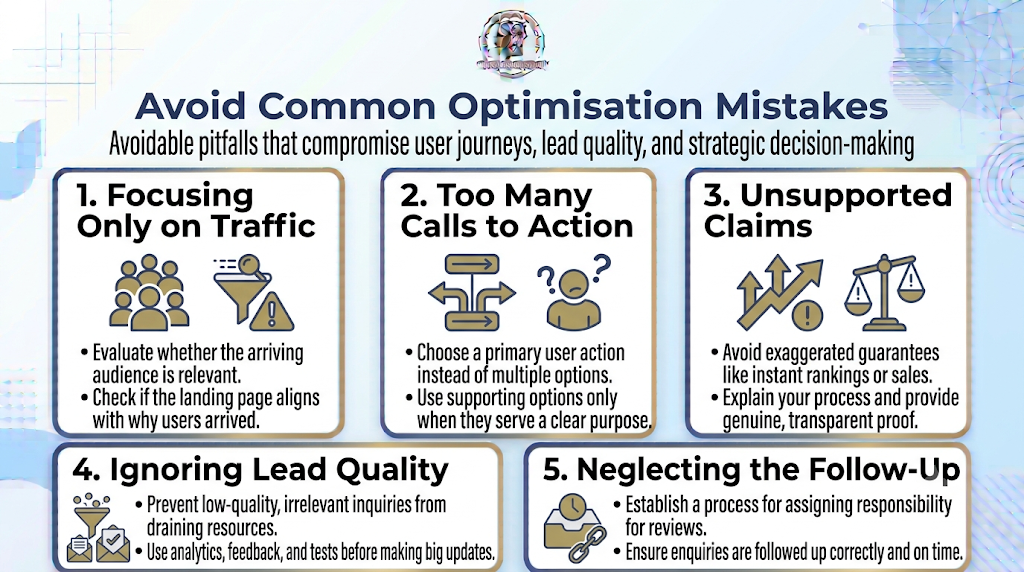
One common mistake is focusing only on traffic. More visitors do not automatically mean more customers. Review whether the audience is relevant and whether the landing page matches the reason people arrived.
Another mistake is adding too many calls to action. If every section asks visitors to do something different, the page can become confusing. Choose a primary action and use supporting options only when they serve a clear purpose.
Avoid unsupported claims such as guaranteed sales or instant search rankings. Explain your process and provide evidence instead of relying on unrealistic promises. Trust signals can strengthen the website conversion rate.
Do not ignore lead quality. A high number of irrelevant enquiries can create extra work without generating revenue. Equally, do not make changes without measurement. Use analytics, customer feedback and structured tests to understand whether an update has helped.
Finally, remember that a submitted form is only the beginning. Establish a process for reviewing enquiries, assigning responsibility and following up. A website cannot compensate for an inbox that nobody checks.
14. Follow a Practical 30-Day Improvement Plan
Week 1: Review the website. Examine the homepage, important service pages and contact process. Test mobile usability, page speed, links and forms. Record baseline traffic and enquiry figures so you have something meaningful to compare.
Week 2: Improve key pages. Rewrite unclear headlines, strengthen service descriptions and make the next step more visible. Remove unnecessary form fields and add genuine trust information where it is missing.
Week 3: Check measurement. Confirm that important events are tracked correctly. Review traffic sources, landing pages and campaign destinations. Identify pages that receive visitors but do not produce useful enquiries.
Week 4: Evaluate and prioritise. Compare results with the baseline. Review both enquiry quantity and lead quality. Decide which remaining obstacle deserves attention first, then plan the next improvement.
The aim is not to change everything in one month. It is to create a repeatable process for identifying problems, making focused improvements and learning from the results. Clear forms can improve the website conversion rate.
15. How SG Digital Business Development Can Help.
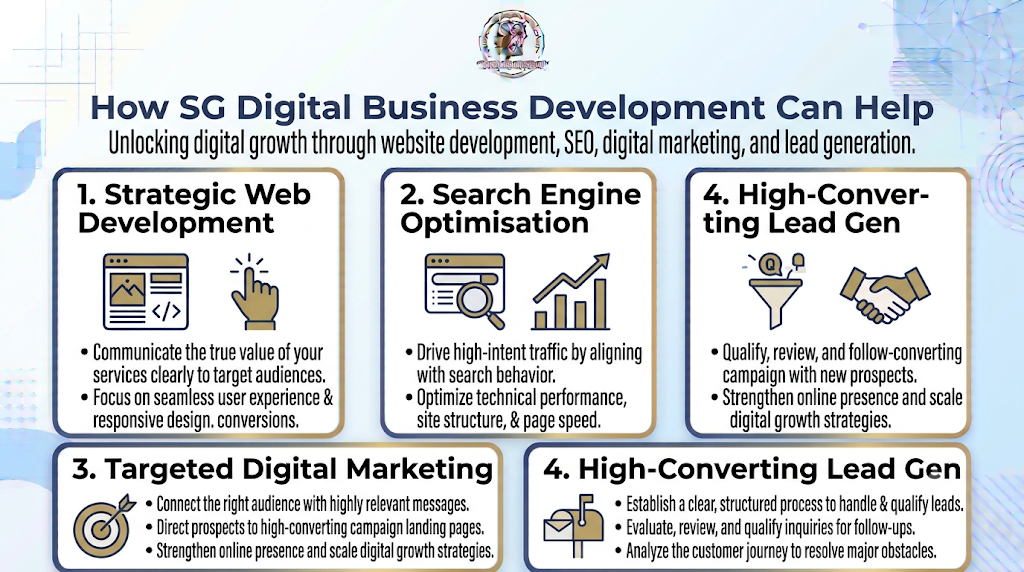
A business website should support wider commercial goals. It should communicate the value of your services, help potential customers find relevant information and create a clear route towards an enquiry.
SG Digital Business Development supports businesses looking to strengthen their online presence and develop digital growth strategies. Depending on your requirements, relevant areas may include website development, search engine optimisation, digital marketing, lead generation and business development. Useful content can support the website conversion rate.
Website development should consider the intended audience, site structure, responsive design, useful content and accessible contact options. SEO should consider search intent, technical performance, content quality and the pages that matter to your business. Digital marketing should connect the right audience with a relevant message and destination page.
Lead generation also requires a clear process after a visitor makes contact. Enquiries should be reviewed, qualified and followed up appropriately. The best approach depends on your services, target market, resources and commercial objectives.
If your website attracts visitors but does not generate the enquiries your business needs, start by reviewing the customer journey and identifying the biggest obstacle. Page speed can affect the website conversion rate.
Frequently Asked Questions
What is a good website conversion rate?
There is no single benchmark for every business. Results vary by industry, audience, traffic source, offer and the action being measured. Compare your performance with your own historical results and relevant industry data where reliable information is available.
How can I improve my website conversion rate?
Clarify your main message, improve navigation, strengthen service pages, simplify forms, build trust and make mobile use easier. Measure the effect of changes and pay attention to lead quality as well as enquiry volume.
Does website design affect conversions?
Yes. Design affects readability, navigation, visual hierarchy and how easily visitors complete actions. However, attractive design cannot compensate for an unclear offer or irrelevant traffic. Accurate analytics make the website conversion rate more useful.
Are landing pages useful for lead generation?
They can be. A focused landing page gives visitors information that matches a particular advertisement, service or audience. It should explain the offer and provide a relevant next step.
Should a contact form be short?
It should be as simple as practical while collecting the information needed to respond. Avoid asking for extensive details before you understand the visitor’s requirement.
How often should website performance be reviewed?
Many businesses can begin with a monthly review. Active campaigns may need more frequent monitoring. The schedule should reflect traffic levels, advertising activity and the speed at which decisions need to be made. Lead follow-up also affects the value of website conversion rate data.
Can SEO generate more enquiries?
SEO can attract people searching for relevant information and services. Whether those visitors become leads depends on the relevance and usefulness of the pages they reach.
Does website speed matter?
Yes. Slow pages and technical problems can interrupt the visitor journey. Improving loading performance, stability and mobile usability supports a smoother experience. Do not judge the website conversion rate in isolation.
How should lead quality be measured?
Review whether enquiries match your target audience, describe a genuine requirement and progress towards a sales conversation or opportunity. Record outcomes consistently so marketing activity can be evaluated meaningfully.
Is a complete website redesign necessary?
Not always. Start with the pages and processes that have the greatest effect on your goals. A clearer headline, better service page or simpler enquiry form may be a more practical first step than rebuilding the entire website.
Conclusion: Turn More Visitors Into Business Opportunities
A successful website should do more than attract attention. It should help visitors understand your services, evaluate your business and take a relevant next step. Use consistent definitions when reporting website conversion rate results.
Improving your website conversion rate requires clear messaging, useful service pages, genuine trust indicators, simple enquiry processes, technical reliability and accurate measurement. No single button colour or design trick can replace a complete and helpful customer journey.
Start with your most important pages. Identify where visitors experience difficulty, make focused improvements and review the results. Pay attention to the quality of enquiries as well as their quantity, and make sure your team follows up when people contact your business.
Conversion optimisation is an ongoing process. Customer expectations, marketing channels and business priorities change, so review your website regularly and keep improving the experience. Review changes to the website conversion rate before making assumptions.
Let’s build your digital future together. Contact SG Digital Business Development today and let’s engineer your global authority!