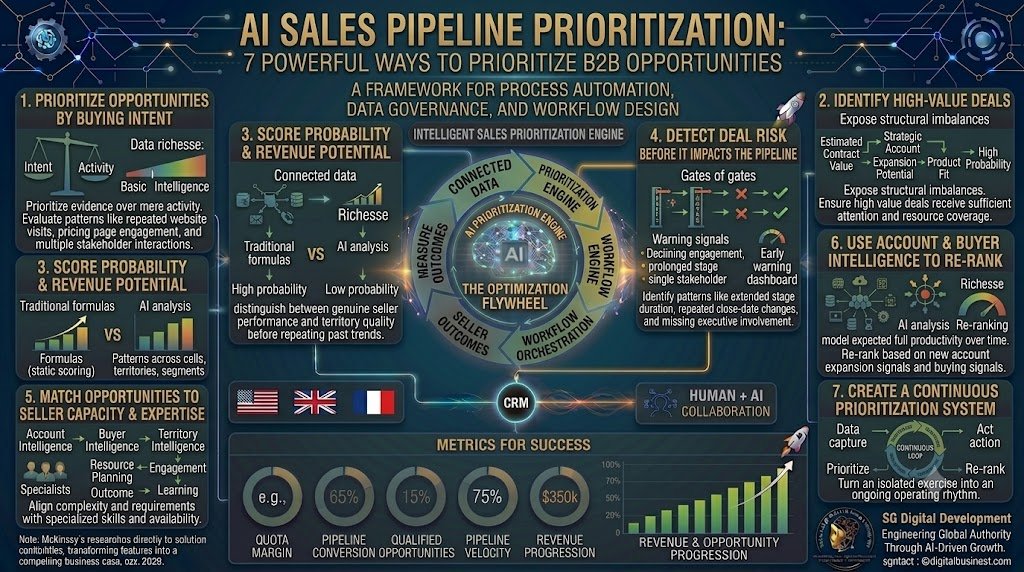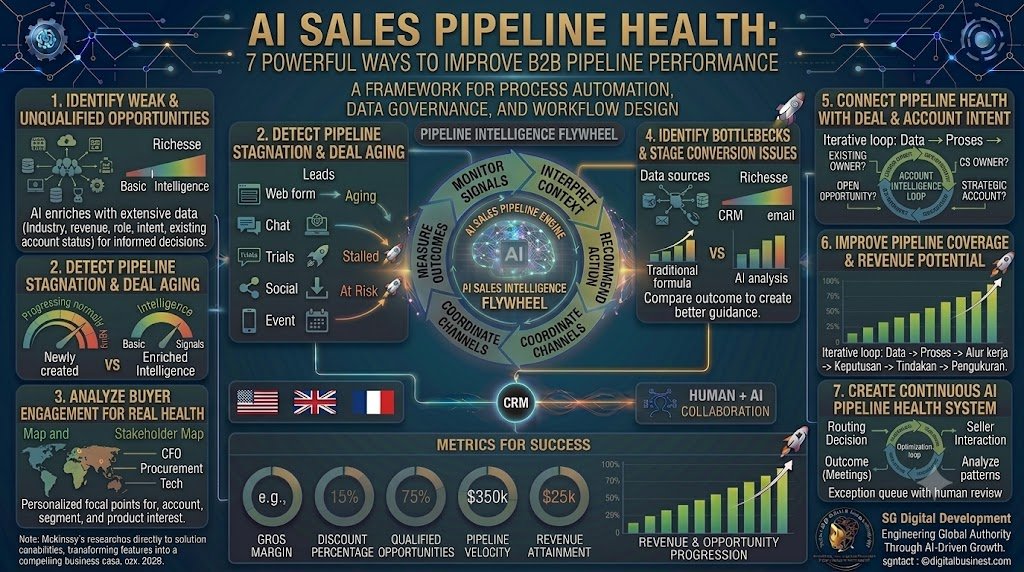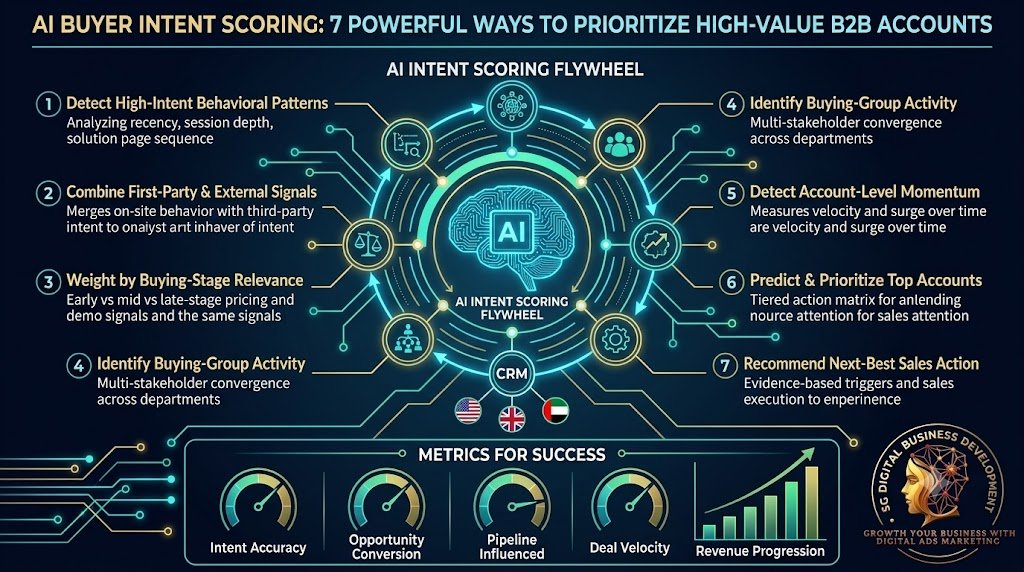
AI Buyer Intent Scoring: 7 Powerful Ways to Prioritize High-Value B2B Accounts.
AI Buyer Intent Scoring: 7 Powerful Ways to Prioritize High-Value B2B Accounts. Introduction B2B buyers rarely announce exactly when they are ready to purchase. A company may spend weeks researching a problem before speaking with sales. Several employees may visit a website without submitting a form. A decision-maker may compare vendors, read implementation content, investigate pricing, or use an AI search engine to understand potential solutions. From the outside, many of these activities can look like ordinary website engagement. But for a revenue team, the difference between ordinary research and meaningful buying intent can be extremely valuable. The challenge is determining which accounts deserve attention now. This is where AI buyer intent scoring becomes useful. Instead of treating every website visit, content download, or form submission equally, AI can analyze multiple signals together and estimate the strength of an account’s current buying activity. The objective is not simply to assign a number to every prospect. The objective is to help sales, marketing, and RevOps answer a much more important question: Which accounts are showing enough evidence of buying intent to justify action right now? A useful intent-scoring system can combine first-party behavior, account-level activity, business events, CRM information, content engagement, buying-group signals, and other relevant data. It can then help revenue teams prioritize accounts, understand why their intent is changing, and determine what action should happen next. In this guide, we will examine seven powerful ways AI can improve buyer intent scoring, explain how intent scoring differs from buyer intent detection and lead scoring, explore the data required, and show how businesses can connect intent intelligence to sales execution and revenue growth. What Is AI Buyer Intent Scoring? AI buyer intent scoring is the process of using artificial intelligence to evaluate multiple buyer signals and estimate the relative strength of an account’s current purchasing intent. Traditional lead scoring often assigns points to predefined actions. For example: This approach can be useful, but it can also oversimplify the buyer journey. A website visitor who reads one article is not necessarily equivalent to an account where four employees are researching pricing, implementation, integrations, and competitor comparisons. AI can evaluate the context behind these signals. For example, an account may show: The individual signals matter. The combination can matter much more. This is the central idea behind AI buyer intent scoring: Intent should be evaluated as a pattern rather than as a collection of isolated events. A strong system should therefore help answer three questions: That makes intent scoring an operational revenue capability rather than just another marketing metric. Why Traditional Lead Scoring Misses Modern B2B Buying Signals Traditional lead scoring was designed around relatively simple rules. A prospect completes a form. The CRM stores the record. Marketing assigns points. A threshold determines whether the lead becomes sales-ready. The problem is that modern B2B buying behavior is much less linear. A buyer may: The buyer’s intent may therefore become visible before the buyer raises their hand. A static score can miss important changes. Imagine an account with an intent score of 35 on Monday. By Friday: The account may now represent a very different commercial situation. The problem is not that the original score was necessarily wrong. The problem is that the score may not have adapted quickly enough to changing evidence. AI can help identify these changes and update the qualification picture more dynamically. The Difference Between Buyer Intent Detection and AI Buyer Intent Scoring These concepts are closely connected, but they serve different purposes. Buyer intent detection Intent detection asks: Which accounts are showing signals that may indicate buying activity? The system looks for patterns such as: The output is primarily a signal. AI buyer intent scoring Intent scoring asks: How strong is the buying signal compared with other accounts? The system can use multiple signals to establish relative priority. For example: Account A Strong ICP fit + moderate engagement + limited commercial activity Account B Strong ICP fit + multiple stakeholders + pricing activity + recent business trigger Account B may receive a stronger intent score because the combined evidence indicates greater buying momentum. Lead scoring Lead scoring asks a somewhat different question: How well does this lead meet predefined sales or marketing criteria? Lead scoring can include: Intent scoring focuses more specifically on evidence of active or emerging purchase interest. The three systems can work together. A practical revenue model might therefore evaluate: Fit + Intent + Timing + Engagement + Account Context This creates a more complete picture than any single score. 7 Powerful Ways AI Buyer Intent Scoring Prioritizes B2B Accounts 1. Detect High-Intent Behavioral Patterns The first major advantage of AI buyer intent scoring is its ability to identify patterns across digital behavior. A single page view may provide limited information. A sequence of related actions can provide much more context. For example: A visitor reads a general educational article. Later, the same account views a service page. A few days later, another employee reads a case study. Then someone from the account visits the pricing page. Finally, the account returns to review implementation information. No single event proves purchase intent. But the sequence can indicate that the account is moving from education toward evaluation. AI can analyze: This allows the system to distinguish between casual engagement and more meaningful research behavior. Why recency matters Intent is not static. An account that visited your website six months ago may be less relevant than an account showing concentrated activity this week. A useful scoring system should therefore consider both historical behavior and recent momentum. For example: Old activity One website visit 120 days ago. Recent activity Seven commercial-page visits in the last ten days. The second pattern may deserve greater attention. AI can identify these differences without requiring sales representatives to manually inspect every account. 2. Combine First-Party and External Intent Signals No single data source provides a complete picture of buyer intent. First-party data shows what prospects are doing on your own digital properties. This