
Introduction: Make Pricing a Strategic Business Decision
Pricing influences far more than the number printed on a proposal. It shapes how buyers understand value, which customers choose your company, how much work your team can deliver sustainably, and whether growth produces a healthy margin. A business may have a strong service, experienced people, and a steady flow of enquiries yet struggle financially because its prices do not reflect the effort, risk, expertise, and outcomes involved. A B2B pricing strategy should begin with customer evidence.
A B2B pricing strategy gives a company a deliberate way to set, explain, test, and improve its prices. It connects customer value, market position, delivery costs, commercial objectives, and buyer expectations. It also helps sales teams discuss price with confidence instead of improvising discounts whenever a prospect raises an objection. A B2B pricing strategy clarifies the value being exchanged.
This guide explains how to assess costs, understand customer value, choose a pricing model, package services, communicate price, manage discounts, and review performance. It is designed for B2B service firms and companies selling complex solutions, but the principles can also support software providers, consultants, agencies, and specialist suppliers.
What Is a B2B Pricing Strategy?
A B2B pricing strategy is a structured approach to deciding how a company charges business customers for its products or services. It defines the pricing model, package structure, value proposition, commercial terms, discount rules, and review process. It should support both customer decision-making and the company’s financial goals. This B2B pricing strategy must reflect delivery realities consistently.
Pricing is not simply a calculation of costs plus a margin. Costs establish an important boundary, but buyers also consider the problem being solved, the alternatives available, the risk of changing providers, the expected result, and the confidence they have in the supplier. A sustainable approach balances these factors instead of relying on one number or competitor comparison. A B2B pricing strategy protects margin without hiding trade-offs.
A useful strategy answers several questions: Who is the offer designed for? What outcome does the customer value? What is included? How is the service delivered? Which pricing structure fits the buying process? What margin does the company need? What evidence supports the price? How will exceptions be approved? Your B2B pricing strategy should reflect distinct buyer segments.
Why B2B Pricing Deserves Strategic Attention
It determines the quality of growth
Revenue growth does not always create healthy growth. A company can win more contracts while accepting low-margin work, excessive customization, or delivery commitments that exceed its capacity. The sales team may celebrate bookings while operations absorbs unplanned effort. Reviewing price alongside scope and delivery cost helps management understand whether new business is commercially sustainable. A B2B pricing strategy starts with actual cost data.
It communicates positioning
Price influences how buyers interpret a service. A low price may signal accessibility, but it can also raise questions about depth, support, or quality in a complex engagement. A premium price can communicate specialist expertise only when the offer, proof, and customer experience support that position. Price alone cannot create differentiation. A B2B pricing strategy also accounts for indirect effort.
It reduces avoidable negotiation
When packages, scope, assumptions, and terms are unclear, prospects may compare offers that are not equivalent. Sales representatives then spend time explaining inconsistencies or making concessions. A clear B2B pricing strategy gives the team a consistent framework for discussing options and trade-offs. This B2B pricing strategy should separate setup from recurring costs.
It supports better resource allocation
Different customers require different levels of support, integration, customization, and account management. Pricing should reflect meaningful differences in delivery requirements. This does not mean charging arbitrary amounts to similar buyers; it means understanding the cost and value drivers behind each offer. A B2B pricing strategy needs evidence about buyer priorities.
Start With the Business Model and Customer Segment
Before choosing a pricing method, define what you sell and to whom. A company offering a standardized monthly service may need a different model from a consultancy delivering a complex transformation project. A software provider may price by user, usage, feature tier, or contract value. A specialist agency may combine an initial project fee with a recurring retainer. A B2B pricing strategy should test assumptions against behavior.
Segment customers by factors that affect value and delivery. These may include company size, industry, complexity, geography, service requirements, urgency, buying process, and expected support. Avoid creating too many segments. Each segment should represent a meaningful difference in needs or economics that justifies a different offer or commercial approach.
Interview current customers and review won and lost opportunities. Ask what triggered the purchase, what alternatives were considered, which outcomes mattered, and what created concern about the price. Sales notes can help, but validate patterns with customers where possible. The aim is to understand how buyers evaluate value, not simply to ask whether they want a lower fee. This B2B pricing strategy can combine several pricing models.
A clear segment definition makes a B2B pricing strategy easier to apply consistently. It also helps marketing and sales describe the offer to the right audience instead of attracting prospects whose requirements do not match the service. A B2B pricing strategy should make package differences meaningful.
Understand Costs Before Setting a Price
Cost analysis is the financial foundation of pricing. Identify direct delivery costs, such as employee time, contractors, software licenses, hosting, materials, payment fees, travel, and third-party services. Then consider indirect costs, including management, administration, sales, marketing, facilities, training, and ongoing support. This B2B pricing strategy helps buyers compare suitable options.
For service businesses, staff time is often underestimated. A project may include discovery, planning, meetings, revisions, reporting, account management, quality assurance, and handover in addition to the visible deliverable. If these activities are not included in estimates, the apparent margin may be misleading. A B2B pricing strategy should explain exclusions before signing.
Calculate the expected delivery effort for a typical engagement and identify the assumptions behind it. Use actual project records to compare estimated and recorded time. Separate one-time setup costs from recurring work. Include a reasonable allowance for rework and uncertainty without adding arbitrary padding.
Cost-plus pricing can provide a useful starting point: calculate the cost of delivery and add a margin that supports the business. However, cost alone does not establish what a customer is willing to pay. It is a floor and planning input, not a complete market strategy. A B2B pricing strategy uses competitor research as context.
Research Customer Value and Willingness to Pay
Customer value is the benefit a buyer expects from the offer compared with its price, risk, effort, and alternatives. In B2B markets, value may include increased revenue, lower operating cost, reduced risk, faster delivery, improved compliance, better customer experience, or access to specialist capability. Your B2B pricing strategy should avoid automatic price matching.
Translate broad claims into customer-relevant outcomes. “We provide SEO services” describes an activity. “We help a business improve qualified organic enquiries by strengthening search visibility and conversion paths” describes a potential business benefit. Do not guarantee outcomes that depend on market conditions, customer participation, or other factors outside your control. A B2B pricing strategy needs a clear value narrative.
Use interviews, proposal feedback, win-loss reviews, renewal discussions, and customer research to understand which benefits matter most. Ask what would happen if the problem remained unresolved, what alternatives are being considered, and what evidence would make the investment worthwhile. This B2B pricing strategy makes commercial terms easier to understand.
Willingness to pay is not a single universal number. It varies by segment, urgency, perceived risk, budget, and available alternatives. Avoid asking only “What would you pay?” because hypothetical answers can differ from real buying decisions. Compare actual purchase behavior, objections, and choices between clearly described options. A B2B pricing strategy should define discount approval limits.
A value-led B2B pricing strategy connects the fee to a credible explanation of the business problem and the work required to address it. It does not mean charging the maximum amount a prospect might accept. The price should remain fair, explainable, and aligned with the value delivered. A B2B pricing strategy should exchange concessions for value.
Choose a Pricing Model That Fits the Offer
Fixed project pricing
A fixed fee works when the scope, deliverables, assumptions, and acceptance criteria can be defined with reasonable confidence. It gives buyers cost certainty and helps suppliers plan resources. The risk is that unclear scope or uncontrolled changes can erode margin. Define exclusions, revision limits, dependencies, and change-request procedures before work begins. This B2B pricing strategy helps sales qualify suitable buyers.
Hourly or daily pricing
Time-based pricing can suit advisory work, flexible support, or tasks where the required effort is difficult to estimate in advance. It is easy to understand, but buyers may focus on hours rather than outcomes. Set expectations about reporting, approval, minimum billing increments, and the circumstances that could increase the time required. A B2B pricing strategy should clarify what buyers receive.
Monthly retainer
A retainer is suitable for ongoing services with a recurring workload, such as marketing support, maintenance, advisory, or managed services. Define the included capacity, deliverables, response expectations, reporting, and treatment of unused time. Avoid promising unlimited work unless the scope and economics genuinely support it. A B2B pricing strategy can reduce inconsistent sales promises.
Tiered packages
Tiered pricing offers different combinations of scope, access, service levels, or features. It can help buyers choose according to their needs and budget. Each tier should have meaningful differences rather than arbitrary labels. Make it clear who each option is designed for and what outcomes or responsibilities change between tiers. This B2B pricing strategy should use measurable performance indicators.
Usage-based pricing
Usage-based models charge according to consumption, such as transactions, API calls, seats, storage, or volume. They can align price with customer activity, but buyers need visibility into expected usage and a way to manage unexpected bills. Explain measurement rules, thresholds, overage charges, and notification options. A B2B pricing strategy needs regular margin reviews too.
Performance-linked pricing
Some engagements include fees connected to agreed outcomes. This can align incentives, but measurement, attribution, timing, and external dependencies must be defined carefully. Avoid tying all payment to results that the provider cannot control. A hybrid model may combine a base fee with a clearly defined performance component. A B2B pricing strategy should separate price from discount.
There is no universally best model. The right choice depends on how predictable the work is, how customers buy, how value is realized, and how risk should be shared. A B2B pricing strategy may use more than one model across different services, provided the rules remain understandable. This B2B pricing strategy should adapt when costs change.
Design Packages Around Customer Needs
Packages should make choices easier, not hide complexity. Begin with the customer problems and outcomes that define each service level. For example, a basic package might cover an assessment and recommendations, while a more comprehensive option includes implementation, ongoing optimization, and reporting. The differences should reflect real work and customer requirements. A B2B pricing strategy must keep customer outcomes central.
Use plain-language package names and explain what is included, what is excluded, who the option suits, and what the customer must provide. Avoid feature lists that do not explain why a difference matters. A buyer should be able to compare options without needing a salesperson to decode every line. A B2B pricing strategy should document every major assumption.
Limit the number of choices. Too many packages can create decision fatigue and increase internal complexity. Three well-differentiated options may be easier to evaluate than a long menu of nearly identical variations, but the right number depends on the offer. This B2B pricing strategy benefits from consistent sales training.
Do not make the entry-level package intentionally inadequate just to push customers toward a higher tier. Each option should deliver a coherent level of value. If a customer needs something outside the standard package, describe the additional work and price it transparently.
Position Your Price Against the Market.
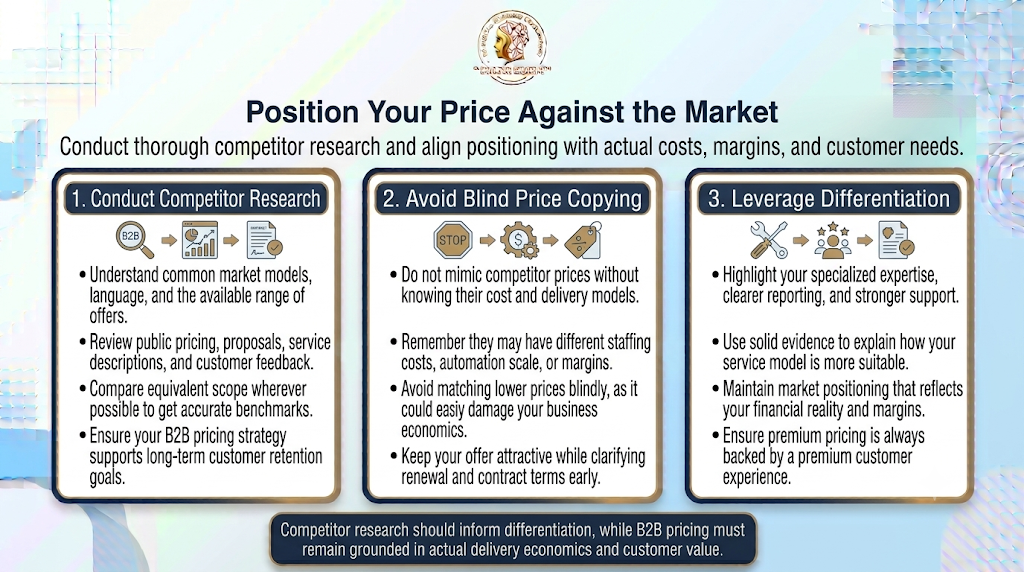
Competitor research can help you understand common models, market language, and the range of offers available. Review publicly available pricing, proposals you are permitted to analyze, service descriptions, contract terms, and customer feedback. Compare equivalent scope wherever possible. A B2B pricing strategy should support long-term retention goals.
Do not copy a competitor’s price without understanding its cost structure, target segment, delivery model, or positioning. A competitor may have different staffing costs, automation, scale, margins, or strategic objectives. Matching a lower price could damage your economics without making your offer more attractive. A B2B pricing strategy should clarify renewal terms early.
Use competitor information to identify differentiation. You may provide more specialist expertise, clearer reporting, stronger implementation support, or a more suitable service model. Explain the difference with evidence. Avoid attacking competitors or claiming superiority without substantiation.
Market positioning should guide how you explain the offer, but it should not override customer needs or financial reality. A premium position requires a premium experience. An accessible position still needs sufficient margin to deliver reliably.
Communicate Price With Confidence
Buyers should understand the price, scope, assumptions, and expected process before they agree. A proposal should state the investment clearly and explain what it covers. If the final price depends on discovery, provide a labelled estimate or range and identify what must be confirmed before it becomes a fixed commitment. This B2B pricing strategy can improve commercial consistency across teams.
Present the business rationale before the number. Explain the customer problem, recommended approach, deliverables, timeline, responsibilities, and relevant proof. Then show the commercial structure. This helps the buyer assess the whole offer rather than treating price as an isolated figure. A B2B pricing strategy should align price with scope.
Break down one-time and recurring charges. Identify taxes, third-party costs, optional services, payment milestones, renewal terms, and conditions that may change the fee. Avoid hidden charges or vague descriptions such as “additional support as required.” If the scope changes, explain how the change will be assessed and approved.
A transparent B2B pricing strategy makes it easier for the buyer to compare options and gain internal approval. It also reduces misunderstandings after the contract is signed.
Manage Discounts Without Damaging Value
Discounts may be appropriate in specific situations, but routine discounting can train customers to negotiate every price and weaken the company’s position. Before reducing a fee, understand the objection. Is the budget genuinely constrained? Is the scope unclear? Does the buyer see enough value? Is a competitor offering a different package? Is the timing wrong? This B2B pricing strategy should guide package reviews regularly.
Consider alternatives to a discount. You may reduce scope, phase the work, change the payment schedule, offer a shorter initial engagement, or remove an optional component. These options preserve the relationship between price and work more effectively than cutting the fee while keeping the same obligations. A B2B pricing strategy must remain fair and explainable.
Create approval rules for exceptions. Define who can authorize discounts, which thresholds require senior review, what information must be recorded, and whether concessions require something in return, such as a longer commitment or reduced scope. Sales representatives should not have to invent rules in the middle of a negotiation.
Track discount frequency, average discount, realized margin, win rate, and reasons for concessions. If a particular segment repeatedly objects to price, review the offer and targeting before assuming the answer is to lower the fee.
Connect Pricing to Sales Qualification
Pricing conversations become more productive when sales teams understand the prospect’s requirements before presenting a package. Discovery should cover the problem, desired outcome, urgency, stakeholders, decision process, budget context, implementation constraints, and alternatives being considered.
Do not qualify prospects only by asking whether they can afford the service. A suitable customer needs a real problem, a reasonable fit with your capabilities, and expectations that your team can meet. A prospect with a large budget may still be a poor fit if the required scope is outside your expertise.
Provide sales with pricing guidance, package comparisons, qualification questions, and examples of how to explain value. Make sure the team understands the difference between an estimate, a proposal, and an approved price. This reduces inconsistent promises and helps management see where deals deviate from the standard model.
A well-designed B2B pricing strategy should support honest qualification. If the customer needs a lower-cost option, explain what can be removed or phased rather than implying that the same outcome can be delivered for less work.
Review Pricing Performance
Pricing should be reviewed regularly, not changed impulsively after one lost deal. Track average selling price, gross margin, contribution margin, discount rate, win rate, renewal rate, expansion, project overrun, and customer retention. Segment results by service, customer type, deal size, and sales channel where the data is reliable.
Look for patterns. If a service wins frequently but produces low margin, the scope or price may be wrong. If proposals are consistently rejected by a specific segment, the offer may not match that segment’s needs. If customers renew but require extensive unpriced support, the service boundaries may need improvement.
Combine quantitative data with customer and sales feedback. Numbers show what is happening; conversations can help explain why. Be careful about drawing conclusions from small samples or short periods, especially when deal cycles are long.
A disciplined B2B pricing strategy uses a documented review process. Review assumptions with finance before publishing changes. Record the reason for each change, the affected segment, the expected result, and the date when performance will be assessed. This creates learning instead of repeated guesswork.
Common Pricing Mistakes to Avoid
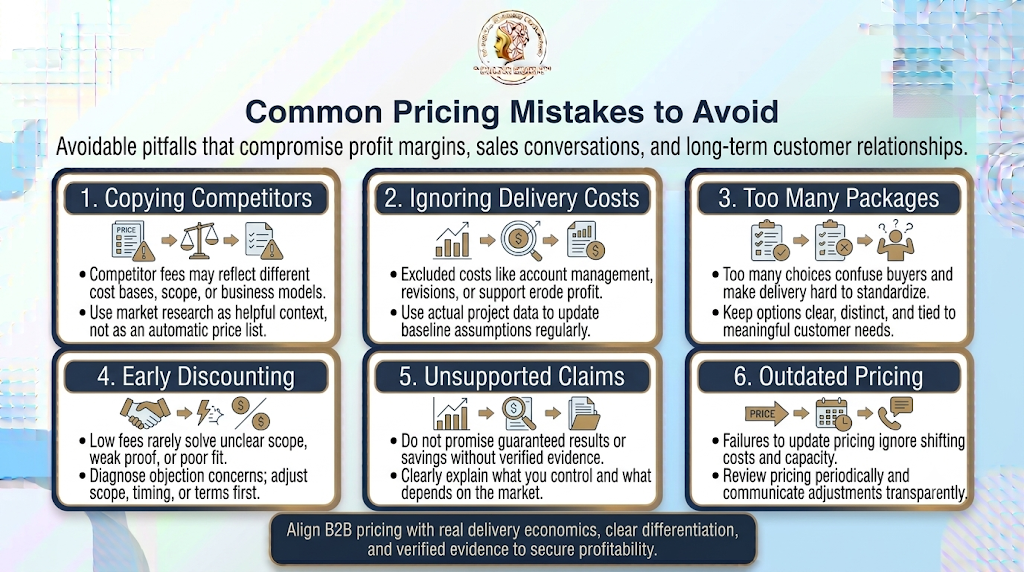
Copying competitor prices
A competitor’s fee may reflect a different cost base, scope, market, or business model. Use competitor research as context, not as an automatic price list.
Ignoring delivery costs
If estimates exclude account management, revisions, reporting, or support, the business may win work that cannot be delivered profitably. Use actual project data and update assumptions regularly.
Offering too many packages
A long menu can confuse buyers and make delivery difficult to standardize. Keep the options clear and differentiate them by meaningful customer needs.
Discounting before understanding the objection
A lower fee may not solve unclear scope, weak proof, or poor fit. Diagnose the concern and consider changes to scope, timing, or payment terms before reducing price.
Making unsupported value claims
Do not promise guaranteed revenue, rankings, savings, or results without evidence and appropriate qualifications. Explain what the company controls and what depends on the customer or market.
Failing to update prices
Costs, capacity, customer expectations, and market conditions change. Review assumptions periodically and communicate changes clearly to existing customers.
A Practical 30-Day Pricing Improvement Plan
Week 1: Audit the current model
Collect current price lists, proposals, contracts, delivery estimates, discount records, and customer feedback. Identify the services and customer segments that matter most. Compare estimated work with actual delivery effort and note where scope regularly expands.
Week 2: Research value and alternatives
Interview selected customers and review recent wins and losses. Identify the outcomes buyers value, the alternatives they consider, and the objections that appear repeatedly. Review competitor offers carefully, comparing scope and service levels rather than headline prices alone.
Week 3: Design and test options
Choose a pricing model for the priority offer. Clarify scope, package differences, assumptions, payment terms, and discount approvals. Test the explanation with sales colleagues and, where appropriate, a small number of customers. Check whether buyers can understand the options without extensive clarification.
Week 4: Implement and measure
Update proposals, sales guidance, website information, and internal approval rules. Brief the team on how to explain the new structure. Record a baseline for price, margin, win rate, and discounting, then schedule a review after enough opportunities have progressed to provide useful evidence.
This plan is a starting point, not a promise that every price change will improve results. The goal is to replace unsupported assumptions with a more consistent process.
How SG Digital Business Development Can Support Commercial Growth.
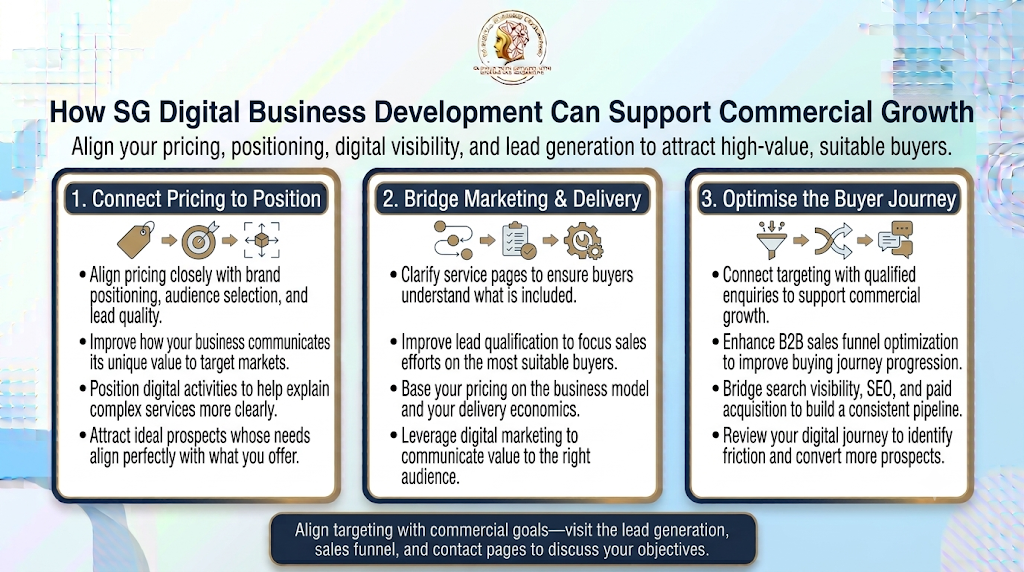
Pricing works best when it is connected to positioning, audience selection, lead quality, and the way a company communicates its value. SG Digital Business Development works across digital visibility, SEO, AI-focused search, website development, paid acquisition, and lead generation. These activities can help businesses explain their services more clearly and attract prospects whose needs are better aligned with the offer.
A company may need to clarify its service pages before changing prices, improve lead qualification so sales conversations focus on suitable buyers, or strengthen its website so prospects understand what is included. Pricing should be based on the business model and delivery economics, while digital marketing helps communicate the value to the right audience.
Explore the B2B Lead Generation Strategy for ways to connect targeting with qualified enquiries, the B2B Sales Funnel Optimization guide for improving progression through the buying journey, and the contact page to discuss your business objectives.
Frequently Asked Questions
What is a B2B pricing strategy?
It is a structured approach to setting and communicating prices for business customers. It includes the pricing model, packages, scope, terms, discount rules, and review process, while balancing customer value with the company’s costs and commercial objectives.
Which pricing model is best for B2B services?
The best model depends on how predictable the work is, how customers buy, and how value is delivered. Fixed fees suit clearly scoped projects, retainers suit recurring work, time-based pricing can suit uncertain advisory tasks, and tiered packages can help customers compare service levels.
Should a B2B company use cost-plus or value-based pricing?
Cost-plus pricing helps establish a financial floor and protect margin. Value-based pricing considers the benefit customers expect and the alternatives they face. Many businesses use cost analysis to understand economics and customer-value research to shape the final offer.
How often should B2B prices be reviewed?
Review pricing when costs, service scope, customer expectations, or market conditions change, and establish a regular review cycle. Avoid changing prices based on one isolated objection or a small number of deals.
How can a company explain a price increase?
Communicate the change clearly, explain the relevant scope or cost factors, state when it takes effect, and give customers reasonable notice according to contract terms and applicable requirements. Do not rely on vague statements about market conditions.
Should businesses publish B2B prices on their websites?
It depends on the offer. Standardized services may benefit from published starting prices or packages. Complex engagements may need discovery before a reliable quote can be prepared. Even when exact prices are not published, explain the factors that influence cost and how buyers can request an estimate.
How can sales teams avoid unnecessary discounting?
Train representatives to diagnose objections, explain value, clarify scope, and offer alternatives such as phased delivery or reduced scope. Set approval rules and review discount patterns so exceptions do not become the default.
What metrics show whether pricing is working?
Review gross margin, average selling price, discount rate, win rate, renewal, expansion, project overruns, and customer retention. Interpret them by service and segment, and combine the numbers with customer feedback.
Conclusion: Price for Value, Deliverability, and Sustainable Growth
A strong pricing approach connects what customers value with what the company can reliably deliver and what the business needs to remain healthy. It starts with a clear customer segment, a realistic understanding of costs, evidence about buyer priorities, and a pricing model that fits the service. It then turns those decisions into understandable packages, transparent proposals, and consistent sales guidance.
A B2B pricing strategy should not be built around copying competitors or discounting whenever a buyer hesitates. It should help the company explain the offer, protect delivery quality, and make informed commercial decisions. Review actual margin and customer outcomes, learn from sales conversations, and update assumptions when the evidence changes.
If your business is reviewing its positioning, lead quality, or commercial growth process, begin by examining whether the right prospects understand the value of your offer. Contact SG Digital Business Development to discuss how clearer digital positioning, stronger acquisition, and a more effective website journey can support your wider business goals.
Let’s build your digital future together. Contact SG Digital Business Development today and let’s engineer your global authority!