
B2B Customer Journey Mapping: Turn Buyers Into Clients
Introduction: Understand the Journey Behind Every Decision
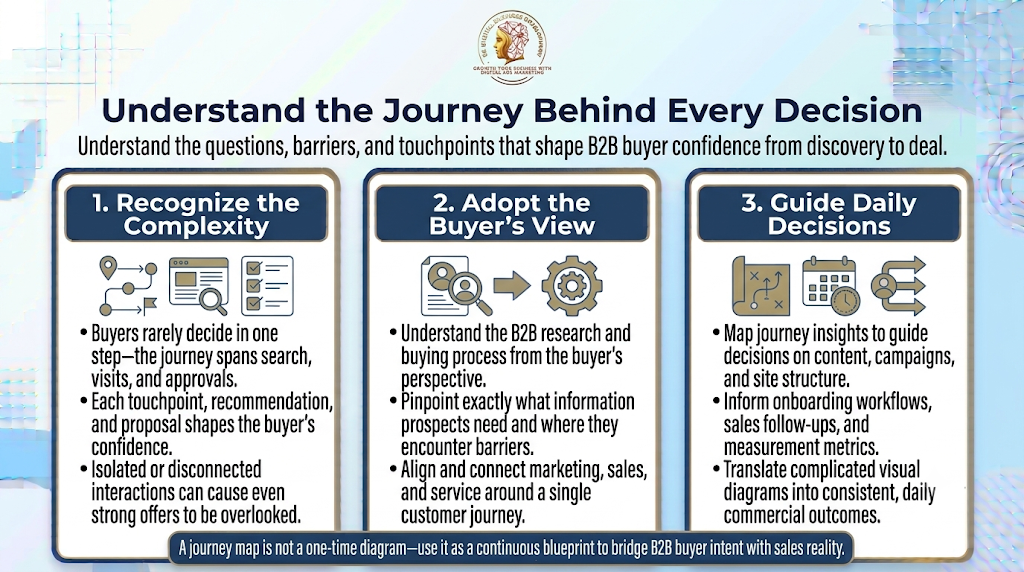
A B2B buyer rarely moves from discovering a company to signing a contract in one step. The journey may include a search, a recommendation, a website visit, a comparison, an internal discussion, a sales call, a proposal, and several rounds of approval. Each interaction shapes the buyer’s confidence. When those interactions feel disconnected, even a strong product or service can be overlooked.
B2B customer journey mapping helps a business understand this process from the buyer’s point of view. It makes visible the questions people ask, the information they need, the barriers they encounter, and the moments when they are ready for a conversation. Instead of treating marketing, sales, and customer service as separate activities, a journey map connects them around the experience of the customer.
The purpose is not to create a complicated diagram and leave it in a presentation. A useful map guides decisions about content, website structure, campaigns, sales follow-up, onboarding, and measurement. This guide explains how to build one that supports better customer experiences and more consistent commercial outcomes.
1. Start With a Clear Business Objective
Before collecting touchpoints, decide what the map needs to improve. A company trying to strengthen organic search visibility needs a different view from one trying to shorten a long sales cycle or reduce customer churn. A map without a defined purpose can become an attractive inventory of interactions without helping anyone make a decision. Customer journey mapping connects teams around buyers.
Choose one primary objective and a small number of supporting measures. Examples include improving the proportion of website enquiries that meet sales criteria, reducing the time between first contact and a qualified meeting, increasing proposal acceptance, or improving customer activation after purchase. Record the current baseline where reliable data exists. If the baseline is unknown, make establishing it part of the project rather than inventing a target.
B2B customer journey mapping is most effective when it is linked to a business question. Write that question in plain language, such as: “Where do suitable prospects lose confidence before requesting a consultation?” This keeps research focused and helps stakeholders judge whether the final map is useful. Customer journey mapping highlights unanswered buyer questions.
2. Define the Customer Segment You Are Mapping
There is rarely one universal journey for every customer. A small business buying a relatively simple service may make a decision quickly, while an enterprise purchase can involve security reviews, procurement, finance, legal teams, and senior leadership. Existing customers may follow a different path when buying an additional service.
Select a segment with enough commercial importance and enough evidence to study. Describe its industry, organization size, geography, business model, typical need, and buying context. Avoid relying only on broad labels such as “business owners” or “decision-makers.” Those descriptions do not explain the situation that causes someone to search for a solution. Customer journey mapping identifies friction before purchase.
Then identify the buying group. The person who experiences the problem may be different from the person who controls the budget. Technical evaluators, end users, procurement specialists, and executive sponsors may each need different evidence. Document their responsibilities and likely concerns. Do not assume that one contact represents the views of an entire organization. Customer journey mapping makes handoffs easier to inspect.
A focused segment makes B2B customer journey mapping practical. You can create additional maps later for other segments rather than combining different buying behaviours into one confusing picture.
3. Research What Buyers Actually Do
A journey map should be based on evidence, not internal assumptions. Start with conversations with recent customers, lost prospects, sales representatives, account managers, and support staff. Ask people to describe what happened, what they were trying to achieve, what information they looked for, and what made the decision easier or harder. Customer journey mapping links evidence with action.
Useful questions include: What first made the problem important? Where did you look for information? Which alternatives did you consider? What nearly stopped you from proceeding? Who else was involved? What proof did you need? Which interaction felt most helpful? What happened after the purchase? Ask for specific examples rather than general opinions.
Review available digital evidence as well. Website analytics can show common entry pages, navigation paths, and form abandonment. Search data can reveal the language people use when researching a problem. CRM records may show time between stages, reasons for lost opportunities, and recurring objections. Support tickets and onboarding notes can expose issues that marketing teams never see. Customer journey mapping improves the relevance of content.
B2B customer journey mapping becomes more reliable when qualitative and quantitative evidence are considered together. Analytics can indicate where a drop-off occurs, while interviews can explain why it happens. Neither source should be treated as complete on its own. Be transparent about sample size, missing information, and assumptions. Customer journey mapping supports clearer website decisions.
4. Separate Stages by Buyer Need, Not Company Department
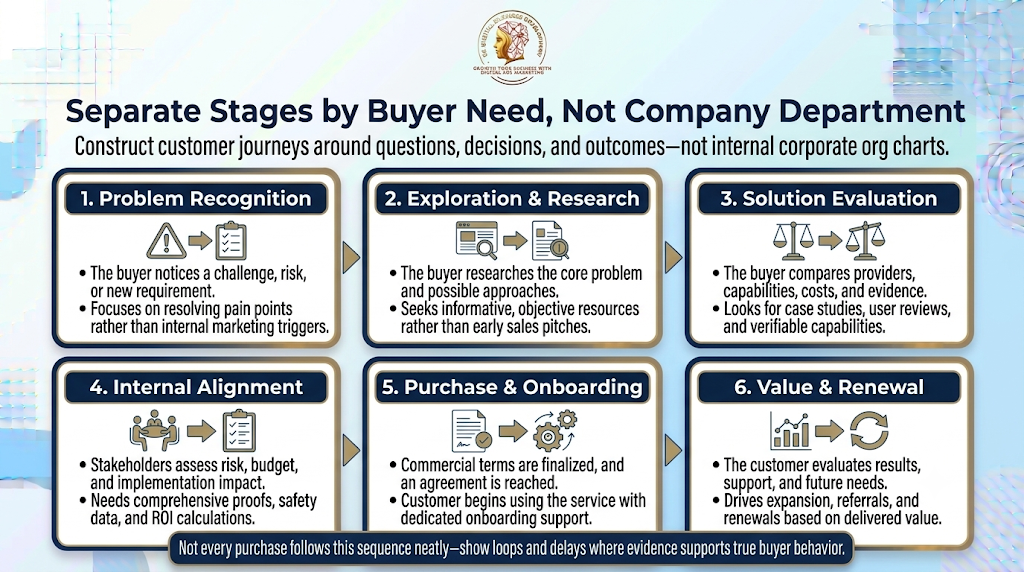
A common mistake is to build a journey around the organization’s internal structure: marketing, sales, delivery, and support. Those teams matter, but buyers do not experience the business in the same way an organization chart is arranged. They experience questions, decisions, expectations, and outcomes.
A practical B2B journey may include these stages:
- Problem recognition: the buyer notices a challenge, risk, missed opportunity, or new requirement.
- Exploration: the buyer researches the problem and possible approaches.
- Solution evaluation: the buyer compares providers, capabilities, costs, and evidence.
- Internal alignment: stakeholders assess risk, budget, timing, and implementation impact.
- Decision and purchase: commercial terms are reviewed and an agreement is reached.
- Onboarding and adoption: the customer begins using the service or solution.
- Value realization and renewal: the customer evaluates results, support, and future needs.
Not every purchase follows this sequence neatly. Some stages overlap, repeat, or happen offline. A buyer may return to research after a proposal, or involve a new stakeholder late in the process. Show loops and delays where evidence supports them. Do not force a linear funnel onto a complex buying process. Customer journey mapping helps teams prioritize improvements.
5. Record Buyer Questions at Every Stage
For each stage, document the questions a buyer is likely to ask. During problem recognition, a prospect may wonder whether the issue is serious enough to address. During exploration, they may ask which approaches are available. During evaluation, they may need to compare providers, understand implementation, or assess risk. After purchase, they may need to know how to get started and how success will be measured.
Use customer language wherever possible. Internal teams may describe a service using technical terminology, while customers describe the same need in terms of cost, delays, missed targets, or operational pressure. Capturing those differences can improve website copy, sales conversations, and educational content. Customer journey mapping reveals where confidence declines.
Map the evidence needed to answer each question. It may be an explainer article, service page, comparison guide, demonstration, case study, proposal, implementation plan, security document, or conversation with a specialist. The right asset depends on the buyer’s question, not on the content format your team prefers to produce. Customer journey mapping clarifies what buyers expect.
6. List Touchpoints and Identify Ownership
A touchpoint is an interaction between a buyer and the business. It may be digital, human, or operational. Examples include search results, social posts, a website page, an enquiry form, an email, a discovery call, a proposal, a product demonstration, an invoice, an onboarding session, or a support response.
For each touchpoint, record its purpose, the buyer’s likely expectation, the information provided, the team responsible, and the next possible step. Note whether the interaction is controlled by your organization or influenced by an external party. A review site, referral partner, or industry publication may affect perception even when your team does not own that experience. Customer journey mapping aligns marketing with sales.
B2B customer journey mapping should expose handoff gaps. For example, a prospect may submit a detailed enquiry but receive a generic response that ignores the stated requirement. A salesperson may promise an onboarding outcome that the delivery team has not been told about. A customer may receive campaign emails after becoming an active client because systems are not connected.
Assign an owner to each important gap. Shared responsibility often becomes no responsibility unless a person or team is accountable for making the improvement happen. Customer journey mapping can expose inconsistent messaging.
7. Measure Friction, Confidence, and Momentum
A journey map should explain more than where interactions happen. It should show how those interactions affect the buyer’s ability to move forward. Look for friction such as unclear pricing, missing technical information, slow responses, repetitive questions, confusing navigation, poor mobile usability, or uncertainty about what happens after a meeting. Customer journey mapping identifies moments requiring reassurance.
Also identify confidence-building moments. A relevant case study, transparent process explanation, useful consultation, clear proposal, or responsive support interaction can reduce uncertainty. Ask customers what made them feel confident and what remained unresolved.
You can add a simple experience rating to each stage, but avoid pretending that a subjective score is precise science. Explain how the rating was collected and support it with comments or observed behaviour. Track important friction points by frequency and business impact so that teams address the most consequential issues first. Customer journey mapping supports more useful follow-up.
8. Connect Content to the Buyer’s Decision
Content should help a buyer make progress. Early-stage resources can explain a business problem, its causes, and the consequences of leaving it unresolved. Evaluation resources can compare approaches, explain service scope, answer objections, and show credible evidence. Decision-stage content can clarify deliverables, timelines, responsibilities, pricing principles, and implementation requirements. Existing customers may need training, support guidance, and ideas for getting more value.
This does not mean creating a separate article for every question. Group related questions into useful resources and connect them with relevant internal links. A service page can link to a case study. An educational article can direct readers to a practical guide. A comparison page can offer a consultation when the visitor is ready to discuss their situation. Customer journey mapping makes hidden delays visible.
B2B customer journey mapping helps reveal content gaps. It can also expose content that attracts traffic but does not answer the next question. Review whether each important page has a clear audience, a defined purpose, accurate information, and an appropriate next step. Avoid forcing a sales CTA into every interaction; some buyers need education before they are ready to speak. Customer journey mapping improves cross-team accountability.
9. Improve the Website Experience Across Devices
The website is often where several parts of the journey meet. A prospect may arrive from search, a professional network, an advertisement, a referral, or an email. The page they land on should match the expectation created by that source. If an advertisement promises a specific service but sends visitors to a generic homepage, the experience becomes disconnected.
Review page speed, mobile layout, navigation, headings, readability, forms, trust signals, and contact options. Make service information easy to understand. Explain who the service is for, what problem it addresses, what the process involves, and what the visitor can do next. Use relevant proof without exaggerating results or implying guarantees that cannot be supported. Customer journey mapping connects campaigns to outcomes.
Test forms from the visitor’s perspective. Ask only for information needed at that stage. Explain what happens after submission and ensure enquiries reach the right person. Confirm that confirmation messages, notifications, and CRM records work correctly. A broken form can undermine an otherwise successful campaign.
10. Align Marketing, Sales, and Delivery
A journey map is valuable because it gives different teams a shared view of the customer experience. Marketing can explain how prospects discover the business and what content they consume. Sales can describe qualification, objections, decision criteria, and stalled opportunities. Delivery and support can explain onboarding, adoption, recurring issues, and renewal concerns. Customer journey mapping helps explain buyer behaviour.
Hold a working session where each team reviews the same evidence. Ask where expectations are created, where they are fulfilled, and where they break. Agree on definitions for key stages and handoffs. For example, define what qualifies an enquiry for sales review, what information must accompany a handoff, and who updates the customer when an issue is escalated.
This alignment is particularly important when a business uses several channels or systems. A contact may appear in advertising platforms, analytics, email tools, and a CRM. Establish consistent naming, ownership, and data-handling rules. Avoid collecting unnecessary personal information and restrict access to people who need it for legitimate work. Customer journey mapping highlights gaps after enquiry.
11. Use CRM and Automation to Support the Experience.
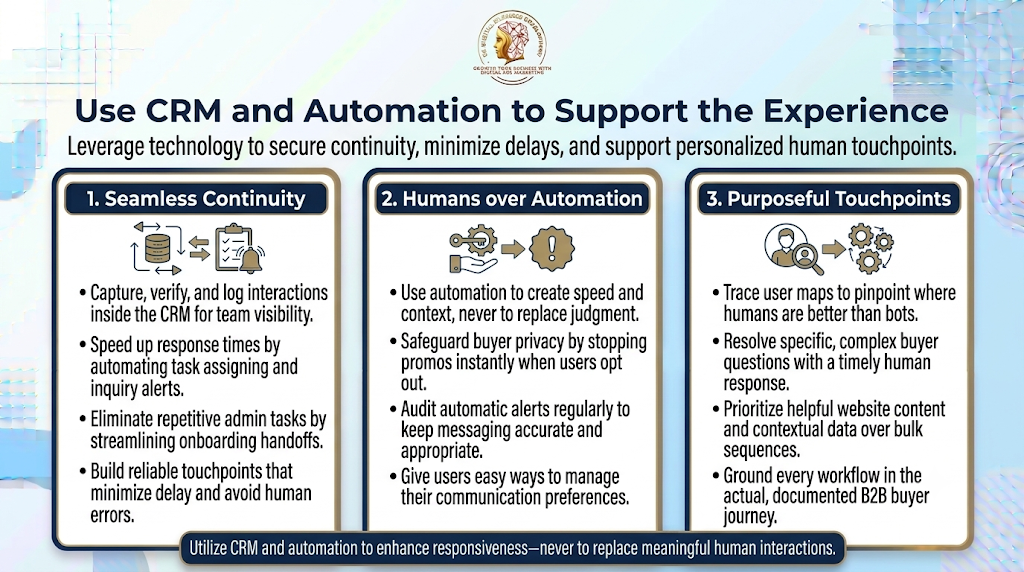
A customer relationship management system can help teams record interactions, manage opportunities, and maintain continuity. Automation can assign enquiries, send relevant confirmations, remind staff about agreed follow-ups, and trigger onboarding tasks. These capabilities are useful when they reduce avoidable delays and repetitive administration. Customer journey mapping can strengthen onboarding communication.
Automation should not replace judgement. A generic sequence that ignores a prospect’s stated needs can make the experience worse. Give people a clear way to manage communication preferences, and stop promotional follow-ups when a recipient opts out. Review automated messages regularly to ensure they remain accurate and appropriate.
B2B customer journey mapping can identify where automation is useful and where a human conversation is more valuable. Use technology to support context, not to create the illusion of personalization. A timely response that addresses the actual question is more helpful than a long automated sequence that does not. Customer journey mapping helps prioritize website content.
12. Build a Measurement Framework
Choose metrics that correspond to the objective set at the beginning. For awareness, useful indicators may include relevant search visibility, visits from target audiences, and engagement with priority resources. For evaluation, examine qualified enquiries, meeting acceptance, proposal progression, and the time spent at key stages. For customer experience, review onboarding completion, product or service adoption, support response, renewal, and customer feedback.
Do not rely on a single attribution model to explain every purchase. B2B decisions often involve multiple people and interactions across a long period. First-touch and last-touch reports can provide useful views, but neither captures the full influence of every interaction. Combine analytics with CRM outcomes, sales feedback, and customer interviews. Clearly distinguish observed data from estimates. Customer journey mapping gives teams shared context.
Create a small dashboard that people will actually use. Define each metric, its source, its owner, and its review frequency. If teams use different definitions for “lead,” “meeting,” or “opportunity,” the dashboard will create confusion rather than insight. Review data quality before interpreting performance. Customer journey mapping supports better service transitions.
13. Prioritize Improvements by Impact and Effort
A journey map can reveal dozens of possible improvements. Trying to fix everything at once usually slows execution. Rank issues by how often they occur, how much they affect the buyer, their likely commercial impact, and the effort required to address them.
A high-impact issue might be a broken enquiry form, unclear service positioning, or a long delay before a prospect receives a response. A lower-priority issue might be a minor design inconsistency on a page with little relevant traffic. Use evidence to distinguish urgent problems from preferences. Customer journey mapping reveals recurring customer concerns.
Choose a small number of improvements for the first cycle. Assign an owner, a deadline, a success measure, and a review date. After implementation, check whether the experience and outcome changed. If the result is unclear, gather more evidence rather than declaring success based on activity alone.
14. Common Journey-Mapping Mistakes
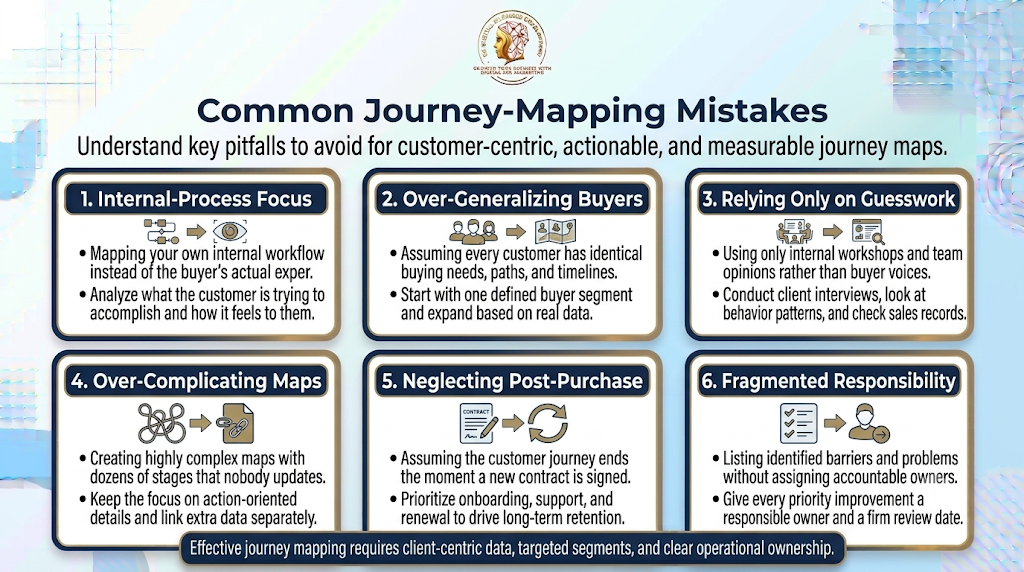
Mapping the internal process instead of the buyer experience. Internal workflows matter, but the map should explain what the customer is trying to accomplish and how each interaction feels from their perspective.
Treating every customer as identical. Different segments, buying groups, and purchase types can have different needs. Start with one defined segment and expand when there is evidence to justify it.
Relying only on workshops. Internal opinions can be useful, but they are not a substitute for customer interviews, behavioural data, and actual sales records.
Making the map too complicated. A map with dozens of stages and decorative detail can become impossible to maintain. Include the information needed to make decisions and keep supporting detail in linked documents.
Ignoring the post-purchase experience. Onboarding, support, adoption, and renewal influence retention and referrals. The journey does not end when a contract is signed.
Failing to assign ownership. A list of problems without accountable owners rarely produces change. Give each priority improvement a responsible person and a review date.
Confusing correlation with causation. A page visit before a sale does not prove that the page caused the sale. Use multiple sources and describe the limits of attribution.
15. A Practical 30-Day Implementation Plan
Week 1: Scope and Evidence
Select one customer segment and one business objective. Review recent won and lost opportunities, interview a small sample of customers and staff, and collect available website, CRM, and support evidence. Write down what is known, what is assumed, and what needs further research. Customer journey mapping can guide practical testing.
Week 2: Build the Current-State Map
Document the stages, buyer questions, touchpoints, channels, expectations, emotions, and handoffs. Highlight moments of confusion or delay. Validate the draft with people who interact with customers and, where possible, with customers themselves. Keep the map focused on the selected segment. Customer journey mapping connects touchpoints across channels.
Week 3: Prioritize and Improve
Rank friction points by frequency, impact, and effort. Choose two or three improvements, such as clarifying a service page, improving an enquiry handoff, adding a missing evaluation resource, or fixing an onboarding communication gap. Assign owners and measures.
Week 4: Review and Establish a Routine
Check whether the changes were implemented and whether the intended signal improved. Collect feedback from sales and delivery teams. Record lessons and decide what should be tested next. Set a monthly review so the map evolves as customer expectations, services, and channels change. Customer journey mapping helps evaluate customer expectations.
16. How SG Digital Business Development Can Help
A journey map becomes commercially useful when it leads to practical improvements across visibility, content, website experience, paid campaigns, and business development. SG Digital Business Development focuses on connecting these activities rather than treating them as isolated tasks.
The work can begin with an assessment of how people discover the business, what they see on key pages, how enquiries are handled, and where the path to a sales conversation becomes unclear. Depending on the evidence, priorities may include search visibility, content structure, landing-page clarity, campaign alignment, conversion paths, or measurement. Customer journey mapping makes improvement ownership clearer.
For businesses already investing in digital marketing, the important question is not simply whether a channel generates traffic. It is whether the right people receive the information they need to take a sensible next step. A connected approach can help identify gaps and focus effort on the parts of the experience that matter most. Customer journey mapping links customer feedback to priorities.
Frequently Asked Questions
1. What is B2B customer journey mapping?
It is the process of documenting how business buyers recognize a need, research options, evaluate providers, make a decision, and experience a solution after purchase. It captures buyer questions, touchpoints, expectations, friction, and opportunities to improve the experience. The map helps marketing, sales, delivery, and support teams work from a shared understanding of the customer.
2. Why is customer journey mapping important for B2B companies?
B2B purchases often involve several stakeholders, longer evaluation periods, and more perceived risk than simple consumer purchases. Mapping helps a company understand what different people need at each stage, identify disconnected interactions, and improve the information and support available to buyers. It can also help teams prioritize improvements based on customer evidence and business impact. Customer journey mapping helps teams remove avoidable friction.
3. How do you collect information for a journey map?
Use customer interviews, lost-deal reviews, sales and support feedback, website analytics, search data, CRM records, and onboarding observations. Ask people to describe specific experiences rather than relying only on broad opinions. Combine qualitative feedback with quantitative signals, and document limitations where the available evidence is incomplete.
4. What are the main stages of a B2B buying journey?
Common stages include problem recognition, exploration, solution evaluation, internal alignment, decision and purchase, onboarding and adoption, and value realization or renewal. The sequence is not always linear. Buyers may revisit earlier stages, involve new stakeholders, or pause while budgets and priorities change. Customer journey mapping makes complex buying paths clearer.
5. What is the difference between a customer journey map and a sales funnel?
A sales funnel usually represents how prospects progress through defined commercial stages. A journey map provides a broader view of the buyer’s experience, including questions, emotions, channels, touchpoints, and post-purchase interactions. The two tools can complement each other: the funnel measures progression, while the map helps explain the experience behind it. Customer journey mapping supports consistent customer communication.
6. How often should a business update its journey map?
Review it when there are meaningful changes in customer behaviour, products, pricing, channels, sales processes, or service delivery. A scheduled quarterly or half-yearly review can help, but important customer feedback or a major process change may justify an earlier update. Keep the map connected to current evidence rather than treating it as a one-time project.
7. Which tools are needed to create a journey map?
A spreadsheet, shared document, or whiteboard can be enough for an initial map. Analytics and CRM systems can provide supporting evidence, while collaboration tools help teams review and update the work. Choose tools that fit the size of the project and the team’s ability to maintain them. Software cannot replace customer research or clear thinking. Customer journey mapping can reveal missing decision support.
8. How can journey mapping improve lead generation?
It can reveal where prospects do not receive the information they need, where forms or handoffs create friction, and where follow-up fails to match buyer intent. Improving those points can help more relevant prospects progress to a useful conversation. It should not be treated as a guarantee of a particular lead volume or revenue outcome.
9. Does customer journey mapping include existing customers?
Yes. The experience continues after the purchase through onboarding, implementation, support, adoption, renewal, and possible expansion. Mapping these stages can help a business identify unmet expectations, recurring service issues, and opportunities to improve customer value and retention. Customer journey mapping helps improve post-purchase experiences.
Conclusion: Make Every Interaction Move the Relationship Forward
A strong B2B experience is built from many connected moments. Buyers need to understand their problem, assess possible solutions, trust the provider, align internal stakeholders, and receive the value they expected after purchase. When those moments are disconnected, opportunities and customer confidence can be lost. Customer journey mapping connects research with measurable changes.
Use evidence to understand the journey, document buyer questions, identify friction, connect teams, and prioritize improvements that can be measured. Keep the map simple enough to maintain and specific enough to guide action. Review it as customer needs and business processes change.
A practical review should include the people responsible for each handoff, the evidence used to judge progress, and the process through which customer feedback reaches decision-makers. Keep a record of changes, compare results with the baseline, and revisit assumptions when the market, offer, or buying process changes. This discipline prevents customer journey mapping from becoming a static presentation. It turns the map into a working management tool that supports continuous improvement across teams and keeps customer experience connected to commercial priorities.
If your website, marketing, and sales activity are generating attention but the path to qualified enquiries feels inconsistent, SG Digital Business Development can help assess the gaps and identify practical next steps. Contact our team: https://sgdigitalbusinessdevelopment.com/contact/ to discuss a clearer customer journey and a more connected growth system.
Customer journey mapping keeps improvements buyer-focused over time.
Let’s build your digital future together. Contact SG Digital Business Development today and let’s engineer your global authority!