
B2B Marketing Operations: Build a Smarter Growth Engine
Introduction
Many B2B companies invest in SEO, paid advertising, content, email, events, websites, and sales development, yet struggle to understand how these activities work together. Teams may use different tools, maintain separate spreadsheets, define leads differently, and report results in formats that cannot be compared. Campaigns launch without clear ownership, follow-up is inconsistent, and useful data remains trapped in disconnected systems. The problem is not always a lack of marketing activity. Often, the operating system behind that activity is unclear.
B2B Marketing Operations is the discipline of designing, coordinating, measuring, and improving the processes, technology, data, and governance that help marketing work effectively with sales and the wider business. It turns individual campaigns into a connected system. It clarifies who does what, how information moves, which metrics matter, and how teams learn from results.
The purpose is not to add unnecessary meetings or software. It is to make work easier to execute, easier to measure, and more closely connected to commercial outcomes. This guide explains how to build a practical operating model that supports reliable execution, better decisions, and sustainable growth. B2B Marketing Operations creates clarity across teams. B2B Marketing Operations works best with shared definitions.
Define the Operating Model
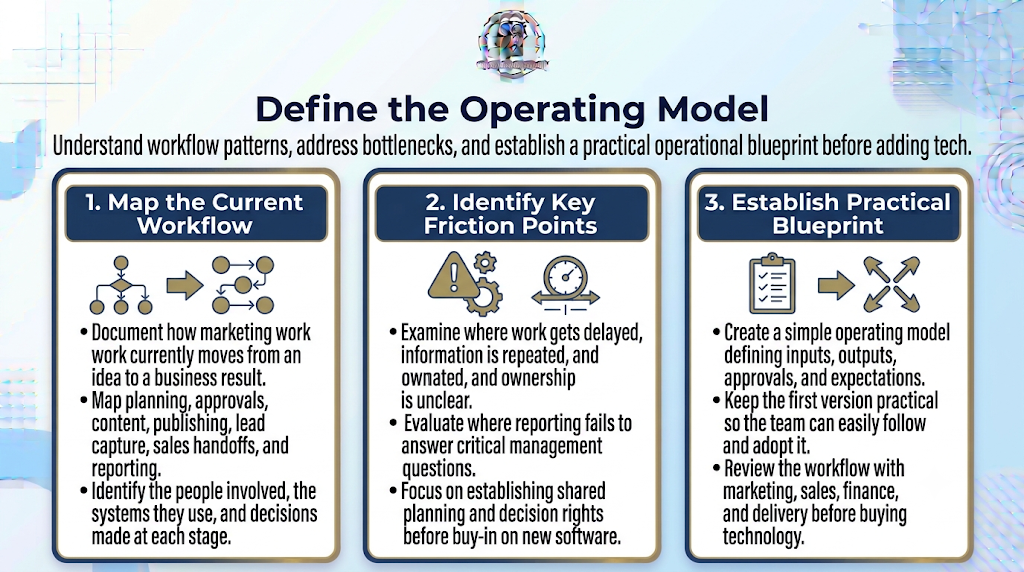
Start by documenting how marketing work currently moves from an idea to a business result. Map planning, audience research, campaign approval, content production, publishing, lead capture, qualification, sales handoff, reporting, and improvement. Identify the people involved, the systems they use, and the decisions they make at each stage.
B2B Marketing Operations should begin with business requirements, not a software demonstration. Ask where work gets delayed, where information is repeated, where ownership is unclear, and where reporting cannot answer management questions. A team that struggles with unclear campaign priorities may not need another automation platform. It may need a shared planning process and clear decision rights.
Create a simple operating model that defines responsibilities, inputs, outputs, approval points, and service expectations. Keep the first version practical. A process that people can follow is more valuable than a complicated diagram that nobody updates. Review it with marketing, sales, finance, and delivery teams before making major technology decisions. B2B Marketing Operations connects activity with outcomes. B2B Marketing Operations requires regular process reviews.
Align Goals With Revenue
Marketing goals should connect to commercial priorities. Website sessions, social engagement, email opens, and content downloads can provide useful diagnostic information, but they do not automatically demonstrate business impact. Leadership needs to understand whether marketing is creating relevant demand, helping sales progress opportunities, and contributing to profitable customer growth.
Translate broad objectives into measurable outcomes. If the business wants to enter a new market, define the target segment, relevant offer, required evidence, expected sales cycle, and indicators of progress. If the goal is to improve pipeline quality, agree on qualification criteria and a feedback process with sales.
Build a measurement hierarchy. At the top, define outcomes such as revenue, pipeline, acquisition cost, retention, or market expansion. Beneath them, identify leading indicators such as qualified enquiries, meetings, opportunity creation, and conversion rates. Use channel metrics to diagnose performance, not as substitutes for business results. B2B Marketing Operations needs practical ownership rules. B2B Marketing Operations should fit team capacity.
Clarify Roles and Ownership
Unclear ownership creates duplicated work and missed deadlines. One person may assume that sales will follow up with a lead, while sales expects marketing to qualify it first. A campaign may wait for approval because nobody knows who has final authority. These problems are often process problems rather than individual performance issues.
Use a responsibility matrix for recurring activities. Identify who completes the work, who is accountable for the outcome, who should be consulted, and who needs to be informed. Avoid adding unnecessary approvers. The aim is to protect quality while allowing teams to move at a reasonable pace. B2B Marketing Operations improves campaign coordination. B2B Marketing Operations can start with simple tools.
Standardize Campaign Planning
A campaign brief should explain the business objective, audience, problem, offer, message, channel mix, budget, owner, timeline, and success measures. It should also describe what happens after someone responds. This prevents campaigns from being judged only by impressions or clicks when the real objective is qualified conversations.
Use a common brief and a visible calendar. The calendar should show launch dates, dependencies, content deadlines, approvals, campaign owners, and important sales activities. Teams should be able to see conflicts before they become urgent.
Prioritize campaigns according to business value, audience relevance, effort, and available capacity. Do not launch every idea at once. A smaller number of well-executed campaigns with clear measurement can produce more useful learning than a crowded calendar with weak follow-through. B2B Marketing Operations makes handoffs more dependable. B2B Marketing Operations makes responsibilities visible.
Improve Lead Handoffs
Marketing and sales must agree on what a lead represents. A form submission, newsletter subscriber, event attendee, and active buying project are not interchangeable. Define the stages used by your organization and the evidence required to move a contact from one stage to another.
Document how leads are captured, enriched, scored where appropriate, assigned, accepted, rejected, and returned for further nurturing. Agree on response expectations and the information sales needs before making contact. Include a clear reason code when a lead is rejected so marketing can improve targeting.
Review handoff performance regularly. Measure how quickly leads receive attention, how many are accepted, how many become opportunities, and which sources produce suitable conversations. If sales repeatedly rejects leads for the same reason, investigate the audience, offer, form, or qualification criteria rather than simply increasing lead volume. B2B Marketing Operations relies on trustworthy records. B2B Marketing Operations helps teams learn faster.
Build Reliable Data
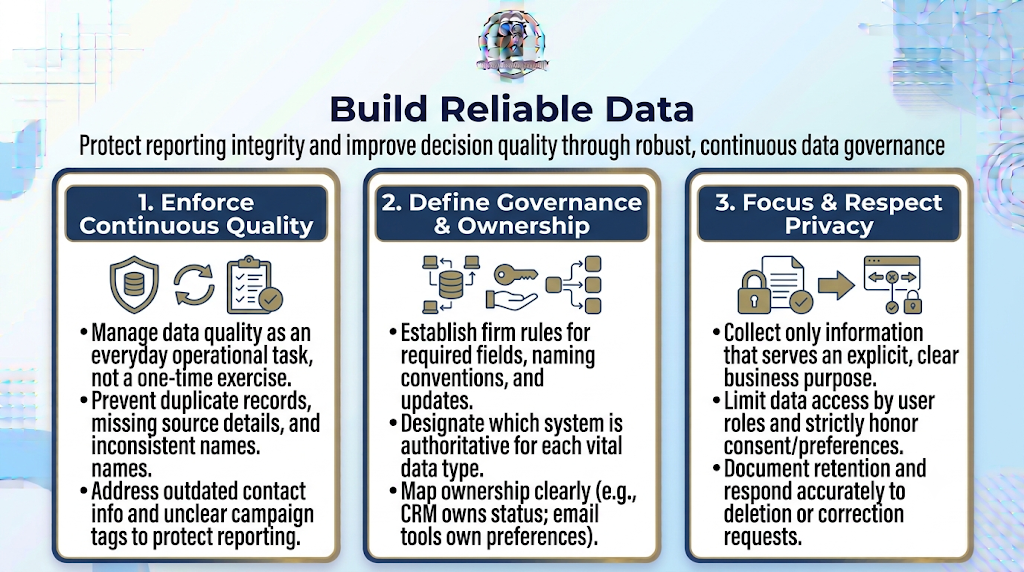
Decisions are only as useful as the information behind them. Duplicate records, inconsistent company names, missing source details, outdated contact information, and unclear campaign tags make reporting unreliable. Data quality should be managed as an operating responsibility, not a one-time cleanup exercise.
Establish rules for required fields, naming conventions, data ownership, duplicate handling, and record updates. Define which system is authoritative for each important data type. For example, the CRM may own account and opportunity status, while the email platform manages subscription preferences.
Collect only information that has a clear business purpose. Limit access according to role, respect consent and communication preferences, and follow applicable privacy requirements. Document retention practices and ensure that teams know how to handle correction or deletion requests under relevant laws. B2B Marketing Operations should simplify the technology stack. B2B Marketing Operations should improve decision quality.
Choose Technology Carefully
Technology should support a defined process. Before buying a CRM, automation platform, analytics product, or project management tool, describe the workflow it must support and the problem it should solve. Evaluate integration, usability, reporting, security, administration effort, and total cost rather than focusing only on feature lists.
Create an inventory of systems, owners, integrations, renewal dates, and business purposes. Remove unused tools and consolidate duplicate functions where practical. Test integrations with real records and realistic exceptions before relying on them for critical lead routing or reporting. B2B Marketing Operations keeps procedures consistent. B2B Marketing Operations links campaigns to pipeline.
Document Repeatable Processes
A process should not depend entirely on one employee remembering every step. Document recurring activities such as campaign launch, landing-page review, webinar follow-up, lead assignment, email approval, reporting, and website updates. Keep instructions short enough to be used during real work.
For each procedure, describe the trigger, owner, required inputs, steps, quality checks, exceptions, and expected output. Include links to templates and systems rather than copying large amounts of information into multiple documents.
Review documentation when a process changes. Assign an owner and a review date. Remove obsolete instructions so employees do not follow outdated steps. For complex activities, record a short walkthrough or checklist that helps new team members learn the process consistently. B2B Marketing Operations strengthens sales alignment. B2B Marketing Operations benefits from documented exceptions.
Improve Sales Communication
Regular communication helps teams share context before problems become escalations. Hold a focused meeting to review pipeline quality, campaign activity, upcoming launches, customer feedback, and decisions that need cross-functional input. Use a shared dashboard or concise report so the meeting is based on the same information.
Create a common language between marketing and sales. Agree on definitions for qualified lead, accepted lead, opportunity, influenced pipeline, and closed revenue. If teams use the same words to mean different things, performance discussions quickly become arguments about data.
Keep meetings decision-oriented. Every unresolved issue should have an owner and a next step. Routine status updates can be shared asynchronously. Use meeting time for decisions, blockers, customer insights, and changes that require collaboration. B2B Marketing Operations makes reporting more useful. B2B Marketing Operations requires careful change management.
Create Useful Reporting
A useful report answers a business question. It should show what happened, why it may have happened, what the team learned, and what action is recommended. Avoid dashboards filled with metrics that look impressive but do not influence a decision.
Document metric definitions and attribution assumptions. Explain whether revenue is sourced, influenced, or associated with a campaign, and avoid presenting these categories as interchangeable. Show date ranges, filters, and known limitations so readers understand what the numbers represent. B2B Marketing Operations supports responsible budget choices.
Manage Budgets
Budget decisions should reflect strategy, evidence, and capacity. Divide spending into clear categories such as people, technology, media, content, events, research, and external services. Track planned spend, committed spend, actual spend, and forecast separately.
For each major activity, identify the expected audience, business objective, cost, leading indicators, and review date. Do not assume that the cheapest channel is the most efficient if it attracts poor-fit prospects or consumes significant sales time.
Review budgets at a regular cadence. Reallocate only after checking performance quality, time lag, seasonality, and sales feedback. Some activities build long-term awareness and should not be judged solely on immediate conversions. Others should be stopped quickly if they fail to meet agreed criteria. B2B Marketing Operations helps content move efficiently. B2B Marketing Operations can reduce reporting confusion.
Govern Content Production
Content often moves through research, briefing, drafting, review, legal or subject-matter approval, design, publishing, distribution, and updating. Without a clear process, content becomes delayed, inconsistent, or disconnected from buyer needs.
Define the purpose and owner of each content asset. A brief should identify the audience, search or business question, key message, evidence, format, distribution plan, and next step. Establish who checks factual accuracy, brand consistency, accessibility, and compliance where relevant.
Build a content inventory with publication date, owner, topic, target audience, URL, performance, and review date. Use it to identify outdated pages, overlapping topics, missing resources, and opportunities to update useful assets. Connect relevant articles to service pages and related resources without forcing links that do not help the reader. B2B Marketing Operations keeps automation under control. B2B Marketing Operations creates a repeatable growth foundation.
Automate Responsibly
Automation can reduce repetitive work, improve consistency, and help teams respond promptly. Examples include routing form submissions, notifying account owners, updating campaign statuses, and sending requested resources. But automation can also multiply mistakes when the underlying process or data is wrong.
For each important automation, document its purpose, owner, trigger, expected action, exception path, and monitoring plan. Test with sample records, including missing fields, duplicate contacts, unsubscribed users, and unusual routing conditions.
Keep human review where judgement matters. Do not automate sensitive decisions without appropriate oversight. Provide a way to pause workflows and correct mistakes. Review performance after changes to forms, CRM fields, integrations, and consent settings. B2B Marketing Operations protects customer information.
Protect Data and Access
Marketing systems may contain personal information, business contact records, behavioural data, and customer histories. Access should be limited to people who need it for their role. Use strong authentication, remove access promptly when employees or suppliers leave, and review permissions periodically.
Align collection and communication practices with applicable privacy and marketing rules. Requirements differ across jurisdictions, so businesses operating internationally should obtain appropriate legal guidance. Make privacy notices understandable and honour preferences such as unsubscribe requests and communication restrictions.
Keep a record of vendors and integrations that process data. Understand what information is transferred, where it is stored, how it is protected, and how it can be exported or deleted. A practical governance process reduces avoidable risk and supports customer confidence. B2B Marketing Operations turns feedback into action.
Improve Continuously
An operating model should evolve as the company, market, and technology change. Schedule reviews of campaign performance, lead quality, data health, workflow reliability, tool usage, and team feedback. Look for repeated friction rather than reacting only to individual incidents.
Keep a decision log that records the issue, evidence, chosen action, owner, and review date. This prevents teams from repeating the same discussion without learning from earlier decisions. Improvement should be small, visible, and connected to a business need. B2B Marketing Operations needs realistic milestones.
90-Day Roadmap
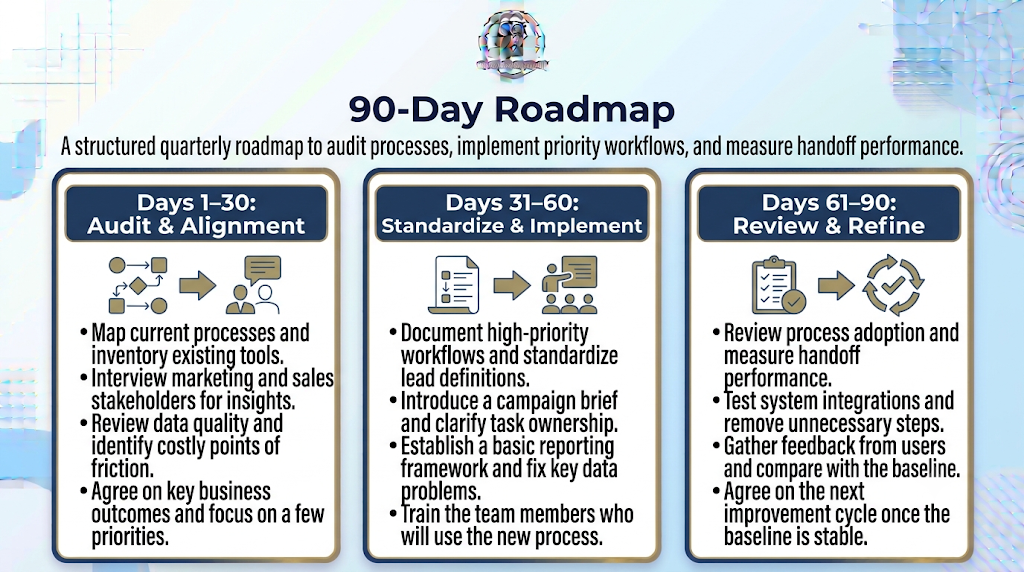
During the first 30 days, map current processes, interview marketing and sales stakeholders, inventory tools, review data quality, and identify the most costly points of friction. Agree on business outcomes and select a small number of priorities. Do not attempt to redesign every process simultaneously.
During days 31 to 60, document the highest-priority workflows, standardize lead definitions, introduce a campaign brief, clarify ownership, and establish a basic reporting framework. Fix one or two data problems that materially affect decisions. Train the people who will use the new process.
During days 61 to 90, review adoption, measure handoff performance, test integrations, remove unnecessary steps, and agree on the next improvement cycle. Collect feedback from users and compare results with the baseline. Expand only after the first changes are working reliably. B2B Marketing Operations reduces avoidable process friction.
Common Mistakes
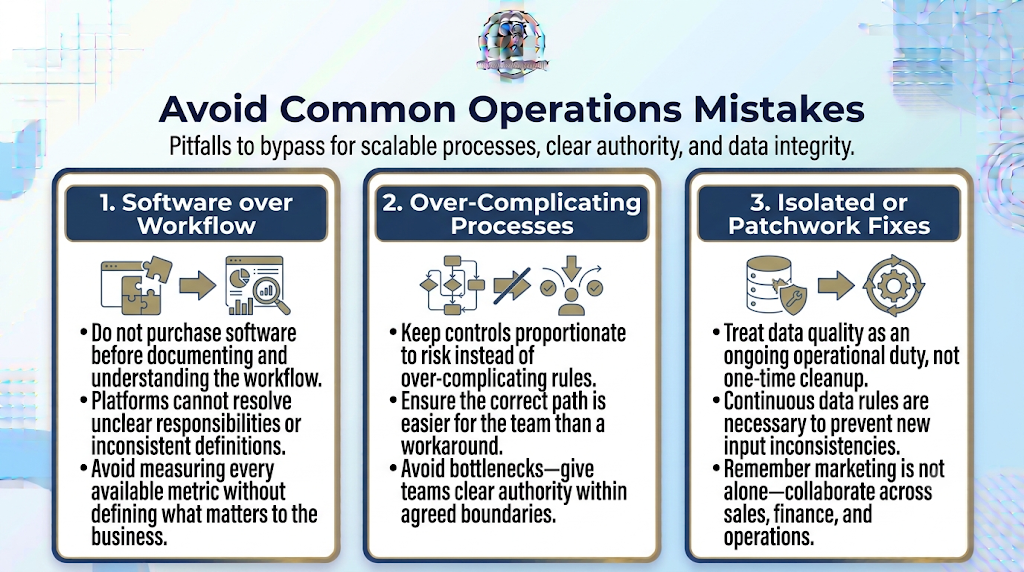
Buying software before understanding the workflow is a frequent mistake. A new platform cannot resolve unclear responsibilities or inconsistent definitions by itself. Another mistake is measuring every available metric without deciding which ones matter to the business.
Avoid creating a process so detailed that people bypass it. Keep controls proportionate to risk and make the correct action easier than the workaround. Do not centralize every decision with one person if that creates delays. Give teams clear authority within agreed boundaries.
Do not treat data cleanup as a permanent solution. New records and campaigns will introduce new inconsistencies unless rules and ownership are maintained. Finally, do not assume that marketing owns every part of the customer journey. Sales, finance, operations, service, and leadership all contribute to the system. B2B Marketing Operations supports consistent customer experiences.
Conclusion
Growth becomes difficult to manage when campaigns, data, technology, and sales processes operate independently. A practical operating model connects those activities without adding unnecessary complexity. It clarifies ownership, improves the quality of information, makes handoffs more dependable, and gives leaders a clearer view of commercial performance.
Start with the workflow that causes the greatest friction. Agree on definitions, assign an owner, document the process, and measure whether the change improves the outcome. Build from there rather than attempting a large transformation before the team understands its real needs.
B2B Marketing Operations is most effective when it helps people make better decisions and deliver useful work consistently. The right processes and tools should support customer understanding, responsible execution, and measurable business progress.
SG Digital Business Development helps businesses connect digital marketing, search visibility, websites, lead generation, and business development into a clearer growth system. If your marketing activities feel disconnected or your team needs a structured path from campaigns to qualified opportunities, contact SG Digital Business Development about an improvement plan. B2B Marketing Operations should remain measurable.
Frequently Asked Questions
What is B2B marketing operations?
It is the function that coordinates processes, technology, data, governance, and measurement so marketing can operate consistently and work effectively with sales. It connects campaign execution with commercial priorities.
Is marketing operations the same as marketing automation?
No. Automation is one capability within a wider operating model. Operations also includes planning, roles, data standards, technology governance, reporting, budgeting, and process improvement.
Does a small business need marketing operations?
Yes, although the model can be simple. A small business may use a shared calendar, clear lead definitions, a CRM, basic reporting, and documented ownership instead of a large specialist team.
Which metrics should be reviewed?
Start with business outcomes such as qualified pipeline, opportunity creation, revenue contribution, acquisition cost, and retention. Use campaign and channel metrics to explain performance and identify improvements.
How does marketing operations support sales?
It creates consistent lead definitions, routing rules, response expectations, shared reporting, and feedback loops. This helps sales receive better context and helps marketing learn which activities produce suitable opportunities.
How long does implementation take?
A focused first phase can often be organized within 90 days, but the timeline depends on company size, system complexity, data quality, and available people. Continuous improvement remains ongoing.
Practical Implementation Checklist
- Map the current marketing and sales workflows.
- Agree on the commercial outcomes that matter.
- Define lead stages and qualification criteria.
- Assign owners and decision rights for recurring activities.
- Create a shared campaign brief and calendar.
- Document CRM fields, naming rules, and data ownership.
- Review tools, integrations, permissions, and renewal costs.
- Establish response expectations for new enquiries.
- Create reporting with documented metric definitions.
- Standardize content briefing, approval, and publishing steps.
- Test automation with exceptions and realistic sample records.
- Review privacy, consent, access, and retention practices.
- Schedule monthly performance and process reviews.
- Maintain a decision log and prioritize improvements by impact.
Final Next Step
SG Digital Business Development can help businesses connect digital marketing, search visibility, websites, lead generation, and business development into a clearer growth system. If your team needs better coordination and a structured path from campaigns to qualified opportunities, contact SG Digital Business Development about an improvement plan.
Let’s build your digital future together. Contact SG Digital Business Development today and let’s engineer your global authority!