AI Customer Retention: 7 Powerful Ways to Reduce B2B Churn.
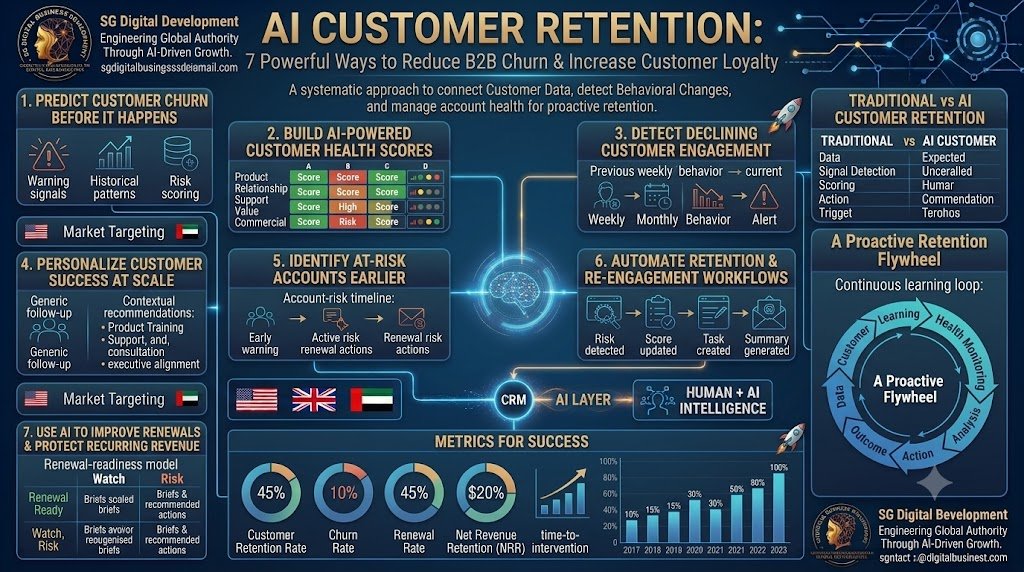
AI Customer Retention: 7 Powerful Ways to Reduce B2B Churn & Increase Customer Loyalty. Introduction Winning a B2B customer is only the beginning of the revenue relationship. After the contract is signed, the business still has to deliver value, maintain engagement, support adoption, manage expectations and demonstrate that the relationship is worth continuing. That makes customer retention one of the most important components of a sustainable B2B revenue strategy. The challenge is that customer churn rarely begins on the day a customer cancels. In many cases, warning signs appear much earlier. Product usage may decline. Key stakeholders may become less engaged. Support issues may remain unresolved. A customer may stop attending meetings. A champion may leave the organization. Business priorities may change. The customer may fail to achieve the outcome that originally justified the purchase. These signals can exist across different systems, teams and conversations. This is where AI customer retention becomes valuable. AI can help businesses bring together customer data, usage patterns, engagement signals, CRM information, support interactions and commercial indicators to identify accounts that may require attention. Research into B2B customer success identifies customer health as an important mechanism for proactive retention, combining factors such as relationship quality, product usage and customer value realization. The objective is not to predict churn and then automatically bombard customers with messages. The objective is to identify risk earlier, understand why the risk may exist, and give customer-facing teams enough context to take a useful action. In 2026, the direction of B2B retention is increasingly moving from reactive reporting toward proactive systems that combine health monitoring, risk detection, intervention workflows and organizational learning. This article explains 7 powerful AI customer retention strategies B2B companies can use to reduce avoidable churn, improve customer health, strengthen relationships and protect recurring revenue. What Is AI Customer Retention? AI customer retention is the use of artificial intelligence, customer data and predictive analysis to identify retention risks, understand customer behavior and help businesses take proactive action to maintain valuable customer relationships. Traditional retention processes often depend on: These methods can work, but they can also leave organizations reacting after important warning signs have already appeared. AI customer retention adds a continuous intelligence layer. Instead of asking only: “Which customers are renewing this month?” the business can ask: “Which customers are showing behavioral or commercial signals that may require attention right now?” That distinction changes retention from a calendar-based activity into an ongoing customer intelligence process. AI can analyze combinations of signals such as: No single signal necessarily proves that a customer is going to churn. The value comes from understanding patterns across multiple signals. Why Customer Retention Matters in B2B Customer retention matters because B2B relationships often develop over time. A customer may initially purchase one service or product and gradually increase its relationship with the provider. Over time, the customer may: When a customer leaves, the business can lose not only the current contract but also potential future revenue. This is why retention connects directly with customer lifetime value. Your AI Customer Lifetime Value strategy asks: How much long-term economic value could this customer generate? Your AI Customer Expansion strategy asks: Where can this customer relationship grow? Your AI Customer Retention strategy asks: What can we do to protect the relationship and prevent avoidable revenue loss? Together, these three areas form an important customer revenue intelligence layer. AI Customer Retention vs Traditional Retention Traditional customer retention often relies on scheduled reviews. For example: Quarterly review → customer health discussion → renewal preparation → account action AI customer retention can create a more continuous process: Customer activity → signal detection → risk analysis → prioritization → intervention → outcome measurement The difference is not simply automation. It is the ability to process a larger volume of customer information consistently. Traditional Retention AI Customer Retention Periodic reviews Continuous monitoring Manual account analysis AI-assisted analysis Static health scores Dynamic health signals Renewal-focused Relationship-focused Reactive intervention Proactive intervention Limited data sources Multiple data sources Generic follow-up Contextual recommendations Manual prioritization Risk-based prioritization AI does not eliminate customer success teams. Instead, it can help them determine where their attention is most valuable. How AI Customer Retention Works An effective AI customer retention system usually combines several data layers. 1. Customer Relationship Data This may include: 2. Product or Service Usage Depending on the business, this could include: 3. Engagement AI can evaluate: 4. Support Support data can provide important context: 5. Commercial Signals These can include: 6. Relationship Signals AI can also help identify: The goal is to create a more complete view of customer health. 7 Powerful AI Customer Retention Strategies 1. Predict Customer Churn Before It Happens One of the most obvious applications of AI customer retention is churn-risk prediction. A traditional approach may identify a customer as at risk when they say: “We are considering not renewing.” At that point, the company may already be late. AI can instead look for patterns that appear earlier. For example: A single signal is not necessarily enough. But several signals appearing together can justify a closer review. An AI model can assign an account a risk score based on historical patterns and current customer behavior. For example: Low Risk Stable usage + strong engagement + healthy relationship. Moderate Risk Some engagement decline + unresolved issues + lower product adoption. High Risk Sharp usage decline + negative engagement + unresolved problems + approaching renewal. The score should not be treated as certainty. It should be treated as a prioritization signal. This distinction is critical. A model can tell a customer success team: “This account deserves attention.” The customer success team still needs to determine: “Why?” and: “What should we do?” 2. Build AI-Powered Customer Health Scores Customer health scores have traditionally been built using manually selected rules. For example: The problem is that the same weighting may not work for every customer segment. AI customer retention can help identify which combinations of signals historically correlate with retention or churn. A modern