AI pricing optimization
AI Growth Engine

AI Pricing Optimization: 7 Powerful Ways to Increase B2B Revenue & Profit.

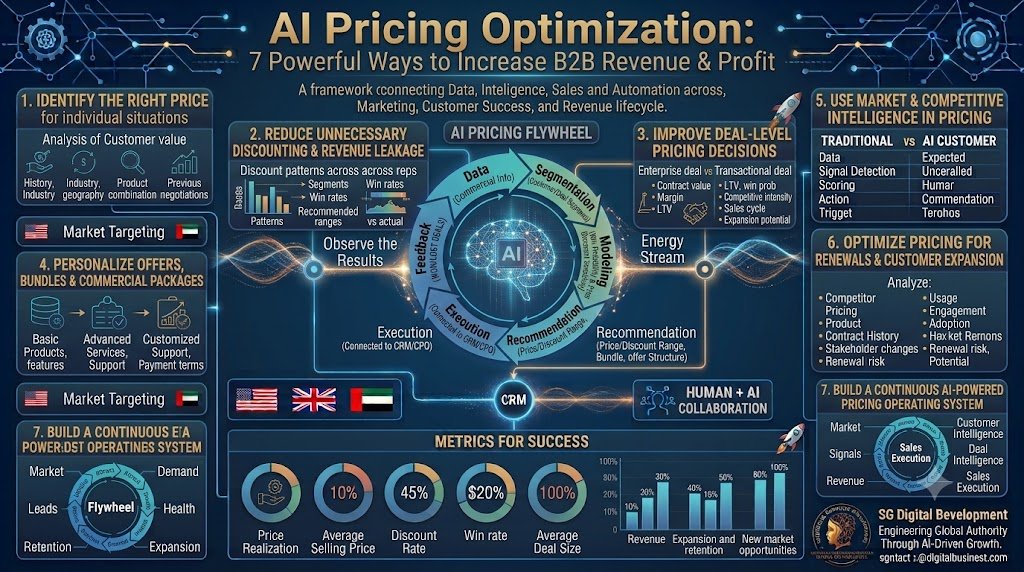
AI Pricing Optimization: 7 Powerful Ways to Increase B2B Revenue & Profit. Introduction Pricing is one of the most important decisions a B2B company makes. It influences revenue, margins, customer acquisition, deal velocity, sales performance and long-term profitability. Yet pricing decisions are often still based on a combination of historical prices, spreadsheets, competitor observations, sales experience and manual approval processes. That becomes increasingly difficult as businesses manage more customers, products, services, markets, contracts and sales opportunities. This is where AI pricing optimization can change the way businesses approach commercial decisions. Instead of relying only on static price lists or historical averages, AI can analyze customer behavior, deal characteristics, market conditions, competitive signals, discounts, purchase history and other variables to help businesses make more informed pricing decisions. McKinsey’s 2026 research describes a shift from human-led pricing supported by analytics toward AI-orchestrated pricing systems that can use data, recommendations, workflow automation and human oversight at greater scale. Its survey of more than 400 B2B pricing executives found substantial expected adoption of generative and agentic AI in pricing over the following one to three years. The opportunity is not simply to charge higher prices. The objective is to determine the right commercial price for the right customer, offer, market, situation and moment. That can mean: This article explains 7 powerful ways AI pricing optimization can improve B2B revenue and profitability, how the technology works, where it fits into the revenue lifecycle and how companies can implement it responsibly. What Is AI Pricing Optimization? AI pricing optimization is the use of artificial intelligence, machine learning, customer data, market intelligence and commercial analytics to determine, recommend or improve pricing decisions. Traditional pricing often begins with: Cost + margin + competitor price + management judgment An AI-powered approach can consider a much larger set of variables. These may include: The system can then identify patterns and provide pricing recommendations. For example, an AI system might determine that a particular customer segment consistently accepts a specific price range while another segment requires a different offer structure. It may also identify that certain discounts improve win rates while others simply reduce margin without materially increasing conversion. That distinction is extremely valuable. Why Pricing Optimization Matters in B2B B2B pricing is often complicated. A company may sell: The same product or service may therefore have different commercial economics depending on the customer and context. Consider two deals Deal A Contract value: $100,000Discount: 5%Expected margin: Strong Deal B Contract value: $100,000Discount: 25%Expected margin: Significantly lower Revenue reporting may show similar contract values. Profitability does not. This is why pricing should not be viewed only as a sales conversion mechanism. It is part of the revenue system. McKinsey’s 2026 B2B sales research describes pricing as one of the commercial workflows where AI can connect customer context, historical deal data, recommendations and execution. How AI Pricing Optimization Works A typical AI pricing system combines several layers. 1. Data The system collects relevant commercial information. Examples include: 2. Segmentation AI identifies customer and deal segments. Examples: 3. Modeling Machine learning models identify patterns between pricing variables and commercial outcomes. These may include: 4. Recommendation The system can recommend: 5. Execution Recommendations can be connected to: 6. Feedback Closed deals provide new information. The system learns from: This creates a continuous pricing intelligence loop. 7 Powerful Ways AI Pricing Optimization Can Improve B2B Revenue 1. Identify the Right Price for Each Customer and Deal One of the most important applications of AI pricing optimization is determining a more appropriate price for individual commercial situations. Traditional pricing often starts with a standard price. AI can introduce more context. The system can analyze: This does not necessarily mean every customer receives a different price. Instead, AI can help determine where pricing flexibility may be appropriate. Example Suppose a B2B company has three customer groups: Segment A High valueLow price sensitivityLong contract potential Segment B Medium valueModerate price sensitivityHigh competition Segment C Lower valueHigh price sensitivityShort contracts A single pricing strategy may not maximize commercial performance across all three. AI can identify patterns in historical transactions and help sales teams understand where pricing flexibility creates value and where it simply reduces margin. The result Sales teams can approach negotiations with greater context. Instead of asking: “How much discount should I give?” they can ask: “What commercial structure is appropriate for this customer and opportunity?” That is a much stronger pricing question. 2. Reduce Unnecessary Discounting and Revenue Leakage Discounting is one of the most common sources of pricing leakage in B2B. Sales teams may discount because: Some discounts are commercially justified. Others may not be. AI pricing optimization can analyze historical deals to identify patterns in discount behavior. For example, the system may find that: AI-powered discount guidance An AI system can provide a recommended range. For example: Recommended discount: 5–8% Typical range for similar deals: 4–9% Discount above 12%: Approval required This gives sellers context before they negotiate. The objective is not to eliminate sales judgment. It is to give salespeople better information. McKinsey’s 2026 pricing research specifically identifies discount guidance, deal scoring and pricing workflow support as areas where AI can improve commercial decision-making. 3. Improve Deal-Level Pricing Decisions Not every deal should be evaluated using the same pricing logic. An enterprise opportunity with a large contract and long-term expansion potential is different from a small transactional opportunity. AI can evaluate deal-level variables such as: This creates a deal quality score. Example A sales representative receives an enterprise opportunity. The proposed deal is: $500,000 annual contract20% discountThree-year agreement AI analyzes comparable historical deals and identifies: The system may recommend reconsidering the discount. The salesperson can then enter the negotiation with stronger evidence. Pricing becomes part of deal intelligence This creates a connection between: AI Account Intelligence → AI Sales Pipeline → AI Revenue Intelligence → AI Pricing Optimization The result is a more connected commercial workflow. 4. Personalize Offers, Bundles and Commercial Packages Pricing is not always about the number on the invoice. The
AI revenue attribution
AI Growth Engine

AI Revenue Attribution: 7 Powerful Ways to Connect Marketing, Sales & Revenue.

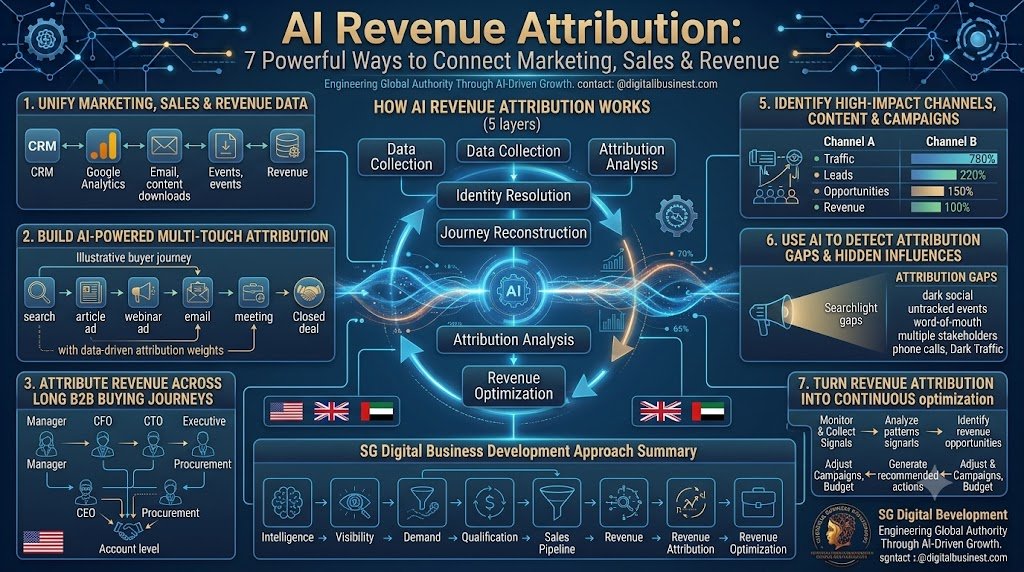
AI Revenue Attribution: 7 Powerful Ways to Connect Marketing, Sales & Revenue. Introduction B2B companies generate revenue through journeys that rarely follow a straight line. A prospect may discover a company through Google, encounter its content in AI search, click a LinkedIn post, return through an email, attend a webinar, speak with a salesperson, revisit the website several times and eventually become a customer. Then another question appears: Which of those activities actually contributed to the revenue? That is where AI revenue attribution becomes increasingly important. Traditional reporting often separates marketing performance, sales performance, customer activity and revenue data into different systems. Marketing may report leads and campaign conversions. Sales may report opportunities and closed deals. Customer success may report renewals and expansion. Finance ultimately reports revenue. The problem is that revenue does not happen inside one department. It happens across the customer journey. Modern attribution systems attempt to connect those interactions to business outcomes. HubSpot, for example, now provides attribution reporting across contacts, deals and revenue, while Google Analytics provides data-driven attribution that uses machine learning to evaluate how different interactions influence key events. For B2B organizations, the challenge is even greater because buying journeys can involve multiple people, channels, campaigns and offline interactions. Gartner’s 2026 research highlights the complexity directly: B2B organizations struggle to demonstrate marketing ROI across complex, multichannel buying journeys, while multitouch attribution tools are increasingly being used to address that problem. AI can help businesses move from basic attribution reporting toward a more connected revenue intelligence system. Instead of asking only: “Which channel generated the lead?” companies can begin asking: This article explains 7 powerful ways AI revenue attribution can connect marketing, sales and revenue, and how businesses can build a more reliable attribution system without treating attribution as perfect or absolute truth. What Is AI Revenue Attribution? AI revenue attribution is the use of artificial intelligence, machine learning, customer data and attribution models to understand how marketing, sales and customer interactions contribute to revenue outcomes. Traditional attribution assigns credit to touchpoints according to predefined rules. AI can make the system more adaptive. Instead of relying exclusively on a fixed model, an AI-powered system can analyze large amounts of customer journey data to identify patterns across: The goal is not simply to give every touchpoint a number. The goal is to understand the relationship between customer interactions and business outcomes. Google describes attribution models as rules or algorithms used to assign credit to interactions along the path toward an important action. Its data-driven attribution uses machine learning to compare converting and non-converting paths and estimate the contribution of interactions. In B2B, however, revenue attribution requires an even broader perspective. A single person rarely represents the entire buying journey. An account might have: The revenue event happens at the account level, while the interactions occur across multiple people. That makes AI revenue attribution particularly useful for organizations selling complex B2B products and services. Why Traditional Attribution Often Falls Short Attribution has existed for years. Businesses have used first-touch, last-touch, linear, time-decay and other models to distribute credit. The problem is not that these models are useless. The problem is that no single model can perfectly explain every B2B buying journey. HubSpot currently supports multiple attribution models, including first touch, last touch, linear, time decay and empirical attribution. Each model answers a slightly different question. First-touch attribution First-touch attribution gives credit to the first tracked interaction. It can help answer: Where did this customer initially discover us? But it may ignore everything that happened afterward. Last-touch attribution Last-touch attribution gives credit to the interaction closest to conversion. It can help answer: What happened immediately before conversion? But the final interaction may not explain the entire journey. Linear attribution Linear attribution distributes credit across multiple interactions. This provides a broader view but assumes each interaction deserves equal weight. Time-decay attribution Time-decay models give more credit to interactions closer to conversion. This can be useful when recent interactions are especially relevant. Data-driven attribution Data-driven models use observed data and machine learning to estimate contribution. Google’s current data-driven attribution methodology evaluates converting and non-converting paths and uses algorithmic calculations to distribute credit. The important point is simple: Attribution is a measurement framework, not an objective record of causality. That distinction matters. A touchpoint receiving 30% attribution does not necessarily mean it caused exactly 30% of the revenue. Instead, the number represents the logic of the selected attribution methodology. That is why advanced B2B organizations increasingly need attribution and experimentation. Gartner’s 2026 research specifically recommends combining attribution and testing to improve marketing measurement. How AI Revenue Attribution Works A modern AI revenue attribution system generally connects five layers. 1. Data collection The system collects customer and business interaction data. Examples include: 2. Identity resolution The system attempts to connect interactions to: This is especially important in B2B. 3. Journey reconstruction AI can organize interactions into customer or account journeys. For example: Search → Website → Content → Webinar → Sales Meeting → Opportunity → Proposal → Closed Won 4. Attribution analysis The system applies an attribution methodology to estimate contribution. This can include: 5. Revenue optimization The final step is turning measurement into action. Instead of simply reporting: Campaign A influenced $500,000 the business can ask: What should we do differently because Campaign A appears to influence revenue? That is where AI can turn attribution into an operating system for growth. 7 Powerful Ways AI Revenue Attribution Can Improve B2B Growth 1. Unify Marketing, Sales & Revenue Data One of the biggest problems in B2B measurement is fragmentation. Marketing data may exist in an advertising platform. Website data may exist in analytics. Sales activity may exist in a CRM. Customer information may exist in another platform. Revenue data may sit with finance. When these systems are disconnected, attribution becomes incomplete. AI revenue attribution starts by creating a connected data foundation. The system should ideally connect: Marketing → Engagement → Lead → Account → Opportunity → Customer → Revenue This allows

AI revenue enablement
AI Growth Engine

AI Revenue Enablement: 7 Powerful Ways to Improve B2B Sales Performance.

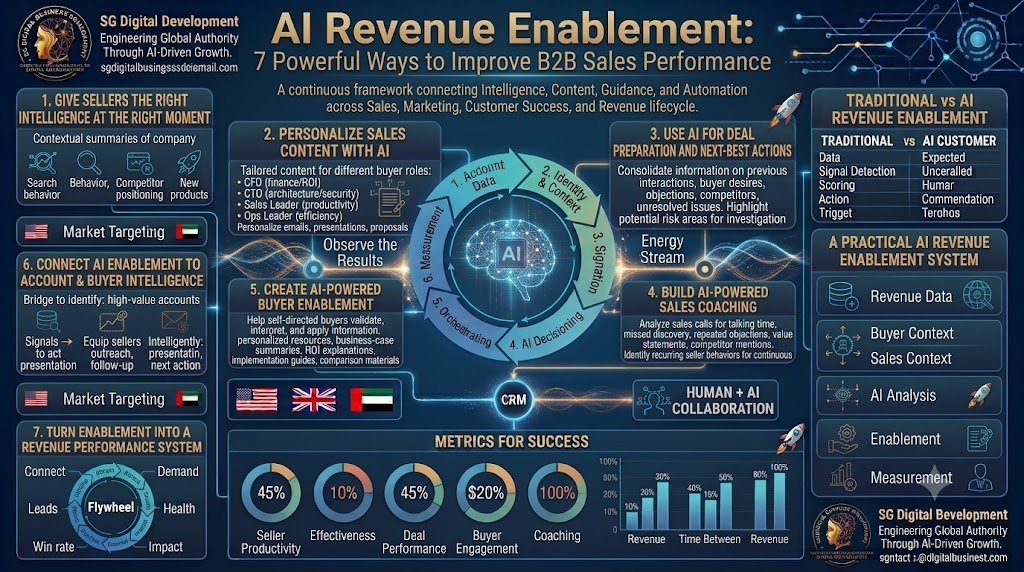
AI Revenue Enablement: 7 Powerful Ways to Improve B2B Sales Performance. Introduction B2B sales teams have more information available to them than ever before. They have CRM data, account intelligence, buyer intent signals, sales conversations, customer information, content libraries, competitive intelligence and analytics. Yet having more information does not automatically make selling easier. Salespeople still need to answer practical questions every day: This is where AI revenue enablement becomes important. Traditional revenue enablement often depends on training programs, sales playbooks, content libraries, onboarding sessions, coaching meetings and periodic performance reviews. Those activities still have value. But modern B2B buying journeys are becoming more digital, self-directed and AI-assisted. Gartner reported in 2026 that 67% of surveyed B2B buyers preferred a rep-free experience, while 45% said they had used generative AI during a recent purchase. That changes what sellers need to do. Sales teams increasingly need to help buyers validate information, understand business value, compare alternatives, build internal consensus and move confidently through complex buying decisions. At the same time, sellers need better intelligence inside their own workflows. AI can help deliver that intelligence. Forrester’s September 2026 research describes the evolution of AI in revenue enablement from basic efficiency and content-generation use cases toward seller productivity, coaching, practice and competency development. This means revenue enablement is evolving from a collection of training and content activities into a more connected commercial capability. In this guide, we will explore 7 powerful AI revenue enablement strategies that can help B2B companies improve seller readiness, deal execution, buyer support, coaching, personalization and revenue performance. What Is AI Revenue Enablement? AI revenue enablement is the use of artificial intelligence, data, automation and intelligent workflows to equip revenue teams with the information, guidance, content, coaching and insights they need to perform better throughout the buyer and customer journey. Traditional revenue enablement may include: AI can make these capabilities more dynamic. Instead of asking a salesperson to search through a large content library, an AI system can identify the relevant resource based on: The difference is important. Traditional enablement often asks: What resources are available? AI revenue enablement can ask: What does this seller and buyer need right now? That moves enablement closer to the actual flow of the deal. AI Revenue Enablement vs Traditional Revenue Enablement Traditional enablement is often structured around scheduled activities. For example: Training ↓ Certification ↓ Content Library ↓ Sales Playbook ↓ Manager Coaching ↓ Performance Review AI revenue enablement can create a more continuous model. Buyer Signal ↓ AI Analysis ↓ Contextual Recommendation ↓ Seller Action ↓ Outcome ↓ Learning The system can then use the outcome to improve future recommendations. Traditional Enablement AI Revenue Enablement Static playbooks Dynamic guidance Periodic training Continuous learning Large content libraries Contextual recommendations Manual deal research AI-assisted preparation Generic messaging Buyer-specific messaging Scheduled coaching Continuous coaching Manual analysis Automated insight generation Activity metrics Revenue-linked metrics Gartner’s 2026 research argues that sales enablement needs to move beyond static content and training toward AI-driven support embedded in sellers’ workflows. Why AI Revenue Enablement Matters B2B sales is becoming more complex. A typical buying process can involve: The seller therefore needs more than a product presentation. The seller needs context. AI revenue enablement can help provide that context. It can help sellers: It can help managers: It can help buyers: The goal is therefore not simply to make salespeople faster. The goal is to make revenue execution more intelligent. How AI Revenue Enablement Works A mature AI revenue enablement system connects several layers. 1. Revenue Data The system uses information from sources such as: 2. Buyer Context The system tries to understand: 3. Sales Context The system also understands: 4. AI Analysis AI identifies patterns and creates useful recommendations. For example: This account has engaged with pricing information but has not interacted with implementation resources. That may suggest the seller should address implementation risk. 5. Enablement Action The system can recommend: 6. Measurement The organization measures whether the recommendation influenced: This creates a continuous improvement loop. 7 Powerful AI Revenue Enablement Strategies 1. Give Sellers the Right Intelligence at the Right Moment One of the biggest problems with traditional enablement is that useful information often exists somewhere, but sellers have to find it themselves. A salesperson might have access to: The problem is not necessarily lack of content. It is lack of context. AI can change this by delivering information based on the current situation. For example, imagine a salesperson preparing for a meeting with a financial-services company. AI could summarize: The salesperson starts the meeting with context rather than spending an hour gathering information. In-workflow intelligence The most valuable enablement happens where the seller is already working. Instead of: Search the enablement portal. the experience becomes: Here are the three resources most relevant to this opportunity. Instead of: Review the entire account. the experience becomes: These are the five changes that matter for this account. Instead of: Find a response to this objection. the experience becomes: Here are two approved responses and a relevant customer example. This is a major shift from content availability to contextual intelligence. 2. Personalize Sales Content with AI B2B buyers do not all have the same priorities. A CFO may care about: A CTO may care about: A sales leader may care about: A customer-success leader may care about: Sending everyone the same presentation is therefore inefficient. AI can help sellers personalize content based on: For example: A generic case study can become a more targeted resource emphasizing the outcomes most relevant to a specific buyer. Content personalization can include: The objective is not to generate unlimited content. The objective is to deliver the most relevant content. 3. Use AI for Deal Preparation and Next-Best Actions Deal preparation is one of the strongest opportunities for AI revenue enablement. Before an important meeting, sellers need to understand: AI can consolidate this information. Example Suppose an opportunity has been open for 90 days. AI identifies: Instead of simply reporting these facts, the system can highlight

AI market intelligence
AI Growth Engine

AI Market Intelligence: 7 Powerful Ways to Find B2B Growth Opportunities.

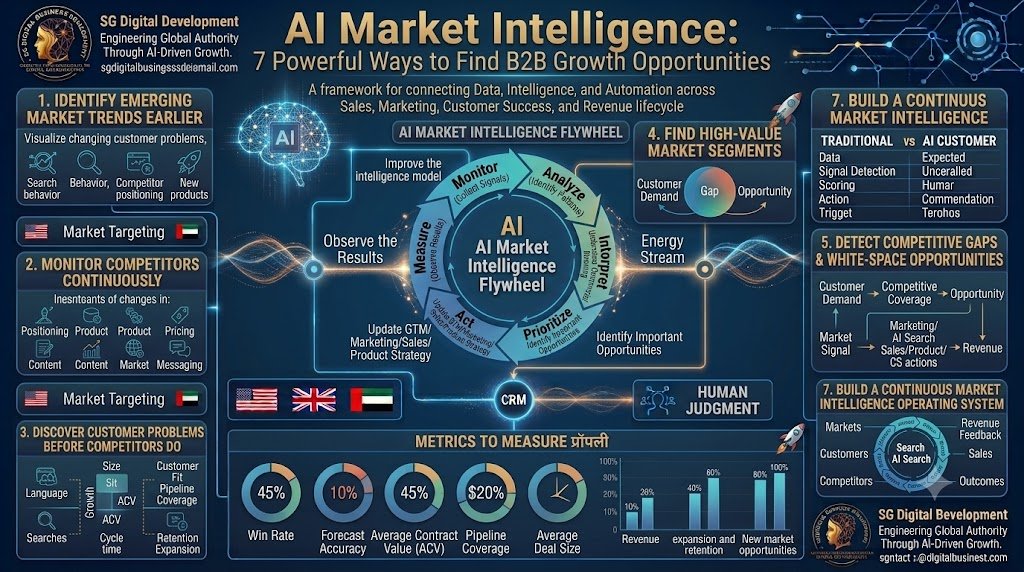
AI Market Intelligence: 7 Powerful Ways to Find B2B Growth Opportunities. Introduction B2B companies make thousands of decisions about markets, customers, competitors, products, pricing and growth. The quality of those decisions depends heavily on the quality of the intelligence behind them. A company may need to determine: Traditionally, businesses have answered these questions through market research, analyst reports, surveys, spreadsheets, competitor monitoring and manual analysis. Those methods remain useful. But the volume and speed of market information have changed. Customer conversations happen across digital channels. Competitors change positioning quickly. Search behavior evolves. New products appear. Pricing changes. AI search influences discovery. Industry conversations move faster. This creates an opportunity for AI market intelligence. AI market intelligence uses artificial intelligence, data analysis, automation and contextual intelligence to help businesses understand markets, competitors, customers and emerging opportunities. Instead of analyzing market information periodically, companies can build systems that continuously monitor relevant signals. The objective is not simply to collect more data. It is to turn market data into actionable commercial intelligence. McKinsey’s 2026 research on B2B pricing identifies market and competitive intelligence as one of the areas where AI adoption is already relatively mature, while also describing the broader shift toward AI-orchestrated commercial processes. At the same time, McKinsey’s 2026 B2B research emphasizes that companies are increasingly using AI to rewire commercial workflows around customer and market intelligence rather than simply adding isolated AI tools. For B2B organizations, this means market intelligence can become a continuous operating capability rather than an occasional research exercise. In this guide, we will explore 7 powerful AI market intelligence strategies for identifying market trends, understanding competitors, discovering customer demand and finding new B2B growth opportunities. What Is AI Market Intelligence? AI market intelligence is the use of artificial intelligence, data, automation and analytical systems to collect, organize, analyze and interpret information about markets, customers, competitors and business opportunities. Traditional market intelligence may involve: AI can help bring these information sources together and analyze them continuously. An AI market intelligence system may monitor: The objective is to answer questions such as: What is changing? Why is it changing? Who is affected? What opportunity does this create? What should the business do next? That final question is particularly important. Intelligence becomes valuable when it improves decisions. AI Market Intelligence vs Traditional Market Research Market research and market intelligence are closely related, but they are not identical. Market research often focuses on answering a specific question. For example: How large is the market for this product? Market intelligence is broader. It continuously monitors the environment surrounding the business. For example: Which customer needs are changing, which competitors are responding, and where are new opportunities emerging? AI can make this intelligence more continuous. Traditional Market Intelligence AI Market Intelligence Periodic research Continuous monitoring Manual data collection Automated data gathering Static reports Dynamic intelligence Human-led analysis AI-assisted analysis Historical information Historical + emerging signals Competitor snapshots Competitor monitoring Broad segments Dynamic segments Manual interpretation Pattern detection Scheduled reviews Real-time or frequent alerts AI does not eliminate human analysis. Instead, it can reduce the time required to find patterns and give teams more time to interpret what those patterns mean. Why AI Market Intelligence Matters B2B markets are becoming more complex. A business can face changes in: A market opportunity that looks attractive today may change quickly. This is why businesses need intelligence that is both broad and current. AI market intelligence can help businesses: Identify emerging demand Discover customer problems before they become obvious. Monitor competitors Track changes in positioning, products and commercial activity. Improve market selection Determine which industries or regions deserve more attention. Improve customer targeting Identify segments with stronger commercial potential. Detect opportunities earlier Find signals that may indicate emerging demand. Improve positioning Understand how competitors and customers describe a problem. Support GTM strategy Connect market intelligence directly to marketing and sales decisions. The result is a more informed growth system. How AI Market Intelligence Works A practical AI market intelligence system can be organized into six layers. Layer 1: Data Collection Collect relevant information from: Layer 2: Data Organization AI organizes information into useful categories. For example: Layer 3: Pattern Detection AI looks for: Layer 4: Contextual Analysis The system asks: What does this signal mean for this business? This is where context becomes important. HubSpot’s 2026 GTM research similarly emphasizes that AI becomes more useful when it has business context, including knowledge about customers, markets and how teams operate. Layer 5: Opportunity Identification AI can classify signals into areas such as: Layer 6: Action The final output may be: The objective is: Data → Intelligence → Opportunity → Action 7 Powerful AI Market Intelligence Strategies 1. Identify Emerging Market Trends Earlier Markets rarely change overnight. They usually produce signals first. Customers start discussing a new problem. Search behavior changes. New competitors appear. Existing companies launch new products. Industry publications begin covering a topic. AI can help identify these signals earlier. What can AI monitor? Depending on the business, an intelligence system can track: The goal is not to react to every new trend. The goal is to identify patterns that are relevant to the business. From isolated signals to trends One mention of a new customer problem may not mean much. But if the same problem appears across: the signal becomes stronger. AI can help connect these occurrences. That can give leadership an earlier indication that something is changing. 2. Monitor Competitors Continuously Competitor intelligence is one of the most obvious applications of AI market intelligence. Businesses need to understand: Traditional competitor research might happen quarterly. AI can help businesses monitor relevant changes more frequently. Competitive intelligence signals An AI system can track changes in: Positioning How is the competitor describing its value? Product What has changed? Pricing Are pricing structures or offers changing? Content Which topics are competitors emphasizing? Market Which industries or regions are they targeting? Messaging Which customer problems are they focusing on? Why continuous monitoring matters A competitor does not need

AI go-to-market strategy
AI Growth Engine

AI Go-To-Market Strategy: 7 Powerful Ways to Build a B2B Growth Engine.

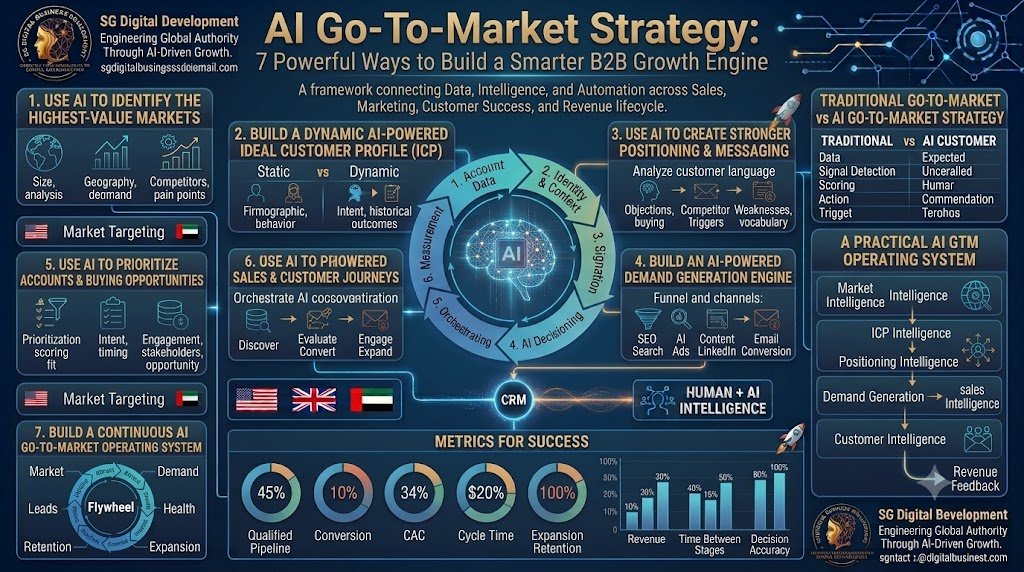
AI Go-To-Market Strategy: 7 Powerful Ways to Build a Smarter B2B Growth Engine. Introduction B2B companies have more data, more marketing channels and more sales technology than ever before. Yet many businesses still struggle with one fundamental question: Who should we target, what should we offer them, where should we reach them, and how should we turn that attention into revenue? That is a go-to-market problem. A traditional go-to-market strategy usually brings together: AI is changing how businesses can approach each of these areas. An AI go-to-market strategy uses artificial intelligence, customer intelligence, market data, automation and predictive analysis to make GTM decisions more informed, connected and responsive. Instead of creating a GTM plan once and reviewing it every few months, businesses can build systems that continuously analyze: This creates a shift from a static GTM plan to an adaptive growth system. The change is already visible in current B2B research. McKinsey’s 2026 research describes companies redesigning commercial workflows around AI and emphasizes end-to-end commercial impact journeys rather than simply adding isolated AI tools. HubSpot similarly recommends that GTM teams begin with specific business problems and measurable outcomes rather than adopting AI simply because the technology is available. For B2B companies, this creates a major opportunity. Instead of asking: How can we use AI in marketing? businesses can ask: How can AI improve the entire way we go to market? In this guide, we will explore 7 powerful AI go-to-market strategy approaches that can help businesses identify better markets, understand ideal customers, improve positioning, generate demand, strengthen sales execution and create a more connected B2B growth engine. What Is an AI Go-To-Market Strategy? An AI go-to-market strategy is a GTM framework that uses artificial intelligence, data, automation and predictive intelligence to improve how a business identifies markets, targets customers, communicates value, generates demand, converts opportunities and grows existing accounts. Traditional GTM planning often relies on research conducted at specific points in time. For example: An AI-powered model can make this process continuous. The system can continually evaluate: Market Which markets are becoming more attractive? Customers Which companies are most likely to need the solution? Intent Which accounts are showing buying signals? Positioning Which messages are producing engagement? Demand Which channels are generating qualified opportunities? Sales Which opportunities are progressing? Customers Which accounts are likely to renew or expand? This creates a feedback loop. Market Intelligence → Customer Intelligence → Demand → Sales → Customer Growth → Revenue Data → New Intelligence That is the foundation of an AI-driven GTM system. Why AI Is Changing Go-To-Market Strategy Traditional GTM models often depend on assumptions. A company might define its ideal customer based on: These are useful starting points. But they do not always explain who is actually ready to buy. AI allows businesses to combine traditional customer characteristics with behavioral and contextual signals. For example: A company may fit the ICP perfectly but show no buying activity. Another company may be slightly outside the traditional ICP but demonstrate: The second account may deserve more immediate attention. This is one reason AI can change GTM from static segmentation to dynamic prioritization. AI Go-To-Market Strategy vs Traditional GTM Traditional GTM AI Go-To-Market Strategy Periodic market research Continuous market intelligence Static ICP Dynamic ICP Broad segmentation Signal-based prioritization Fixed messaging Adaptive messaging Campaign-based demand generation Continuous demand intelligence Manual account research AI-assisted account intelligence Standard sales sequences Context-aware sales workflows Historical reporting Predictive intelligence Separate departmental data Connected GTM intelligence Periodic strategy reviews Continuous optimization The goal is not to eliminate strategic planning. Instead, AI can make GTM planning more responsive to changing market conditions. How an AI Go-To-Market Strategy Works A practical AI GTM system can be organized into seven layers. 1. Market Intelligence Analyze: 2. Customer Intelligence Understand: 3. Positioning Intelligence Analyze: 4. Demand Generation Use insights to improve: 5. Sales Intelligence Support: 6. Customer Intelligence Monitor: 7. Revenue Feedback Connect outcomes back to the GTM system. This means the strategy can continuously improve. 7 Powerful AI Go-To-Market Strategy Approaches 1. Use AI to Identify the Highest-Value Markets The first question in any GTM strategy should be: Where should we compete? A business can have an excellent product and still struggle if it targets the wrong market. Traditional market research can identify: AI can help analyze these signals at greater scale. An AI-powered market intelligence system can evaluate: This can help identify markets where multiple positive signals overlap. Market scoring A company could evaluate potential markets based on: Market attractiveness Is demand increasing? Customer fit Does the business solve a meaningful problem? Competitive intensity How difficult is differentiation? Buying readiness Are potential customers actively looking for solutions? Commercial value Can the company acquire and serve these customers profitably? AI can help bring these factors together. Example Imagine a B2B AI consultancy considering three markets: Instead of selecting one based only on intuition, the company can analyze: The output becomes a market opportunity map. This does not replace strategic judgment. It improves the evidence available for that judgment. 2. Build a Dynamic AI-Powered Ideal Customer Profile An ICP should not remain a static document. Markets change. Customers change. Products change. Buying behavior changes. Therefore, the ideal customer profile should evolve as new data becomes available. AI can help create a dynamic ICP using: The most valuable insight may come from comparing: Customers you thought were ideal with Customers that actually produce strong commercial outcomes. For example, a business may believe its ideal customers are companies with 500+ employees. But after analyzing revenue, retention and expansion, AI may reveal that companies with 100–300 employees generate: That information can change the GTM strategy. Dynamic ICP scoring A dynamic ICP can include: Firmographic fit How closely does the account match the target profile? Problem fit How relevant is the company’s problem? Intent Is the account showing buying signals? Engagement How much meaningful interaction is occurring? Commercial potential What is the potential value? Historical similarity How closely does the account resemble successful customers? This creates a

AI revenue operations
AI Growth Engine

AI Revenue Operations: 7 Powerful Ways to Align Sales, Marketing & Revenue

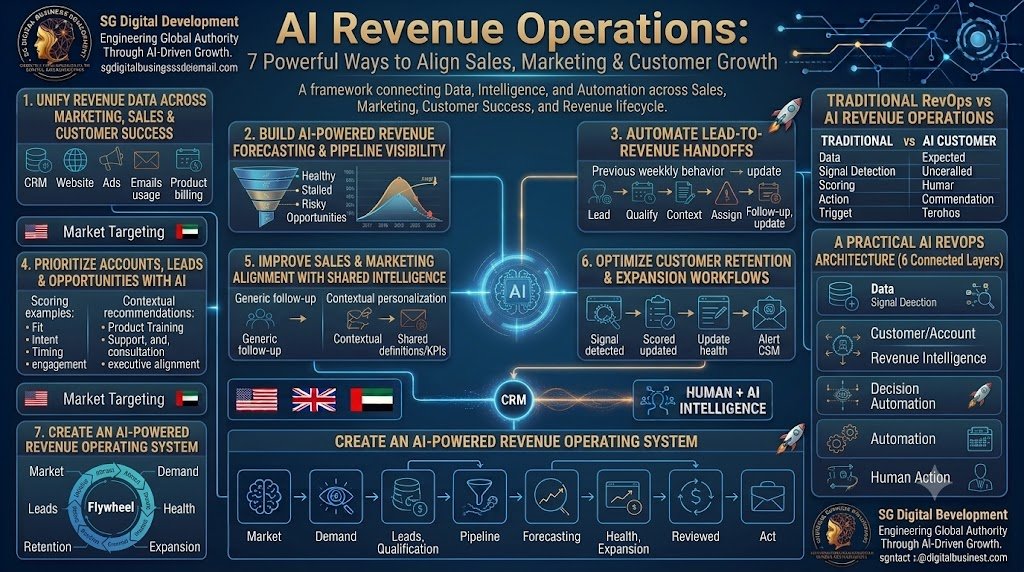
AI Revenue Operations: 7 Powerful Ways to Align Sales, Marketing & Customer Growth Introduction B2B revenue rarely depends on one department. Marketing creates demand. Sales converts opportunities. Customer success protects relationships and creates expansion opportunities. Finance measures revenue. Operations connects the systems behind all of them. Yet many businesses still operate these functions as separate systems. Marketing may measure leads. Sales may measure opportunities. Customer success may measure retention. Finance may measure recognized revenue. Leadership may look at all of these numbers and still struggle to understand what is actually happening across the revenue lifecycle. This is where AI revenue operations becomes increasingly important. Revenue operations, commonly called RevOps, is designed to connect the teams, processes, data and technology involved in generating and retaining revenue. Salesforce describes RevOps as a framework that aligns revenue-related activities across functions such as marketing, sales, customer success and finance. AI adds another layer. Instead of simply connecting systems, businesses can use AI to analyze large volumes of revenue data, identify patterns, prioritize accounts and opportunities, automate workflows, detect risks and recommend next actions. Recent industry research is also moving toward this broader model. HubSpot describes revenue intelligence as an AI-driven approach that connects revenue data across the customer lifecycle so RevOps teams can forecast, prioritize and act on insights. The result is a shift from disconnected departmental optimization toward a connected revenue system. In this guide, we will explore 7 powerful AI revenue operations strategies that B2B companies can use to connect marketing, sales, customer success, account intelligence, pipeline management and revenue growth. What Is AI Revenue Operations? AI revenue operations is the use of artificial intelligence, connected data, automation and revenue processes to coordinate the teams and systems responsible for generating, converting, retaining and expanding revenue. Traditional RevOps focuses heavily on alignment. AI revenue operations adds intelligence and automation to that alignment. Instead of simply asking: What happened? an AI-powered RevOps system can help answer: This changes the role of RevOps from reporting and coordination toward continuous revenue optimization. A connected RevOps system can bring together: AI can then analyze these signals to identify patterns and recommend actions. The objective is not to replace revenue teams. The objective is to give them better intelligence and better operating systems. Why AI Revenue Operations Matters for B2B Companies As companies grow, their revenue systems become more complicated. More channels create more data. More products create more customer journeys. More salespeople create more CRM activity. More customers create more retention and expansion opportunities. More technology creates more disconnected systems. This creates a common problem: data exists everywhere, but actionable revenue intelligence exists nowhere. Salesforce identifies fragmented data, inconsistent processes and communication breakdowns as common obstacles RevOps is designed to address. AI revenue operations addresses this by creating a connected layer between data, people, processes and revenue outcomes. 1. It connects revenue teams Marketing, sales and customer success can work from shared revenue definitions and customer information. 2. It improves visibility Leadership can see how demand generation, pipeline, conversion, retention and expansion connect. 3. It reduces manual work Repetitive reporting, routing, data enrichment and workflow tasks can be automated. 4. It improves prioritization AI can help identify which accounts, leads and opportunities deserve attention. 5. It connects acquisition with retention Revenue does not end when a contract is signed. Customer health, renewals, expansion and lifetime value also matter. 6. It creates a feedback loop Revenue outcomes can feed information back into marketing, sales and customer success. That creates a more intelligent revenue engine. AI Revenue Operations vs Traditional RevOps Traditional RevOps and AI revenue operations share the same fundamental objective: connecting revenue-generating functions. The difference is the level of intelligence and automation. Traditional RevOps AI Revenue Operations Connects systems Connects and analyzes systems Standardizes processes Continuously optimizes processes Reports performance Identifies patterns and risks Uses dashboards Uses predictive and contextual intelligence Routes leads Prioritizes leads based on signals Tracks pipeline Identifies pipeline risk and opportunity Supports forecasting Improves forecasting with connected signals Automates workflows Dynamically triggers workflows Reviews customer data Predicts customer needs and risks Human-led decisions Human + AI decision support The goal is not to eliminate human judgment. In fact, human judgment remains essential for strategic decisions, complex relationships and high-value commercial conversations. The opportunity is to remove unnecessary manual analysis so revenue teams can spend more time acting on meaningful opportunities. How AI Revenue Operations Works A useful AI revenue operations architecture can be viewed as six connected layers. Layer 1: Data The system collects information from: Layer 2: Customer and Account Intelligence AI combines these signals to understand: Layer 3: Revenue Intelligence The system analyzes: Layer 4: Decision Intelligence AI identifies: Layer 5: Automation The system can trigger: Layer 6: Human Action Revenue teams make decisions and execute: This creates a continuous loop: Data → Intelligence → Decision → Action → Revenue Outcome → New Data That loop is the foundation of AI revenue operations. 7 Powerful AI Revenue Operations Strategies 1. Unify Revenue Data Across Marketing, Sales & Customer Success The first requirement for effective AI revenue operations is connected data. AI cannot produce reliable revenue intelligence if important information is fragmented across disconnected systems. Imagine a B2B company where: but none of those systems communicate effectively. Each team sees a different version of the customer. This makes revenue optimization difficult. AI revenue operations begins by creating a unified revenue data layer. What should be connected? Depending on the company, this can include: The goal is not to collect data simply because it exists. The goal is to connect data that helps explain revenue performance. Create a single customer view A unified customer profile might show: Account Company information and firmographic data. Marketing Campaign engagement, content consumption and website behavior. Sales Meetings, opportunities, pipeline stage and sales activity. Customer Success Health score, product engagement, support activity and renewal status. Revenue Contract value, recurring revenue, expansion and lifetime value. AI can then analyze the complete picture. This is one of the biggest

AI account intelligence
AI Growth Engine

AI Account Intelligence: 7 Powerful Ways to Identify & Grow B2B Accounts.

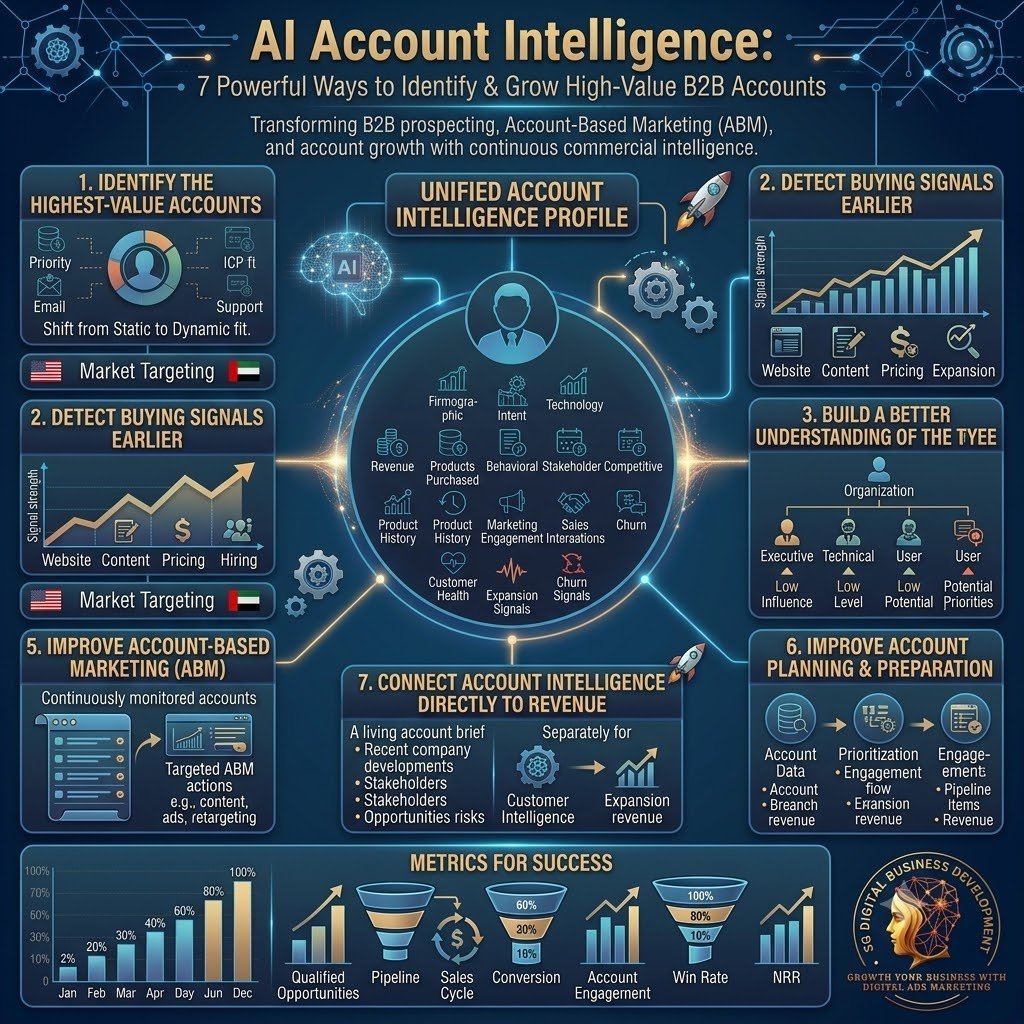
AI Account Intelligence: 7 Powerful Ways to Identify & Grow High-Value B2B Accounts Introduction B2B companies rarely have a shortage of potential accounts. The real challenge is knowing which accounts deserve attention now. A sales team may have thousands of companies in its database. Marketing may have hundreds of target accounts. Business development representatives may have hundreds of contacts available for outreach. But not every account has the same potential. Some accounts fit the ideal customer profile but are not actively looking for a solution. Some are actively researching a problem but have not yet engaged with the company. Some have recently hired a new executive, launched a new initiative, expanded into a new market, or changed their technology stack. Others may already be customers with significant expansion potential. The difference is timing, context, intent, fit, and opportunity. This is where AI account intelligence becomes increasingly important. AI account intelligence combines company information, behavioral signals, engagement data, buying intent, technology information, stakeholder information, and predictive analysis to create a more complete picture of a B2B account. Instead of asking only: “Is this company a potential customer?” businesses can ask: “Why does this account matter, what is happening inside the account, how strong are the buying signals, who may influence the decision, and what should we do next?” That shift can transform B2B prospecting and account-based growth. Recent 2026 account-intelligence research describes the category as combining firmographic, technographic, contact, engagement, and intent data into an account-level view that can be prioritized and activated through CRM and revenue workflows. For SG Digital, this creates an important connection between AI visibility, lead generation, lead qualification, sales intelligence, customer intelligence, and revenue growth. What Is AI Account Intelligence? AI account intelligence is the use of artificial intelligence, company data, behavioral signals, intent data, predictive analytics, and automation to understand, prioritize, and engage B2B accounts. Traditional account research may involve manually checking: That research can provide useful information. But it can also become outdated quickly. AI account intelligence introduces a more dynamic approach. Instead of creating a static account profile once, the system can continuously analyze changing signals and help determine which accounts deserve attention. An account intelligence profile may include: The goal is not to collect information simply because it exists. The goal is to transform information into commercial intelligence. Why AI Account Intelligence Matters for B2B Growth B2B buying is increasingly complex. A major purchase may involve: At the same time, buying activity can happen across many channels. Potential buyers may: This creates an enormous amount of potential signal. The problem is that sales teams cannot manually analyze every signal from every account. AI account intelligence can help convert this complexity into a prioritized account view. A modern account intelligence system can help answer: Who should we target? Based on: Who should we target now? Based on: Who should we contact? Based on: What should we say? Based on: What should we do next? Based on: This transforms account targeting from a static list into a dynamic decision system. AI Account Intelligence vs Traditional Account Research Traditional account research remains useful. However, manual research can become difficult to maintain when account volumes increase. Traditional Account Research AI Account Intelligence Manual AI-assisted Often periodic Continuously updated Static account profiles Dynamic account profiles Individual research Large-scale analysis Human prioritization AI-assisted prioritization Limited signals Multiple signal sources Reactive Predictive Research-heavy Intelligence-driven Often disconnected from workflows Connected to CRM and activation The objective is not to eliminate human research. It is to make human research more focused. Instead of spending thirty minutes determining whether an account is worth pursuing, a sales representative can begin with an AI-generated account intelligence profile and spend more time understanding the actual business opportunity. How AI Account Intelligence Works A practical system can be organized into several layers. 1. Account Data The first layer contains basic company information. This can include: This establishes the basic account profile. 2. Technology Intelligence Technographic information can reveal the technology environment surrounding an account. For example: Technology information can help identify compatibility, replacement opportunities, integration opportunities, and potential business requirements. 3. Behavioral Intelligence Behavioral signals may include: These signals can indicate changing levels of interest. 4. Intent Intelligence Intent signals can indicate that an account may be actively researching a problem, category, competitor, or solution. However, intent should not automatically be interpreted as a guaranteed buying decision. Intent is a signal. It becomes more useful when combined with fit, engagement, account context, and other evidence. 5. Stakeholder Intelligence B2B deals involve people. AI account intelligence can help identify: Understanding the buying committee can make account engagement more precise. 6. Predictive Intelligence AI can then analyze the combined signals. Potential predictions include: 7. Activation Finally, intelligence should lead to action. For example: High-fit + high-intent account → Sales research task High-fit + strong engagement → Personalized outreach Existing customer + expansion signals → Account expansion workflow Strategic account + leadership change → Account plan update This final layer is critical. Intelligence that never changes an action has limited commercial value. 7 Powerful Ways AI Account Intelligence Can Drive B2B Growth 1. Identify the Highest-Value Accounts The first major application is account prioritization. Many businesses use an ideal customer profile. For example: B2B SaaS company, 100–1,000 employees, United States, technology sector, recurring revenue model. That provides useful targeting criteria. But thousands of companies may fit that description. AI account intelligence can add another layer. Instead of asking: “Does this account fit our ICP?” the system can ask: “Which ICP accounts are showing signals that make them especially relevant right now?” AI can combine: This creates a more dynamic priority model. Example Imagine 2,000 companies fit the basic ICP. AI identifies 150 accounts that also show: The sales team now has a more focused account universe. The objective is not simply generating more prospects. It is allocating limited sales capacity more intelligently. 2. Detect Buying Signals Earlier Buying signals can appear before a buyer contacts sales. An account

AI customer intelligence
AI Growth Engine

AI Customer Intelligence: 7 Powerful Ways to Turn Customer Data Into B2B Growth.

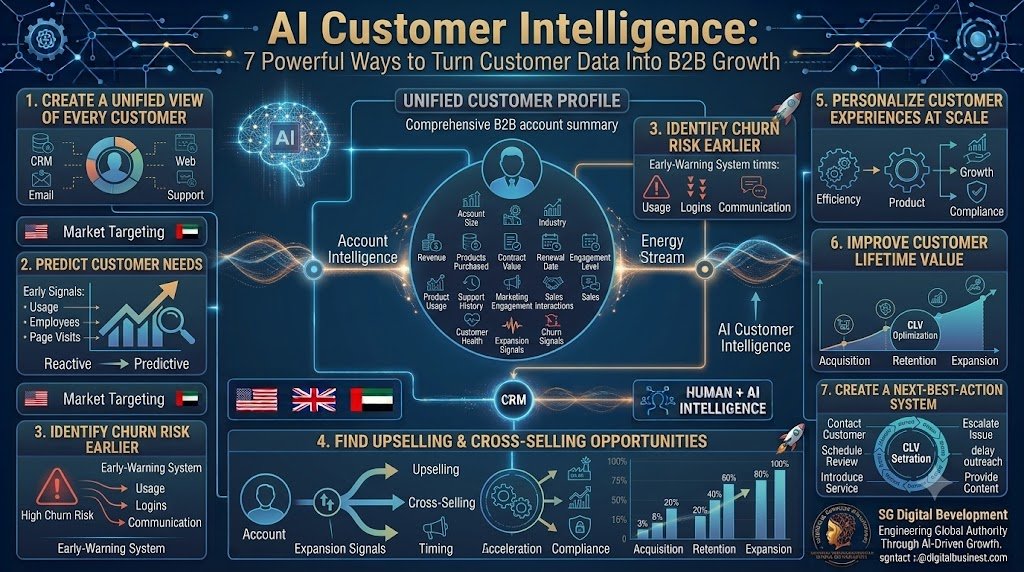
AI Customer Intelligence: 7 Powerful Ways to Turn Customer Data Into B2B Growth Introduction B2B companies have more customer data than ever before. CRM records, website visits, sales conversations, email engagement, product usage, customer support interactions, campaign responses, purchase history, renewal activity, and account-level behavior can all reveal valuable information about customers. The problem is that having customer data is not the same as understanding customers. Many businesses still operate with fragmented customer information spread across CRM platforms, marketing systems, spreadsheets, analytics tools, customer success platforms, support systems, and sales databases. This makes it difficult to answer some of the most important questions in modern B2B growth: This is where AI customer intelligence becomes increasingly important. AI customer intelligence combines customer data, behavioral signals, artificial intelligence, predictive analytics, machine learning, automation, and business intelligence to create a more complete understanding of customers and accounts. Instead of simply reporting what happened, an AI-powered customer intelligence system can help businesses identify what is happening, why it may be happening, what could happen next, and what action should be taken. For B2B companies, this creates an opportunity to connect customer intelligence directly with retention, customer lifetime value, expansion, customer success, sales, and revenue growth. What Is AI Customer Intelligence? AI customer intelligence is the use of artificial intelligence, customer data, predictive analytics, behavioral signals, and automation to understand customers and predict their needs, risks, opportunities, and likely next actions. Traditional customer analytics often focuses on historical reporting. For example: Customer X purchased $50,000 of services last year. AI customer intelligence goes further. It can potentially identify: Customer X has increased product usage, added new users, engaged with expansion-related content, opened several commercial emails, and recently discussed a related business problem with the account team. These signals may indicate increasing expansion potential. That difference is important. Traditional reporting tells a business what happened. AI customer intelligence helps the business understand what the data may mean and determine what to do next. McKinsey describes AI-powered customer decisioning as an approach that can combine integrated customer data, predictive models, recommendation engines, and generative AI to determine more relevant customer interactions. For B2B organizations, the concept can be applied across the entire customer lifecycle. AI customer intelligence can connect: The result is a more connected commercial system. Why AI Customer Intelligence Matters for B2B Companies B2B customer relationships are rarely based on one interaction. A prospect may discover a company through search, visit the website, consume content, speak with sales, request a proposal, become a customer, use the product or service, contact support, renew, expand, and eventually become an advocate. Every stage generates information. The challenge is converting that information into usable intelligence. Without an intelligence layer, companies often have isolated data points. Marketing sees engagement. Sales sees opportunities. Customer success sees health scores. Finance sees revenue. Support sees tickets. Leadership sees reports. But the customer experiences only one relationship with the company. AI customer intelligence can help connect those perspectives. From customer data to customer intelligence There is a useful progression: Customer Data → Customer Insights → Customer Intelligence → Customer Action → Revenue Impact Customer data is the raw material. Customer insights explain patterns. Customer intelligence adds prediction, prioritization, context, and recommendations. Customer action converts intelligence into operational decisions. Revenue impact is the business outcome. This is why AI customer intelligence should not be treated as another analytics dashboard. Its value comes from connecting intelligence to action. AI Customer Intelligence vs Traditional Customer Analytics Traditional customer analytics remains valuable. Businesses still need dashboards, reports, historical analysis, segmentation, and performance measurement. However, AI changes the operating model. Traditional Customer Analytics AI Customer Intelligence Primarily historical Historical + predictive Reports customer behavior Interprets customer behavior Manual segmentation Dynamic segmentation Static dashboards Continuously updated intelligence Reactive Proactive Rule-based alerts Predictive signals Separate data sources Connected customer context Human analysis required AI-assisted analysis Reports what happened Helps identify what may happen next Insights often separate from action Intelligence connected to workflows This does not mean AI replaces customer-facing teams. Instead, AI can help those teams spend more time acting on meaningful signals and less time searching for them. How AI Customer Intelligence Works A practical AI customer intelligence system can be organized into several layers. 1. Customer Data The system collects relevant customer information. This may include: 2. Data Unification The next step is connecting customer information. A company may have five different systems containing information about the same account. AI cannot create reliable intelligence if the underlying customer identity and data relationships are inconsistent. Data quality therefore becomes a fundamental part of the system. Salesforce’s 2026 research on marketers in India similarly highlights unified customer data as an important foundation for AI-powered engagement, while its sales research notes that incomplete, duplicate, and inaccurate data can limit AI effectiveness. 3. AI Analysis Once data is available, AI can analyze patterns across customer behavior. Models may identify: 4. Prediction The system can then estimate future outcomes. For example: 5. Recommendation The system can recommend an action. For example: Schedule executive review. Or: Introduce advanced service package. Or: Customer engagement is declining; initiate retention workflow. 6. Activation Finally, the intelligence becomes operational. It can trigger: This is where intelligence becomes commercially valuable. 7 Powerful Ways AI Customer Intelligence Can Drive B2B Growth 1. Create a Unified View of Every Customer The first major opportunity is creating a more complete customer profile. A B2B account may interact with a company through multiple departments and channels. Sales may know the commercial history. Marketing may know the content engagement. Customer success may know product adoption. Support may know service problems. Finance may know payment behavior. AI customer intelligence can bring these signals together. Instead of viewing an account as a CRM record, the company can develop a broader account intelligence profile. A unified profile might include: This provides context for better decisions. Why this matters Without context, individual signals can be misleading. A customer opening three emails might not mean much. But if

AI customer journey orchestration
AI Growth Engine

AI Customer Journey Orchestration: 7 Powerful Ways to Transform B2B CX.

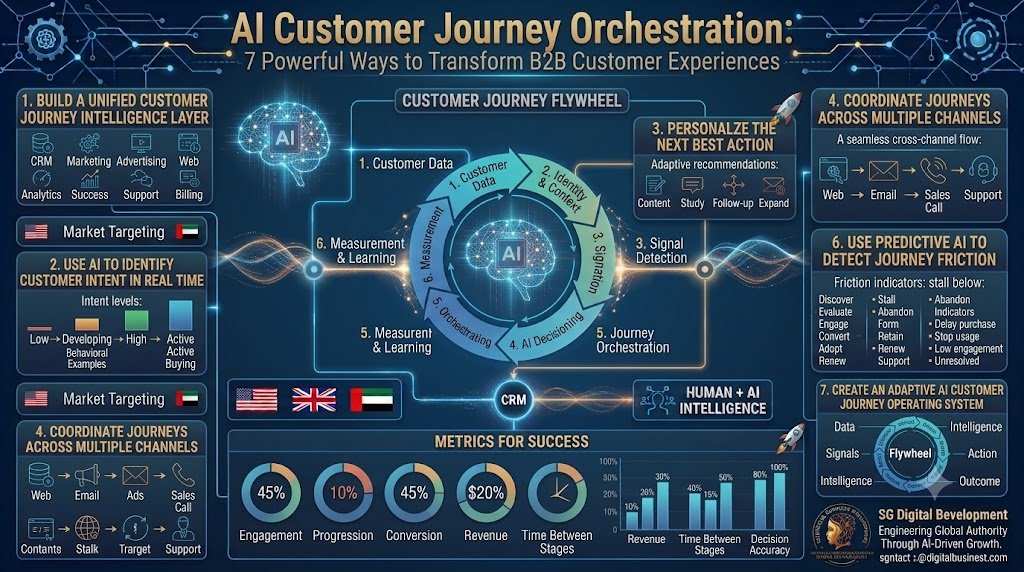
AI Customer Journey Orchestration: 7 Powerful Ways to Transform B2B Customer Experiences Introduction B2B customer journeys are becoming more complex. A modern buyer may discover a company through Google, encounter its content in AI search, visit the website, watch a video, interact with a sales representative, download a resource, return weeks later, speak with another stakeholder and eventually become a customer. After the purchase, the journey continues. Customers interact with onboarding teams, customer success managers, support teams, account managers, billing departments and sales teams. The challenge is that these interactions are often managed through separate systems. Marketing has one view. Sales has another. Customer success has another. Support has another. The customer, however, experiences only one company. This is why AI customer journey orchestration is becoming an important part of modern B2B growth strategy. Instead of treating the customer journey as a collection of disconnected campaigns and touchpoints, AI customer journey orchestration connects customer data, behavioral signals, decision-making and actions across the lifecycle. The objective is not simply to automate more messages. It is to determine: That creates a more dynamic customer experience. McKinsey describes this shift as a move from predefined customer journeys toward dynamic, cross-channel orchestration in which AI agents can help make moment-to-moment decisions. Adobe’s 2026 B2B research similarly reports that more than half of surveyed B2B organizations expect agentic AI to coordinate sales, marketing and service journeys in real time. For B2B companies, this creates a significant opportunity. In this guide, we will explore 7 powerful AI customer journey orchestration strategies that can help businesses create more connected, personalized and revenue-focused customer experiences. What Is AI Customer Journey Orchestration? AI customer journey orchestration is the use of artificial intelligence, customer data, automation and real-time decision-making to coordinate interactions across the customer lifecycle. Traditional journey automation usually follows predefined rules. For example: If a prospect downloads an ebook → send an email after two days. That workflow can be useful. But real customer behavior is rarely that predictable. A prospect may: The optimal next action may change after every interaction. AI customer journey orchestration allows the system to respond to these changing signals. Instead of following one fixed journey, the system can continuously evaluate context and determine the next appropriate action. This creates a model closer to: Observe → Understand → Decide → Act → Learn rather than: Trigger → Wait → Send → Wait → Send Why AI Customer Journey Orchestration Matters in 2026 B2B organizations are dealing with increasingly complex customer journeys. Customers expect: At the same time, companies have more customer data than ever. The challenge is connecting that data. Adobe’s 2026 B2B research found that only 41% of surveyed organizations reported having a unified customer-data foundation capable of supporting AI at scale, while 56% expected agentic AI to coordinate sales, marketing and service journeys in real time. This highlights an important issue. AI capability is increasing faster than many organizations’ ability to connect their data and workflows. That means successful orchestration requires more than adding an AI tool. Businesses need: AI Customer Journey Orchestration vs Traditional Journey Automation Traditional automation is usually designed around predefined paths. AI orchestration is designed around changing context. Traditional Automation AI Customer Journey Orchestration Rule-based journeys Context-aware journeys Fixed paths Adaptive paths Scheduled actions Signal-driven actions Static segmentation Dynamic segmentation Manual optimization AI-assisted optimization Campaign-centric Customer-centric Channel-specific Cross-channel Historical analysis Real-time decision support Limited personalization Contextual personalization Human-defined next step AI-assisted next-best action This does not mean traditional automation becomes useless. Rules are still valuable. The difference is that AI can sit above the rules and help determine which workflow should be activated based on current customer context. How AI Customer Journey Orchestration Works A practical system can be organized into six layers. 1. Customer Data The system collects relevant information. This may include: 2. Identity and Context The system attempts to understand who the customer or prospect is and what context surrounds the interaction. For B2B organizations, context may include: Without context, personalization can become superficial. 3. Signal Detection AI identifies meaningful changes. For example: 4. AI Decisioning The system determines what the signal may mean. For example: Pricing-page visit + high account fit + recent product research = potential buying intent Or: Usage decline + support increase + upcoming renewal = potential retention risk AI can then recommend the next action. 5. Journey Orchestration The system coordinates the appropriate response. That may include: 6. Measurement and Learning The system measures the outcome. Did engagement improve? Did the prospect progress? Did the customer adopt the product? Did the opportunity advance? Did the customer renew? The results can then inform future decision-making. 7 Powerful AI Customer Journey Orchestration Strategies 1. Build a Unified Customer Journey Intelligence Layer The first step is connecting customer information. Many organizations have data distributed across: This fragmentation makes it difficult to understand the complete customer journey. A unified intelligence layer can bring these signals together. Example Suppose an account: Individually, each event is useful. Together, they provide a much stronger indication of buying intent. AI can connect the events. That creates a more complete customer picture. Why this matters Without unified data, AI may optimize individual interactions. With unified data, AI can optimize the journey. That is a major difference. 2. Use AI to Identify Customer Intent in Real Time Intent is one of the most valuable signals in a B2B journey. The challenge is that intent can appear through many behaviors. A prospect may: AI can analyze these signals together. Instead of treating every website visitor equally, the system can identify patterns associated with higher-intent journeys. Intent levels A practical framework could include: Low intent General information consumption. Developing intent Repeated engagement with relevant content. High intent Pricing, product, comparison or commercial engagement. Active buying intent Direct interaction with sales, demo requests or high-value account activity. The objective is not to assume that every signal means a purchase is imminent. The objective is to prioritize attention. 3. Personalize the Next Best

AI customer success automation
AI Growth Engine

AI Customer Success Automation: 7 Powerful Ways to Scale B2B Success.

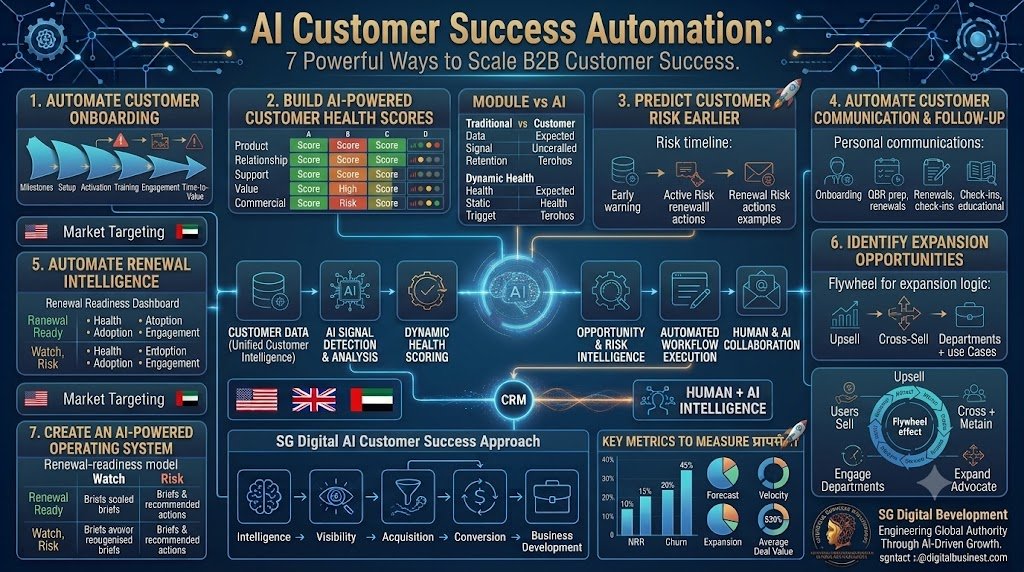
AI Customer Success Automation: 7 Powerful Ways to Scale B2B Customer Success. Introduction B2B customer success becomes more difficult as a company grows. A business may start with a small number of customers that can be managed through direct relationships, regular meetings and manual follow-ups. But as the customer base expands, the same approach becomes increasingly difficult to maintain. Customer success teams must monitor account health, understand customer behavior, track product or service adoption, identify risks, prepare reviews, manage onboarding, support renewals and discover opportunities for expansion. The problem is not necessarily a lack of customer data. The problem is turning that data into timely action. This is where AI customer success automation becomes increasingly important. Instead of relying entirely on manual account reviews, spreadsheets and reactive customer communication, businesses can use AI to analyze customer signals, identify risks, prioritize accounts, automate repetitive workflows and help customer success teams focus on higher-value conversations. Modern B2B AI systems can bring together information from CRM platforms, product usage, customer communications, support interactions, billing information and engagement signals. AI can then help transform these signals into customer health insights, risk alerts, recommended actions and personalized workflows. This does not mean replacing customer success managers. The stronger model is human and AI collaboration. AI can monitor, analyze, prioritize and prepare. Human customer success professionals can interpret context, build relationships, make strategic decisions and handle sensitive customer conversations. McKinsey’s 2026 research on B2B sales and growth similarly describes AI moving into core commercial workflows, including customer intelligence, next-best-opportunity identification and relationship management. In this guide, we will examine 7 powerful AI customer success automation strategies that B2B companies can use to improve customer experience, retention, renewals, expansion and revenue. What Is AI Customer Success Automation? AI customer success automation is the use of artificial intelligence to monitor customer data, identify patterns, predict customer needs, prioritize accounts and automate customer-success workflows. Traditional customer success often depends heavily on manual processes. A customer success manager might need to: As the customer base grows, this becomes difficult to manage consistently. AI customer success automation can assist by continuously analyzing available signals and turning them into actionable recommendations. For example, an AI system might identify that: Instead of expecting a customer success manager to discover every signal manually, AI can surface the relevant information. The human team can then decide what action should happen next. That distinction is important. The goal is not simply to automate communication. The goal is to automate customer intelligence and workflow execution while keeping strategic customer relationships human-led. Why AI Customer Success Automation Matters in 2026 Customer success is becoming increasingly connected to revenue. Retention protects existing revenue. Expansion creates additional revenue. Customer advocacy can create referrals and new opportunities. Renewals protect recurring revenue. Customer success therefore sits at the intersection of customer experience and commercial performance. TSIA’s 2026 research describes customer success as increasingly focused on demonstrating economic value and operating as a strategic function rather than simply maintaining customer relationships. AI can support that transition by helping customer success teams understand what is happening across the customer base. Instead of asking: Which customers need attention? Teams can increasingly ask: Which customers need attention, why do they need it, what is the likely business impact and what should we do next? That is a much more valuable question. AI Customer Success Automation vs Traditional Customer Success Traditional customer success is often reactive. A customer complains. A CSM investigates. A renewal date approaches. The team prepares. A customer stops engaging. Someone notices later. An expansion opportunity appears. The account manager identifies it manually. AI customer success automation introduces a more proactive operating model. Traditional Customer Success AI Customer Success Automation Manual account reviews Continuous signal monitoring Spreadsheet-based tracking Connected customer intelligence Reactive risk management Predictive risk identification Manual health scoring AI-assisted health scoring Generic follow-ups Contextual personalization Manual QBR preparation AI-assisted QBR preparation Individual account prioritization Portfolio-level prioritization Manual expansion discovery AI-assisted opportunity detection Calendar-based workflows Signal-based workflows Separate data sources Unified customer intelligence The objective is not to remove human judgment. The objective is to give customer success teams better information before they act. How AI Customer Success Automation Works A practical AI customer success system can be viewed as a six-stage process. 1. Data Collection The system collects relevant customer signals. These may include: The more reliable the underlying data, the more useful the resulting intelligence becomes. 2. Customer Signal Analysis AI analyzes customer behavior and identifies patterns. For example: A customer may have historically logged into a platform five times per week. That activity suddenly falls to once per week. At the same time, support tickets increase and a key stakeholder stops attending meetings. Individually, each signal may not be decisive. Together, they could represent a meaningful change in customer health. AI can help connect these signals. 3. Customer Health Scoring The system can convert multiple signals into a customer health assessment. A health model may consider: The result can be a dynamic health score or customer-risk classification. Importantly, a health score should not be treated as absolute truth. It is a decision-support mechanism. 4. Opportunity and Risk Detection AI can identify patterns associated with: The customer success team can then prioritize accounts. 5. Workflow Automation Once a signal is identified, an automated workflow can begin. For example: Usage decline → AI detects risk → CSM receives alert → AI prepares account summary → CSM reviews → personalized outreach is sent. Or: Feature adoption → AI detects expansion signal → account is prioritized → AI prepares opportunity brief → sales/CS team coordinates expansion conversation. This is where AI customer success automation becomes more than analytics. It connects intelligence with execution. 6. Human Review The final step should often involve human judgment. AI may identify a potential risk. The customer success manager decides whether the risk is real. AI may recommend an expansion opportunity. The account team determines whether the timing is appropriate. AI may draft an email. A human reviews

Scroll to Top