AI Search Citation Strategy: How to Get Your Business Cited in AI Search in 2026.
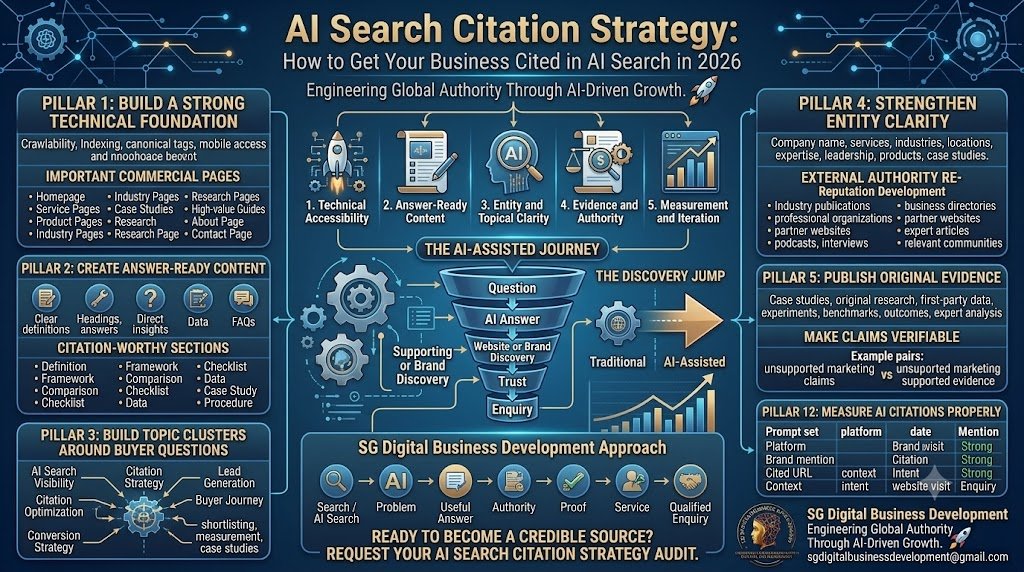
Introduction Search visibility is changing. For years, businesses focused on getting a page into Google results, improving rankings, earning clicks, and converting visitors. That model still matters. But buyers are increasingly asking longer questions and using AI-powered search experiences to research companies, solutions, products, services, and vendors. Google’s AI search experiences can provide links to supporting websites, while AI Mode can explore related searches and sources before producing a response. This creates a new opportunity for businesses: Become a source that AI systems can discover, understand, retrieve, and potentially cite. That is where an AI Search Citation Strategy becomes useful. An AI citation is not simply another backlink. It is a situation where an AI search experience references a page or source to support an answer, explanation, comparison, recommendation, or factual statement. For a business, the commercial question is bigger than: “How do I get cited?” The better question is: “How do I become a credible source for the questions my potential customers are asking?” That requires a combination of technical SEO, useful content, clear entities, original evidence, topical authority, internal linking, external recognition, and continuous testing. A practical AI Search Citation Strategy should therefore focus on building genuine information value rather than trying to manipulate individual AI responses. For SG Digital Business Development, the important point is simple: Visibility is valuable only when it can move toward trust, qualified enquiries, and business opportunities. What Is an AI Search Citation Strategy? An AI Search Citation Strategy is a structured approach to creating, organizing, and promoting information so that AI-powered search systems can discover, understand, retrieve, and potentially reference a business and its content for relevant questions. It combines traditional search fundamentals with a broader visibility model. Traditional SEO asks: AI search adds questions such as: This does not mean there is a secret AI citation ranking factor. Google’s guidance emphasizes the continuing importance of foundational SEO practices for AI search experiences, including indexability, internal links, useful content, textual information, and accurate structured data. Therefore, an AI Search Citation Strategy should extend SEO rather than replace it. The foundation remains a technically accessible website containing useful information. Why AI Citations Matter for Businesses The discovery journey can now look different from the classic search funnel. Traditional Journey Search → Result → Click → Website → Enquiry AI-Assisted Journey Question → AI Answer → Supporting Sources → Website or Brand Discovery → Trust → Enquiry A buyer may first encounter a company because an AI system mentions the business, references a case study, or links to an article. This can be particularly important for B2B businesses. A B2B buyer may ask: An effective AI Search Citation Strategy focuses on becoming useful during this research process. The objective is not simply to collect citations. The objective is to become a useful and credible source within the buyer’s information journey. Citation Is Different From Ranking Ranking and citation are related, but they are not identical. A page can rank for a keyword and never be cited in an AI answer. Another page may not be the first traditional result but can still become a supporting source for a specific AI response. AI search systems can explore related searches, sources, and subtopics before generating a response. Consider a buyer asking: “Which B2B SEO agency should a SaaS company consider if it wants stronger Google and AI search visibility?” The underlying information requirements could include: One page rarely answers every part perfectly. That is why an AI Search Citation Strategy should build a connected information ecosystem rather than trying to make one article answer everything. The goal is to create a collection of useful pages where each page addresses a meaningful part of the buyer’s research journey. The Five Pillars of an AI Search Citation Strategy A practical AI Search Citation Strategy can be built around five connected pillars: Each pillar supports the others. A weakness in one area can limit the value created by the others. For example, excellent content has limited value if important pages cannot be indexed. Likewise, technically accessible pages may not build meaningful visibility if the content is generic or the business entity is unclear. 1. Build a Strong Technical Foundation Before worrying about citations, make sure important pages can actually be discovered. Review: Important pages should be accessible through normal search-engine crawling and website navigation. Start with commercially important pages: Make sure these pages can be reached through normal website architecture. A technically strong foundation is the first requirement for any AI Search Citation Strategy. If your service page is blocked, noindexed, poorly connected, or missing important text, publishing more articles will not solve the underlying problem. 2. Create Answer-Ready Content AI systems need information they can retrieve and use. That does not mean writing robotic content. It means making important information clear. Strong pages can use: For example, instead of beginning an article with several paragraphs of generic marketing language, answer the core question early: “An AI Search Citation Strategy is a process for making a business and its information easier for AI-powered search systems to discover, understand, retrieve, and reference.” Then explain the details. This structure helps readers understand the topic while creating clearer information units for search systems. The principle is simple: One important question → one clear answer → useful supporting evidence. That approach should be repeated throughout the content system. 3. Build Topic Clusters Around Buyer Questions One article is rarely enough to establish meaningful expertise. Build a connected topic cluster. For example: Each article should have a distinct search intent. Then connect them. A pillar page can link to supporting guides. Supporting guides can link to relevant service pages. Service pages can link to case studies. Case studies can link back to relevant concepts. This creates semantic relationships. The purpose is not to manipulate an AI system. The purpose is to make the website’s knowledge structure easier for both people and search systems to understand. A strong AI Search Citation Strategy therefore treats