AI opportunity intelligence
AI Growth Engine

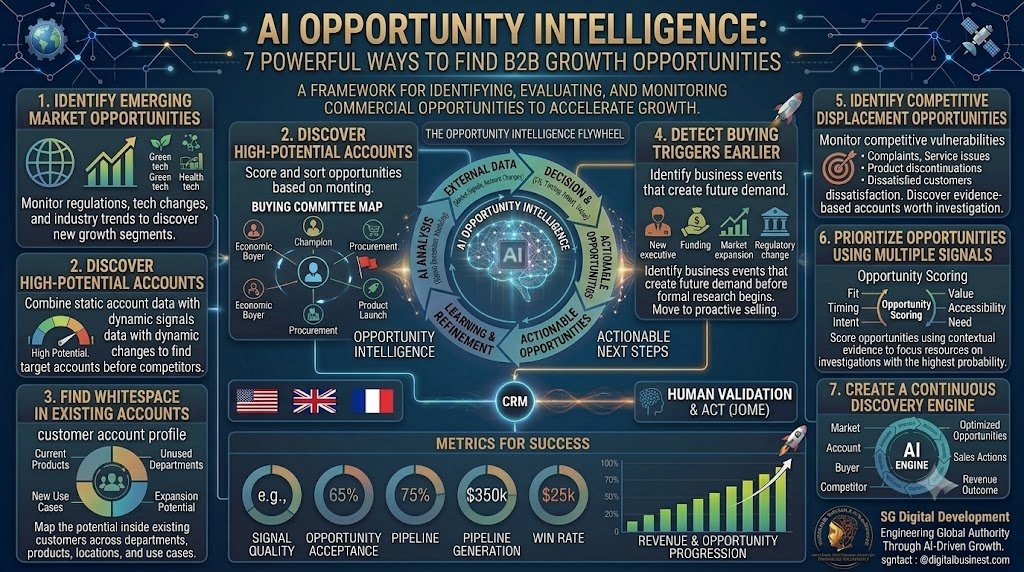
AI Opportunity Intelligence: 7 Powerful Ways to Find B2B Growth Opportunities.

AI Opportunity Intelligence: 7 Powerful Ways to Find B2B Growth Opportunities. Introduction B2B companies rarely have a shortage of possible customers. The challenge is identifying which opportunities matter, why they matter and when the business should act. A company may have thousands of potential accounts. It may have hundreds of leads. It may have dozens of market segments. It may monitor competitors, hiring activity, company news, technology changes, product launches and industry developments. Yet sales teams can still miss valuable opportunities. Why? Because opportunity discovery is often fragmented. Marketing sees one signal. Sales sees another. Business development sees another. Customer success may know about an expansion opportunity that sales has not identified. Market intelligence may identify an emerging segment that has not yet reached the pipeline. The organization has information. But it lacks a connected way to turn information into commercial opportunity. This is where AI opportunity intelligence becomes valuable. AI opportunity intelligence uses artificial intelligence to identify, evaluate, prioritize and monitor potential business opportunities using internal data, external signals, account information, buyer behavior, market intelligence and commercial context. The goal is not simply to generate more leads. The goal is to discover better opportunities earlier. The progression is: Signals → Opportunity Intelligence → Prioritization → Action → Pipeline → Revenue McKinsey’s 2026 B2B research describes opportunity identification and account planning as part of the commercial workflows that can be redesigned around AI. Its research highlights the potential for AI to combine external signals with proprietary data to identify emerging needs, target accounts and opportunities before competitors. This represents an important change in B2B growth. Instead of asking: “How many leads did we generate?” companies can increasingly ask: “Which new commercial opportunities are emerging, and how quickly can we identify and act on them?” This article explores seven powerful AI opportunity intelligence strategies that can help B2B companies identify growth opportunities, uncover whitespace, detect buying triggers and focus sales resources where they can create the most value. What Is AI Opportunity Intelligence? AI opportunity intelligence is the use of artificial intelligence to analyze market, account, buyer, customer and commercial signals to identify potential business opportunities. These opportunities can include: Traditional opportunity discovery often depends on: These sources remain valuable. AI changes how they can be connected. For example, a business might discover: Individually, these signals may not be enough. Together, they may represent an emerging opportunity. AI can help connect the signals. That is the foundation of opportunity intelligence. AI Opportunity Intelligence vs Traditional Lead Generation Lead generation generally focuses on finding people or companies that may fit a target profile. Opportunity intelligence goes further. Lead generation asks: Opportunity intelligence asks: This distinction is important. A database can provide thousands of contacts. But a sales organization may only have capacity to investigate a small number of opportunities. AI opportunity intelligence can help prioritize that limited capacity. The objective is: Fewer low-value investigations → More focused opportunity discovery. Why AI Opportunity Intelligence Matters in 2026 B2B markets are changing quickly. Companies change: Each change can create commercial implications. McKinsey’s 2026 B2B Pulse research, based on nearly 4,000 buyers and sellers across 13 countries, describes a shift toward AI-enabled commercial workflows that connect data, decision logic, human judgment and AI agents across activities including opportunity identification and account planning. The implication is significant. Opportunity discovery does not have to remain a periodic exercise. AI can continuously monitor relevant signals. For example: Monday A company announces a new market expansion. Tuesday It begins hiring for a relevant department. Wednesday Its website launches a new product page. Thursday Several employees begin researching a related category. The organization may now represent a stronger commercial opportunity than it did one week earlier. A traditional database may still show the same account record. AI opportunity intelligence can identify the change. 7 Powerful AI Opportunity Intelligence Strategies 1. Identify Emerging Opportunities From Market Signals Markets continuously generate signals. Examples include: AI can monitor these signals at scale. Instead of manually reviewing thousands of sources, businesses can use AI to identify events that may have commercial relevance. Example A company announces a major expansion into the United States. For a B2B technology provider, that event may create opportunities involving: The announcement itself is not the opportunity. The opportunity is the business need created by the change. That distinction is fundamental. AI opportunity intelligence should therefore connect: Event → Business Change → Potential Need → Commercial Opportunity This is more valuable than simply collecting news. 2. Discover High-Potential Accounts Before Competitors Not every account in an ICP is equally valuable. Traditional account prioritization often uses: These attributes are useful. But opportunity potential can change quickly. AI can combine static account characteristics with dynamic signals. Potential signals include: Example Imagine two accounts. Account A Account B Account B may represent the more interesting opportunity at this moment. AI opportunity intelligence can help surface that difference. The objective is not to predict the future perfectly. It is to identify where new evidence suggests that sales attention may be worthwhile. 3. Find Whitespace Opportunities Inside Existing Accounts Opportunity intelligence is not only about finding new customers. Existing customers can contain substantial untapped potential. Whitespace can exist across: For example, a company may already purchase one service. But AI identifies: This may indicate expansion potential. Account whitespace model Existing customer ↓ Current products ↓ Unused departments ↓ Unused use cases ↓ New business needs ↓ Expansion opportunity This connects AI opportunity intelligence with: The commercial advantage is that the business already has a relationship. The opportunity is to understand where additional value may exist. 4. Detect Buying Triggers Earlier Some opportunities become visible only after the buyer begins actively researching. Others can be identified earlier through business changes. Potential buying triggers include: These events can create a need before a prospect ever submits a form. Example A company hires a new Chief Revenue Officer. That executive may begin reviewing: The hiring event does not prove a purchase is coming. But it may justify
AI buyer intelligence
AI Growth Engine

AI Buyer Intelligence: 7 Powerful Ways to Understand B2B Buyers.

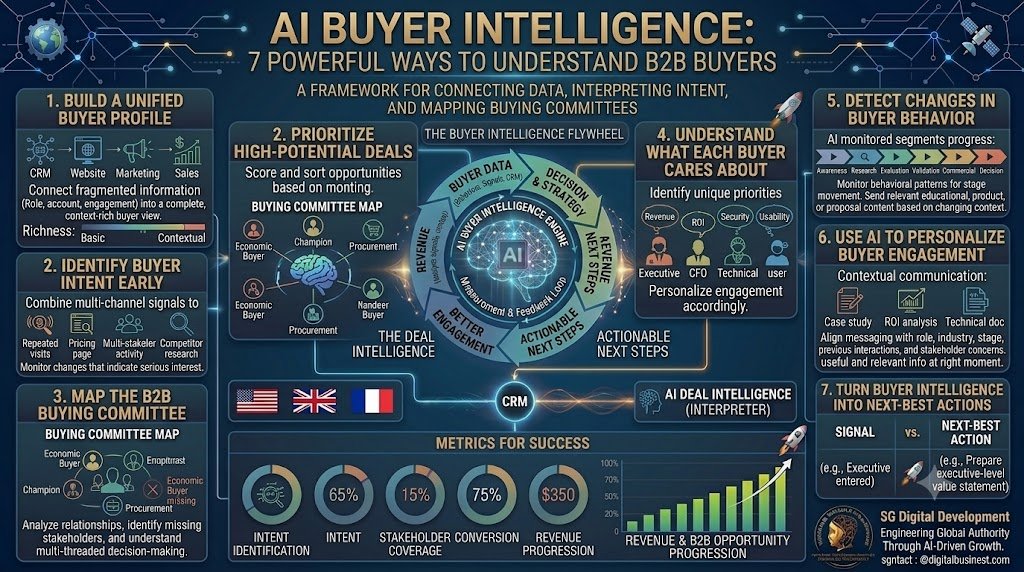
AI Buyer Intelligence: 7 Powerful Ways to Understand B2B Buyers Introduction B2B buyers have more information than ever before. They can research vendors through search engines, AI assistants, review platforms, websites, communities, social networks, analyst content and peer recommendations before speaking with a salesperson. At the same time, buying decisions are becoming more complex. A single B2B purchase may involve: The result is a difficult challenge for sales and marketing teams. The organization may have plenty of customer and prospect data, but still struggle to understand: This is where AI buyer intelligence becomes valuable. AI buyer intelligence combines artificial intelligence, buyer data, behavioral signals, account information, engagement patterns and commercial context to help businesses understand how buyers behave and what they may need throughout the B2B buying journey. The goal is not simply to collect more buyer information. The goal is to transform: Buyer Data → Buyer Intelligence → Better Engagement → Better Decisions → Revenue Gartner’s 2026 research shows how important this shift has become. One Gartner survey found that 45% of B2B buyers had used GenAI during a purchase, while 69% said they preferred to validate AI-generated insights with sales representatives. This creates a new commercial environment. Buyers increasingly research independently, but human sellers still matter when buyers need validation, confidence, context and help moving forward. For businesses, understanding the buyer therefore becomes more important than simply generating more leads. This article explores 7 powerful AI buyer intelligence strategies that can help B2B companies understand buyers, identify intent, map buying committees, personalize engagement and create stronger revenue opportunities. What Is AI Buyer Intelligence? AI buyer intelligence is the use of artificial intelligence to collect, connect, analyze and interpret information about B2B buyers so businesses can make better marketing, sales and customer decisions. Traditional buyer research may involve: AI can connect these different information sources and identify patterns. A modern buyer intelligence system may analyze: The objective is to create a more complete picture of the buyer. For example: A prospect repeatedly researches implementation information, shares product content with colleagues and brings a technical stakeholder into a sales conversation. Individually, these events may not provide much insight. Together, they may indicate that the buying process is becoming more serious. AI can help connect the signals. That is the foundation of buyer intelligence. AI Buyer Intelligence vs Traditional Buyer Research Traditional buyer research often happens periodically. A company might: This can provide valuable information. But buyer behavior changes continuously. AI can help create a more dynamic intelligence layer. Traditional buyer research Focuses on: AI buyer intelligence Can analyze: The distinction is important. Traditional research asks: “Who is our buyer?” AI buyer intelligence asks: “What is this buyer doing, what may they need now, and what should we understand about their decision process?” Why AI Buyer Intelligence Matters in 2026 B2B buying is becoming increasingly self-directed. Gartner reported that B2B buyers use an average of seven information sources during a purchase, while 67% in its 2026 survey preferred a sales-rep-free experience and 70% preferred a completely digital self-service buying experience. At the same time, buyers still turn to sales representatives for validation and decision support. This creates an important paradox. Buyers want independence. But they still need expertise. A modern sales organization therefore needs to understand when the buyer wants: AI buyer intelligence can help identify these changing needs. It can help answer: Where is the buyer? What does the buyer care about? Who else is involved? What information is missing? What should the business do next? 7 Powerful AI Buyer Intelligence Strategies 1. Build a Unified Buyer Intelligence Profile The first step is creating a complete view of the buyer. Many organizations have buyer information scattered across different systems. For example: CRM Marketing Website Sales Customer success Each source provides only part of the picture. AI can help connect these signals. The result is a more complete buyer profile. Example A buyer may appear in the CRM as: Marketing Director But additional intelligence may reveal: The buyer profile is now much richer. Instead of knowing only the person’s title, the sales team can understand the context surrounding the buying process. 2. Identify Buyer Intent Earlier One of the most important uses of AI buyer intelligence is detecting potential intent. Buyer intent can appear through multiple signals. Examples include: A single signal is rarely enough. The value comes from combining signals. Example Suppose an account previously showed little activity. Over the next two weeks: AI can connect these events. The system may identify: Increasing buyer engagement detected. This does not mean the account will definitely purchase. It means the pattern deserves investigation. That distinction is critical. AI identifies signals. Humans interpret context. 3. Map the B2B Buying Committee B2B purchases rarely depend on one person. The buying committee may include: Each stakeholder may have different priorities. Executive Cares about: Finance Cares about: Technical Cares about: User Cares about: Procurement Cares about: AI buyer intelligence can help identify these different stakeholder relationships. It can also identify gaps. For example: Strong technical engagement but no economic buyer identified. That is a useful commercial signal. Another example: Multiple users are engaged, but executive sponsorship is unclear. The sales team can then decide whether executive-level engagement is necessary. Salesforce’s current B2B automation capabilities similarly emphasize understanding the buying committee, identifying missing members and using cross-channel interactions to support next-best actions. 4. Understand What Each Buyer Actually Cares About Different stakeholders can participate in the same purchase for completely different reasons. Consider a B2B AI software purchase. The CEO may care about: Revenue growth. The CFO may care about: Return on investment. The sales leader may care about: Productivity. The IT team may care about: Security and integration. The end user may care about: Ease of use. A generic sales message will not address all of these needs. AI buyer intelligence can help identify the topics each stakeholder engages with. For example: Buyer A Frequently interacts with: Potential interest: Commercial value Buyer B Frequently interacts

AI deal intelligence
AI Growth Engine

AI Deal Intelligence: 7 Powerful Ways to Win More B2B Deals

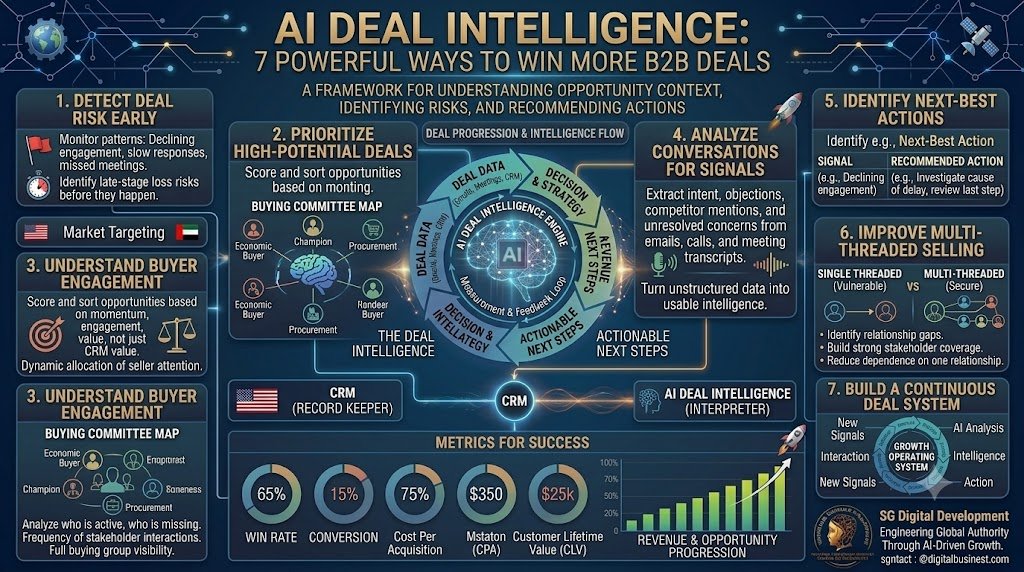
AI Deal Intelligence: 7 Powerful Ways to Win More B2B Deals. Introduction B2B sales opportunities rarely fail because a salesperson does not have enough information. They often fail because the sales team does not recognize what the information means soon enough. A deal can appear healthy in the CRM while: Traditional CRM systems often record what happened. Sales teams increasingly need to understand what is happening now, why it matters and what should happen next. This is where AI deal intelligence becomes valuable. AI deal intelligence uses artificial intelligence to analyze opportunity data, buyer interactions, sales activity, account information, conversations and other commercial signals to help sales teams understand deal health and make better decisions. The objective is not simply to create another sales dashboard. The objective is to transform: Deal Data → Deal Intelligence → Sales Action → Deal Progression → Revenue Modern AI can analyze information from emails, meetings, calls, CRM records, account activity and other sources to identify patterns that may be difficult for a salesperson or manager to see manually. For example, an opportunity may show: At first glance, the opportunity may appear healthy. But AI might identify: The value comes from connecting those signals. AI deal intelligence helps sales teams understand the difference between an opportunity that exists in the CRM and an opportunity that is actually progressing. This article explores seven powerful ways businesses can use AI deal intelligence to improve opportunity management, identify risks earlier, strengthen buyer engagement and improve B2B sales execution. What Is AI Deal Intelligence? AI deal intelligence is the use of artificial intelligence to analyze sales opportunities and related buyer, account, conversation and commercial data to provide insights about deal health, risks, momentum and potential next actions. Traditional deal management usually depends on: These remain useful. However, much of the information surrounding a deal is unstructured. Important information may exist inside: AI can help analyze these signals and connect them to the opportunity. A modern AI deal intelligence system can potentially answer questions such as: The objective is not to replace the salesperson’s judgment. It is to give the salesperson better context. AI Deal Intelligence vs Traditional Deal Management Traditional deal management often looks like this: CRM ↓ Opportunity Stage ↓ Deal Value ↓ Close Date ↓ Sales Forecast This provides a useful structure. But it may not capture everything happening around the opportunity. AI deal intelligence adds another layer. Traditional deal management Focuses on: AI deal intelligence Can analyze: This creates a more dynamic understanding of the opportunity. The important distinction is: CRM records the deal. AI deal intelligence interprets the deal context. Why AI Deal Intelligence Matters B2B deals are becoming increasingly information-rich. Buyers may research vendors independently, consult multiple stakeholders, use digital channels and interact with AI during their purchasing process. Gartner reported in 2026 that B2B buyers use an average of seven information sources during a purchase, while 45% of surveyed buyers said they had used generative AI for vendor and product research. This creates a more complex environment for sales teams. A salesperson may only see a small portion of the buyer journey. The CRM may show: Proposal sent. But the wider opportunity could include: AI deal intelligence can help bring these signals together. This is particularly important for complex B2B sales involving multiple stakeholders, long sales cycles and significant commercial value. 7 Powerful AI Deal Intelligence Strategies 1. Detect Deal Risk Before the Opportunity Becomes Lost One of the most valuable applications of AI deal intelligence is identifying early warning signals. Traditional deal reviews often happen after a problem becomes obvious. For example: “The deal has been sitting in proposal stage for 45 days.” By that point, the opportunity may already be in trouble. AI can instead monitor changes in deal behavior. Potential risk signals include: The objective is not to declare that a deal will fail. The objective is to identify opportunities that deserve investigation. Example Imagine an enterprise opportunity worth $120,000. The CRM shows: Stage: ProposalProbability: 70%Expected close: This quarter However, AI identifies: The opportunity may require immediate attention. The salesperson can investigate before the deal becomes a late-stage loss. AI deal intelligence risk model A useful framework can combine: Engagement Momentum Stakeholder Coverage Competitive Pressure Next-Step Clarity Historical Deal Patterns The result is a more contextual view of opportunity risk. 2. Identify the Deals Most Worth Seller Attention Sales teams rarely have unlimited time. A salesperson may have: Treating every opportunity equally is inefficient. AI deal intelligence can help prioritize attention. For example: Opportunity A Opportunity B Opportunity C A simple CRM sorting system might prioritize by deal value. AI can consider broader context. That means the highest-value deal is not necessarily the only deal deserving attention. A smaller opportunity with strong momentum may require immediate action. A large opportunity with declining engagement may require intervention. This creates dynamic opportunity prioritization. 3. Understand Buyer Engagement Across the Entire Deal Deal intelligence becomes stronger when it considers the full buying group. B2B opportunities often involve multiple stakeholders. For example: A seller may believe the deal is progressing because one contact remains engaged. But that does not necessarily mean the entire buying committee is aligned. AI deal intelligence can help analyze: Example An opportunity has five known stakeholders. AI identifies: The sales team now has a clearer picture. The deal may need stronger executive alignment before progressing. This is where deal intelligence connects with AI buyer intelligence and AI account intelligence. 4. Analyze Sales Conversations for Deal Signals Important deal information often exists inside conversations rather than structured CRM fields. A sales call may reveal: AI can analyze conversations and extract relevant signals. For example: Buyer statement “We are still evaluating whether we should build this internally.” Potential interpretation: Build-vs-buy concern Buyer statement “We need our security team to review this before moving forward.” Potential interpretation: Technical approval requirement Buyer statement “Our CFO wants to understand the expected payback.” Potential interpretation: Economic validation required The objective is not simply transcription. The

AI sales intelligence
AI Growth Engine

AI Sales Intelligence: 7 Powerful Ways to Turn Sales Data Into Revenue Growth.

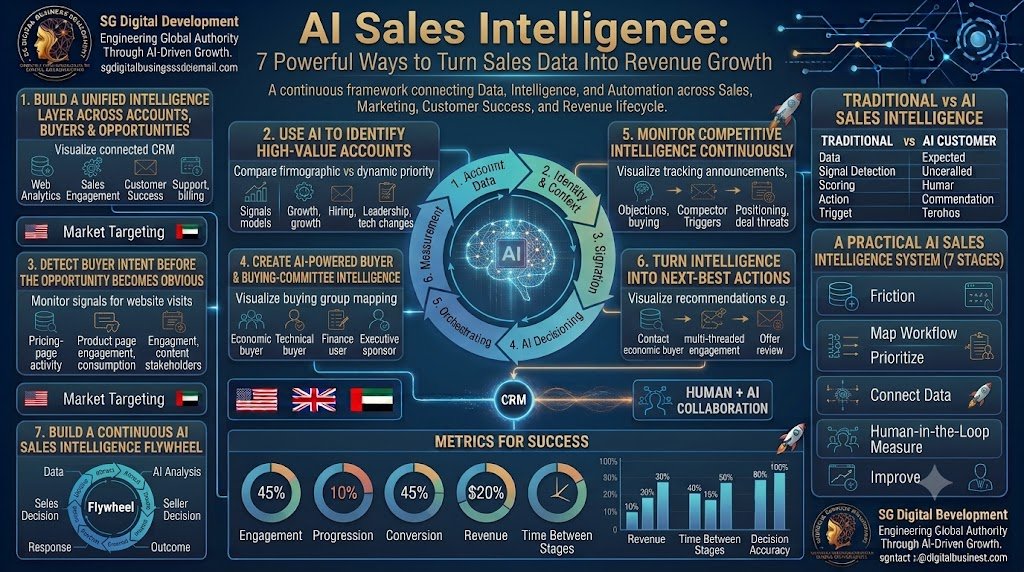
AI Sales Intelligence: 7 Powerful Ways to Turn Sales Data Into Revenue Growth. Introduction B2B sales has become an information-intensive business. Sales teams have access to CRM records, account data, website activity, buyer interactions, marketing signals, sales conversations, customer information, competitive intelligence and revenue data. The problem is no longer simply a lack of information. The problem is knowing which information matters, when it matters and what the sales team should do with it. A salesperson may have hundreds of accounts in a CRM. A sales manager may have thousands of opportunities across the organization. A revenue leader may have multiple dashboards showing pipeline, conversion, forecast, activity and customer growth. Yet the organization can still struggle to answer critical questions: This is where AI sales intelligence becomes important. AI sales intelligence combines artificial intelligence, sales data, account intelligence, buyer signals, competitive information and commercial context to help sales teams understand what is happening across their markets and opportunities. It is not simply another analytics dashboard. It is a decision-support layer. The goal is to transform: Data → Intelligence → Action → Revenue Current 2026 research reinforces this direction. McKinsey reports that B2B growth leaders are increasingly redesigning commercial workflows around AI rather than simply adding isolated tools. Gartner similarly highlights the importance of centralized context, proprietary data, next-best actions and integrated workflows for making AI useful to sellers. For B2B companies, this creates a major opportunity. Instead of asking: “How can we give salespeople more data?” the better question becomes: “How can we give salespeople the right intelligence at the right moment?” This article explores 7 powerful AI sales intelligence strategies that can help businesses answer that question. What Is AI Sales Intelligence? AI sales intelligence is the use of artificial intelligence to collect, connect, interpret and act on sales-related information so businesses can make better commercial decisions. Traditional sales intelligence may involve: AI can connect these activities into a more continuous intelligence system. An AI sales intelligence system may analyze: It can then identify patterns and surface information that may be relevant to salespeople and managers. For example: Account: Enterprise technology company Signal: Three stakeholders recently engaged with pricing and implementation content. Historical pattern: Similar accounts typically create opportunities within 30–60 days. Recommended attention: High. The value is not simply the information. The value is the context around the information. AI Sales Intelligence vs Traditional Sales Intelligence Traditional sales intelligence often requires salespeople to gather information manually. A seller might: This can consume significant time. AI can help bring these signals together. Instead of requiring sellers to search multiple sources, the system can potentially produce a consolidated account view. For example: Account Intelligence Buyer Intelligence Opportunity Intelligence Customer Intelligence Competitive Intelligence This creates a broader commercial picture. Why AI Sales Intelligence Matters in 2026 B2B buyers increasingly use digital channels and generative AI during their research. Gartner reported in 2026 that B2B buyers use an average of seven information sources during a purchase and that 45% reported using generative AI, primarily to gather information about vendors and products. This changes the information environment surrounding sales. A prospect may know a significant amount about a company before speaking with a salesperson. The seller therefore needs more than a basic CRM record. The seller needs context. The salesperson needs to understand: AI sales intelligence can help create that context. 7 Powerful AI Sales Intelligence Strategies 1. Build a Unified Intelligence Layer Across Accounts, Buyers and Opportunities The first step is connecting fragmented information. Many businesses have separate systems for: Each system provides useful information. But salespeople rarely need isolated data. They need a complete picture. For example: A CRM might show: Opportunity: $75,000Stage: Proposal Marketing data might show: Three stakeholders engaged with content. Website data might show: Pricing page visited twice. Customer data might show: Existing business unit already uses another product. Competitive intelligence might show: A competitor has recently entered the account. Individually, these signals are useful. Together, they create intelligence. The intelligence layer A strong AI sales intelligence architecture can connect: Account ↓ Buyer ↓ Engagement ↓ Opportunity ↓ Customer ↓ Revenue This allows AI to interpret sales information in context. Gartner’s 2026 research emphasizes that AI recommendations become more useful when they are grounded in proprietary data such as deal history, buyer behavior and competitive intelligence. 2. Use AI to Identify High-Value Accounts Not every account deserves equal sales attention. Traditional account prioritization often uses: These are useful starting points. But they do not necessarily indicate current buying potential. AI can combine firmographic information with dynamic signals. Potential signals include: This can create a dynamic account-priority model. Example Two companies may have almost identical firmographic profiles. Account A Account B AI can identify Account B as requiring greater attention. This does not mean the account will definitely buy. It means the available signals justify closer investigation. That distinction is essential. AI sales intelligence identifies commercial signals, not certainty. 3. Detect Buyer Intent Before the Opportunity Becomes Obvious One of the most valuable applications of AI sales intelligence is identifying changes in buyer behavior. Buying intent can appear through many signals. For example: One signal may mean very little. A combination of signals can be more informative. AI can analyze these patterns continuously. Example An account previously had limited activity. Then within two weeks: The individual events are separate. AI sales intelligence can connect them. The result might be: Emerging buying activity detected. Review account. This allows sellers to investigate earlier. 4. Create AI-Powered Buyer and Buying-Committee Intelligence B2B purchases often involve multiple people. A deal may include: Understanding only one contact can leave a major gap. AI can help map the buying group. For example: Executive stakeholder Concern: Finance stakeholder Concern: Technical stakeholder Concern: User stakeholder Concern: Sales intelligence can help identify these different perspectives. It can also identify gaps. For example: Opportunity has strong technical engagement but no identified economic buyer. That is a useful insight. The seller can then decide whether executive engagement is needed.

AI sales analytics
AI Growth Engine

AI Sales Analytics: 7 Powerful Ways to Turn Sales Data Into B2B Growth.

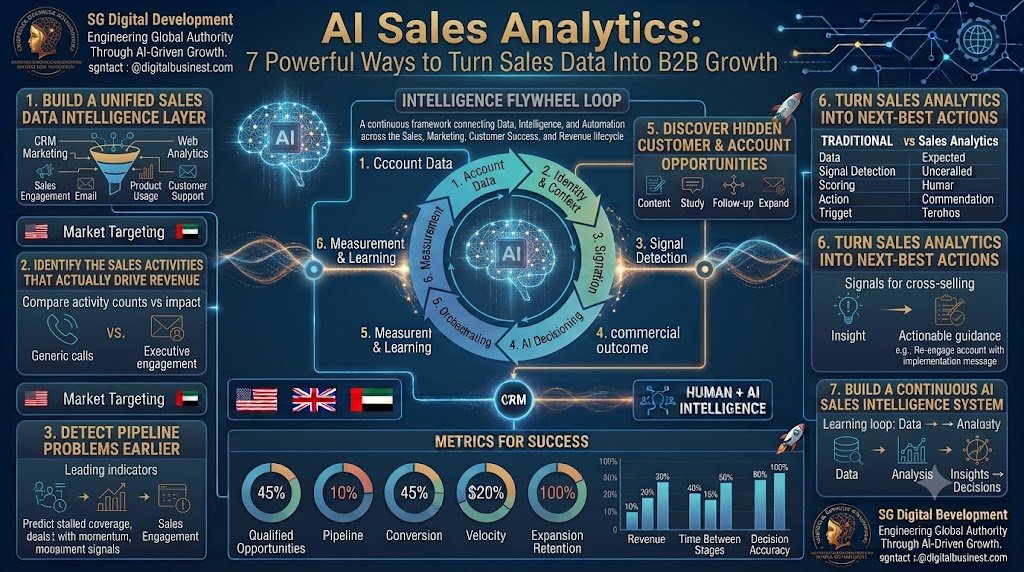
AI Sales Analytics: 7 Powerful Ways to Turn Sales Data Into B2B Growth. Introduction B2B sales teams generate enormous amounts of data. Every prospect interaction creates information. Every email, meeting, opportunity, proposal, follow-up, pipeline movement and closed deal adds another data point. Yet having more sales data does not automatically produce better sales decisions. Many businesses still struggle to answer basic questions: Traditional reporting can show what happened. Modern AI sales analytics can help businesses understand what happened, why it happened, what may happen next and what action should be considered. That difference is strategically important. AI sales analytics combines sales data, customer information, behavioral signals, pipeline information and artificial intelligence to generate insights that can support better sales decisions. Instead of treating analytics as a monthly reporting exercise, businesses can turn sales intelligence into a continuous decision-making system. This article explores 7 powerful AI sales analytics strategies that B2B companies can use to improve targeting, pipeline visibility, seller performance, opportunity management and revenue growth. What Is AI Sales Analytics? AI sales analytics is the use of artificial intelligence, machine learning, predictive analysis and connected sales data to identify patterns, generate insights and support better commercial decisions. Traditional sales analytics typically focuses on historical reporting. For example: These metrics remain valuable. But AI can analyze much larger and more complex datasets to identify relationships and patterns that may be difficult to detect manually. An AI-enabled sales analytics system may analyze: The objective is not simply to create more dashboards. The objective is to create better decisions from sales data. Why AI Sales Analytics Matters in 2026 B2B sales organizations are becoming increasingly data-driven. At the same time, buyers are interacting with businesses across more channels and using AI and digital resources during their research process. McKinsey’s 2026 B2B research describes a shift toward connected commercial workflows in which AI is embedded into prospecting, account intelligence, personalization, next-best opportunity identification and other sales processes. This creates a growing requirement for businesses to understand their commercial data continuously. A static dashboard may tell a sales leader that conversion declined. An intelligent analytics system can help investigate: The difference is between reporting and decision intelligence. AI Sales Analytics vs Traditional Sales Analytics Traditional analytics generally answers: What happened? AI sales analytics can help answer: What happened, why might it have happened, what could happen next, and what should we investigate or do about it? Consider a pipeline with 500 opportunities. Traditional reporting may show: Pipeline value: $5 million Win rate: 24% Average deal size: $50,000 AI analytics can add another layer: This makes analytics more actionable. 7 Powerful AI Sales Analytics Strategies 1. Build a Unified Sales Data Intelligence Layer The foundation of useful analytics is data. Many B2B companies have sales information spread across multiple systems. For example: Each system may contain valuable information. The problem is that the information may not be connected. An account may appear differently across several systems. A prospect may engage with marketing content before entering the CRM. A customer may show expansion signals inside a customer-success platform that sales never sees. This creates fragmented intelligence. A strong AI sales analytics architecture begins by connecting relevant data. Example Imagine an account has: When these signals are analyzed separately, each may look ordinary. When combined, they can reveal a stronger commercial pattern. The goal is therefore to create a unified view of: Account → Buyer → Activity → Opportunity → Customer → Revenue This becomes the foundation for intelligent sales analysis. Salesforce’s current CRM analytics guidance similarly emphasizes turning siloed information into connected insights that customer-facing teams can use in their workflows. 2. Identify the Sales Activities That Actually Drive Revenue Sales teams perform hundreds of activities. But not every activity has the same commercial value. Traditional reporting often counts: The problem is that activity volume does not necessarily equal sales effectiveness. AI can analyze relationships between activities and outcomes. For example, analytics may reveal that successful enterprise opportunities typically involve: This allows managers to move from: “How many activities did the seller complete?” to: “Which activities are associated with better commercial outcomes?” That is a much more useful question. Activity analytics can help identify: The objective is not to eliminate human judgment. It is to provide better evidence for improving sales execution. 3. Use AI to Detect Pipeline Problems Earlier Pipeline problems rarely appear suddenly. They often develop gradually. An opportunity may begin losing momentum long before it is officially marked as “at risk.” Potential warning signals include: AI sales analytics can monitor these signals and identify unusual patterns. Instead of waiting for the opportunity to become obviously stalled, managers can investigate earlier. Example A deal is forecast to close in 30 days. The CRM still shows it as active. But AI analytics detects: The analytics system can flag the opportunity. The salesperson can then investigate. The AI does not decide that the deal is lost. It identifies a pattern that deserves human attention. This distinction is important. Analytics should surface risk—not create false certainty. 4. Analyze Seller Performance Beyond Traditional KPIs Sales performance has traditionally been measured using metrics such as: These are important. But they are often lagging indicators. By the time a seller misses quota, the underlying problem may have existed for months. AI sales analytics can help identify leading indicators. For example: Gartner’s 2026 research on AI-driven sales metrics argues that traditional lagging measures can hide the actual drivers of seller performance and highlights the potential for AI-enabled metrics to provide more actionable insight. This changes the role of analytics. Instead of simply evaluating sellers after the quarter ends, managers can use analytics to support performance during the quarter. Example A seller is currently at 72% of quota. Traditional reporting says: Performance is below target. AI-enabled analysis may reveal: Pipeline coverage is healthy, but enterprise opportunities are progressing more slowly than comparable deals. That insight creates a much more useful coaching conversation. 5. Discover Hidden Customer and Account Opportunities Sales analytics should

AI sales strategy
AI Growth Engine

AI Sales Strategy: 7 Powerful Ways to Build a Smarter B2B Sales Engine.

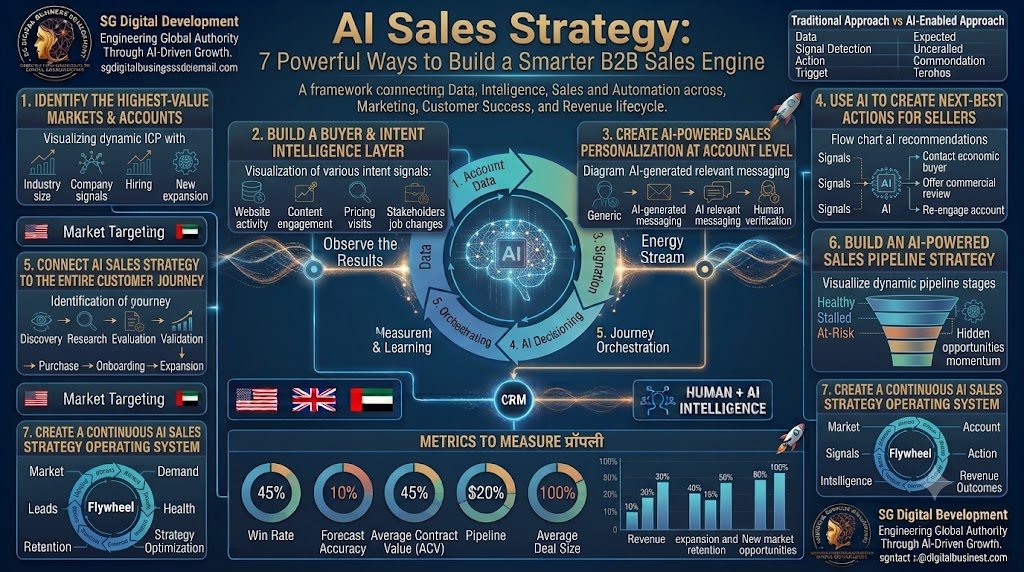
AI Sales Strategy: 7 Powerful Ways to Build a Smarter B2B Sales Engine. Introduction B2B sales has always required a combination of strategy, relationships, market knowledge and execution. But the environment in which sales teams operate has changed dramatically. Buyers have access to more information. Buying committees are larger. Digital channels influence more of the buying journey. AI can identify patterns across enormous amounts of data. Sales teams have access to more technology than ever. Yet more technology does not automatically produce better sales results. The real challenge is turning technology and intelligence into a coherent commercial strategy. That is where an AI sales strategy becomes important. An AI sales strategy is not simply a collection of AI tools for prospecting, email generation or CRM automation. It is a structured approach to using artificial intelligence across the sales process to improve: Current B2B research increasingly points toward this broader transformation. McKinsey’s 2026 research found that companies capturing meaningful value from AI are redesigning commercial workflows end to end rather than simply adding AI tools to existing processes. Gartner similarly emphasizes that AI-enabled next-best actions, seller upskilling, workflow redesign and strong data foundations are becoming important components of an AI-first sales organization. The implication is important: AI should not simply make the existing sales process faster. It should help businesses build a smarter sales system. This article explores 7 powerful AI sales strategy approaches that B2B companies can use to improve targeting, prospecting, selling, pipeline management and revenue growth. What Is an AI Sales Strategy? An AI sales strategy is a structured approach to using artificial intelligence, data and automation to improve how a business identifies prospects, engages buyers, manages opportunities and generates revenue. Traditional sales strategy typically answers questions such as: An AI-enabled approach adds another layer: This turns sales strategy from a largely static plan into a more adaptive system. Instead of reviewing the market periodically, businesses can continuously analyze signals. Instead of assigning accounts based only on firmographic criteria, they can incorporate behavioral and intent data. Instead of relying entirely on historical pipeline stages, sales teams can use AI to identify changes in opportunity momentum. That is the strategic value of AI. Why AI Sales Strategy Matters in 2026 B2B buyers increasingly move between digital channels, self-service research, AI-assisted discovery and human sales interactions. Gartner reported in 2026 that B2B buyers use multiple information sources and increasingly use generative AI during purchasing. The research also found that buyers continue to value sales representatives for validation, contextual understanding and helping them advance purchasing decisions. This creates a new sales environment. A buyer may: An effective AI sales strategy must therefore connect digital discovery with human selling. The sales process cannot operate independently from: The sales strategy becomes part of a broader growth system. AI Sales Strategy vs Traditional Sales Strategy Traditional sales strategy often relies heavily on historical information. For example: These remain useful. But AI can make the strategy more dynamic. Traditional approach Research → Plan → Execute → Review AI-enabled approach Research → Predict → Prioritize → Execute → Measure → Learn → Adapt The second model creates a continuous feedback loop. The strategy is no longer something created once per quarter and stored in a presentation. It becomes an operating system that can adapt as: 7 Powerful AI Sales Strategy Approaches 1. Use AI to Identify the Highest-Value Markets and Accounts The foundation of sales strategy is targeting. A sales team can only achieve efficient growth if it focuses on the right customers. Traditional ICP development may use: AI can add additional dimensions. It can analyze: This can help businesses create a more dynamic ICP. Example A traditional ICP might say: B2B SaaS companies with 100–1,000 employees. An AI-supported ICP might identify: B2B SaaS companies with 200–1,000 employees, expanding into new markets, increasing sales hiring, showing strong website engagement and experiencing rising customer acquisition complexity. The second description is much more actionable. AI can also help identify accounts that fit the profile but are not yet obvious prospects. This is where AI account intelligence becomes strategically valuable. The system can continuously monitor target accounts and identify changes that may increase their relevance. Strategic benefit Instead of asking: Who looks like our customer? sales teams can increasingly ask: Which accounts appear most likely to become valuable customers now? That is a major shift. 2. Build an AI-Powered Buyer and Intent Intelligence Layer Finding the right account is only the beginning. Sales teams also need to understand buyer intent. A company may fit the ICP perfectly but have no current buying requirement. Another company may have a smaller profile but show strong signals that a purchase decision is developing. AI can help identify these differences. Potential signals include: AI can combine these signals and help identify changes in buying probability. For example: Account A Account B Account B may deserve more immediate sales attention. This does not mean AI can know a buyer’s intentions with certainty. It means AI can help sales teams process signals more effectively. Gartner’s 2026 research identifies account research, personalized messaging, signal monitoring and next-best actions as areas where AI can support sellers while humans remain differentiated in empathy, judgment and contextual understanding. 3. Create AI-Powered Sales Personalization at Account Level Personalization has become a standard part of B2B sales. But personalization can easily become superficial. Changing a company name in an email is not strategic personalization. True personalization requires understanding: AI can help synthesize that information. For example, instead of: “We help companies improve sales performance with AI.” An account-specific message might focus on: “Your expansion into three new markets appears to be increasing the complexity of your sales operations. We work with B2B teams to connect account intelligence, sales workflows and AI-powered revenue systems as they scale.” The difference is relevance. AI can help sales teams produce this level of contextual communication at greater scale. However, personalization should remain grounded in verified information. Incorrect personalization can damage trust. The objective is

AI sales coaching
AI Growth Engine

AI Sales Coaching: 7 Powerful Ways to Improve B2B Sales Performance.

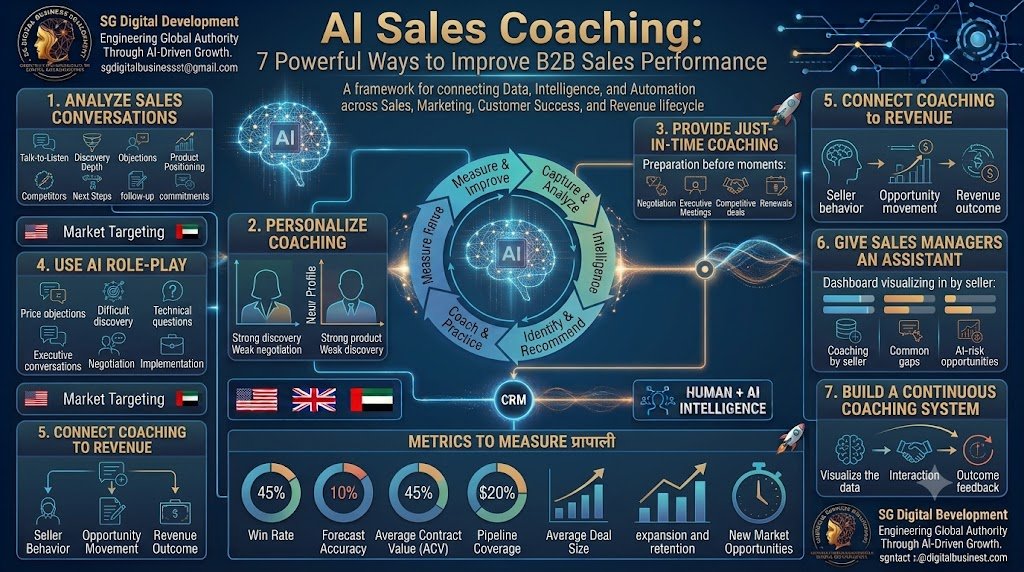
AI Sales Coaching: 7 Powerful Ways to Improve B2B Sales Performance. Introduction Sales performance depends on more than having a good product, a large pipeline or a sophisticated CRM. It depends on what salespeople actually do during customer interactions. How effectively do they discover customer needs? How well do they communicate value? How confidently do they handle objections? Do they ask the right questions? Do they involve the right stakeholders? Do they follow up consistently? Do they know when to advance an opportunity and when to slow down? Traditionally, sales managers have been responsible for helping sellers improve these skills. But traditional coaching has a major limitation: managers cannot observe every customer interaction. A manager may listen to a handful of calls, review pipeline reports and conduct periodic one-to-one meetings. That creates only a partial view of seller performance. AI sales coaching changes this model. AI can analyze sales interactions, identify patterns, surface potential skill gaps, provide personalized recommendations and help managers focus their coaching time where it can have the greatest impact. The result is a shift from occasional coaching to a more continuous sales improvement system. McKinsey’s 2026 B2B research describes this transition directly: AI can analyze customer interactions and performance data, identify coaching opportunities and provide targeted guidance, allowing managers to spend less time diagnosing performance and more time on high-impact coaching. This does not mean replacing sales managers. In fact, the strongest model is the opposite. AI handles more of the observation, analysis and pattern recognition. Managers spend more time on judgment, motivation, deal strategy, relationship development and personalized coaching. This article explores 7 powerful AI sales coaching strategies B2B companies can use to improve seller capability, create more consistent execution and build a stronger revenue organization. What Is AI Sales Coaching? AI sales coaching is the use of artificial intelligence to analyze sales activity, customer interactions, seller behavior and revenue outcomes in order to provide personalized coaching insights and recommendations. Traditional sales coaching often depends on: These approaches remain valuable. However, they can be limited by time and scale. A sales manager may oversee 8, 10, 15 or even more sellers. It is difficult to personally observe every conversation. AI can expand the manager’s visibility. Depending on the systems and data available, AI can analyze: AI can then help identify patterns. For example: A seller may be strong at discovery but weak at closing. Another may explain products well but struggle with objections. Another may create strong initial engagement but fail to follow up consistently. Another may spend too much time presenting before understanding customer requirements. Instead of providing the same training to everyone, AI sales coaching can help identify where individual improvement may matter most. Why AI Sales Coaching Matters in B2B B2B sales environments are becoming more complex. Salespeople increasingly need to manage: At the same time, sales managers have limited time. They need to: This creates a coaching capacity problem. AI can help by making performance information easier to analyze. Salesforce describes AI-guided selling as a way to surface relevant actions, accounts and information while reducing manual effort. The broader opportunity is to connect those insights to coaching. Instead of asking: “How is this seller performing?” a manager can increasingly ask: “What specific behavior is affecting this seller’s results, and what coaching intervention should happen next?” That is a much more actionable question. AI Sales Coaching vs Traditional Sales Coaching Traditional coaching is usually periodic. A manager might conduct: AI can make coaching more continuous. Traditional model Observe → Review → Discuss → Train AI-supported model Capture → Analyze → Identify → Recommend → Coach → Measure → Improve This does not make traditional coaching obsolete. Instead, AI can make the traditional process more informed. Managers can enter coaching conversations with evidence rather than relying only on memory. For example: Instead of saying: “You need to improve your discovery calls.” A manager could say: “Across your recent conversations, customers frequently discuss business impact before you ask about measurable outcomes. Let’s work on changing the order of your discovery questions.” That is more specific. And specificity makes coaching more actionable. 7 Powerful AI Sales Coaching Strategies 1. Analyze Sales Conversations to Identify Skill Gaps One of the most powerful applications of AI sales coaching is conversation analysis. AI can analyze customer interactions and identify patterns across large numbers of calls. Depending on the system, analysis may include: The goal is not to score sellers for the sake of scoring them. The goal is to identify behaviors that may influence outcomes. For example, suppose a sales organization discovers that successful discovery calls frequently contain: AI can identify whether those behaviors appear consistently across the sales team. Managers can then coach sellers on specific gaps. From opinion to evidence Without AI, a manager might remember one difficult sales call and conclude that a seller needs improvement. With AI, the manager can analyze a broader sample of interactions. That creates a stronger evidence base. McKinsey’s research describes this as one of the emerging AI coaching opportunities: AI can evaluate customer interactions against sales-skill and product-knowledge models and surface coaching opportunities at both individual and organizational levels. The result is a more systematic coaching process. 2. Personalize Coaching for Every Seller Not every salesperson needs the same coaching. This sounds obvious, but many organizations still use generalized training. For example, the entire sales team might receive a workshop on: “How to Handle Customer Objections.” But individual sellers may have very different challenges. Seller A: Seller B: Seller C: Seller D: A generalized training session may help everyone slightly. Personalized coaching can focus on the specific behavior most relevant to each seller. AI can help managers identify these differences. Personalized coaching example Seller: Account Executive Observed strength: Customer discovery Potential development area: Commercial negotiation Observed pattern: Pricing discussions introduced early in several opportunities Coaching recommendation: Practice value-based negotiation before discussing discounts. Suggested exercise: Simulate three pricing objections. This is more useful than giving the seller another generic

AI sales productivity
AI Growth Engine

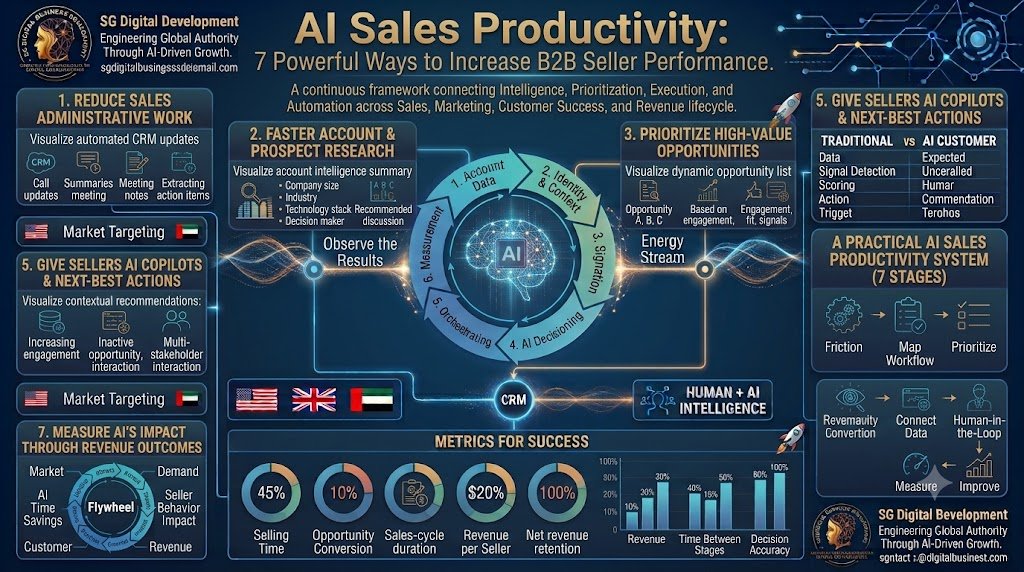
AI Sales Productivity: 7 Powerful Ways to Increase B2B Seller Performance.

AI Sales Productivity: 7 Powerful Ways to Increase B2B Seller Performanc. Introduction B2B sales teams are under constant pressure to generate more pipeline, manage more opportunities, personalize more interactions and close revenue faster. Yet many sellers still spend a significant amount of their working day on activities that do not directly create customer value. They research accounts manually. They update CRM records. They prepare for meetings. They search for information across multiple systems. They write follow-up emails. They summarize conversations. They build reports. They look for buying signals. They decide which opportunity deserves attention next. They move information between disconnected tools. This creates a productivity problem. The challenge is not necessarily that salespeople are unwilling to work harder. The challenge is that too much of their capacity can be consumed by administrative work, fragmented information and repetitive processes. That is where AI sales productivity becomes increasingly important. AI can help sales teams research prospects faster, summarize account information, prioritize opportunities, prepare for meetings, generate personalized communication, identify next-best actions and automate repetitive workflows. But the goal should not simply be to make sellers perform more activities. The real goal is to help sellers spend more time on the activities that require human judgment, relationship building, commercial thinking and customer conversations. Recent 2026 sales research reflects this shift. Salesforce reports that sales organizations are increasingly using AI and agents to reduce administrative friction, prospect more efficiently and give sellers more productive time. McKinsey similarly describes a move toward AI-enabled commercial workflows in which AI handles more searching, synthesizing, drafting and administrative work while sellers focus on relationship building, problem solving and judgment. This article explains 7 powerful AI sales productivity strategies B2B companies can use to increase seller capacity, improve sales execution and create a more efficient revenue engine. What Is AI Sales Productivity? AI sales productivity is the use of artificial intelligence to help sales professionals spend more time on high-value selling activities while reducing repetitive, manual and administrative work. Traditional sales productivity often focuses on questions such as: These metrics can be useful, but they do not tell the entire story. A salesperson can complete hundreds of activities without creating meaningful revenue progress. AI changes the productivity conversation. Instead of measuring productivity only by activity volume, businesses can increasingly measure whether AI helps sellers: This creates an important distinction. Sales activity is not the same as sales productivity. A productive seller is not necessarily the person doing the most tasks. A productive seller is the person using their available time and information effectively to create meaningful commercial outcomes. Why AI Sales Productivity Matters in B2B Sales B2B selling has become increasingly complex. A typical enterprise opportunity may involve: Salespeople therefore need more information while having limited time to process it. AI can help reduce this information burden. For example, an AI system can combine: The seller does not necessarily need to read every piece of information individually. AI can organize the information and surface what matters. This is one of the most important principles behind AI sales productivity: AI should reduce the amount of work required to reach a high-quality sales decision. The objective is not to remove the salesperson. It is to increase the salesperson’s capacity. AI Sales Productivity vs AI Sales Automation These concepts are closely related but different. AI sales automation focuses primarily on automating sales processes. Examples include: AI sales productivity focuses on improving the effectiveness of the salesperson. Examples include: Automation asks: What work can be automated? Productivity asks: How can the salesperson spend more time doing valuable work? The two should work together. A company may automate a repetitive workflow while simultaneously giving the salesperson better intelligence to make the next decision. That combination is much more powerful than automation alone. AI Sales Productivity vs AI Sales Performance Management AI sales performance management is focused on measuring and improving seller performance. It may include: AI sales productivity has a different primary objective. It asks: How can we increase the amount of valuable selling capacity available to each seller? For example: If a seller spends two hours researching an account manually, AI may reduce that research workload significantly. If a seller spends hours preparing meeting notes, AI can summarize the relevant account context. If a seller struggles to identify which opportunity deserves attention, AI can prioritize opportunities using available signals. The result is not necessarily more activity. The result is more productive capacity. 7 Powerful AI Sales Productivity Strategies 1. Use AI to Reduce Sales Administrative Work One of the biggest opportunities for AI sales productivity is reducing repetitive administrative work. Salespeople often have to: Individually, these tasks may seem small. Collectively, they can consume substantial amounts of selling capacity. AI can assist by automatically summarizing conversations, extracting action items, preparing CRM updates and organizing sales information. For example, after a customer meeting, an AI system could identify: Customer priorities Commercial signals Next steps The salesperson can then review the information instead of rebuilding it manually. This creates a human-in-the-loop workflow. AI prepares the information. The salesperson verifies it. The CRM receives the structured information. The seller returns to customer-facing work. Why this matters Administrative automation is not valuable merely because it saves minutes. Its real value comes from returning attention to revenue-producing activities. That may include: The productivity principle is simple: Remove low-value friction so sellers can spend more time on high-value decisions. 2. Use AI for Faster Account and Prospect Research Research is essential to B2B sales. However, manual research can consume substantial time. A seller preparing for a prospect may need to understand: AI can accelerate this process by bringing multiple signals together. Instead of beginning with a blank screen, the salesperson can receive an account intelligence summary. For example: Account Overview Company: Example Enterprise Industry: B2B SaaS Growth signal: Expanding into North America Potential challenge: Increasing customer acquisition costs Technology signal: Recently expanded marketing technology stack Decision-maker role: Chief Revenue Officer Potential opportunity: Revenue optimization and AI-powered demand generation

AI sales performance management
AI Growth Engine

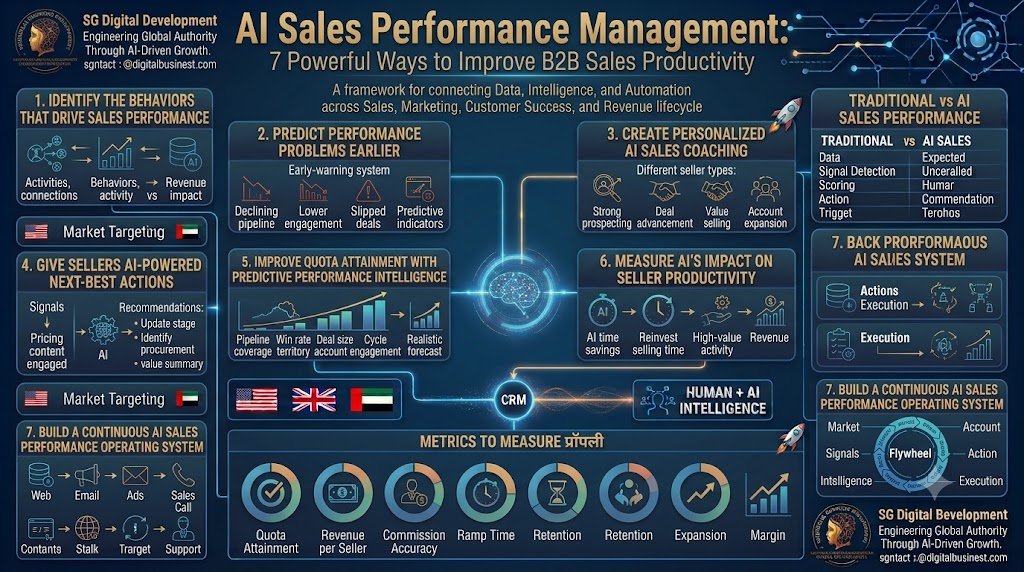
AI Sales Performance Management: 7 Powerful Ways to Improve B2B Sales Productivity.

AI Sales Performance Management: 7 Powerful Ways to Improve B2B Sales Productivity. Introduction Sales performance management has traditionally focused on a relatively simple set of questions: Are salespeople hitting quota? Are deals closing? Which representatives are performing well? Which representatives are falling behind? But modern B2B sales organizations are becoming much more complex. Sales teams now work across multiple channels, customer segments, territories, products and buying groups. AI is also changing how sellers research accounts, prioritize opportunities, prepare for meetings, create sales content and manage follow-up. That creates a new challenge. Companies can no longer improve sales performance simply by measuring more activity. They need to understand which activities, behaviors and decisions actually create revenue outcomes. This is where AI sales performance management becomes important. AI sales performance management combines artificial intelligence, sales data, CRM information, predictive analytics, performance intelligence and automated coaching to help organizations understand and improve seller performance. Instead of only asking whether a salesperson achieved quota, companies can investigate: Gartner’s 2026 research argues that traditional sales productivity measurements can miss the behaviors that actually drive seller performance and highlights AI-driven measures such as account reach, account engagement and average interaction value. The shift is significant. Sales performance management is moving from reporting what happened toward understanding what is happening, why it is happening and what should happen next. This article explores seven powerful ways AI can help B2B companies improve sales productivity, coaching, quota attainment, forecasting and revenue performance. What Is AI Sales Performance Management? AI sales performance management is the use of artificial intelligence, predictive analytics, sales intelligence and automation to measure, understand and improve sales-team performance. Traditional sales performance management often depends on: These metrics remain useful. The limitation is that many of them are lagging indicators. For example, if a salesperson misses quota at the end of a quarter, management knows there was a performance problem. But the more useful question is: When did the problem begin? Perhaps the salesperson: AI can analyze these patterns earlier. That creates the foundation for a more proactive performance-management system. Why AI Sales Performance Management Matters in 2026 The role of the salesperson is changing. AI can increasingly support: Gartner reported in May 2026 that AI saves sellers an average of 4.8 hours per week, but 72% of surveyed sales organizations reported low reinvestment of those time savings into high-value activities. This creates what Gartner describes as a sales productivity gap. Saving time is not the same thing as increasing revenue productivity. If AI saves three hours but those hours are not redirected toward valuable customer-facing work, the business may not see meaningful commercial improvement. Therefore, companies need a system for measuring: AI Efficiency → Seller Capacity → Seller Behavior → Customer Impact → Revenue That is a major role for AI sales performance management. AI Sales Performance Management vs Traditional Performance Management Traditional systems often emphasize historical performance. AI-powered systems can combine historical, behavioral and predictive information. Traditional Sales Performance AI-Powered Sales Performance Quota attainment Predictive quota performance Activity volume Activity quality and impact Historical reports Real-time performance intelligence Manual coaching AI-assisted coaching Periodic reviews Continuous performance monitoring Lagging indicators Leading + lagging indicators Generic sales guidance Personalized recommendations Manual opportunity reviews AI-powered opportunity analysis Static dashboards Dynamic performance insights Manager intuition Data-supported decision making The objective is not to replace sales managers. Instead, AI gives managers more context. A manager can spend less time collecting information and more time helping sellers improve. 7 Powerful Ways to Use AI Sales Performance Management 1. Identify the Behaviors That Actually Drive Sales Performance One of the biggest problems with traditional sales performance measurement is confusing activity with productivity. A salesperson may make 100 calls. Another salesperson may make 40 calls. The first seller appears more active. But what if the second seller generates significantly more qualified opportunities? Activity volume alone does not explain performance. AI sales performance management can analyze relationships between seller behaviors and commercial outcomes. It can examine: This helps identify which activities actually matter. Moving Beyond Activity Metrics Instead of asking: How many calls did the salesperson make? A modern system can ask: Which seller behaviors increased the probability of advancing opportunities? That is a much more useful question. Gartner’s 2026 research recommends looking at metrics such as account reach, account engagement and average interaction value to understand the value of seller interactions rather than relying solely on traditional activity measures. This creates a stronger performance-management model. 2. Use AI to Predict Performance Problems Earlier Traditional performance management often reacts after performance has already declined. AI can help identify risk earlier. For example, an AI model may detect that a seller is showing: Individually, these signals may not look serious. Together, they can indicate a potential performance problem. AI sales performance management can identify these patterns before they become visible in quarterly results. Example Suppose a salesperson has historically created $500,000 of qualified pipeline each month. During the current month: The salesperson has not yet missed quota. A traditional system may show normal performance. An AI system may flag the emerging risk. That allows the manager to intervene earlier. 3. Create Personalized AI Sales Coaching Sales coaching is one of the most important responsibilities of frontline sales managers. But managers often have limited time. They may manage: AI can help managers prioritize coaching. Instead of giving every seller generic advice, AI can identify specific development opportunities. For example: Seller A Strong prospecting but weak opportunity progression. Coaching focus: Discovery and deal advancement. Seller B Strong closing performance but excessive discounting. Coaching focus: Value selling and negotiation. Seller C Strong existing-account relationships but low expansion. Coaching focus: Cross-sell and expansion discovery. Seller D High activity but weak conversion. Coaching focus: Account prioritization and qualification. This creates personalized coaching. Salesforce’s sales-performance guidance also emphasizes AI-powered coaching and personalized resources connected to seller workflows and performance data. 4. Give Sellers AI-Powered Next-Best Actions Knowing that a seller is underperforming is useful. Knowing what the seller should do

AI sales compensation
AI Growth Engine

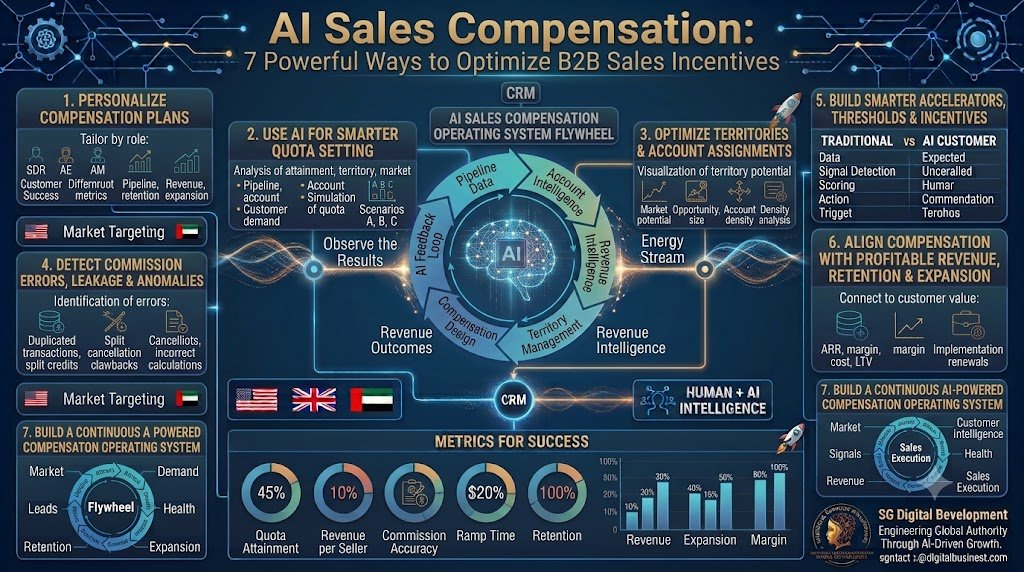
AI Sales Compensation: 7 Powerful Ways to Optimize B2B Sales Incentives.

AI Sales Compensation: 7 Powerful Ways to Optimize B2B Sales Incentives Introduction Sales compensation has always been one of the strongest levers for influencing seller behavior. What sales teams are rewarded for often determines what they prioritize. If compensation rewards revenue volume, sellers naturally focus on closing revenue. If it rewards new logos, acquisition becomes the priority. If it rewards expansion, account growth becomes more important. If it rewards profitable revenue and retention, sales behavior can shift toward higher-quality deals and longer-term customer value. The challenge is that modern B2B sales environments have become much more complicated. Sales teams now operate across multiple customer segments, territories, products, channels and buying groups. AI is also changing how sellers prospect, research accounts, create content, qualify opportunities and manage customer interactions. That creates a new question: How should companies design sales compensation when AI is changing the way sales work gets done? This is where AI sales compensation becomes strategically important. Instead of treating compensation as a fixed annual spreadsheet exercise, companies can use AI, sales data, CRM information, revenue intelligence and predictive analytics to continuously understand whether compensation plans are producing the desired business outcomes. Modern sales performance management increasingly connects compensation with territories, quotas, scenario planning, seller behavior, forecasting, analytics and governance. Gartner’s 2026 research describes sales performance management as covering areas including territory and quota planning, incentive compensation, risk modeling, seller analytics and performance intelligence. This means compensation is no longer simply about calculating commissions. It is becoming part of the broader AI-powered revenue operating system. In this guide, we will explore seven powerful ways companies can use AI sales compensation to improve incentive design, quota planning, sales performance, profitability and revenue growth. What Is AI Sales Compensation? AI sales compensation is the use of artificial intelligence, predictive analytics, sales data and automation to design, manage, analyze and optimize compensation plans for sales teams. Traditional compensation management usually relies on historical performance data, spreadsheets, predefined formulas and periodic management reviews. AI-powered compensation can go further. It can analyze: The objective is not simply to pay commissions faster. The objective is to understand whether the compensation structure is encouraging the right revenue-producing behaviors. For example, an AI model may identify that a sales team is consistently receiving strong compensation for low-margin deals while higher-value expansion opportunities receive comparatively little incentive. Management can then investigate whether the compensation structure is unintentionally influencing seller behavior. That is the strategic opportunity behind AI sales compensation. Why AI Sales Compensation Matters in 2026 Sales compensation is becoming more complex because the sales environment itself is changing. AI is already being incorporated into prospecting, account research, content creation, forecasting and seller workflows. Salesforce’s 2026 State of Sales research reports that sales teams increasingly view AI and AI agents as major growth tools. At the same time, compensation teams are beginning to incorporate AI into planning and decision-making. CaptivateIQ’s 2026 incentive compensation research reports that more than eight in ten organizations surveyed are using AI in some capacity, while only a smaller proportion report extensive use. The report also highlights AI’s growing role in plan design, quota setting and compensation strategy. This creates an important distinction. AI should not simply make compensation administration faster. It should help companies make better compensation decisions. For example: A traditional approach may ask: How much commission did each salesperson earn last quarter? An AI-driven approach can ask: Which compensation structures are producing the most profitable and sustainable revenue, for which sellers, territories, customer segments and sales motions? That is a much more strategic question. AI Sales Compensation vs Traditional Sales Compensation Traditional compensation management generally follows a periodic cycle: AI sales compensation can make this process more dynamic. Instead of relying exclusively on historical averages, AI can analyze multiple signals simultaneously. Traditional Approach AI-Powered Approach Historical performance Predictive performance modeling Static quotas Dynamic quota analysis Manual territory planning Data-driven territory optimization Spreadsheet calculations Automated calculations Periodic reviews Continuous monitoring Basic commission reporting Performance intelligence Revenue-focused incentives Revenue + profitability + retention Manual anomaly detection AI-powered risk detection Annual plan changes Scenario-based plan modeling Limited seller visibility Real-time compensation insights The goal is not to remove human judgment. Instead, AI can give sales operations, finance and sales leadership better information for making compensation decisions. 7 Powerful Ways to Use AI Sales Compensation 1. Personalize Compensation Plans by Role, Segment and Sales Motion One of the biggest weaknesses of traditional compensation planning is assuming that one structure can work equally well across every sales role. It usually cannot. An SDR, account executive, account manager, enterprise seller and customer expansion representative may have very different responsibilities. Their sales cycles can also vary dramatically. For example: Giving every role the same compensation logic can create unintended incentives. AI sales compensation can analyze performance patterns across different roles and segments. AI can help identify: This allows companies to design more role-specific compensation plans. Example Suppose an enterprise sales team sells contracts with long sales cycles. Paying the majority of variable compensation immediately on early-stage pipeline creation may encourage volume rather than quality. An AI-supported analysis could reveal that closed revenue, customer retention and expansion are stronger indicators of long-term account value. Management could then redesign the plan around those outcomes. The important point is that AI is helping identify the relationship between incentives and business results. 2. Use AI for Smarter Quota Setting Quota planning is one of the most important parts of sales compensation. If quotas are unrealistic, sellers can become disengaged. If quotas are too low, companies may underutilize their revenue capacity. Gartner’s 2026 research specifically highlights quota allocation quality as an important sales performance issue. Poor quota design can increase sales costs and damage seller motivation, while attainment distributions can help organizations evaluate whether quota allocation is working effectively. AI can make quota planning more data-driven. Instead of using only last year’s revenue, AI can analyze: This creates a more comprehensive picture of expected sales capacity. AI Quota Scenario Modeling AI can

Scroll to Top