AI Growth Engine

Strategic insights on how Artificial Intelligence is transforming ad performance and digital ROI.

AI Search Citation Strategy
AI Growth Engine

AI Search Citation Strategy: How to Get Your Business Cited in AI Search in 2026.

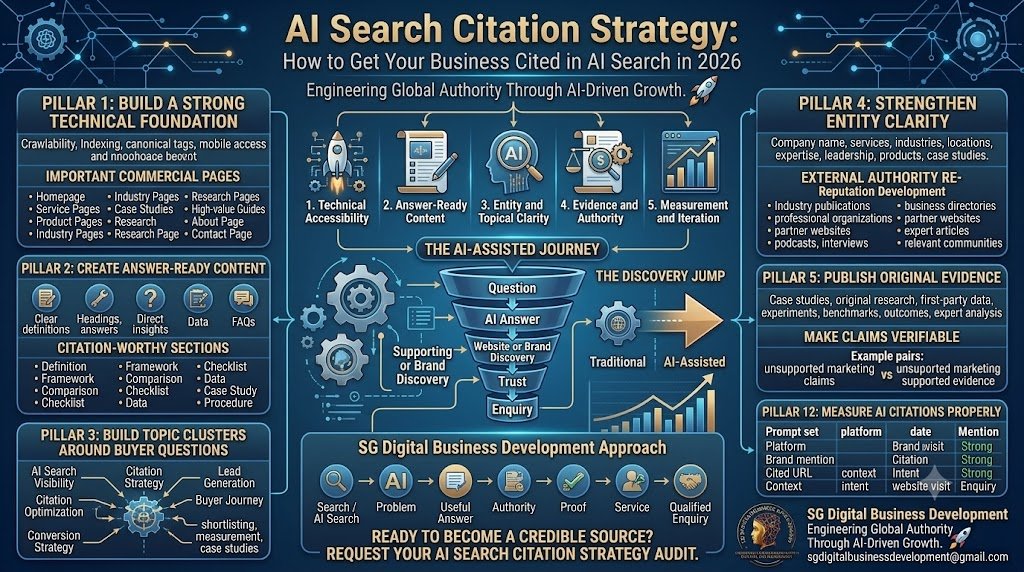
Introduction Search visibility is changing. For years, businesses focused on getting a page into Google results, improving rankings, earning clicks, and converting visitors. That model still matters. But buyers are increasingly asking longer questions and using AI-powered search experiences to research companies, solutions, products, services, and vendors. Google’s AI search experiences can provide links to supporting websites, while AI Mode can explore related searches and sources before producing a response. This creates a new opportunity for businesses: Become a source that AI systems can discover, understand, retrieve, and potentially cite. That is where an AI Search Citation Strategy becomes useful. An AI citation is not simply another backlink. It is a situation where an AI search experience references a page or source to support an answer, explanation, comparison, recommendation, or factual statement. For a business, the commercial question is bigger than: “How do I get cited?” The better question is: “How do I become a credible source for the questions my potential customers are asking?” That requires a combination of technical SEO, useful content, clear entities, original evidence, topical authority, internal linking, external recognition, and continuous testing. A practical AI Search Citation Strategy should therefore focus on building genuine information value rather than trying to manipulate individual AI responses. For SG Digital Business Development, the important point is simple: Visibility is valuable only when it can move toward trust, qualified enquiries, and business opportunities. What Is an AI Search Citation Strategy? An AI Search Citation Strategy is a structured approach to creating, organizing, and promoting information so that AI-powered search systems can discover, understand, retrieve, and potentially reference a business and its content for relevant questions. It combines traditional search fundamentals with a broader visibility model. Traditional SEO asks: AI search adds questions such as: This does not mean there is a secret AI citation ranking factor. Google’s guidance emphasizes the continuing importance of foundational SEO practices for AI search experiences, including indexability, internal links, useful content, textual information, and accurate structured data. Therefore, an AI Search Citation Strategy should extend SEO rather than replace it. The foundation remains a technically accessible website containing useful information. Why AI Citations Matter for Businesses The discovery journey can now look different from the classic search funnel. Traditional Journey Search → Result → Click → Website → Enquiry AI-Assisted Journey Question → AI Answer → Supporting Sources → Website or Brand Discovery → Trust → Enquiry A buyer may first encounter a company because an AI system mentions the business, references a case study, or links to an article. This can be particularly important for B2B businesses. A B2B buyer may ask: An effective AI Search Citation Strategy focuses on becoming useful during this research process. The objective is not simply to collect citations. The objective is to become a useful and credible source within the buyer’s information journey. Citation Is Different From Ranking Ranking and citation are related, but they are not identical. A page can rank for a keyword and never be cited in an AI answer. Another page may not be the first traditional result but can still become a supporting source for a specific AI response. AI search systems can explore related searches, sources, and subtopics before generating a response. Consider a buyer asking: “Which B2B SEO agency should a SaaS company consider if it wants stronger Google and AI search visibility?” The underlying information requirements could include: One page rarely answers every part perfectly. That is why an AI Search Citation Strategy should build a connected information ecosystem rather than trying to make one article answer everything. The goal is to create a collection of useful pages where each page addresses a meaningful part of the buyer’s research journey. The Five Pillars of an AI Search Citation Strategy A practical AI Search Citation Strategy can be built around five connected pillars: Each pillar supports the others. A weakness in one area can limit the value created by the others. For example, excellent content has limited value if important pages cannot be indexed. Likewise, technically accessible pages may not build meaningful visibility if the content is generic or the business entity is unclear. 1. Build a Strong Technical Foundation Before worrying about citations, make sure important pages can actually be discovered. Review: Important pages should be accessible through normal search-engine crawling and website navigation. Start with commercially important pages: Make sure these pages can be reached through normal website architecture. A technically strong foundation is the first requirement for any AI Search Citation Strategy. If your service page is blocked, noindexed, poorly connected, or missing important text, publishing more articles will not solve the underlying problem. 2. Create Answer-Ready Content AI systems need information they can retrieve and use. That does not mean writing robotic content. It means making important information clear. Strong pages can use: For example, instead of beginning an article with several paragraphs of generic marketing language, answer the core question early: “An AI Search Citation Strategy is a process for making a business and its information easier for AI-powered search systems to discover, understand, retrieve, and reference.” Then explain the details. This structure helps readers understand the topic while creating clearer information units for search systems. The principle is simple: One important question → one clear answer → useful supporting evidence. That approach should be repeated throughout the content system. 3. Build Topic Clusters Around Buyer Questions One article is rarely enough to establish meaningful expertise. Build a connected topic cluster. For example: Each article should have a distinct search intent. Then connect them. A pillar page can link to supporting guides. Supporting guides can link to relevant service pages. Service pages can link to case studies. Case studies can link back to relevant concepts. This creates semantic relationships. The purpose is not to manipulate an AI system. The purpose is to make the website’s knowledge structure easier for both people and search systems to understand. A strong AI Search Citation Strategy therefore treats
AI Search Visibility Audit
AI Growth Engine

AI Search Visibility Audit: How to Find Why Your Business Is Missing From AI Search in 2026.

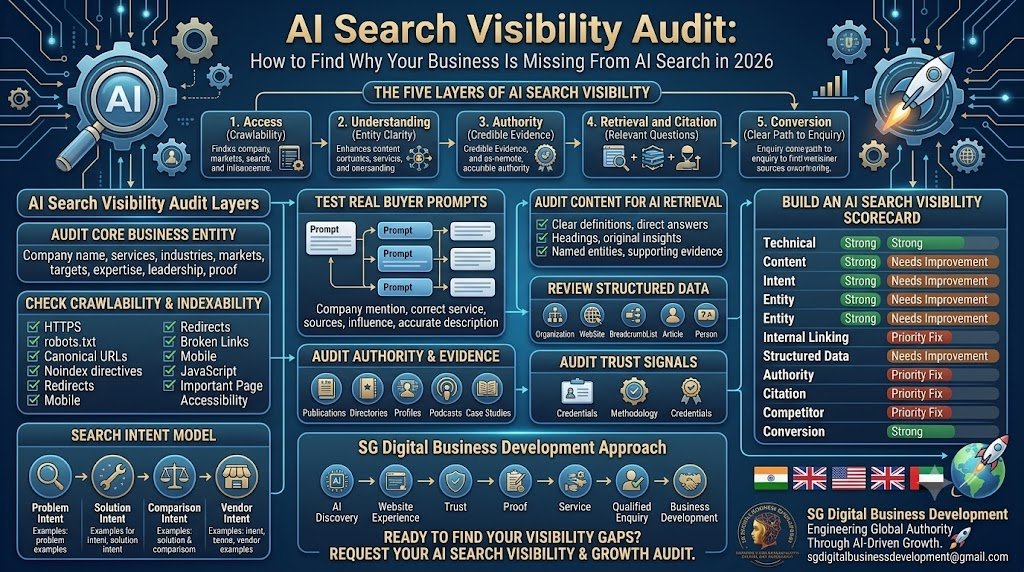
Introduction Search visibility is no longer limited to whether a website appears on a Google results page. A potential customer can now ask an AI system a question, compare several businesses, request recommendations, investigate a vendor, or ask for a solution before visiting any website. That changes the visibility problem for businesses. A company may have a website, publish blogs, rank for some keywords, and still be missing from the answers that influence buying decisions. That is where an AI Search Visibility Audit becomes useful. Instead of asking only, “Do we rank?”, an audit asks a broader set of business questions: In 2026, AI search visibility should be treated as an additional layer of search strategy, not a replacement for SEO. Current audit frameworks increasingly combine crawlability, content structure, entity clarity, trust, citations, and real prompt testing rather than treating AI visibility as a simple ranking score. For SG Digital Business Development, the important point is simple: Visibility is valuable only when it can move toward trust, qualified enquiries, and business opportunities. What Is an AI Search Visibility Audit? An AI Search Visibility Audit is a structured review of how well a business can be discovered, understood, referenced, and trusted across AI-powered search experiences. These experiences can include ChatGPT, Google AI Overviews and AI Mode, Perplexity, Gemini, and other answer-oriented discovery systems. A traditional SEO audit might examine: An AI Search Visibility Audit adds another layer. It examines whether the information about the business is clear enough for AI systems to retrieve and interpret, whether important claims are supported, whether the website provides answer-ready information, and whether the brand appears when real buyer questions are tested. The objective is not to manufacture a guaranteed AI recommendation. No legitimate audit can guarantee that an AI system will mention a business. The objective is to find the gaps that reduce the business’s ability to be discovered and understood. Why Businesses Need an AI Search Visibility Audit The traditional journey often looked like this: Search → Results → Website → Enquiry The emerging journey can look more like: Question → AI Answer → Sources or Recommendations → Website → Trust → Enquiry This creates a new problem. A business can lose visibility before the buyer ever reaches the website. For example, a buyer might ask: “Which agencies help B2B companies improve SEO and AI search visibility?” If competitors are repeatedly mentioned while your company is absent, your website may not get the opportunity to compete for that buyer. An AI Search Visibility Audit helps turn that invisible problem into a diagnostic process. It can reveal whether the problem is: It also prevents a common mistake: assuming that publishing more content automatically creates AI visibility. More content is not necessarily more useful content. If the business entity is unclear, pages are disconnected, evidence is weak, or content does not answer buyer questions, increasing publishing volume may simply increase noise. The Five Layers of AI Search Visibility A practical AI Search Visibility Audit should examine five connected layers. 1. Access Can search systems reach and process important content? 2. Understanding Can systems clearly understand what the company does, who it serves, and which problems it solves? 3. Authority Is there enough credible evidence connecting the brand with its expertise? 4. Retrieval and Citation Does useful content appear when relevant questions are tested, and are the right pages being referenced? 5. Conversion When a person moves from discovery to the website, is there a clear path toward trust and enquiry? These layers matter because visibility without conversion is incomplete. 1. Audit Your Core Business Entity The first part of an AI Search Visibility Audit should be the business entity itself. Ask whether a visitor or AI system can quickly understand: Your website should not force a search system to infer basic facts from scattered pages. For example, if your homepage says “digital growth engineering” but your service pages discuss SEO, Google Ads, web development, AI search, and lead generation without a clear relationship, the business may be harder to classify. Create one clear business identity across your website. Use consistent company naming, service terminology, descriptions, organization information, and author information. The goal is not to repeat the company name everywhere. The goal is consistency. 2. Check Crawlability and Indexability A technically strong content strategy cannot compensate for pages that search systems cannot properly access. Your AI Search Visibility Audit should check: Google’s current guidance continues to emphasize the importance of normal search fundamentals for AI search experiences. AI Overviews and AI Mode use existing Search systems, so basic crawlability and indexability remain foundational. Use Google Search Console to check whether important pages are indexed. Prioritize: Do not start with a complicated AI strategy if your most important commercial pages are not properly accessible. 3. Audit Search Intent Coverage AI systems do not only respond to short keywords. They respond to: Your AI Search Visibility Audit should therefore map content against buyer intent. A useful intent model includes four major stages. Problem Intent The buyer knows something is wrong. Example: “Why is my B2B website getting traffic but no leads?” Solution Intent The buyer is looking for a method. Example: “How can I improve B2B website conversion?” Comparison Intent The buyer is comparing alternatives. Example: “SEO agency vs in-house SEO team for B2B growth” Vendor Intent The buyer is looking for a provider. Example: “Best AI SEO agency for B2B companies” There is also a fifth important layer. Trust Intent The buyer wants proof. Example: “What should I check before hiring an AI SEO agency?” If your content only targets informational topics, you may generate awareness without supporting commercial decisions. A stronger content system covers the journey from: Problem → Solution → Comparison → Vendor → Trust → Enquiry 4. Test Real Buyer Prompts This is one of the most important parts of an AI Search Visibility Audit. Do not test only branded questions. Test the questions your ideal customers would actually ask. Create a prompt

AI Content Optimization
AI Growth Engine

AI Content Optimization: How to Make Your Content Win Google & AI Search in 2026.

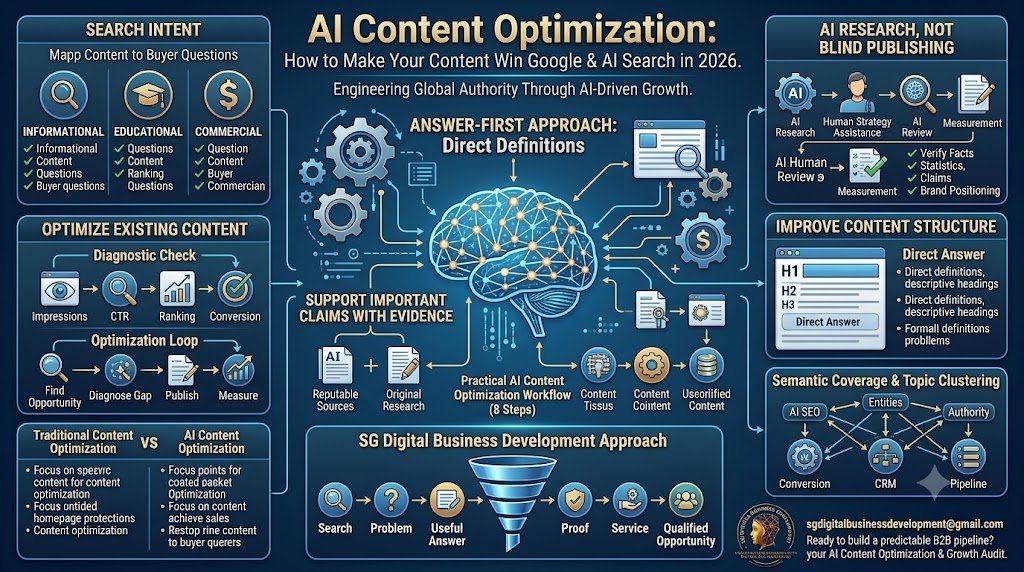
Introduction Content marketing has changed. For years, businesses created articles primarily to rank for keywords, attract organic traffic, and move visitors toward a conversion. That model still matters. But search is becoming more conversational and increasingly influenced by AI-powered experiences. Buyers can now ask ChatGPT, Google AI Overviews, Gemini, Perplexity, Claude, and other systems to explain a problem, compare solutions, identify vendors, summarize research, or recommend what they should do next. This creates a new challenge. Your content must work for people, traditional search engines, and AI-powered discovery systems at the same time. That is where AI Content Optimization becomes important. AI Content Optimization is not simply asking an AI tool to rewrite an article. It is the process of improving content so it is useful, accurate, easy to understand, aligned with search intent, technically accessible, commercially relevant, and structured clearly enough for search and AI systems to interpret. The strongest approach combines human judgment with AI-assisted research, analysis, content improvement, internal linking, structured information, and performance measurement. The objective is not to publish more content. The objective is to make existing and new content more useful, more discoverable, more trustworthy, and more capable of supporting business growth. What Is AI Content Optimization? AI Content Optimization is the process of using artificial intelligence and strategic SEO methods to improve content for human readers, traditional search engines, and AI-powered search experiences. It can involve: There are two sides to the concept. Using AI to Optimize Content AI can help identify missing topics, analyze competing pages, summarize search patterns, suggest structures, compare content coverage, and find opportunities for improvement. Optimizing Content for AI Search Content can also be structured so AI-powered systems can more easily understand the subject, identify important facts, connect entities, extract useful passages, and potentially cite or surface the page. These two ideas work together. But human expertise remains essential. AI can accelerate analysis and production. It should not be treated as an automatic replacement for strategy, evidence, editorial judgment, or business knowledge. AI Content Optimization. Why AI Content Optimization Matters in 2026 The biggest change is not that search engines have disappeared. They have not. The change is that search now includes more answer-based and conversational experiences. A buyer might ask: “Which B2B SEO strategies can help a technology company generate international leads?” The answer may contain explanations, sources, recommendations, and follow-up questions. That means a business needs content that clearly communicates: Traditional SEO foundations remain important. Technical accessibility, useful content, relevant search intent, internal linking, authority, and a strong user experience still matter. AI search adds another layer. Content must also be understandable enough for AI systems to interpret and potentially use in generated answers. This makes AI Content Optimization a natural extension of strong SEO rather than a replacement for it. 1. Start With Search Intent The first rule is simple: Do not optimize content before understanding why someone is searching. Consider three queries: “What is AI SEO?” This is primarily informational. “How does AI SEO work for B2B companies?” This is educational and strategic. “AI SEO agency for B2B companies” This has commercial intent. The same article should not attempt to satisfy all three equally. A strong optimization process maps content to intent. Ask: AI tools can help analyze search results and group queries, but the final intent decision should come from business and SEO judgment. Good AI Content Optimization starts with the buyer’s question, not the keyword alone. 2. Optimize Existing Content Before Publishing More One of the biggest opportunities for businesses is often already sitting on their website. An article may have: Instead of immediately publishing another article, review the existing page. A practical workflow is: Find Opportunity → Diagnose Gap → Improve Page → Publish Update → Measure Result This is where AI Content Optimization can create efficiency. AI can help compare your page with relevant search results, identify missing subtopics, summarize competing structures, and suggest areas for review. But do not automatically copy the competition. The purpose is to identify what the reader needs and where your content can provide better information, evidence, examples, or clarity. 3. Make the Main Answer Easy to Find AI-powered search systems need understandable information. Readers do too. A page should not make the visitor read five paragraphs before discovering the basic definition. Start important sections with a direct answer. For example: “AI Content Optimization is the process of improving content so it performs effectively across traditional search and AI-powered discovery while remaining useful and credible for human readers.” Then explain the details. This answer-first approach improves clarity. Use: The objective is not to write robotic content. It is to make useful information easy to find, understand, and reference. 4. Improve Content Structure Content structure affects both user experience and machine interpretation. A strong article usually has: Avoid creating headings simply because an SEO plugin recommends more headings. Every section should answer a meaningful question or move the argument forward. A good structure often follows: Definition → Why It Matters → Process → Examples → Mistakes → Framework → Measurement → FAQ → Next Step This creates a predictable information architecture. In AI Content Optimization, structure should support meaning rather than keyword placement. 5. Strengthen Semantic Coverage Search engines do not understand a topic only through repeated keywords. A page about AI SEO may naturally involve: These concepts help establish context. Semantic coverage means discussing the related ideas that a knowledgeable reader would reasonably expect. For example, a page about B2B lead generation should not only repeat “B2B lead generation.” It should discuss: This makes the content more complete. AI Content Optimization 6. Build Content Around Entities and Relationships AI systems need context. A business should make it clear: For example, if a company provides B2B SEO, its content ecosystem may connect: B2B SEO → Search Intent → Semantic SEO → Topical Authority → AI Search → Lead Generation → Conversion These relationships help users navigate the subject and help search systems understand the broader

AI Search Conversion Strategy
AI Growth Engine

AI Search Conversion Strategy: How to Turn AI Discovery Into Qualified Leads in 2026.

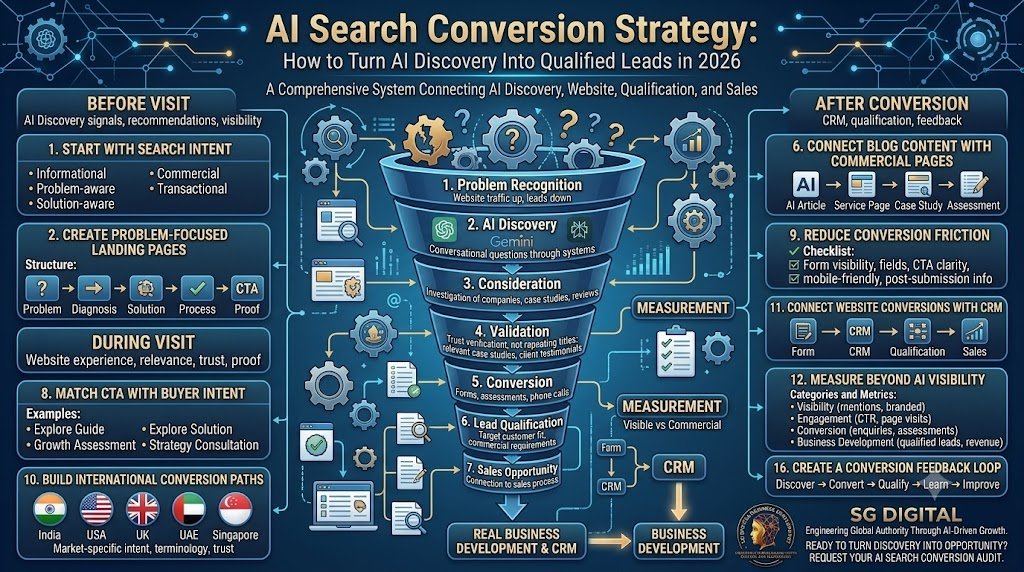
Introduction AI search is changing the way customers discover businesses. Instead of typing a short keyword into Google and opening several websites, buyers can now ask complete questions through ChatGPT, Google AI Overviews, Gemini, Perplexity, Claude, and other AI-powered discovery systems. A buyer may ask: The answer may include companies, services, websites, articles, comparisons, and recommendations. This creates a new opportunity for businesses. But appearing in AI search is only the beginning. A company can receive an AI recommendation and still lose the prospect when that person reaches the website and cannot understand the offer, find relevant proof, identify the right service, or see an obvious next step. That is why businesses need more than AI Search Visibility. They need an AI Search Conversion Strategy. The purpose is simple: Turn AI discovery into trust, trust into action, and action into qualified business opportunities. A complete system connects AI search, SEO, content, website experience, conversion optimization, lead qualification, CRM, and business development. The goal is not simply to generate more visitors. The goal is to help the right visitors move from discovery to a meaningful commercial conversation. What Is an AI Search Conversion Strategy? An AI Search Conversion Strategy is a structured system that connects AI-powered discovery with website conversion and business development. It considers what happens before, during, and after a prospect discovers a company through AI search. The journey can look like this: AI Discovery → Website Visit → Relevance → Trust → Proof → Conversion → Qualification → Sales Opportunity Traditional SEO often focuses heavily on rankings, impressions, clicks, and organic traffic. Those metrics remain important. However, AI search can influence the buying journey before the prospect even visits a website. An AI system may summarize a company, explain its services, compare alternatives, or recommend a provider. That means the website has a new responsibility. It must confirm the recommendation. The visitor should quickly understand: A strong AI Search Conversion Strategy therefore combines visibility with commercial experience. Why AI Search Creates a New Conversion Challenge Search behaviour is becoming more conversational. A traditional search might be: B2B SEO agency An AI search might be: “What should a B2B company do if it gets organic traffic but very few qualified enquiries?” The second query contains more context. The AI system can interpret the problem and potentially recommend solutions. This means businesses are no longer competing only for keywords. They are competing to become useful, credible, relevant sources within a buyer’s research process. That creates three major challenges. Challenge 1: Discovery Can the business become visible when the buyer asks an AI system a relevant question? Challenge 2: Validation When the buyer reaches the website, can the company prove that it deserves consideration? Challenge 3: Conversion Can the buyer easily take the next appropriate commercial action? An AI Search Conversion Strategy needs to address all three. The AI Search Conversion Funnel A practical AI-driven buyer journey can be divided into seven stages. 1. Problem Recognition The customer realizes that something is not working. For example: 2. AI Discovery The buyer asks an AI system for information, recommendations, or possible solutions. 3. Consideration The buyer investigates companies, services, content, reviews, and case studies. 4. Validation The buyer checks whether the company actually understands the problem. 5. Conversion The buyer submits a form, requests an assessment, books a call, requests a proposal, or starts a conversation. 6. Qualification The business determines whether the enquiry fits its target customer and commercial requirements. 7. Business Development The qualified opportunity moves into a sales process. This means the real journey is not: AI Search → Lead It is: AI Search → Discovery → Trust → Decision → Conversion → Qualification → Business Development That distinction is critical. 1. Start With Search Intent The first step in an AI Search Conversion Strategy is understanding intent. Not every visitor is ready to buy. Consider these searches: “What is AI SEO?” This is primarily informational. Now consider: “Best AI SEO agency for B2B companies” This is commercial investigation. And: “AI SEO agency consultation” This is much closer to transactional intent. Each visitor needs a different experience. A business should therefore classify important search queries into categories such as: The content, landing page, internal links, and CTA should reflect that intent. A common mistake is sending every visitor to the same homepage. A better approach is to guide each visitor toward the most relevant next step. 2. Create Problem-Focused Landing Pages AI search often starts with a business problem. For example: “Why is my B2B website getting traffic but not generating leads?” If your company provides conversion optimization, the visitor should ideally reach a relevant resource or service page that directly addresses that problem. A strong landing page can follow this structure: Problem → Diagnosis → Solution → Process → Proof → CTA The problem section shows that you understand the customer’s situation. The diagnosis explains why the problem may exist. The solution introduces the appropriate service. The process explains how the work is performed. Proof reduces uncertainty. The CTA provides the next action. This structure makes the AI Search Conversion Strategy more commercially useful because the visitor does not have to search through multiple unrelated pages. 3. Make the Website Immediately Understandable An AI-referred visitor may arrive with a specific expectation. The first screen should therefore answer the most important questions quickly. Who are you? The company identity should be obvious. What do you do? The service should be clear. Who do you help? The target audience should be identifiable. What problem do you solve? The business outcome should be understandable. What should I do next? The CTA should be visible. For example: Turn Digital Visibility Into Real Business Growth Human Intelligence + AI Capability + Digital Marketing + Business Development The message should then explain how the company connects visibility, trust, conversion, and business development. The objective is not to impress the visitor with complicated terminology. The objective is to create immediate relevance. A visitor should

AI Vendor Shortlisting
AI Growth Engine

AI Vendor Shortlisting in 2026: How B2B Buyers Choose Vendors Before They Visit Your Website.

Introduction A B2B buyer no longer has to visit ten vendor websites before creating a shortlist. They can ask an AI assistant: “Which companies can solve this problem?” “Compare the best vendors for my requirements.” “Which agency has experience with companies like mine?” “What should I look for before choosing a provider?” The answer can create a shortlist in seconds. That changes digital marketing. For years, companies competed to get the click. Now they increasingly need to compete to become one of the businesses considered before the click. This is the new reality of AI Vendor Shortlisting. The important question is no longer only: “Can Google find my website?” It is: “Can AI understand my business well enough to consider it when a buyer asks for the solution I provide?” That question connects SEO, AI search, website strategy, authority, content, proof, conversion and business development. What Is AI Vendor Shortlisting? AI Vendor Shortlisting is the process in which a buyer uses an AI-powered search or conversational system to identify, compare, filter or recommend potential vendors before making a purchasing decision. Instead of manually opening dozens of results, a buyer can describe a business problem and ask AI to narrow the options. The system may consider information from: For businesses, this creates a new visibility layer. Traditional SEO tries to win a position. AI-assisted buying increasingly tries to produce a useful answer or shortlist. That means the business needs to be understood in context. Why AI Vendor Shortlisting Matters in 2026 B2B buying behavior is changing quickly. G2’s 2026 AI Search Insight Report found that 51% of surveyed B2B software buyers start research with an AI chatbot more often than Google, while 71% use AI chatbots during software research. G2 also reports that AI chatbots are the leading source influencing which vendors make buyer shortlists in its survey. Forrester’s 2026 research found that 94% of business buyers use AI during the buying process, while buyers still validate AI-generated information through trusted people and external sources. This tells us something important: AI is not replacing trust. AI is changing how buyers begin research, narrow options and decide which information deserves attention. That is why AI Vendor Shortlisting should be treated as a business-development problem, not simply an SEO trend. The B2B Buyer Journey Has Changed The old model often looked like: Google Search → Website → Service Page → Contact Form → Sales Call The new journey can look like: Business Problem → AI Question → Vendor Shortlist → Validation → Website → Comparison → Enquiry → Sales Conversation Sometimes the website appears very late. A buyer might already know three companies before visiting any of them. This means your website is no longer the only place where your first impression is created. Your reputation exists across an ecosystem: A strong AI Vendor Shortlisting strategy therefore needs consistent information across these touchpoints. The Real Problem: AI Cannot Shortlist What It Cannot Understand Many businesses describe themselves with vague language. For example: “We provide innovative solutions that help modern businesses transform.” It sounds professional. But it does not answer the buyer’s practical questions. What do you actually provide? Who do you serve? Which industries do you understand? Which problems do you solve? What outcomes can you influence? Why should someone trust you? What evidence supports your claims? For AI Vendor Shortlisting, clarity is fundamental. Your business entity needs to be understandable. If your website, profiles and external mentions consistently explain your expertise, AI systems have more useful context. If every page describes the business differently, the buyer and the machine both have to work harder. Build a Clear Business Entity A strong business entity should connect: Company → Services → Audience → Problems → Expertise → Geography → Proof For example, a B2B digital growth company should make the relationship between its services obvious. SEO connects to visibility. AI search optimization connects to discovery. Website optimization connects to conversion. Lead generation connects to demand. Business development connects opportunities to revenue. This creates a coherent business story. The goal of AI Vendor Shortlisting is not to manipulate an AI model. The goal is to make your business genuinely easy to understand when it is relevant to a buyer. Stop Creating Content Only Around Keywords Keywords still matter. But a keyword list is not a buyer strategy. Imagine your keyword is: “B2B lead generation.” You could create one page and repeat the phrase. Or you could build a complete problem-solving ecosystem around it: Now your content demonstrates expertise rather than simply mentioning a phrase. That matters for AI Vendor Shortlisting because buyers increasingly ask broader questions that require context. Answer the Questions Buyers Ask AI Your content should reflect real buyer prompts. Examples include: These are not simply SEO keywords. They are decision questions. The buyer is really asking: Who understands my problem? Who has done this before? Can I trust them? Will they understand my business? Can they connect marketing with revenue? A strong AI Vendor Shortlisting system answers these concerns before the sales call. Proof Becomes More Important Than Claims When AI gives a buyer a shortlist, the buyer still needs to validate it. This is where proof matters. Useful proof includes: Do not simply say: “We are experts in AI marketing.” Show what that expertise means. Explain a problem you solved. Show how you approached it. Explain what changed. Share what you learned. That creates evidence. For AI Vendor Shortlisting, evidence can be more persuasive than another generic service description. Reviews Become a Trust Layer G2’s 2026 research highlights review sites as an important trust signal when buyers evaluate AI-generated recommendations. This makes sense. An AI answer can introduce a company. A buyer may then look for independent validation. They may: So your reputation should not depend entirely on your own website. A strong AI Vendor Shortlisting strategy builds a connected trust ecosystem. Your Website Still Matters AI discovery does not make your website irrelevant. It makes your website more important

Get Recommended by AI
AI Growth Engine

Get Recommended by AI: How Businesses Can Become the Brand AI Search Suggests in 2026.

Introduction Imagine a potential client opens ChatGPT, Gemini, Perplexity, or Google AI Search and asks: “Which companies can help me solve this problem?” Your competitor appears. You do not. The buyer may never visit your website. They may never see your Google ranking. They may never know your company existed. This is one of the biggest changes happening in digital marketing. For years, businesses focused on ranking on Google. Now they also need to understand how AI systems discover businesses, understand their expertise, compare alternatives, and decide which brands are worth mentioning. That creates a new business question: How do you get recommended by AI when a potential customer is looking for a solution you provide? The answer is not simply “use more AI.” It requires a combination of human expertise, AI capabilities, search visibility, structured information, authority, proof, and business development strategy. That is where modern digital marketing is heading. What Does It Mean to Get Recommended by AI? To get recommended by AI means building enough relevance, clarity, authority, evidence, and contextual information around your business that AI-powered search systems can understand what your company does, who it serves, what problems it solves, and when it may be a relevant recommendation. This is different from traditional ranking. Traditional SEO often asks: “How can my page appear higher for this keyword?” AI search introduces another question: “How can my business become a useful answer when someone asks for a solution?” That difference is extremely important. A buyer may not ask: “What is B2B SEO?” They may ask: “Which agency can help a B2B company generate qualified leads through SEO and AI search?” The second question is much closer to a commercial decision. Your business needs to be understood in that context. Why AI Recommendations Matter for Businesses in 2026 AI search is increasingly becoming part of how buyers research categories, compare vendors, and create shortlists. G2’s 2026 AI Search Insight Report found that 51% of surveyed B2B software buyers start research with an AI chatbot more often than Google, while 71% use AI chatbots somewhere during software research. The same research found that AI chatbots can influence vendor shortlists and purchasing decisions. This does not mean Google has disappeared. Google remains important. In fact, Google says its AI Search experiences are still rooted in foundational Search systems and helpful content. The real change is that the buyer journey now has multiple discovery environments. A potential customer may move through: Google → AI Overview → ChatGPT → LinkedIn → Website → Reviews → Sales Conversation Or: ChatGPT → Google → Competitor Website → Case Study → LinkedIn → Enquiry This means businesses cannot think about visibility as one ranking position anymore. They need to think about being discoverable throughout the decision journey. Get Recommended by AI. 1. AI Does Not Recommend What It Cannot Understand One of the biggest mistakes businesses make is assuming AI automatically understands their company. It does not. Your website may say: “We provide innovative digital solutions for modern businesses.” That sounds professional. But it is extremely vague. What do you actually do? SEO? Lead generation? Web development? AI consulting? Digital advertising? Business development? Who do you serve? B2B companies? SaaS? Manufacturers? Professional services? International businesses? What business problem do you solve? If these relationships are unclear, your business becomes difficult to categorize. And if your business is difficult to understand, it becomes harder for search systems to connect your company with the right questions. Get Recommended by AI. Make your business entity clear Your website should communicate: Clarity comes before visibility. 2. Stop Writing Only for Keywords Keywords are still important. But keyword-only thinking is becoming too narrow. Suppose your target keyword is: B2B lead generation You could write an article containing that phrase repeatedly. Or you could build a complete information ecosystem around the business problem. For example: Now the website communicates a broader concept. This helps humans understand your expertise. It also gives search systems more context.Get Recommended by AI. The objective is not to repeat one phrase endlessly. The objective is to build semantic clarity around a business problem. 3. Build Content Around the Questions Buyers Actually Ask If you want to get recommended by AI, your content needs to answer real questions. Think about what a buyer would ask an AI assistant. For example: “Why is my website getting traffic but no leads?” “How can a B2B company improve AI search visibility?” “What should I look for in an AI SEO agency?” “How can I generate international B2B leads?” “Why does my competitor appear in AI search but my company doesn’t?” These are not just keywords. They are business problems expressed as questions. That distinction matters. A strong article should make the reader think: “This is exactly the problem I am facing.” Then it should help them understand: Problem → Cause → Solution → Implementation → Measurement → Business Outcome That is much more powerful than publishing another generic list of SEO tips. 4. Create Answer-Ready Content AI systems need information they can understand and use. That means your content should be structured clearly. Use: Direct definitions Explain the topic in the first few paragraphs. Clear subheadings Make every major question easy to identify. Short explanations Avoid unnecessary complexity. Comparison tables Help readers and systems understand differences. FAQs Answer commercial and informational questions. Examples Show how an idea works in the real world. Original frameworks Create your own way of explaining a problem. For example: Human Insight → AI Analysis → Marketing Execution → Business Development A framework gives your brand something memorable. 5. Original Experience Can Become a Major Advantage There is an enormous amount of generic AI-generated content online. That creates a problem. If everyone publishes the same information, why should an AI system or human buyer consider one source more useful than another? Get Recommended by AI. The answer is original evidence and experience. Publish: For example: Instead of writing: “Website trust is important.” Explain: “We observed

Agentic SEO
AI Growth Engine

Agentic SEO in 2026: How to Optimize Your Website for AI Agents & AI Search.

Introduction Search is changing again. For years, businesses optimized websites mainly for human users and traditional search engines. The objective was straightforward: identify keywords, create content, build backlinks, improve rankings, attract clicks, and convert visitors into leads. That model is still important. But in 2026, another type of visitor is becoming increasingly important: AI agents. AI systems are no longer limited to generating answers. They are increasingly being used to research companies, compare solutions, summarize information, evaluate products, recommend vendors, and assist users with decisions. Google is also expanding AI-powered experiences and agentic capabilities across Search, Ads, Shopping, and business workflows. Its 2026 marketing updates include AI-powered campaign tools, Business Agent for Leads, AI Performance Insights, and richer conversational product information. At the same time, SEO platforms are beginning to discuss how websites should be optimized not only for people and crawlers, but also for AI agents that can interpret and act on information. Ahrefs has identified agent optimization as an emerging AI-search trend, including interest around structured content, accessibility, and agent-readable information. This creates a new opportunity for businesses. Agentic SEO is about preparing your digital presence so AI systems can understand your business, interpret your content, evaluate your authority, and potentially use your information when helping users make decisions. The future of search is not simply about getting a page ranked. It is increasingly about becoming a trusted, understandable, actionable digital entity. What Is Agentic SEO? Agentic SEO is the practice of optimizing a website, content ecosystem, structured data, and digital authority so AI agents can efficiently understand, retrieve, evaluate, and use business information. Traditional SEO asks: How can I help Google understand and rank this page? AI-search optimization asks: How can I help AI systems understand and cite this business? Agentic SEO adds another question: How can I make my digital information useful and actionable for AI agents? That difference is important. An AI agent may need to understand: This means your website needs more than keywords. It needs clarity, structure, context, evidence, and machine-readable information. Why Agentic SEO Matters in 2026 The biggest change is happening in how people discover information. B2B buyers are increasingly using AI systems during research. G2’s 2026 AI Search Insight Report found that 71% of surveyed B2B software buyers rely on AI chatbots somewhere in their research, while 51% say they start software research with an AI chatbot more often than Google. At the same time, 80% still use Google somewhere in the buying journey. That means businesses should not think: Google OR AI. The stronger strategy is: Google + AI Search + AI Agents + Human Decision-Making. This is where Agentic SEO becomes commercially relevant. If an AI system is helping a potential customer research vendors, your company needs to be: A company that satisfies those requirements has a better chance of appearing in modern discovery journeys. Agentic SEO vs Traditional SEO Traditional SEO and Agentic SEO are not competing strategies. They are layers of the same digital growth system. Traditional SEO Agentic SEO Keywords Context and entities Rankings AI discoverability Search snippets Answer-ready information Human clicks Human + agent interactions Backlinks Broader authority signals Pages Connected knowledge architecture Search intent Intent + task context Traffic Visibility + actions + business outcomes Technical crawlability Machine-readable accessibility Content relevance Content usefulness for AI systems Traditional SEO remains foundational. But businesses should increasingly build content that is easy for both humans and machines to understand. How AI Agents Change Website Discovery Imagine a potential customer asks an AI assistant: “Find a B2B digital marketing company that understands AI search, lead generation, website optimization, and international growth.” The AI system does not necessarily need to show ten blue links. It may instead analyze multiple information sources and produce a shortlist. This creates a different visibility problem. Your company may rank for: B2B digital marketing agency but still fail to become part of an AI-generated recommendation if the system cannot confidently understand: Therefore, Agentic SEO is partly an entity and information-architecture problem. The objective is to make your business easier to understand. 7 Core Elements of Agentic SEO 1. Build a Clear Business Entity AI systems need to understand exactly who you are. Your website should clearly communicate: Avoid making visitors or AI systems guess what your company actually does. Your homepage, About page, service pages, author information, social profiles, and external mentions should reinforce a consistent entity. 2. Create Answer-Ready Content AI systems work with information differently from traditional search users. A page should contain clear answers to important questions. For example: What is B2B AI SEO? Give a direct definition. Who needs B2B AI SEO? Explain the ideal customer. How does it work? Explain the process. What results should a business measure? Explain the commercial metrics. This does not mean writing robotic content. It means making important information easy to extract and understand. 3. Build Connected Topic Clusters One isolated article rarely establishes deep authority. A stronger architecture connects related topics. For example: Agentic SEO ↓ B2B AI SEO ↓ AI Search Visibility ↓ B2B Semantic SEO ↓ B2B Topical Authority ↓ AI Content Strategy ↓ B2B AI Buyer Journey ↓ AI Lead Generation ↓ Conversion Optimization This type of architecture creates contextual relationships between pages. It also gives AI systems more information about your expertise. Your website becomes less like a collection of random articles and more like a business knowledge system. 4. Improve Structured Data Structured data can help search engines understand important entities and relationships. Depending on your business and page type, this may include: Schema should not be treated as a magic ranking button. Its real value is helping search systems interpret information more clearly. For businesses investing in Agentic SEO, structured data should be part of a broader entity and information architecture. 5. Make Important Information Machine-Readable AI agents need accessible information. If critical information exists only inside: it may be harder for automated systems to interpret. Important information should be available as clear HTML text

Human AI Collaboration
AI Growth Engine

Human AI Collaboration in 2026: How Businesses Can Combine Human Intelligence & AI for Smarter Growth.

Introduction AI is changing the way businesses work. But the biggest business question in 2026 is no longer: “Can AI do this task?” The better question is: “What can humans and AI achieve together that neither could achieve as effectively alone?” That question is becoming increasingly important across marketing, sales, customer experience, business development, operations, research, and decision-making. This is where Human AI Collaboration becomes more than a technology concept. It becomes a business strategy. AI can process large amounts of information, identify patterns, automate repetitive work, personalize experiences, analyze campaigns, summarize data, and support complex workflows. Humans bring something different: The strongest businesses will not simply choose between humans and AI. They will learn how to combine both. Human intelligence decides what matters. AI helps businesses process, execute, and optimize at scale. Together, they can create a stronger digital business development system. What Is Human AI Collaboration? Human AI Collaboration means designing workflows where humans and artificial intelligence work together, with each contributing the capabilities they are best suited to provide. AI does not have to replace the human. Instead, AI can become a capability multiplier. For example: A marketing manager may understand the company’s customers, positioning, and commercial goals. AI can analyze thousands of search queries, campaign signals, website interactions, customer questions, and content opportunities. The human decides which opportunity is strategically important. AI helps process the information faster. The human validates the recommendation. AI helps execute the selected workflow. The business measures the result. This creates a continuous loop: Human Strategy → AI Analysis → Human Decision → AI Execution → Measurement → Human Learning That is the foundation of modern Human AI Collaboration. Why Human AI Collaboration Matters in 2026 The AI market has moved beyond simple content generation. Businesses are now integrating AI into: Adobe’s 2026 AI and Digital Trends research reports that 63% of organizations expect agentic AI to give employees more time for strategic and creative work. At the same time, businesses are learning that adding AI tools does not automatically create growth. The real challenge is integration. A company can have ten AI tools and still have: Technology alone is not the strategy. The way humans and AI work together is the strategy. Human Intelligence and AI Intelligence Are Different One of the biggest mistakes businesses make is expecting humans and AI to perform exactly the same role. They should not. Humans are strong at: AI is strong at: The objective is not to determine who is better. The objective is to determine: Who should do what? That question creates a much stronger operating model. Human AI Collaboration Is Not Human vs AI The public discussion around AI often creates a false choice. Either: AI replaces humans. Or: Humans reject AI. Businesses need a better option. Human + AI The human remains responsible for direction. AI increases capability. The human provides context. AI increases speed. The human makes important decisions. AI processes more information. The human owns the relationship. AI helps manage the signals. This partnership can be especially powerful in digital marketing and business development because both fields involve large volumes of information combined with human judgment. How Human AI Collaboration Changes Digital Marketing Digital marketing has traditionally involved separate activities: AI can connect these activities through shared data and workflows. For example: A customer searches for a problem. AI identifies emerging search demand. The marketing team creates an authoritative answer. The website attracts the visitor. AI analyzes visitor behaviour. The system identifies stronger commercial intent. The sales team receives better context. Business development follows up. The result is not simply more traffic. It is a connected customer journey. That is where Human AI Collaboration becomes commercially valuable. 1. Human Strategy + AI Market Research Market research is one of the strongest areas for human-AI teamwork. AI can analyze: But AI does not automatically know which opportunity fits the business. A human strategist must evaluate: Is this market important? Can we serve it? Does it match our positioning? Is the opportunity commercially attractive? AI accelerates research. Humans provide business meaning. This combination can help companies move from slow periodic research toward continuous market intelligence. 2. Human Creativity + AI Content Production AI can produce content quickly. But speed is not the same as authority. If every company publishes similar AI-generated articles, the internet becomes crowded with repetitive information. Businesses therefore need human expertise. Humans should contribute: AI can then help with: The best model is not: AI writes everything. It is: Human expertise creates the value. AI helps scale the value. That distinction will become increasingly important as AI-generated content becomes easier to produce. 3. Human Judgment + AI SEO SEO is becoming more complex because search is expanding beyond traditional blue links. Businesses now need to think about: AI can help identify: But humans still need to determine: This is where Human AI Collaboration can turn SEO from a keyword exercise into a business visibility system. 4. AI Can Find Signals. Humans Can Understand the Buyer. Imagine a potential customer visits a website. The visitor: AI can identify these behavioural signals. But a human sales professional can understand the larger context. Maybe the customer has a deadline. Maybe they are replacing an existing provider. Maybe they need a solution before the next quarter. Maybe several decision-makers are involved. The combination is powerful: AI identifies the signal. Human understands the situation. Business development responds appropriately. This is much more valuable than simply generating another automated email. 5. Human Relationships + AI Lead Qualification Lead generation is not the same as business development. A business can generate hundreds of leads and still have poor growth if the leads are not relevant. AI can help organize prospects based on signals such as: The human team can then prioritize relationships. This means AI supports qualification without replacing relationship building. The principle is simple: AI helps decide where attention may be valuable. Humans decide how to build the relationship. That is an important part

Agentic Marketing
AI Growth Engine

Agentic Marketing in 2026: The Biggest Shift Changing Digital Marketing.

Introduction Digital marketing is entering another major transition. For years, businesses used software to help marketers create campaigns, analyze data, automate emails, schedule social posts, manage leads, and optimize advertising. Then generative AI changed content creation. Now the next shift is happening. AI is increasingly moving from generating marketing outputs to helping make decisions and execute marketing tasks. This is where Agentic Marketing becomes important. Instead of simply asking AI to write an advertisement, marketers can increasingly use AI-powered systems to analyze campaign information, identify opportunities, recommend actions, personalize experiences, qualify leads, optimize workflows, and coordinate multiple marketing activities. The difference is significant. Traditional automation follows predefined rules. Generative AI creates content from instructions. Agentic systems can work toward a goal, evaluate information, select actions, and continue through a workflow with varying levels of human oversight. That does not mean marketers are disappearing. It means the role of the marketer is changing. The competitive advantage increasingly comes from knowing what should be automated, what should remain human, what data the system needs, and how marketing actions connect to revenue. Current 2026 industry coverage is increasingly focusing on agentic AI, AI-powered commerce, AI search, autonomous workflows, and the movement from AI-assisted marketing toward AI-assisted decision-making. For businesses, the question is no longer simply: “How can we use AI to create more content?” The better question is: “How can AI systems help our marketing make better decisions and move qualified customers toward conversion?” That is the real opportunity behind Agentic Marketing. What Is Agentic Marketing? Agentic Marketing is a marketing approach in which AI-powered agents can analyze information, make or recommend decisions, execute marketing tasks, and adapt actions based on goals, data, and outcomes. A traditional automation workflow might look like: Trigger → Rule → Action For example: A visitor submits a form → send an email → create CRM record. An agentic workflow can be more flexible: Goal → Analyze → Decide → Act → Evaluate → Adjust For example: A visitor arrives from organic search → AI evaluates intent signals → identifies the visitor as potentially high-value → recommends personalized content → qualifies the lead → updates the CRM → alerts sales → measures the outcome. The important distinction is not that AI is performing one task. The distinction is that AI can participate in a multi-step decision process. Why Agentic Marketing Is Becoming Important in 2026 Marketing systems are becoming more complex. Businesses now operate across: Managing every interaction manually becomes increasingly difficult. At the same time, customers expect faster and more relevant experiences. They want: This creates a natural opportunity for AI agents. Recent 2026 research and industry reporting increasingly describe agentic AI as moving beyond content generation into workflows, decision support, optimization and commerce. The opportunity is not simply to reduce marketing workload. It is to create a marketing system that can observe, interpret, act and learn. Agentic Marketing vs Traditional Marketing Automation It is important not to confuse AI agents with normal automation. Traditional Automation Traditional automation usually depends on fixed conditions. Example: If lead downloads ebook → send email. The workflow is predictable. AI-Assisted Marketing AI-assisted marketing might create the email automatically. For example: Lead downloads ebook → AI writes personalized follow-up email. The execution becomes more flexible. Agentic Marketing An agentic system can potentially evaluate several signals before deciding what should happen next. For example: Lead downloads ebook → AI evaluates company size, page visits, service interest, engagement and previous interactions → determines lead intent → selects next action → updates CRM → recommends sales follow-up → measures result. The difference is the decision layer. This is why businesses should not treat Agentic Marketing as simply another name for marketing automation. 9 Ways Agentic Marketing Is Changing Digital Marketing 1. AI Agents Can Support Marketing Research Research takes significant time. Marketers regularly need to analyze: AI agents can help organize this information. A marketing team could define a recurring research objective: “Identify emerging search topics in our industry and recommend content opportunities.” The system could gather relevant information, categorize themes, compare existing content, and prepare recommendations for human review. This can make research faster. But human validation remains important because automated systems can misinterpret sources or overstate weak signals. 2. Agentic Marketing Can Improve Lead Qualification Not every lead deserves the same sales response. One enquiry may come from a serious buyer. Another may be a student. Another may be an early-stage researcher. Another may represent a large company with immediate commercial intent. An AI-powered system can evaluate signals such as: The system can then help classify leads. For example: High intent → Sales notification Medium intent → Nurture sequence Low intent → Educational content This makes Agentic Marketing especially valuable for B2B businesses with longer sales cycles. 3. AI Agents Can Personalize Customer Journeys Personalization has existed for years. The problem is scale. A human marketing team cannot manually personalize every customer journey. AI agents can potentially coordinate personalization across multiple touchpoints. For example: A visitor reads a B2B SEO article. The system recognizes interest in SEO. The next experience can emphasize: Another visitor may show interest in website conversion. Their journey can prioritize: The objective is not to show random personalization. It is to make the journey more relevant to the buyer’s actual intent. 4. Agentic Marketing Can Change Advertising Optimization Paid advertising already uses machine learning for bidding, targeting and creative optimization. The next stage is broader coordination. An AI agent could potentially analyze: Instead of optimizing only for clicks, the system can help marketers evaluate the relationship between advertising and business outcomes. This matters because: Cheap traffic is not necessarily good marketing. A campaign generating fewer leads but significantly higher-quality opportunities may be more valuable. That moves marketing optimization toward revenue rather than surface-level engagement. 5. AI Agents Can Connect SEO and Content Strategy SEO has traditionally involved: Keyword research → Content → Optimization → Ranking → Traffic Modern SEO increasingly requires: Search intent → Entity understanding → Content

B2B AI Buyer Journey
AI Growth Engine

B2B AI Buyer Journey: How Buyers Discover, Compare & Choose Vendors in 2026.

Introduction B2B buying has always been complicated. Multiple decision-makers, long research cycles, internal approvals, vendor comparisons, procurement questions, risk checks, and budget discussions can all influence one purchasing decision. But in 2026, something important has changed. AI is becoming part of the research layer that sits between the buyer and the information that shapes the buying decision. A business buyer can now describe a problem in ChatGPT, Gemini, Claude, Perplexity, or Google AI features and receive an explanation, possible solutions, comparison criteria, and sometimes a shortlist of vendors before visiting a company website. That shift is creating a new B2B AI Buyer Journey. The important point is not that AI has replaced Google or sales teams. It has not. Instead, AI has become another discovery and evaluation channel. G2’s 2026 AI Search Insight Report found that 51% of surveyed B2B software buyers start their research with an AI chatbot more often than Google, while 71% rely on AI chatbots somewhere in the software research process. G2 also reports that 80% still use Google somewhere in their buying journey. That means the future of B2B buying is not simply Google versus AI. It is increasingly Google + AI + websites + reviews + social content + sales conversations + internal research. For businesses, this creates a major visibility question: When a potential customer asks an AI system which companies, agencies, platforms, or service providers should be considered, does your brand have enough useful, trustworthy, and structured information to enter that conversation? This article explains the B2B AI Buyer Journey, how it differs from the traditional B2B funnel, what buyers do at each stage, and what businesses should change across SEO, content, websites, authority, proof, and conversion systems. What Is the B2B AI Buyer Journey? The B2B AI Buyer Journey is the process through which business buyers use AI-powered search and conversational tools alongside traditional search, websites, reviews, social media, and sales interactions to discover problems, understand solutions, compare vendors, validate claims, and move toward a purchase decision. A traditional B2B journey may look like: Problem → Google Search → Website → Content → Demo → Sales → Proposal → Purchase The modern B2B AI Buyer Journey can look more like: Problem → AI Question → Category Education → Vendor Shortlist → Google Search → Website → Proof → Sales → Procurement → Purchase There is no single fixed path. A buyer may move between: The major difference is that AI can compress several research steps into a single interaction. Instead of opening ten pages to understand a category, a buyer can ask one detailed question and receive a synthesized answer. That makes the B2B AI Buyer Journey less linear and more information-driven. Why the B2B AI Buyer Journey Matters in 2026 AI is increasingly influencing buyers before they speak with vendors. A 2026 study from LLM Listed reported that 91% of surveyed B2B buyers use AI during the purchasing process, while 90% of those B2B AI users research vendors before speaking with a company. The study surveyed 350 B2B buyers and 420 B2C consumers in the United States and United Kingdom, so these numbers should be treated as survey findings rather than universal market statistics. G2’s research points in a similar direction for B2B software buyers: AI is being used for orientation, research, comparison, and narrowing the vendor field. This changes the visibility problem for businesses. Previously, a company could focus heavily on: Those remain important. But a buyer may never begin with a commercial keyword. They may ask: “Which agencies help B2B companies improve AI search visibility?” “What should I look for in an international SEO agency?” “What are the best options for improving B2B website conversions?” “Compare these three agencies for a SaaS company.” If your company is missing from the answer, you may lose consideration before your website gets an opportunity to compete. That is why the B2B AI Buyer Journey needs to become part of modern B2B SEO and digital marketing strategy. The 9 Stages of the B2B AI Buyer Journey 1. Problem Discovery The first stage starts with a business problem rather than a vendor. Examples include: At this stage, the buyer is trying to understand the problem. This is where educational content becomes important. A strong content strategy should explain the problem before aggressively selling a service. For example, a B2B SEO agency could explain why organic traffic does not automatically become qualified pipeline. A web development company could explain how website structure, performance, trust, and conversion barriers influence lead generation. An AI search consultancy could explain how AI systems interpret entities, evidence, expertise, and brand information. The objective is simple: Become useful before becoming promotional. That is one of the most important principles of the B2B AI Buyer Journey. 2. Category Education Once the buyer understands the problem, the next question becomes: What is the right type of solution? The buyer may ask: This is the category education stage. Businesses should therefore create content that explains their solution categories clearly. Examples include: The content should define the category, explain when it is useful, discuss common approaches, identify limitations, and connect the solution to measurable business outcomes. In the B2B AI Buyer Journey, educational authority can influence whether a business becomes part of the buyer’s consideration set later. 3. Vendor Discovery The buyer eventually moves from: “What is this?” to: “Who can do this?” This is where the B2B AI Buyer Journey becomes commercially important. A buyer may ask: At this point, entity clarity becomes extremely important. Your website should make it easy to understand: A vague homepage creates ambiguity. A clear website architecture creates context. Your service pages, About page, case studies, author information, social profiles, and external mentions should tell a consistent story. 4. Vendor Shortlisting A buyer rarely chooses the first company they discover. Instead, the buyer creates a shortlist. That shortlist may contain three, five, or more companies depending on the complexity of the purchase. This creates a new meaning

Scroll to Top