AI Growth Engine

Strategic insights on how Artificial Intelligence is transforming ad performance and digital ROI.

AI customer retention
AI Growth Engine

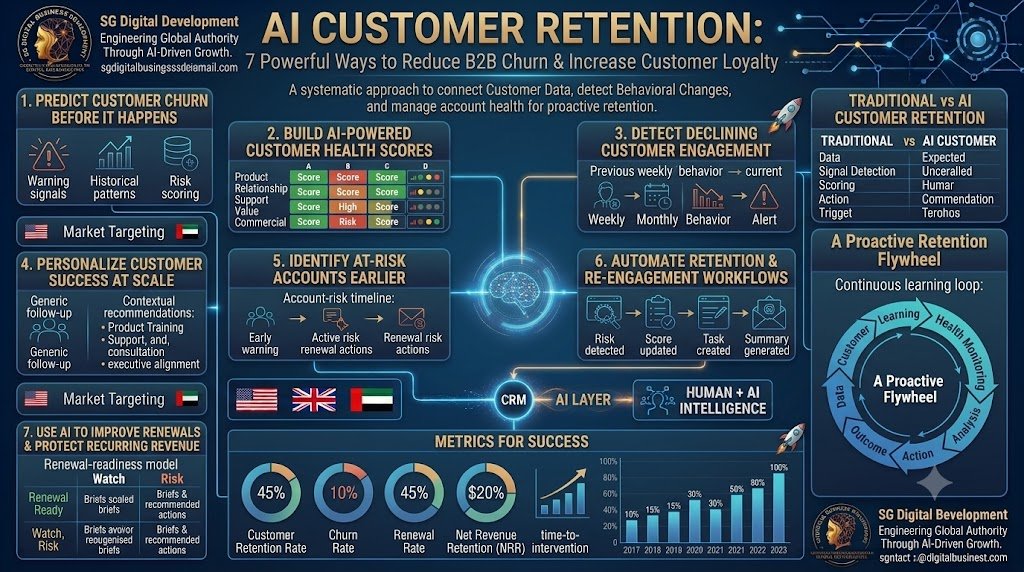
AI Customer Retention: 7 Powerful Ways to Reduce B2B Churn.

AI Customer Retention: 7 Powerful Ways to Reduce B2B Churn & Increase Customer Loyalty. Introduction Winning a B2B customer is only the beginning of the revenue relationship. After the contract is signed, the business still has to deliver value, maintain engagement, support adoption, manage expectations and demonstrate that the relationship is worth continuing. That makes customer retention one of the most important components of a sustainable B2B revenue strategy. The challenge is that customer churn rarely begins on the day a customer cancels. In many cases, warning signs appear much earlier. Product usage may decline. Key stakeholders may become less engaged. Support issues may remain unresolved. A customer may stop attending meetings. A champion may leave the organization. Business priorities may change. The customer may fail to achieve the outcome that originally justified the purchase. These signals can exist across different systems, teams and conversations. This is where AI customer retention becomes valuable. AI can help businesses bring together customer data, usage patterns, engagement signals, CRM information, support interactions and commercial indicators to identify accounts that may require attention. Research into B2B customer success identifies customer health as an important mechanism for proactive retention, combining factors such as relationship quality, product usage and customer value realization. The objective is not to predict churn and then automatically bombard customers with messages. The objective is to identify risk earlier, understand why the risk may exist, and give customer-facing teams enough context to take a useful action. In 2026, the direction of B2B retention is increasingly moving from reactive reporting toward proactive systems that combine health monitoring, risk detection, intervention workflows and organizational learning. This article explains 7 powerful AI customer retention strategies B2B companies can use to reduce avoidable churn, improve customer health, strengthen relationships and protect recurring revenue. What Is AI Customer Retention? AI customer retention is the use of artificial intelligence, customer data and predictive analysis to identify retention risks, understand customer behavior and help businesses take proactive action to maintain valuable customer relationships. Traditional retention processes often depend on: These methods can work, but they can also leave organizations reacting after important warning signs have already appeared. AI customer retention adds a continuous intelligence layer. Instead of asking only: “Which customers are renewing this month?” the business can ask: “Which customers are showing behavioral or commercial signals that may require attention right now?” That distinction changes retention from a calendar-based activity into an ongoing customer intelligence process. AI can analyze combinations of signals such as: No single signal necessarily proves that a customer is going to churn. The value comes from understanding patterns across multiple signals. Why Customer Retention Matters in B2B Customer retention matters because B2B relationships often develop over time. A customer may initially purchase one service or product and gradually increase its relationship with the provider. Over time, the customer may: When a customer leaves, the business can lose not only the current contract but also potential future revenue. This is why retention connects directly with customer lifetime value. Your AI Customer Lifetime Value strategy asks: How much long-term economic value could this customer generate? Your AI Customer Expansion strategy asks: Where can this customer relationship grow? Your AI Customer Retention strategy asks: What can we do to protect the relationship and prevent avoidable revenue loss? Together, these three areas form an important customer revenue intelligence layer. AI Customer Retention vs Traditional Retention Traditional customer retention often relies on scheduled reviews. For example: Quarterly review → customer health discussion → renewal preparation → account action AI customer retention can create a more continuous process: Customer activity → signal detection → risk analysis → prioritization → intervention → outcome measurement The difference is not simply automation. It is the ability to process a larger volume of customer information consistently. Traditional Retention AI Customer Retention Periodic reviews Continuous monitoring Manual account analysis AI-assisted analysis Static health scores Dynamic health signals Renewal-focused Relationship-focused Reactive intervention Proactive intervention Limited data sources Multiple data sources Generic follow-up Contextual recommendations Manual prioritization Risk-based prioritization AI does not eliminate customer success teams. Instead, it can help them determine where their attention is most valuable. How AI Customer Retention Works An effective AI customer retention system usually combines several data layers. 1. Customer Relationship Data This may include: 2. Product or Service Usage Depending on the business, this could include: 3. Engagement AI can evaluate: 4. Support Support data can provide important context: 5. Commercial Signals These can include: 6. Relationship Signals AI can also help identify: The goal is to create a more complete view of customer health. 7 Powerful AI Customer Retention Strategies 1. Predict Customer Churn Before It Happens One of the most obvious applications of AI customer retention is churn-risk prediction. A traditional approach may identify a customer as at risk when they say: “We are considering not renewing.” At that point, the company may already be late. AI can instead look for patterns that appear earlier. For example: A single signal is not necessarily enough. But several signals appearing together can justify a closer review. An AI model can assign an account a risk score based on historical patterns and current customer behavior. For example: Low Risk Stable usage + strong engagement + healthy relationship. Moderate Risk Some engagement decline + unresolved issues + lower product adoption. High Risk Sharp usage decline + negative engagement + unresolved problems + approaching renewal. The score should not be treated as certainty. It should be treated as a prioritization signal. This distinction is critical. A model can tell a customer success team: “This account deserves attention.” The customer success team still needs to determine: “Why?” and: “What should we do?” 2. Build AI-Powered Customer Health Scores Customer health scores have traditionally been built using manually selected rules. For example: The problem is that the same weighting may not work for every customer segment. AI customer retention can help identify which combinations of signals historically correlate with retention or churn. A modern
AI customer expansion
AI Growth Engine

AI Customer Expansion: 7 Powerful Ways to Grow B2B Revenue.

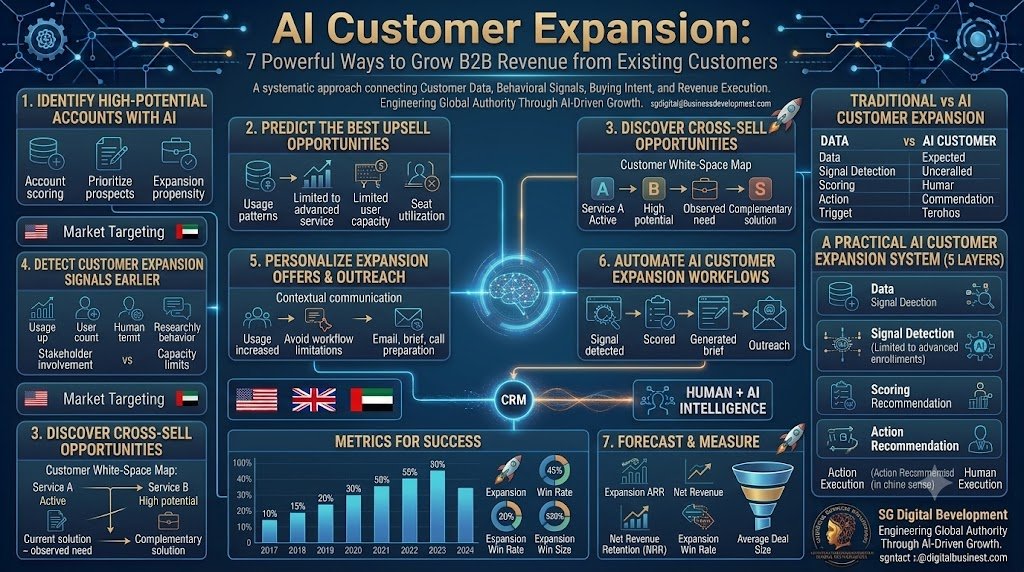
AI Customer Expansion: 7 Powerful Ways to Grow B2B Revenue from Existing Customers Introduction For many B2B companies, revenue growth is still heavily associated with acquiring new customers. Sales teams build prospect lists. Marketing generates demand. SDRs contact new accounts. Paid advertising brings new visitors. Business development teams search for new opportunities. But there is another revenue opportunity that is often much closer to the business: the customers who already buy from you. Existing customers already understand your company, have experience with your products or services, have established relationships with your team and may already have internal use cases that can support additional purchases. The challenge is knowing which customers are ready to expand, what they are likely to buy, and when the conversation should happen. This is where AI customer expansion becomes increasingly valuable. AI can analyze customer behavior, product usage, CRM information, support interactions, engagement patterns, account changes and other business signals to identify potential expansion opportunities. Instead of asking account managers to manually inspect hundreds of accounts, AI can help prioritize the accounts most likely to have a relevant growth opportunity. In 2026, AI-powered customer expansion is moving beyond simple automated recommendations. Modern systems can connect customer data, detect behavioral changes, identify buying signals and recommend next actions for sales and customer success teams. Gartner, for example, describes AI-powered listening as a way to improve the targeting of cross-sell and upsell opportunities. The objective is not to sell more to every customer. The objective is to understand customers better and identify situations where additional products, services, capacity or functionality can genuinely create more value. This article explains 7 powerful AI customer expansion strategies B2B companies can use to grow revenue from existing accounts. What Is AI Customer Expansion? AI customer expansion is the use of artificial intelligence, customer data and predictive analysis to identify, prioritize and act on opportunities to increase revenue from existing customers. Expansion can happen in several ways: Traditional customer expansion often depends heavily on account-manager experience. A salesperson might know that a particular customer is growing rapidly. A customer success manager might notice increased usage. A support representative might hear a customer asking for a capability that is not included in their current plan. These signals can be valuable, but they are often fragmented across different systems. AI can bring those signals together. For example, an AI customer expansion system could identify an account where: Individually, these signals may not mean much. Together, they could indicate a meaningful expansion opportunity. That is the fundamental value of AI customer expansion: connecting fragmented customer signals to identify commercially relevant opportunities. Why Customer Expansion Matters in B2B Customer expansion is different from new customer acquisition. When acquiring a new customer, a company typically has to generate awareness, establish credibility, identify a business problem, create demand, overcome objections, compete against alternatives and complete a sales process. An existing customer starts from a different position. There is already a commercial relationship. There is already customer history. There may already be product adoption. There may already be trust. And the company has access to information about the customer’s needs. That makes the existing customer base an important source of potential revenue growth. Customer expansion also connects directly with customer lifetime value. A company can increase customer lifetime value by retaining customers longer, increasing their purchase frequency, expanding their product usage or increasing the value of their contracts. AI customer expansion focuses particularly on identifying those growth opportunities. Research and industry analysis in 2026 increasingly highlights AI’s ability to identify expansion opportunities by combining product usage, engagement, service interactions and account information. However, expansion should not become aggressive selling. A strong expansion strategy begins with customer value. The question should be: “What additional solution could help this customer achieve a business outcome they are already pursuing?” Not: “What else can we sell this customer?” That distinction is critical. AI Customer Expansion vs Traditional Account Expansion Traditional expansion often relies on periodic account reviews. An account manager may review customers once a month or once a quarter and ask: The problem is that important signals can appear between reviews. A customer may suddenly increase usage. A new executive may join the company. A customer may hire 100 new employees. A support conversation may reveal a capacity problem. A customer may begin using a feature associated with a higher plan. An existing customer may visit a product page several times. An AI customer expansion system can continuously analyze these signals instead of waiting for the next scheduled account review. Traditional Expansion AI Customer Expansion Periodic account reviews Continuous signal monitoring Manual analysis Automated analysis Individual account-manager judgment AI-assisted prioritization Limited data sources Multiple data sources Static customer segments Dynamic account scoring Reactive outreach Signal-based outreach Generic expansion campaigns Personalized recommendations Manual opportunity discovery Automated opportunity detection AI does not eliminate the account manager. Instead, it can help the account manager spend more time on the customers and conversations that matter most. How AI Customer Expansion Works An effective AI customer expansion system generally combines several layers of data. 1. Customer and CRM Data This can include: 2. Product or Service Usage For technology companies, this could include: For service businesses, comparable signals could include: 3. Engagement Data AI can analyze: 4. Support and Service Data Support interactions can contain commercially important information. Customers may mention: Recent research and industry commentary increasingly points to service and support interactions as potential sources of expansion signals. 5. External Business Signals AI can also incorporate signals such as: The more relevant signals an organization can connect responsibly, the more context its expansion models can potentially provide. 7 Powerful AI Customer Expansion Strategies 1. Identify High-Potential Accounts with AI Not every customer has the same expansion potential. Some accounts may be stable but unlikely to increase spending. Others may be growing rapidly and already showing multiple signs of additional demand. AI customer expansion systems can help identify these differences. An AI model can create an expansion

AI customer lifetime value
AI Growth Engine

AI Customer Lifetime Value: 7 Powerful Ways to Increase B2B Customer Value

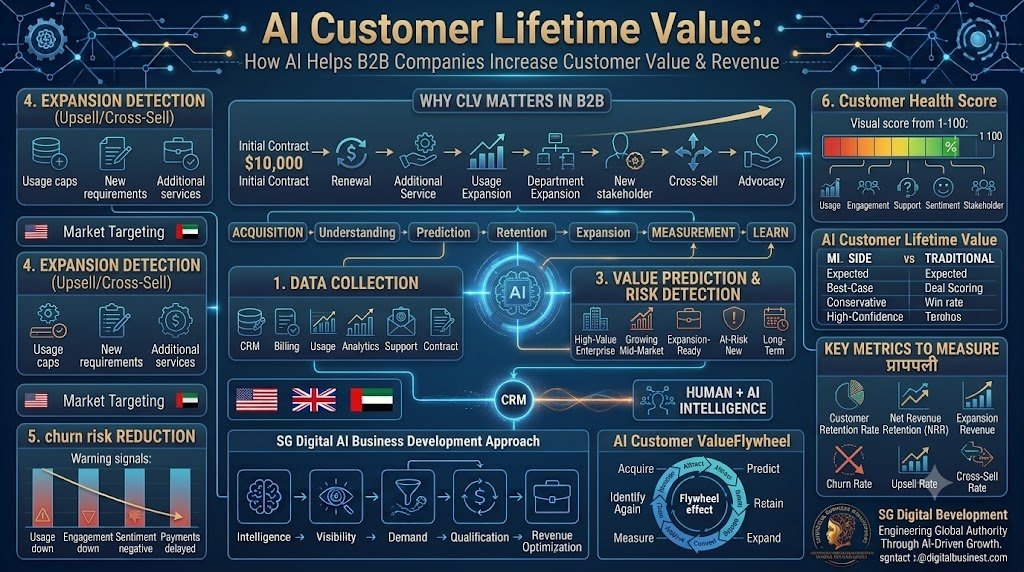
AI Customer Lifetime Value: How AI Helps B2B Companies Increase Customer Value & Revenue Introduction B2B growth is often measured by how many new customers a company acquires. But acquisition is only one part of the revenue equation. A company can generate hundreds of leads, close new accounts and still struggle to build predictable long-term revenue if customers do not renew, expand or remain engaged. That is why AI customer lifetime value is becoming an important concept for modern B2B growth. Customer lifetime value, commonly abbreviated as CLV or LTV, represents the economic value a customer may generate throughout the relationship with a business. In B2B markets, calculating that value can be more complicated than simply multiplying an average order value by the number of purchases. A B2B customer may: AI can help businesses analyze these patterns and identify opportunities to improve the long-term value of customer relationships. Instead of asking only: “How much did this customer buy?” businesses can begin asking: “What is this customer likely to be worth over the entire relationship, what could increase that value, and what risks could reduce it?” That shift connects customer success, sales, marketing, revenue operations and business development. This article explains how AI customer lifetime value works, how AI can improve retention and expansion, and how B2B companies can build a customer-value system that connects acquisition with long-term revenue growth. What Is AI Customer Lifetime Value? AI customer lifetime value refers to using artificial intelligence, predictive analytics and customer data to estimate, understand and improve the long-term economic value of individual customers or customer segments. Traditional customer lifetime value calculations often use relatively simple formulas. For example: Customer Lifetime Value = Average Customer Revenue × Expected Customer Lifespan More advanced models may incorporate: AI can take this analysis further by incorporating a much broader range of signals. These may include: The objective is not simply to calculate one LTV number. The objective is to understand customer value dynamically. Why Customer Lifetime Value Matters in B2B B2B customer relationships can last for months or years. A customer who initially purchases a small service may eventually become a major account. For example: A company may initially purchase a $10,000 service. After a successful first year, it may: The initial transaction therefore does not represent the full commercial opportunity. Customer lifetime value provides a broader perspective. Instead of optimizing only for the first transaction, businesses can optimize for: Acquisition → Activation → Retention → Expansion → Advocacy AI can help identify where customers are within this lifecycle and what actions may increase long-term value. AI Customer Lifetime Value vs Traditional CLV Traditional CLV models can still be useful. They provide a structured way to estimate customer economics. However, traditional calculations can become limited when customer behavior changes rapidly. A static calculation may not fully capture: AI can make customer value analysis more dynamic. Traditional CLV AI Customer Lifetime Value Historical calculation Dynamic prediction Periodic analysis Continuous analysis Limited variables Multiple customer signals Segment-based Account-level potential Reactive Predictive Revenue-focused Revenue + retention + expansion Manual reporting Automated intelligence The objective is not to replace traditional financial analysis. It is to complement it with more detailed customer intelligence. How AI Customer Lifetime Value Works An AI-powered customer value system can be organized into several stages. 1. Customer Data Collection The system collects relevant information from multiple sources. This can include: The more connected the data environment, the more complete the customer profile can become. 2. Customer Segmentation AI can identify patterns among customers. For example, it may distinguish between: This allows businesses to avoid treating every customer identically. 3. Value Prediction AI can estimate future customer value using historical and current signals. Potential factors include: The result can be a dynamic customer-value estimate. 4. Risk Detection AI can identify patterns associated with declining customer value. Examples include: These signals can trigger proactive intervention. 5. Expansion Detection AI can also identify positive signals. For example: These can indicate potential expansion opportunities. 7 Powerful Ways AI Can Increase B2B Customer Lifetime Value 1. Predict High-Value Customers Earlier Not every customer has the same long-term commercial potential. AI can analyze customer characteristics and identify patterns associated with higher future value. For example, a customer may initially generate modest revenue but demonstrate: These characteristics may indicate future growth potential. Sales and customer-success teams can then prioritize relationship development accordingly. The goal is not to ignore smaller customers. The goal is to understand where different levels of commercial potential exist. 2. Predict and Reduce Churn Risk Customer churn can reduce lifetime value significantly. AI can help detect warning signals before a customer formally decides to leave. Potential signals include: An AI system can combine multiple signals to identify accounts that deserve attention. For example: Usage declining Key stakeholder no longer engaging Support issues increasing Renewal approaching could create a higher-priority retention alert. The system does not need to decide automatically that the customer will churn. Instead, it can prompt the customer-success team to investigate. 3. Identify Upsell Opportunities Upselling means encouraging an existing customer to purchase a higher-value version of a product or service. AI can help identify when a customer may be ready. Potential signals include: Timing matters. An upsell offer delivered too early may be irrelevant. An offer delivered when the customer is already experiencing a need may be much more relevant. AI can help identify these moments. 4. Identify Cross-Sell Opportunities Cross-selling involves offering complementary products or services. AI can analyze patterns among similar customers. For example: Customers who purchase Service A may frequently purchase Service B after a particular period. AI can identify that relationship. The business can then develop a relevant expansion strategy. Instead of sending generic: “Would you like to buy another service?” the business can approach the customer with a more contextual proposition. This can improve the relevance of expansion conversations. 5. Personalize Customer Experiences Customer lifetime value is influenced by the quality and relevance of the customer relationship. AI can help personalize:

AI sales forecasting
AI Growth Engine

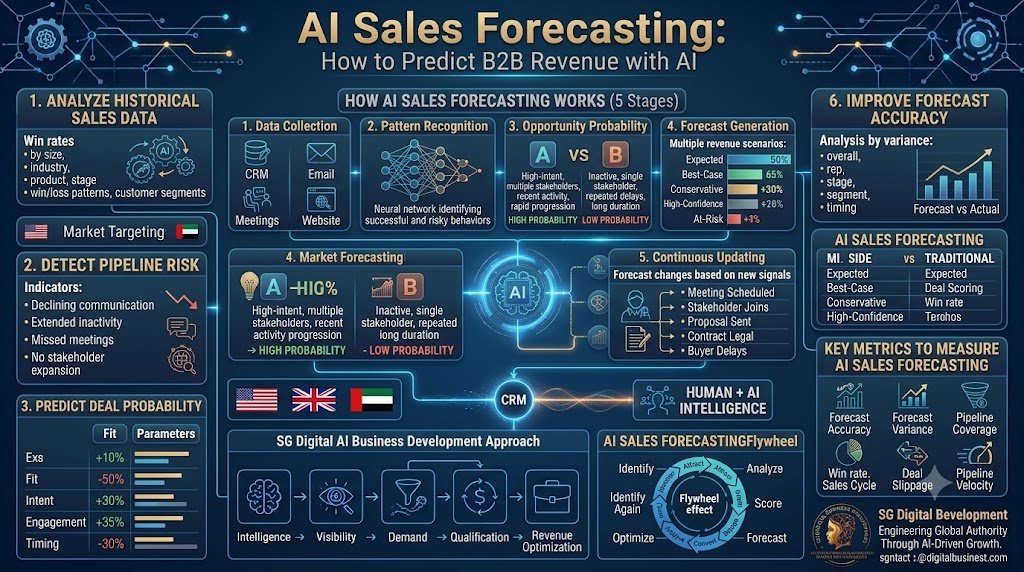
AI Sales Forecasting: How to Predict B2B Revenue with AI.

Introduction B2B companies are under constant pressure to answer one important question: How much revenue are we likely to generate? Traditional sales forecasting often depends on spreadsheets, historical averages, sales-representative judgment, CRM updates and periodic pipeline reviews. These methods can provide useful information, but they can also become difficult to manage when sales pipelines become larger, buying journeys become more complex and customer behavior changes quickly. AI sales forecasting introduces a more dynamic approach. Instead of relying only on historical performance and manually updated forecasts, businesses can use artificial intelligence to analyze pipeline activity, opportunity data, buyer behavior, historical sales patterns, engagement signals and other commercial information to identify patterns that may influence future revenue. For B2B organizations, this can transform forecasting from a periodic reporting exercise into an ongoing revenue intelligence process. AI can help sales teams identify opportunities that deserve attention, detect deals showing signs of risk, recognize changes in buyer engagement and create more informed revenue scenarios. However, AI does not eliminate the need for sales leadership or human judgment. The most effective approach combines machine intelligence with accurate CRM data, clear sales processes and experienced commercial decision-making. This article explains how AI sales forecasting works, why it matters, how it connects with AI sales pipelines and revenue intelligence, and how B2B companies can build a practical forecasting system. What Is AI Sales Forecasting? AI sales forecasting is the use of artificial intelligence, machine learning, predictive analytics and business data to estimate future sales performance and revenue outcomes. A traditional forecast might ask: “Which deals do our sales representatives expect to close this quarter?” An AI-supported forecasting system can ask a much broader set of questions: The objective is not simply to produce another sales number. The objective is to create a more complete understanding of future revenue probability, pipeline health and commercial risk. Why B2B Companies Need Better Sales Forecasting B2B sales cycles can involve multiple decision-makers, long procurement processes, technical evaluations, budgets, legal reviews and changing priorities. A deal that appears likely to close can sometimes move backward or remain inactive for weeks. At the same time, an opportunity that initially appears uncertain can accelerate when buyer engagement increases. This creates a major forecasting challenge. A sales manager may have dozens or hundreds of opportunities across different stages. Manually reviewing every opportunity in detail is difficult. AI can help analyze these opportunities continuously. Traditional forecasting often depends on: AI-supported forecasting can additionally analyze: This creates a more dynamic view of potential revenue. How AI Sales Forecasting Works An AI forecasting system generally combines multiple data sources and analyzes relationships between them. The process can be simplified into five stages. 1. Data Collection The system collects relevant commercial information. This may include: The quality of this data matters enormously. If CRM records are incomplete or outdated, the forecasting model may produce unreliable outputs. 2. Pattern Recognition AI analyzes historical and current information to identify patterns. For example, the system may discover that certain combinations of signals historically correlate with successful deals. It may identify patterns such as: It can also identify risk patterns. For example: These patterns can contribute to opportunity-level forecasting. 3. Opportunity Probability AI can estimate the likelihood of different opportunities progressing. Instead of treating every opportunity in the same stage as equally valuable, an AI-supported system can consider additional signals. For example: Opportunity A Opportunity B A traditional stage-based forecast might give both opportunities significant weight. An AI system can distinguish between their different risk profiles. 4. Forecast Generation The system can then produce forecasts based on available opportunity and historical information. Forecast categories may include: This allows management teams to examine different revenue scenarios. 5. Continuous Updating One of the major advantages of AI forecasting is that forecasts can be updated as new information becomes available. For example, a forecast may change when: This creates a more dynamic forecasting environment. 7 Powerful Ways AI Improves B2B Sales Forecasting 1. Analyze Historical Sales Data Historical data provides an important foundation for forecasting. AI can analyze previous sales activity and identify patterns across: For example, a company might discover that enterprise opportunities sourced through a particular channel have a significantly longer sales cycle than smaller opportunities. That information can improve future forecasts. Instead of applying one generic probability to every opportunity, the business can incorporate historical patterns into its forecasting process. 2. Detect Pipeline Risk One of the most valuable applications of AI is identifying potential risk before a deal is officially lost. Pipeline risk can appear in subtle ways. An opportunity may still be marked as “active” inside a CRM while buyer engagement has already declined. AI can help identify patterns associated with potential risk. Examples include: The purpose is not to automatically declare a deal lost. Instead, AI can flag the opportunity for human review. A sales manager can then ask: “What changed in this opportunity?” That can lead to earlier intervention. 3. Predict Deal Probability Not every opportunity has the same probability of producing revenue. AI can analyze multiple variables to estimate deal probability. Potential variables include: This creates a more detailed opportunity view. For example: Opportunity Deal Value Pipeline Stage AI Risk Signal Forecast Consideration A $40,000 Proposal Low Strong B $75,000 Negotiation Medium Review C $120,000 Proposal High Conservative D $25,000 Discovery Medium Longer-term The exact calculations will depend on the company’s data and forecasting system. The important point is that AI can help move forecasting beyond a simple stage-based model. 4. Identify Stalled Opportunities Pipeline stagnation can significantly affect revenue. An opportunity may remain in the same stage for: depending on the sales cycle. AI can compare opportunity duration with historical patterns. If similar opportunities normally progress within 14 days but one has remained in the same stage for 45 days, the system can flag it. Sales leadership can then investigate. Possible actions might include: This helps keep the pipeline more realistic. 5. Monitor Buyer Intent Signals Revenue forecasting becomes more useful when it incorporates signals from

AI revenue optimization
AI Growth Engine

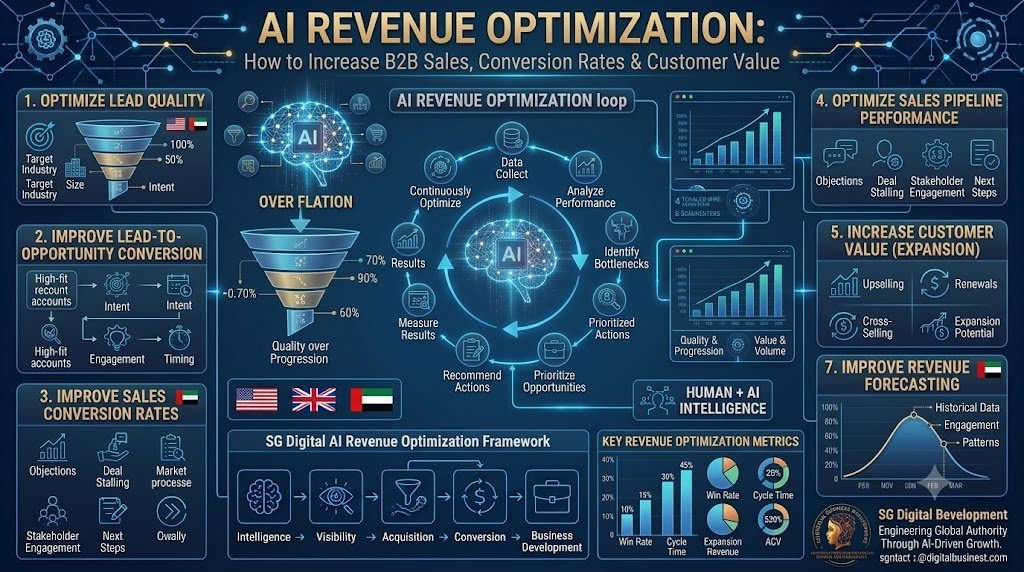
AI Revenue Optimization: How to Increase B2B Sales, Conversion Rates & Customer Value.

Introduction AI revenue optimization is becoming an important strategy for B2B companies that want to improve sales performance, increase conversion rates, reduce revenue leakage and generate more value from existing customer relationships. Traditional revenue growth often depends on increasing lead volume, hiring more salespeople or spending more money on advertising. Those strategies can work. But there is another opportunity: improving the efficiency of the revenue system that already exists. A B2B company may already have website traffic, leads, sales opportunities, customers, CRM data, sales conversations and marketing campaigns. The question is whether the business is extracting the maximum possible value from those assets. This is where AI revenue optimization becomes relevant. AI can analyze large volumes of revenue data, identify patterns, surface bottlenecks, prioritize opportunities and help teams determine where improvement may have the greatest commercial impact. Instead of asking only: “How can we generate more leads?” businesses can begin asking: These questions move the focus from volume to efficiency. For B2B companies targeting markets such as the USA, UK and UAE, this can create an opportunity to build a more connected revenue engine across marketing, sales, business development and customer growth. This guide explains how AI revenue optimization works, where businesses can use it, which metrics matter, how it connects with AI sales pipelines and revenue intelligence, and how to build a practical optimization system. What Is AI Revenue Optimization? AI revenue optimization is the use of artificial intelligence, revenue data and automated analysis to identify opportunities for improving the efficiency and performance of a company’s revenue-generating processes. It can be applied across the customer journey. That includes: The objective is not simply to automate sales. It is to determine where revenue performance can be improved and help teams act on those opportunities. For example, imagine a company generating 1,000 monthly leads. Increasing that number to 1,500 may sound attractive. But if only 20 of the original 1,000 become customers, increasing volume without improving qualification or conversion may create more work without producing proportional revenue. AI revenue optimization asks a different question: Can the business improve the percentage of valuable leads that become customers? That shift can be commercially important. Why AI Revenue Optimization Matters for B2B Companies B2B revenue systems contain many interconnected variables. A typical journey may involve: Search → Website → Lead → Qualification → Sales Conversation → Opportunity → Proposal → Negotiation → Customer → Expansion A weakness at any stage can affect the final result. For example: Revenue optimization looks at the complete system. AI becomes useful because modern B2B organizations generate large amounts of information across these stages. That information may exist in: AI can help connect those signals and identify patterns that would be difficult to detect manually. AI Revenue Optimization vs Revenue Growth Revenue growth and revenue optimization are related but not identical. Revenue Growth Focuses on generating more revenue. Examples: Revenue Optimization Focuses on improving the efficiency and value of the existing revenue system. Examples: The strongest B2B growth strategy often combines both. You can generate more demand while simultaneously improving the efficiency of converting that demand into revenue. How AI Revenue Optimization Works A practical AI revenue optimization system can be viewed as a continuous loop. Step 1: Collect Data Bring together relevant revenue information. This may include: Step 2: Analyze Performance AI examines patterns across the available data. Step 3: Identify Bottlenecks The system looks for areas where performance is weaker than expected. Step 4: Prioritize Opportunities Not every improvement has equal commercial value. AI can help identify which opportunities deserve attention first. Step 5: Recommend Actions The system can surface potential next steps. Step 6: Measure Results The business measures whether the intervention improved performance. Step 7: Continuously Optimize Successful changes become part of the revenue process. The cycle becomes: Data → Analysis → Opportunity → Action → Measurement → Optimization 7 Powerful Ways AI Can Optimize B2B Revenue 1. Optimize Lead Quality More leads do not automatically mean more revenue. Lead quality matters. AI can analyze lead characteristics and engagement signals to identify patterns associated with qualified opportunities. Potential signals include: Instead of treating every lead equally, sales teams can prioritize leads according to relevance and potential value. This can improve sales productivity. A representative who has 100 leads does not necessarily need to contact all 100 with equal urgency. AI can help determine which leads deserve immediate attention. 2. Improve Lead-to-Opportunity Conversion The transition from lead to opportunity is one of the most important points in a B2B funnel. A company may generate thousands of leads but create relatively few qualified opportunities. AI can analyze historical conversion patterns and identify factors associated with successful progression. For example, successful opportunities might commonly involve: These patterns can inform qualification. The objective is not to assume every future buyer will behave exactly like previous buyers. The objective is to use historical evidence as an additional decision signal. 3. Improve Sales Conversion Rates Conversion optimization is not limited to websites. It also applies to sales conversations. AI can analyze sales activity to help businesses understand: This can reveal opportunities to improve sales processes. For example: If successful deals consistently involve three or more stakeholder conversations while unsuccessful deals involve only one contact, sales teams may want to improve multi-stakeholder engagement. That is an actionable revenue insight. 4. Optimize Sales Pipeline Performance Your sales pipeline contains potential future revenue. But pipeline value is not the same as pipeline quality. AI can help evaluate: This allows revenue teams to identify: The result is a more focused pipeline management process. 5. Increase Customer Value Revenue optimization does not stop when a customer signs a contract. Existing customers can generate additional revenue through: AI can analyze account activity to identify potential expansion signals. For example: A customer may begin using more of a service, engage with additional product information or ask about capabilities outside their current contract. Those signals may indicate expansion potential. The account team can then decide whether a conversation

AI revenue intelligence
AI Growth Engine

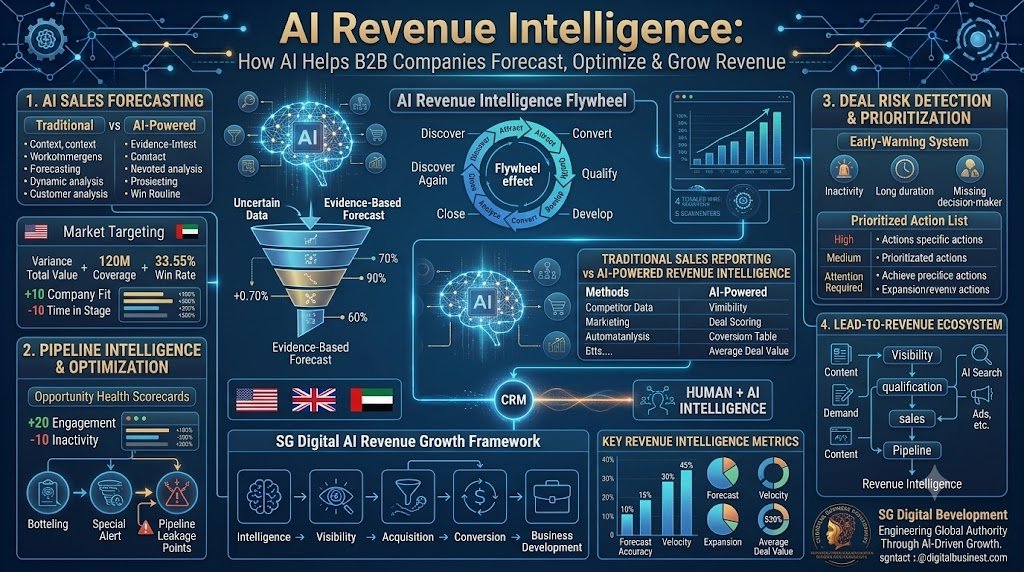
AI Revenue Intelligence: How AI Helps B2B Companies Forecast, Optimize & Grow Revenue.

Introduction AI revenue intelligence is changing how B2B companies understand sales performance, identify revenue opportunities, manage pipeline risk and make forecasting decisions. Traditional sales reporting tells businesses what happened. Modern revenue intelligence aims to help teams understand what is happening now, what may happen next and which actions deserve attention. For B2B companies operating across competitive markets such as the USA, UK and UAE, this distinction matters. Sales teams are dealing with longer buying journeys, multiple stakeholders, fragmented customer data, increasing digital touchpoints and buyers who often research vendors before speaking with a salesperson. An effective AI revenue intelligence system connects these signals. It can combine CRM activity, sales conversations, email engagement, pipeline movement, lead qualification, account activity and other available business signals to help sales and revenue teams identify opportunities, detect risks and prioritize actions. Revenue intelligence is therefore not simply another dashboard. It is an approach to making revenue decisions using connected data, artificial intelligence and actionable sales intelligence. In this guide, we will explore how AI revenue intelligence works, how it supports forecasting, how it improves pipeline management, how it identifies revenue opportunities, how it connects marketing and sales, and how B2B companies can build a practical revenue intelligence system. What Is AI Revenue Intelligence? AI revenue intelligence is the use of artificial intelligence, data analysis and connected revenue signals to help B2B companies understand, predict and improve revenue performance. Instead of relying exclusively on manually updated CRM records, spreadsheets or sales representative opinions, an AI-powered system can analyze multiple signals across the customer journey. These signals may include: The objective is not to remove humans from revenue decisions. The objective is to give sales and business development teams better information so they can make better decisions faster. Modern revenue intelligence is increasingly described as a forward-looking layer that connects revenue data and uses AI to surface risks, opportunities and recommended actions rather than simply producing historical reports. Why AI Revenue Intelligence Matters for B2B Companies B2B revenue generation is rarely a straight line. A prospect may discover a company through Google or AI search, visit the website, download information, speak with a salesperson, involve another stakeholder, compare competitors, request pricing and then disappear for three weeks. A traditional CRM may record only some of these events. This creates a major visibility problem. A sales manager may see: Opportunity → Proposal → $50,000 → 60% probability But the underlying reality could be very different. The buyer may not have responded for 14 days. The decision-maker may never have joined the conversation. A competitor may have entered the evaluation. The prospect may have stopped engaging. The next step may not actually be scheduled. AI revenue intelligence attempts to identify these patterns. Instead of asking only: “What deals are in our pipeline?” the business can begin asking: This changes revenue management from simple reporting toward continuous intelligence. AI Revenue Intelligence vs Traditional Sales Reporting Traditional sales reporting is valuable. Businesses still need dashboards, CRM reports, revenue summaries and historical performance analysis. The difference is that reporting generally describes data, while AI revenue intelligence attempts to interpret that data and turn it into actionable insight. Traditional Sales Reporting AI Revenue Intelligence Primarily historical Historical + current + predictive Shows pipeline value Evaluates pipeline health Tracks opportunity stages Analyzes deal signals Relies heavily on CRM updates Can analyze multiple data sources Static reports Continuously updated intelligence Human interpretation required AI can surface patterns and risks Focuses on what happened Helps identify what may happen next Limited recommendations Can suggest next actions Modern revenue intelligence systems can combine predictive AI, generative AI and workflow automation to move from reporting toward insights and action. The distinction is important. A dashboard might show that an opportunity has been open for 90 days. Revenue intelligence can help identify that the opportunity has: The second view is much more actionable. How AI Revenue Intelligence Works A practical AI revenue intelligence system typically follows a five-step process. 1. Collect Revenue Data The system first needs access to relevant business information. This may include: The goal is to create a connected view of revenue activity. 2. Clean and Organize the Data AI cannot produce reliable insights from severely fragmented or inaccurate information. Data quality therefore matters. A revenue intelligence system may help identify: Good data creates a stronger foundation for analysis. 3. Analyze Revenue Signals The AI layer evaluates available signals. For example: A prospect opens several emails, attends a product demonstration, brings another stakeholder into a meeting and requests implementation information. Individually, each event may appear relatively ordinary. Together, they can represent a meaningful change in buying intent. AI can help connect these events. 4. Identify Opportunities and Risks Once signals are analyzed, the system can identify patterns. Potential positive signals include: Potential risk signals include: These signals can then be used to prioritize sales activity. 5. Recommend or Trigger Actions The final stage is action. AI revenue intelligence becomes much more valuable when insights lead to practical next steps. For example: Signal: Decision-maker has not engaged. Recommendation: Identify and engage the relevant stakeholder. Or: Signal: Opportunity has stalled for 21 days. Recommendation: Trigger a structured re-engagement sequence. Or: Signal: Multiple buying signals detected. Recommendation: Increase sales priority and schedule an executive-level conversation. This creates a closed loop: Data → Intelligence → Decision → Action → Outcome AI Revenue Intelligence for Sales Forecasting Forecasting is one of the most important applications of revenue intelligence. Traditional forecasting often depends heavily on: These inputs can be useful, but they may not capture the full picture. AI-powered forecasting can incorporate a wider range of signals. For example: The result can be a more evidence-based forecast. Importantly, AI forecasting should not be treated as an infallible prediction. It is a decision-support system. Sales leaders should understand what signals influence a forecast and retain human judgment for unusual deals, strategic accounts and situations where the available data is incomplete. AI Revenue Intelligence and Pipeline Forecasting Pipeline value alone does not equal

AI sales pipeline
AI Growth Engine

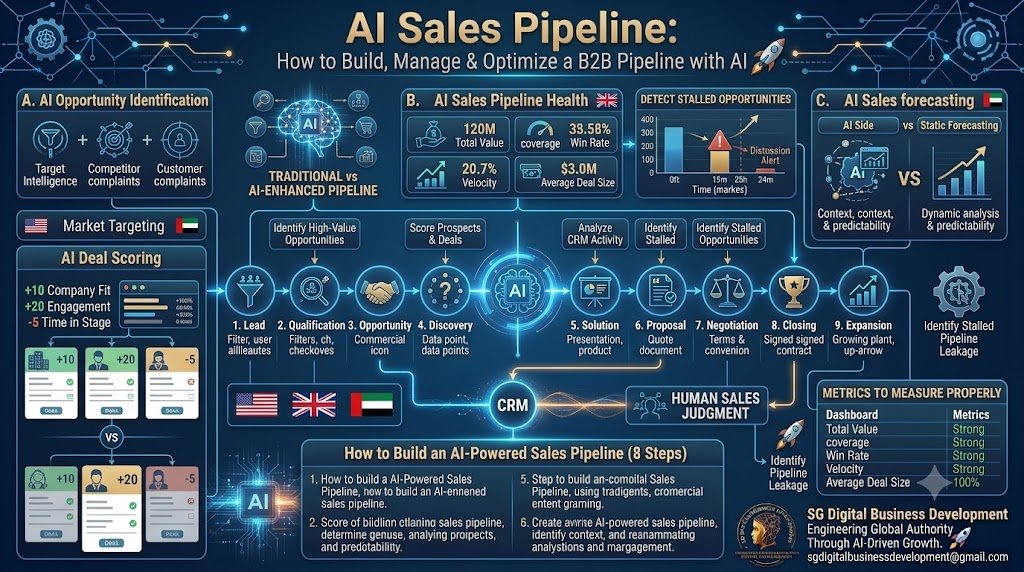
AI Sales Pipeline: How to Build, Manage & Optimize a B2B Pipeline with AI.

Introduction B2B sales pipelines have traditionally been managed through spreadsheets, CRM dashboards, sales meetings and manual forecasting. These systems can work, but modern B2B sales environments are becoming more complex. Companies now generate opportunities from multiple channels, including organic search, AI search, paid advertising, LinkedIn, outbound prospecting, referrals, content marketing and partnerships. At the same time, buyers conduct more independent research before speaking with a salesperson. This creates a challenge for sales teams. A company may have hundreds of leads and dozens of opportunities, but knowing which opportunities matter, which deals are progressing, which prospects are likely to stall and where revenue is coming from can be difficult. This is where an AI sales pipeline can become valuable. An AI sales pipeline uses artificial intelligence, CRM data, buyer signals, sales activity and automation to help businesses identify opportunities, prioritize deals, monitor pipeline health, automate appropriate follow-up and improve sales forecasting. The objective is not simply to automate sales tasks. The objective is to make the sales pipeline more intelligent. Instead of asking only: How many opportunities do we have? sales teams can begin asking: Which opportunities are most important, what is happening inside each deal, what action should happen next and how is the pipeline likely to develop? That shift can help B2B companies build a more structured and data-driven approach to revenue generation. What Is an AI Sales Pipeline? An AI sales pipeline is a B2B sales pipeline enhanced with artificial intelligence to help manage opportunities, analyze buyer signals, prioritize deals, automate workflows and provide sales intelligence. A traditional sales pipeline might contain stages such as: Lead → Qualified Lead → Meeting → Proposal → Negotiation → Closed An AI-powered pipeline adds intelligence to these stages. For example, AI can help: The AI layer does not replace the CRM. Instead, it can make the information inside the CRM more useful. Why B2B Companies Need an AI Sales Pipeline B2B sales teams deal with large amounts of information. A single opportunity can involve: When a sales team has dozens or hundreds of opportunities, manually reviewing every signal becomes difficult. An AI sales pipeline can help organize this information. It can potentially identify patterns that humans may overlook when reviewing a large CRM database. For example: These signals can help sales teams decide where to focus their attention. AI Sales Pipeline vs Traditional Sales Pipeline The traditional sales pipeline focuses primarily on stages and activities. For example: Traditional Pipeline AI-Enhanced Pipeline Lead status Lead and opportunity intelligence Manual qualification AI-assisted qualification Sales activity Activity + engagement analysis Manual follow-up Automated follow-up workflows Static pipeline report Dynamic pipeline intelligence Manual forecasting AI-assisted forecasting Sales manager review Continuous opportunity monitoring Historical analysis Predictive and behavioral analysis The difference is not that traditional sales systems disappear. Instead, AI adds another layer of intelligence. The CRM remains the operational foundation. AI helps interpret the information inside it. The Stages of an AI Sales Pipeline A B2B sales pipeline can be structured around several stages. Stage 1: Lead A potential customer enters the system. Stage 2: Qualification The company evaluates fit, need and intent. Stage 3: Opportunity A genuine commercial opportunity is identified. Stage 4: Discovery Sales professionals understand the business problem, requirements and buying process. Stage 5: Solution The company presents a relevant solution. Stage 6: Proposal Commercial terms and proposals are discussed. Stage 7: Negotiation The buyer and seller work through pricing, scope and contractual considerations. Stage 8: Closing The opportunity becomes a customer or is lost. Stage 9: Expansion Existing customers may generate additional opportunities. AI can support intelligence throughout these stages. 1. AI Opportunity Identification One of the first applications of AI in pipeline management is identifying which leads have the potential to become opportunities. Not every lead is a sales opportunity. A lead may download content without having purchase intent. Another lead may actively evaluate solutions and request a meeting. AI can help analyze available signals to identify the difference. Potential opportunity signals include: The objective is to help sales teams focus on meaningful commercial opportunities. 2. AI Lead-to-Opportunity Conversion The transition from lead to opportunity is one of the most important parts of the B2B sales process. A company can generate hundreds of leads without creating a healthy pipeline. AI can help analyze which leads are progressing. For example: Lead A Strong company fit + relevant need + high engagement → Potential opportunity Lead B Strong company fit + low current engagement → Nurture Lead C Weak fit + low engagement → Lower priority This can help prevent sales teams from spending the same amount of time on every lead. 3. AI Deal Scoring Lead scoring evaluates potential leads. Deal scoring focuses on opportunities that have already entered the sales pipeline. An AI deal-scoring system can consider factors such as: The score should not be treated as an unquestionable decision. It should act as a signal that helps sales professionals prioritize their attention. 4. AI Pipeline Prioritization Sales teams rarely have unlimited time. If there are 50 open opportunities, which five should receive immediate attention? AI can help prioritize them using multiple signals. For example: High attention Monitor Re-engage This creates a more dynamic pipeline. Instead of treating every opportunity equally, sales teams can focus on opportunities based on current evidence. 5. AI Sales Pipeline Health Pipeline health is about understanding whether the pipeline is capable of producing future revenue. Important indicators include: AI can help analyze these metrics together. For example, a pipeline may appear healthy because it contains $1 million in opportunities. But if most opportunities have been inactive for months, the actual pipeline condition may be very different. AI can help surface these patterns. 6. Detecting Stalled Opportunities A stalled opportunity is one that remains open without meaningful progression. Common causes include: AI can monitor activity and identify opportunities that may be becoming inactive. For example: Opportunity: $40,000 Stage: Proposal Last meaningful activity: 17 days ago Expected stage duration: 7 days Possible action: Sales manager review

AI business development
AI Growth Engine

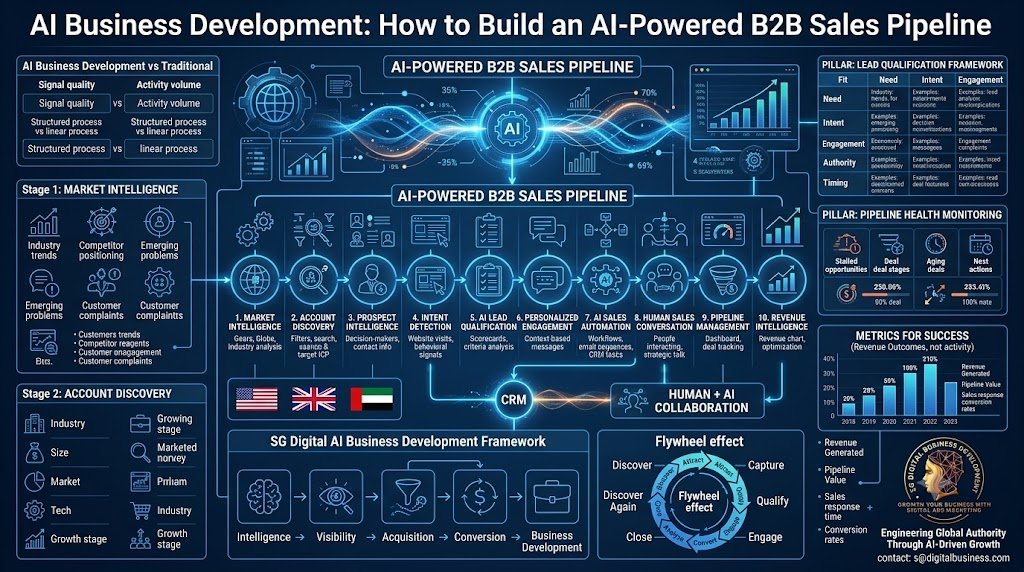
AI Business Development: How to Build an AI-Powered B2B Sales Pipeline.

Introduction B2B business development is changing rapidly. For years, companies built sales pipelines through a combination of cold outreach, referrals, networking, LinkedIn prospecting, email campaigns, paid advertising and manual follow-up. These methods can still work. But the way buyers discover companies, research solutions, compare vendors and decide who deserves a sales conversation is changing because of artificial intelligence. Today, a potential B2B buyer may discover a company through traditional Google search, an AI-generated search result, a recommendation from an AI assistant, LinkedIn content, a targeted advertisement, a comparison page, a case study or a combination of several digital touchpoints. That creates a new opportunity for companies that can connect AI visibility, lead generation, lead qualification, sales automation and business development into one system. This is where AI business development becomes important. AI business development is not simply using ChatGPT to write cold emails. It is the use of artificial intelligence, automation, customer data, buyer-intent signals and digital acquisition systems to identify potential accounts, understand their needs, prioritize opportunities, personalize engagement, automate repetitive sales activities and move qualified prospects toward revenue. The goal is not to remove humans from sales. The goal is to build a sales development system in which AI handles repetitive intelligence and operational work while sales and business development professionals focus on conversations, relationships, negotiation and closing. For B2B companies, this can create a more structured, measurable and scalable approach to pipeline development. What Is AI Business Development? AI business development is the application of artificial intelligence to the processes used to identify, engage, qualify, nurture and convert potential B2B customers. Traditional business development often depends heavily on manual research. A salesperson may: AI can assist with many of these activities. An AI-powered business development system can help identify suitable accounts, analyze buying signals, summarize company information, prioritize prospects, generate personalized messaging, automate follow-up and provide sales teams with relevant intelligence before conversations take place. The important distinction is that AI business development is a system, not a single tool. It combines: Market Intelligence + Prospecting + Lead Generation + Qualification + Personalization + Automation + CRM + Human Sales The objective is to create a continuous flow from potential market opportunity to qualified sales pipeline. Why AI Business Development Matters for B2B Companies B2B sales cycles can be complex. A buyer may need to research multiple vendors before contacting a company. Several people may influence the purchase. The sales cycle can involve: This creates a major challenge for traditional business development. Sales teams need to identify the right accounts and the right people while understanding where those prospects are in the buying journey. AI can help organize this complexity. Instead of treating every lead equally, businesses can use AI to identify patterns and prioritize prospects based on factors such as: This can help sales teams spend more time on prospects that demonstrate meaningful relevance or intent. AI Business Development vs Traditional Business Development Traditional business development generally follows a linear process: Find Prospect → Contact Prospect → Follow Up → Qualify → Meeting → Proposal → Close AI-powered business development can introduce intelligence at every stage: Identify Market → Discover Accounts → Detect Intent → Prioritize → Personalize → Engage → Qualify → Nurture → Convert → Learn The difference is important. Traditional sales development can depend heavily on activity volume. For example: AI business development focuses more heavily on signal quality and decision intelligence. The question becomes: Which accounts are most relevant, what problem are they trying to solve, what signals indicate potential intent, and what should happen next? That shift can make the sales process more strategic. The AI-Powered B2B Sales Pipeline An AI-powered B2B sales pipeline can be structured into several connected stages. Stage 1: Market Intelligence Understand the market, industries, companies and buyer segments. ↓ Stage 2: Account Discovery Identify companies that match the ideal customer profile. ↓ Stage 3: Prospect Intelligence Identify decision-makers and relevant stakeholders. ↓ Stage 4: Intent Detection Identify behavioral, digital and business signals that may indicate demand. ↓ Stage 5: AI Lead Qualification Evaluate whether prospects fit the company’s criteria. ↓ Stage 6: Personalized Engagement Deliver relevant messages and content based on prospect context. ↓ Stage 7: AI Sales Automation Automate repetitive outreach, follow-up and workflow tasks. ↓ Stage 8: Human Sales Conversation Sales professionals engage qualified opportunities. ↓ Stage 9: Pipeline Management Track opportunities, stages, risks and next actions. ↓ Stage 10: Revenue Intelligence Analyze what produces meetings, opportunities and revenue. This creates a closed-loop business development system. 1. Start With Your Ideal Customer Profile AI cannot compensate for an unclear target market. Before building an AI business development system, define the Ideal Customer Profile (ICP). Your ICP should identify the characteristics of companies that are most relevant to your business. For example: Company characteristics Buyer characteristics Buying characteristics AI can then use these criteria to help identify accounts that match the profile. Without a clear ICP, automation can simply produce more irrelevant prospects. 2. Use AI for Market Intelligence Business development begins before prospecting. You need to understand where demand exists. AI can help analyze large amounts of market information and organize it into useful intelligence. For example, companies can use AI-assisted research to examine: This can help business development teams identify new opportunities. For example, suppose an AI system identifies that companies in a particular industry are rapidly adopting a new technology. That insight can become a business development campaign. Instead of sending generic messages to thousands of companies, the sales team can target organizations experiencing a specific market transition. 3. AI-Powered Account Prospecting Traditional prospecting often requires hours of manual research. AI can accelerate account discovery. An AI-assisted prospecting workflow can combine: The objective is not simply to create a large list. It is to create a relevant account universe. For example: Target market: B2B technology companies in the United States Criteria: AI can help identify and organize companies matching these criteria. The sales team can then prioritize them. 4. AI Prospect

AI sales automation
AI Growth Engine

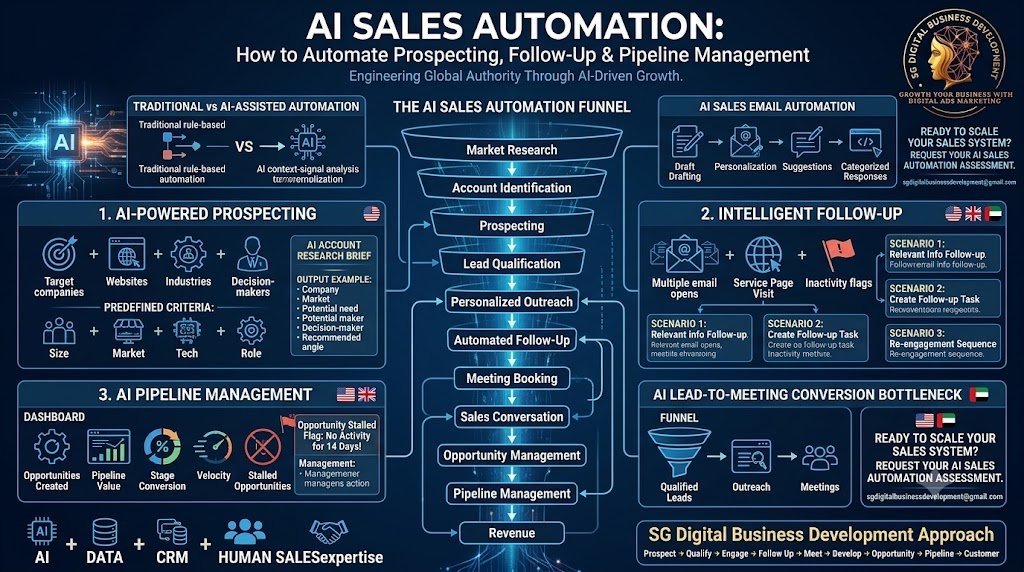
AI Sales Automation: How to Automate Prospecting, Follow-Up & Pipeline Management.

Introduction B2B sales teams spend a significant amount of time on activities that are necessary for revenue growth but do not always require a salesperson’s full attention. Finding prospects.Researching companies.Updating CRM records.Writing follow-up emails.Scheduling reminders.Checking pipeline stages.Sending sales sequences.Tracking responses.Re-engaging inactive prospects. These activities can become increasingly difficult as a company grows. A sales representative may start the day with a list of prospects, spend hours researching accounts, send personalized outreach, update the CRM, follow up with older leads, and then discover that several high-value opportunities have not received timely attention. This is where AI sales automation can change the way B2B sales teams operate. AI sales automation combines artificial intelligence, CRM systems, sales workflows, prospect data, intent signals, automation and human sales expertise to reduce repetitive work and help sales teams manage opportunities more efficiently. The goal is not simply to send more automated emails. The goal is to build a sales system that can help businesses: For modern B2B businesses, AI sales automation can become an important layer connecting marketing, lead qualification and business development. What Is AI Sales Automation? AI sales automation is the use of artificial intelligence and automated workflows to support repetitive and data-intensive sales activities across the prospecting, engagement, qualification and pipeline-management process. Traditional sales automation typically follows predefined rules. For example: If a prospect fills out a form, send an email. AI-assisted automation can go further by incorporating context and signals. For example: A prospect from a target account has repeatedly engaged with commercial content, matches the ideal customer profile and recently requested information about a relevant service. Prioritize the account, prepare a prospect summary and recommend a personalized sales action. The difference is important. Traditional automation primarily follows rules. AI-assisted automation can help interpret information and recommend actions based on multiple signals. However, AI should not be treated as an independent salesperson making every commercial decision. The most practical model is: AI handles repetitive intelligence and workflow tasks. Salespeople handle relationships, judgment and complex conversations. Why B2B Companies Need AI Sales Automation B2B sales processes often involve many small activities. A representative might need to: When this process is performed manually for hundreds or thousands of prospects, productivity can suffer. AI sales automation can help connect these activities into one workflow. Instead of having separate systems for: Prospecting Email CRM Lead qualification Follow-up Pipeline the business can create an integrated sales-development process. AI Sales Automation vs Traditional Sales Automation Traditional automation is still valuable. Rules-based systems can perform predictable tasks very efficiently. For example: AI adds another layer. It can help interpret: The two approaches can work together. Traditional automation Rule → Action AI-assisted automation Data → Context → AI analysis → Recommendation → Workflow → Human action The strongest systems usually combine both. The AI Sales Automation Funnel A practical B2B sales automation system can follow this structure: Market Research ↓ Account Identification ↓ Prospecting ↓ Lead Qualification ↓ Personalized Outreach ↓ Automated Follow-Up ↓ Meeting Booking ↓ Sales Conversation ↓ Opportunity Management ↓ Pipeline Management ↓ Revenue This is important because automation should not be limited to email. A sales pipeline is a complete system. 1. AI-Powered Prospecting Prospecting is one of the first areas where AI sales automation can reduce repetitive work. A sales team may have a target such as: Find 500 B2B companies in the USA that match our ideal customer profile. Traditionally, a salesperson or researcher might manually search for companies, websites, industries and decision-makers. An AI-assisted workflow can help organize this process. The system can use predefined criteria such as: The output can be a prioritized prospect list. For example: Target Account Industry: B2B SaaSMarket: USACompany size: 100–500 employeesPotential need: AI search visibility + lead generationDecision-maker: VP MarketingPriority: High The sales representative can then decide whether the account deserves outreach. This is a better use of AI than simply generating thousands of generic prospects. 2. AI Account Research Finding a company is only the beginning. Good B2B outreach requires context. Before contacting a prospect, salespeople may want to understand: AI can help summarize large amounts of information into a usable account brief. Instead of spending 20 minutes researching each account, a salesperson may receive a structured summary. For example: AI Account Brief Company: Example B2B Technology Company Market: United States Business model: B2B SaaS Potential opportunity: AI search visibility Observed digital gap: Limited visibility for commercial search topics Relevant decision-maker: Head of Marketing Recommended approach: Lead with an AI visibility assessment rather than a generic agency introduction. The salesperson still needs to verify important information. But the research process becomes faster. 3. AI Prospect Prioritization Not every prospect deserves the same amount of sales effort. This is where AI sales automation connects directly with your AI lead qualification process. A prospect can be evaluated using: The system can then organize prospects into categories such as: Priority Strong fit + strong intent + relevant business need. Sales Ready Good fit + clear engagement + reasonable buying signals. Nurture Good fit but limited current intent. Low Fit Does not match the target customer profile. This helps sales teams allocate time more effectively. 4. AI-Powered Personalized Outreach One of the biggest problems with sales automation is generic messaging. A prospect receives: Hi, We are a leading digital marketing agency and would love to discuss how we can help your business grow. The message may technically be personalized with the prospect’s name. But it is not truly personalized. AI sales automation can help sales teams create messages based on relevant business context. For example: Observed situation: The company is expanding into a new international market. Potential message angle: International search visibility and demand generation. The outreach could then be structured around that specific business situation. The goal should be: Relevant personalization, not artificial personalization. AI should help the salesperson communicate why the conversation may be relevant. It should not invent facts about the prospect. 5. AI Sales Email Automation Email remains an important component of many B2B sales

AI lead qualification
AI Growth Engine

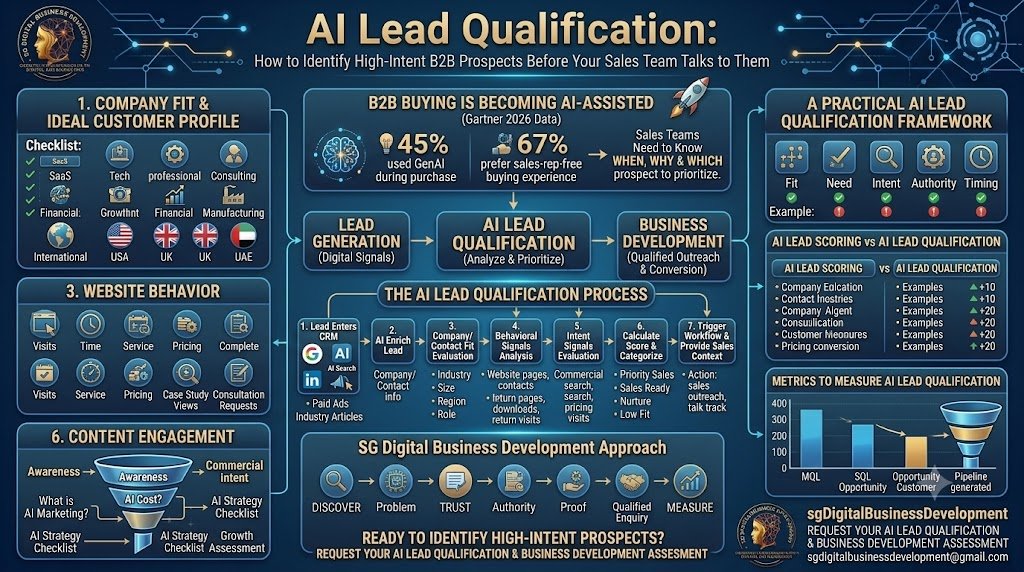
AI Lead Qualification: How to Identify High-Intent B2B Prospects Before Your Sales Team Talks to Them.

Introduction B2B companies are generating more digital signals than ever before. A prospect may discover a company through Google, an AI search engine, LinkedIn, a paid advertisement, an industry article, a case study, or a recommendation from an AI assistant. They may visit several pages, return days later, download a resource, compare services, view a pricing page, and eventually request a consultation. The challenge is that not every lead is ready for a sales conversation. Some prospects are simply researching. Some are interested but have no immediate buying timeline. Some fit your ideal customer profile but have no active requirement. Others may have strong buying intent and could become valuable opportunities if your sales team contacts them at the right moment. This is where AI lead qualification becomes important. Instead of treating every enquiry as equal, businesses can use AI, CRM data, behavioral signals, company information, engagement history, and buyer-intent indicators to identify which prospects deserve immediate attention. According to HubSpot, lead qualification evaluates factors such as prospect fit, buying readiness, and likelihood of becoming a customer. Modern lead-scoring systems can combine company or contact attributes with behavioral events to determine which records are the best fit or most engaged. At the same time, B2B buying is becoming increasingly digital and AI-assisted. Gartner reported in 2026 that 45% of surveyed B2B buyers had used GenAI during a recent purchase, while 67% preferred a sales-rep-free buying experience. That means sales teams increasingly need to know when to intervene, why to intervene, and which prospect deserves attention first. This guide explains how AI lead qualification can help B2B businesses identify high-intent prospects before a sales representative starts a conversation. What Is AI Lead Qualification? AI lead qualification is the process of using artificial intelligence, customer data, behavioral signals, business information, and predefined qualification criteria to determine whether a prospect is likely to be a suitable and potentially sales-ready opportunity. Traditional qualification often depends heavily on manual research. A salesperson receives a lead, opens the company’s website, checks LinkedIn, reviews the form submission, searches for relevant information, and decides whether the prospect appears valuable. This can work for a small number of leads. But as lead volume increases, manual qualification becomes difficult to maintain. AI lead qualification introduces an additional intelligence layer. Instead of asking only: “Did this person submit a form?” the business can ask: “Does this company fit our ideal customer profile, and what evidence suggests that the prospect may have a relevant business need right now?” That distinction is critical. A lead can be interested without being qualified. A prospect can be qualified without being ready. And a prospect can be both qualified and showing strong buying intent. The objective of AI lead qualification is to help businesses distinguish between these different situations. Why Lead Generation Alone Is Not Enough Generating leads is only the beginning of the B2B sales process. Imagine a company generates 200 leads in one month. At first glance, that sounds successful. But suppose: The company technically generated 200 leads. But the sales team may only need to focus heavily on a small portion of them. This is why AI lead qualification should be connected to lead generation rather than treated as a separate activity. The objective is not simply to generate a larger database. The objective is to identify opportunities that have a meaningful combination of: Fit + Need + Intent + Timing + Engagement When these signals are analyzed together, sales teams can make better decisions about where to spend their time. AI Lead Qualification vs Traditional Lead Qualification Traditional qualification usually depends on sales representatives manually reviewing leads. A salesperson may ask: These questions remain valuable. AI does not eliminate them. Instead, AI lead qualification can help gather, organize, interpret, and prioritize information before the salesperson begins the conversation. For example, an AI-assisted qualification system could combine: Qualification Area Example Signal Company fit Industry, location, company size Contact fit Job title, department, seniority Website engagement Pricing, service and case-study visits Intent Repeated visits to commercial pages Content engagement Downloads, webinar registrations Acquisition source Organic, paid, referral, social Timing Recent high-intent activity CRM history Previous conversations Account activity Multiple people from the same company Buying stage Research, evaluation or decision The result is a more complete prospect profile. How AI Lead Qualification Identifies High-Intent Prospects High-intent prospects rarely announce their buying intent with a single signal. Instead, intent often appears through a combination of behaviors. For example: A company discovers your website through an AI search result. The visitor reads an educational article. Later, they visit a service page. The following day, they return to review a case study. They then visit your pricing or consultation page. Finally, another employee from the same company visits your website. No single event proves that the company is ready to buy. But together, these signals can create a much stronger qualification picture. This is where AI lead qualification can become particularly useful. 1. Company Fit The first question should be: Is this company actually the type of customer we want to serve? Your ideal customer profile might include: An AI-assisted qualification system can compare incoming prospects against these criteria. For example: Company A Industry: B2B SaaSEmployees: 150Market: USAWebsite: EstablishedRequirement: AI search visibilityEstimated budget: Suitable Company B Industry: Individual freelancerEmployees: 1Market: Outside target regionRequirement: Basic websiteBudget: Very low Both are technically leads. But they should not necessarily receive the same sales priority. AI lead qualification can help separate fit from simple lead volume. 2. Job Title and Decision-Making Role The person submitting a form matters. A Chief Marketing Officer may have different purchasing authority from an intern. A founder may have direct decision-making authority. A marketing manager may influence the purchase. A researcher may simply be gathering information. This does not mean job title alone should determine qualification. Instead, AI can combine role information with behavioral and company signals. For example: High relevance CEO + target company + pricing page visit + consultation request Potentially relevant Marketing

Scroll to Top