AI Growth Engine

Strategic insights on how Artificial Intelligence is transforming ad performance and digital ROI.

B2B SEO Migration
AI Growth Engine

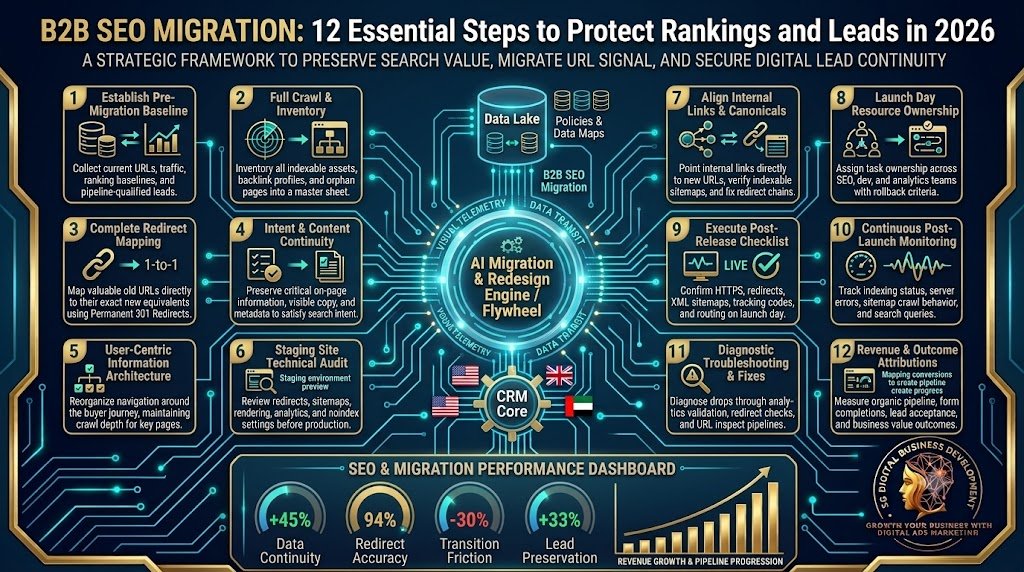
12 Best B2B SEO Migration Steps to Protect Traffic Fast

B2B SEO Migration: 12 Essential Steps to Protect Rankings and Leads in 2026. Introduction Website redesigns, domain changes, CMS replacements, URL restructuring, and platform migrations can improve a B2B website—but they can also damage organic visibility if search signals are not transferred carefully. A successful B2B SEO Migration is not simply a technical launch task. It is a controlled process for preserving valuable URLs, search intent, internal links, conversion paths, and the authority earned by existing pages. The B2B SEO Migration scope should identify these dependencies. For B2B companies, the stakes are especially high. A page may attract only a modest number of visits yet influence a high-value opportunity months later. Losing that page can affect discovery, lead quality, pipeline contribution, and sales conversations long after the development team considers the B2B SEO Migration complete. This guide explains how to plan, execute, and monitor a B2B SEO Migration without treating rankings as the only success metric. It includes a practical checklist, ownership recommendations, common mistakes, and a post-launch recovery process. What Is a B2B SEO Migration? A B2B SEO Migration is the planned transfer of search-engine signals from an existing website setup to a new one. The change may involve URLs, domain names, site architecture, content management systems, hosting, JavaScript frameworks, international targeting, or a combination of these. Not every redesign is a B2B SEO Migration in the strict technical sense. However, any project that changes crawlable pages, page templates, navigation, content, redirects, or indexation rules should include SEO migration planning. Keep this decision documented in the B2B SEO Migration plan. Typical scenarios include: The central objective of a B2B SEO Migration is continuity: search engines should understand which new page corresponds to each valuable old page, users should reach the information they expect, and lead-generation journeys should keep working. Why B2B Website Migrations Need Extra Care B2B buying journeys are rarely linear. A prospect may discover an educational article, return through a branded search, compare service pages, read a case study, and submit a form weeks later. If B2B SEO Migration work preserves only the homepage and top-level service pages, the business can lose useful entry points deeper in the journey. Review the result during B2B SEO Migration quality assurance. Several factors make the risk easy to underestimate. Long sales cycles. Organic traffic may influence opportunities long after the first visit. A sudden drop in visits can take time to show up in pipeline reporting. Low-volume, high-value pages. A page that attracts twenty relevant visits a month may be more commercially important than a page attracting thousands of unqualified visitors. Complex site architecture. B2B sites often have service pages, industry pages, resource hubs, case studies, integration pages, and supporting articles. A poorly planned B2B SEO Migration can break the relationships between them. Multiple stakeholders. Marketing, sales, developers, product teams, leadership, and external agencies may all own different parts of the launch. SEO tasks can fall between teams unless responsibility is explicit. Conversion dependencies. Forms, CRM tracking, analytics events, meeting-booking links, consent settings, and thank-you pages may change alongside the website. Protecting rankings while breaking lead capture is not a successful outcome. For these reasons, treat a B2B SEO Migration as a cross-functional release with clear acceptance criteria, not a last-minute checklist assigned to one marketer. 1. Establish a Baseline Before Changing Anything A migration baseline gives the team a reliable picture of the current website. Without it, post-launch changes are difficult to interpret. You may not know whether a page lost traffic because of the B2B SEO Migration, seasonality, a tracking change, or an unrelated search update. Capture at least: Use a consistent date range that reflects normal business patterns. For seasonal businesses, compare appropriate periods and annotate campaigns, releases, or tracking changes. Export raw data where possible so it remains available if the old analytics setup is retired. Do not rank pages solely by traffic. Create a business-value score that considers qualified conversions, pipeline influence, strategic relevance, backlinks, and organic visibility. This helps the team protect pages that matter commercially, even if their traffic is relatively small. Add this requirement to the B2B SEO Migration launch checklist. A useful baseline should answer three questions: Which URLs must be preserved? Which pages are eligible for consolidation? Which business outcomes must continue working after launch? 2. Crawl and Inventory the Existing Website Run a full crawl of the current site before development changes make it inaccessible. Combine crawler exports with analytics, Search Console data, XML sitemaps, backlink data, and the CMS content export. Each source finds URLs the others may miss. Create one master URL inventory with columns such as: Normalize URLs consistently before comparing lists. Watch for trailing slashes, uppercase characters, URL parameters, pagination, language variants, and duplicate protocol or hostname versions. Do not assume the sitemap contains every URL Google knows about. The B2B SEO Migration owner should verify this item. Review orphan pages separately. A page may receive backlinks or organic visits even if the current navigation no longer links to it. If the team overlooks it, that page may disappear from the new architecture without anyone noticing. For large websites, divide the inventory by template, business unit, language, or directory. This makes quality assurance manageable while retaining a single source of truth. 3. Map Every Valuable Old URL to a Relevant Destination The redirect map is one of the most important deliverables in a B2B SEO Migration. Every old URL with meaningful traffic, backlinks, conversions, or strategic value should have a deliberate destination. Use a direct one-to-one mapping wherever possible. If an old service page is replaced by a new service page covering the same subject, redirect the old URL to that new page. If a resource is renamed, redirect it to the closest equivalent resource. Avoid sending every retired URL to the homepage. A homepage is rarely a relevant substitute for a specific guide, service, industry page, or case study. Irrelevant redirects may confuse visitors and search engines and can fail to preserve the
B2B Keyword Mapping
AI Growth Engine

7 Best B2B Keyword Mapping Strategies to Boost Traffic Fast.

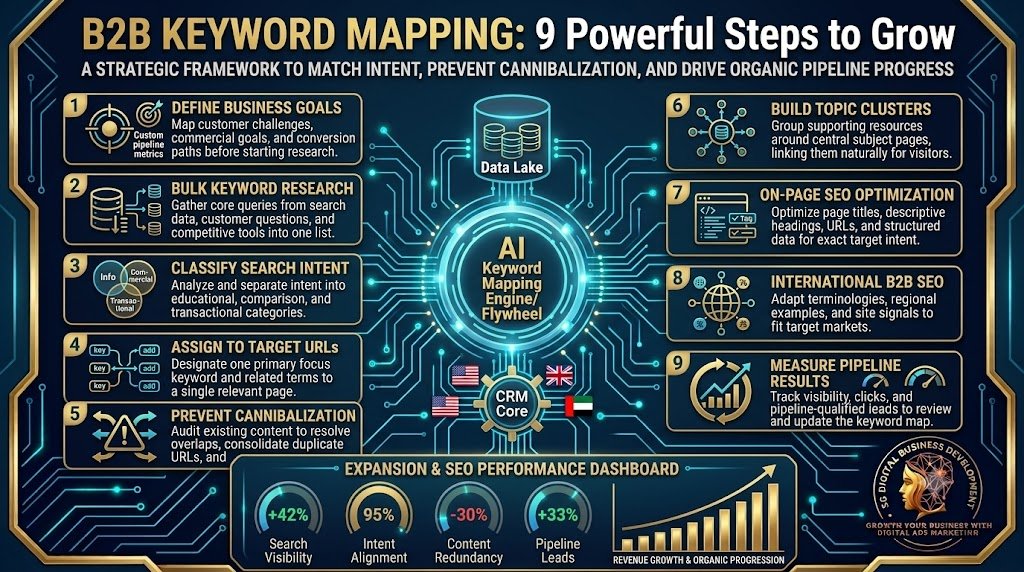
B2B Keyword Mapping: 9 Powerful Steps to Grow Introduction: Build a Smarter B2B SEO Strategy B2B companies invest in keyword research, content marketing, technical SEO, and website optimization to attract potential customers through organic search. However, publishing more articles does not automatically generate qualified leads. A website may contain hundreds of pages and still struggle to reach the right audience when content overlaps, search intent is misunderstood, or important service pages are difficult to discover. B2B Keyword Mapping helps solve these problems by connecting relevant search terms with the most suitable website URLs. It gives every important page a clear purpose and turns keyword research into an organized SEO strategy. An effective B2B Keyword Mapping process connects keyword research with content planning, internal linking, and lead generation. Instead of treating keywords as an unorganized list, businesses evaluate search intent, review existing pages, and assign primary and supporting terms to the most relevant resources. B2B buyers usually research a problem before comparing solutions and evaluating providers. An educational article, a commercial service page, and a case study may discuss related topics, but each serves a different stage of the buying journey. B2B Keyword Mapping helps businesses organize these resources without unnecessarily duplicating content. A structured approach also makes it easier to identify content gaps, improve existing articles, and investigate potential keyword cannibalization. When every URL has a defined role, content teams can focus on making useful resources more effective instead of repeatedly publishing similar pages. In this guide, you will learn nine practical steps for building a keyword map, matching content with search intent, organizing topic clusters, improving on-page SEO, and measuring business results. The goal is to create a website structure that supports relevant search visibility and helps qualified prospects find the information they need. What Is B2B Keyword Mapping? B2B Keyword Mapping is the process of assigning relevant search queries to specific website pages according to search intent, subject relevance, audience needs, and business objectives. A keyword map is generally maintained in a spreadsheet or SEO planning document. It connects each primary keyword with a target URL and records related keywords, page type, performance data, and recommended improvements. A practical B2B Keyword Mapping document can include: This structure makes SEO planning easier for writers, editors, marketers, and business owners. Everyone can understand what a page should cover, which search queries it should address, and how it contributes to the wider website strategy. Why keyword mapping matters for B2B companies B2B purchases often involve several decision-makers, detailed research, and a longer evaluation process. A buyer may first investigate a business problem, then compare possible approaches, assess providers, and finally request a consultation. B2B Keyword Mapping helps businesses create resources for these different needs. An educational article can explain the problem, a comparison guide can help evaluate options, and a service page can explain how the company can help. Keyword mapping is not keyword stuffing. The objective is to create useful pages with distinct purposes, not to repeat an exact phrase unnecessarily. Keyword density can help identify how often a phrase appears, but it does not guarantee better rankings. A strong B2B Keyword Mapping strategy prioritizes relevance, page purpose, useful information, and a clear connection between the searcher’s needs and the content provided. 1. Define Your Business Goals Before Researching Keywords Before collecting search terms, decide what your SEO strategy should achieve. Without clear objectives, teams may prioritize high-volume queries that generate traffic but few qualified enquiries. Identify your ideal customer Define the industries, company sizes, locations, and business models you want to reach. Identify the challenges your services solve and the people involved in purchasing decisions. A marketing manager may search for implementation details, while a business owner may prioritize cost, business outcomes, and return on investment. These differences influence keyword selection and content planning. Use sales conversations, customer enquiries, support questions, and existing customer data to understand the language your audience uses. This information can help you discover useful topics that generic keyword lists may miss. Connect SEO with commercial objectives Your goals may include generating qualified enquiries, increasing consultation requests, improving visibility for priority services, or attracting relevant organic visitors. B2B Keyword Mapping should reflect these goals. An informational query may support awareness, while a service-related query may reach someone who is actively evaluating providers. For example, a company that provides technical SEO services may need educational content about website crawling as well as a commercial landing page explaining its audit service. Both pages can support business growth, but they should not have identical purposes. Match goals with page types Different pages should serve different purposes. Educational articles answer questions, service pages explain offerings, case studies demonstrate relevant experience, and contact pages help visitors take the next step. A useful B2B Keyword Mapping plan connects these page types to the appropriate audience needs and business goals. Action step: Document your target audience, priority services, target markets, and primary conversion goals before building the keyword list. 2. Build a Comprehensive Keyword Research List B2B Keyword Mapping starts with a reliable list of relevant search queries. Begin with your core services and expand the list using customer questions, keyword research tools, and actual search performance data. Start with core service topics For a B2B digital marketing company, initial topic groups might include: These are research categories, not automatically separate articles. B2B Keyword Mapping helps determine which subjects need their own pages and which can be covered within an existing resource. Discover related search queries Use Google Search Console, keyword research tools, customer enquiries, sales conversations, and relevant search results to identify how your audience describes its needs. Useful research sources include customer questions, search suggestions, competitor content, pricing enquiries, implementation concerns, and industry-specific terminology. AI tools can help organize keyword lists, group related phrases, and suggest additional research ideas. However, validate those suggestions against actual search data and your company’s expertise before creating content. Evaluate business value Where available, record search volume estimates, current rankings, impressions, clicks, commercial relevance,

AI SEO Strategy
AI Growth Engine

AI SEO Strategy: 9 Powerful Ways to Grow in Search.

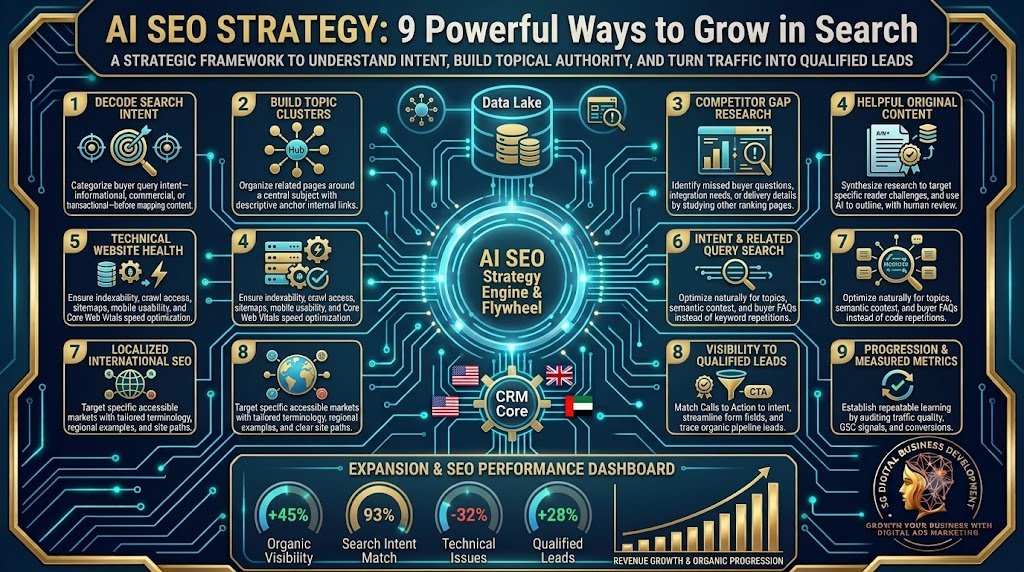
AI SEO Strategy: 9 Powerful Ways to Grow in Search. Introduction: Why Businesses Need a Smarter SEO Approach Search engines are an important starting point for people researching products, comparing service providers, and choosing businesses they can trust. But online search is evolving. Search engines increasingly interpret context, understand relationships between topics, and use artificial intelligence to help people discover relevant information. For businesses, this creates an opportunity to move beyond publishing content around individual keywords. A well-planned AI SEO Strategy can help connect technical website improvements, useful content, customer search intent, competitive research, and conversion optimization into one measurable process. The objective is not simply to publish more pages or insert more keywords. It is to understand what potential customers need, create content that answers their questions, build a technically accessible website, and make it easier for relevant visitors to take the next step. Artificial intelligence can support this process by organizing research, identifying content gaps, analyzing large datasets, and helping teams develop and improve content more efficiently. However, AI tools are not a replacement for accurate information, human expertise, editorial judgment, or a clear business strategy. Businesses that combine automation with thoughtful planning can create a more consistent approach to organic growth. They can identify promising opportunities, prioritize work based on potential value, and evaluate performance against outcomes that matter to the business. This guide explains nine practical ways to develop an effective AI SEO Strategy, from understanding search intent and improving technical SEO to building topical authority, measuring qualified leads, and creating a sustainable optimization process. What Is an AI SEO Strategy? An AI SEO Strategy is a structured approach to search engine optimization that uses artificial intelligence, data analysis, and human expertise to improve how a website is discovered, understood, and evaluated by search engines and potential customers. AI SEO Strategy, It combines established SEO practices with AI-assisted research, content planning, semantic analysis, technical diagnostics, and performance monitoring. For example, a business might use AI-assisted research to group related customer questions, identify missing information on existing pages, or summarize patterns in its Search Console data. AI SEO Strategy, An SEO specialist can then evaluate those findings, select the right priorities, and make improvements that serve the audience and business goals. A practical approach may include: The value comes from connecting these activities rather than treating each as a separate task. AI SEO Is More Than AI-Generated Content One common misconception is that AI SEO means generating large quantities of articles with an AI writing tool. Content production is only one possible use. A stronger strategy considers the entire search journey. It asks which questions customers are asking, which pages should answer those questions, how search engines can access those pages, and what visitors should do when they arrive. For example, a software company may need educational guides for people researching a problem, comparison pages for people evaluating solutions, and a service page for decision-makers ready to contact a provider. AI can help organize the research and suggest content relationships. Human specialists must still confirm accuracy, distinguish useful insights from speculation, and ensure every page has a clear purpose. 1. Use AI to Understand Search Intent Before Choosing Keywords Keyword research is most valuable when it reveals what a potential customer actually wants to accomplish. Two people can use similar search phrases but have different goals. One might want a definition, another might be comparing agencies, and a third might be ready to request a quote. A single page is not always the right answer for all three. An effective AI SEO Strategy begins by separating search intent into practical categories. Informational intent The searcher wants to learn something, understand a problem, or explore possible solutions. Examples include: These searches are suitable for educational guides, explanatory articles, and tutorials. Commercial investigation The searcher is comparing options before making a decision. Examples include: Comparison guides, detailed service explanations, and decision-support content can help this audience evaluate its choices. Transactional intent The searcher is closer to taking action. Examples include: These searches generally call for a clear service page, a relevant offer, and a simple contact process. How AI can help AI tools can classify keyword lists, summarize common questions, group related phrases, and identify possible content themes. Use these outputs as research assistance rather than unquestionable facts. Review actual search results for the most important queries. Examine whether the results predominantly feature service pages, tutorials, comparison articles, videos, or other formats. This helps determine what kind of page is likely to satisfy the searcher. Practical action: Create a keyword map with columns for the query, search intent, target audience, recommended page type, business relevance, and existing URL. Assign one primary purpose to each page. This prevents unnecessary duplication and helps each article support a different stage of the customer journey. 2. Build Topic Clusters Instead of Publishing Random Articles A website can publish dozens of posts and still struggle to establish a clear subject focus. The problem may be that its content does not form a useful, connected information structure. Topic clustering organizes related pages around a central subject. It gives readers a logical path through the website and helps search engines discover relationships between pages. Choose a central topic Start with a subject directly connected to the services your business offers. For a digital marketing agency, a central SEO topic could connect technical optimization, keyword research, content planning, website performance, and lead generation. The main service page should explain the offering and its commercial value. Supporting articles should answer narrower questions that the service page cannot cover in depth. Create supporting content with distinct purposes A cluster might include articles such as: Each page should provide a useful answer to a distinct question. Avoid publishing several articles that repeat the same advice with slightly different titles. Connect the pages with internal links Internal links help visitors discover related information and help search engines find important pages. For example, an educational article about AI SEO planning can

Mutual Action Plans
AI Growth Engine

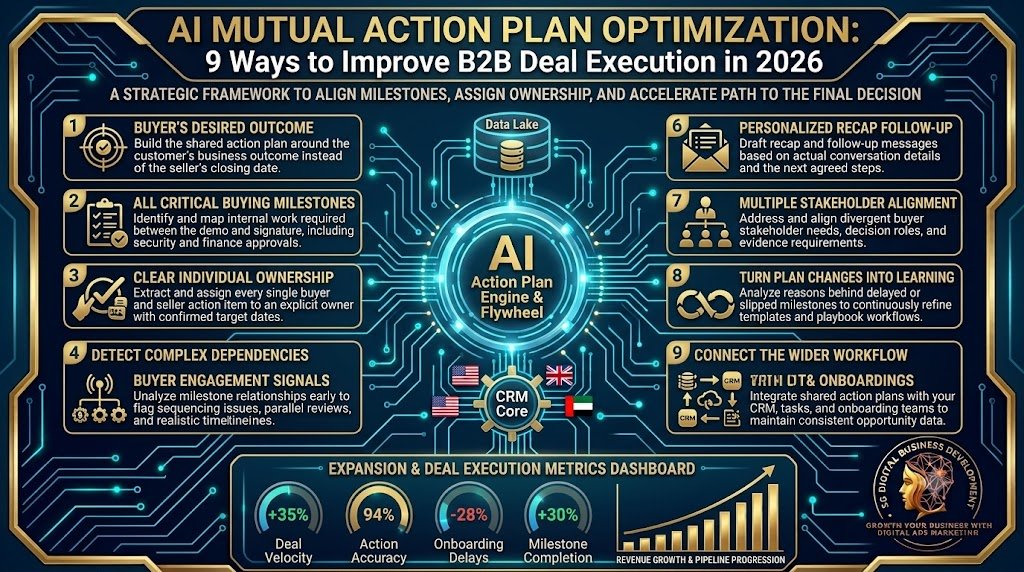
AI Mutual Action Plan Optimization: 9 Powerful Ways to Win More B2B Deals.

Powerful Mutual Action Plans: 9 Proven Ways to Win More B2B Deals. Introduction: Turn Deal Uncertainty Into Shared Progress B2B sales opportunities rarely close simply because a salesperson delivers an impressive presentation or sends a detailed proposal. Complex purchases often involve multiple stakeholders, technical evaluations, budget approvals, security assessments, procurement reviews, legal discussions, and implementation planning. Even when a buyer recognizes the value of a solution, the opportunity can stall because nobody has clearly agreed on the next steps. A technical review may remain unfinished. Procurement may be waiting for documents. Finance may need a stronger business case. An executive sponsor may assume another department is coordinating approval. Meanwhile, the seller may continue forecasting the opportunity as likely to close. This gap between perceived progress and confirmed progress creates unnecessary uncertainty. Mutual Action Plans help close that gap by providing buyers and sellers with a shared roadmap of the work required to reach a decision. An effective plan defines the desired outcome, important milestones, responsible owners, dependencies, target dates, and completion criteria. With artificial intelligence, teams can make these plans easier to maintain, analyze, and improve. AI can identify missing owners, summarize documented commitments, flag conflicting dates, and recommend follow-up actions for human review. However, technology alone does not create buyer alignment. The plan must reflect the customer’s actual decision process, not simply the seller’s preferred closing date. Its purpose is to make the buying journey clearer, reduce avoidable coordination problems, and help both parties understand what needs to happen next. This guide explains nine practical optimization strategies, a step-by-step implementation framework, useful performance metrics, governance considerations, common mistakes, and ways to connect shared planning with a wider B2B revenue strategy. What Are Mutual Action Plans in B2B Sales? A Mutual Action Plans is a shared roadmap describing the activities that a buyer and seller agree are necessary to reach a business outcome. It is particularly useful when a purchase requires several departments, formal approvals, technical validation, or coordinated implementation. Depending on the opportunity, the roadmap may include discovery confirmation, product evaluation, integration testing, security assessment, business-case approval, commercial review, procurement, legal approval, contract completion, and onboarding preparation. Traditional plans are often maintained in spreadsheets or documents. These tools can work, but they become harder to manage when information is scattered across emails, meeting notes, CRM records, project tools, and individual conversations. AI-assisted planning can help consolidate approved information, identify missing details, and suggest improvements. For example, an AI system might flag that a security review has no assigned owner or that a proposed contract date comes before a required technical assessment. The salesperson can then verify the issue and discuss it with the buyer. Effective Mutual Action Plans answer five essential questions: These questions establish a practical foundation for managing complex buying processes without confusing activity with genuine progress. Why Shared Planning Matters for Revenue Teams A CRM opportunity can appear healthy even when the customer’s internal decision process is stalled. Meetings may be taking place, stakeholders may express interest, and a proposal may have been requested. None of these signals independently proves that the purchase is advancing. Sales teams also face coordination challenges when different stakeholders have different priorities. A technical evaluator may focus on integrations, finance may review the business case, and procurement may check supplier requirements. Each department may have its own approval process and timeline. Without a shared view, representatives may chase updates without understanding the underlying obstacle. They may forecast a closing date based on optimism rather than verified milestones. Well-managed Mutual Action Plans help distinguish confirmed actions from assumptions. They provide a reference point for discussing delays, identifying missing information, and updating expectations. AI can strengthen the process by highlighting changes that deserve attention, but it cannot guarantee a purchase, eliminate every delay, or replace human judgment. The objective is to help both sides make informed decisions with fewer avoidable surprises. 1. Start With the Buyer’s Business Outcome A useful plan begins with the reason the customer wants to make a change. It should not start with an arbitrary closing date selected to satisfy an internal sales target. For example, a company purchasing a marketing platform may want to improve lead quality before its next planning cycle. A technology business may need a solution ready before launching a new product. A professional services organization may need an initiative approved before the next financial quarter.Mutual Action Plans. These business outcomes influence which milestones matter, which stakeholders must participate, and how much time the process may require. AI can summarize documented customer priorities from approved discovery notes, meeting summaries, and CRM records. It can suggest an outcome statement, but the account owner should validate the wording with the buyer before adding it to the shared roadmap. A practical outcome statement might be: “Complete the technical and commercial evaluation, confirm that the solution meets the agreed requirements, and decide whether to proceed within the planned implementation window.” This statement provides a meaningful destination without pretending that the seller controls the final decision. To establish a strong foundation: Mutual Action Plans , AI-generated summaries should not turn a tentative customer comment into a confirmed commitment. If a buyer says that a project might be completed by the end of the quarter, the plan should record that as a possibility until the timeline is confirmed. Revisit the outcome when the customer’s circumstances change. A plan that reflects an outdated business priority will not become effective simply because its tasks are completed on time. 2. Identify Every Critical Buying Milestone Many sales plans include a demonstration, proposal, and contract signature but overlook the internal work required between those activities. The buyer may need to complete a security questionnaire, validate integrations, obtain budget approval, consult an executive sponsor, register a supplier, or review contractual terms. Some organizations also require accessibility, compliance, data protection, or risk assessments. Mutual Action Plans , AI can compare a proposed roadmap with a library of milestones from similar purchases and flag possible omissions. It

AI Sales Meeting Intelligence
AI Growth Engine

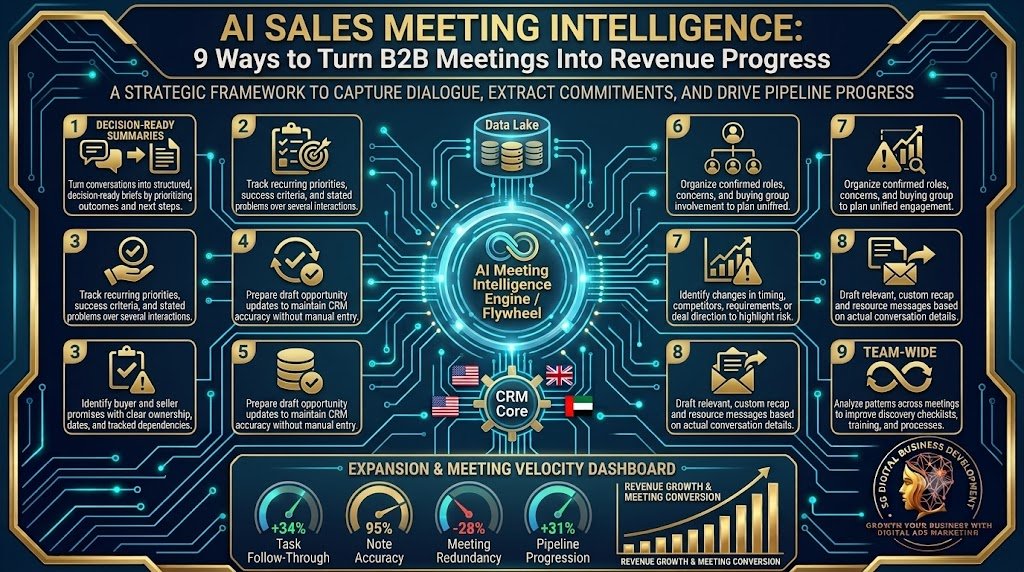
AI Sales Meeting Intelligence: 9 Ways to Turn B2B Meetings Into Revenue Progress.

AI Sales Meeting Intelligence: 9 Ways to Improve B2B Deals. Introduction B2B sales meetings create valuable information about customer needs, buying priorities, internal decision processes, commercial concerns, and the next steps required to move an opportunity forward. Yet much of that information is lost between the meeting and the next action. Notes remain incomplete, CRM records are updated late, commitments are forgotten, and important questions receive follow-up only after the buyer asks again. AI Sales Meeting Intelligence helps sales teams convert meeting information into structured, actionable insights. It can summarize discussions, identify buyer priorities, extract commitments, highlight unanswered questions, and help representatives maintain accurate opportunity records. Rather than relying entirely on memory, sellers can use a consistent process to turn conversations into decisions and follow-through. The value is not simply producing meeting summaries faster. A summary that nobody reads does not improve revenue performance. The real opportunity is connecting what happened in a meeting with what the seller, buyer, and wider account team need to do next. This guide explains how AI Sales Meeting Intelligence works, nine practical ways B2B teams can use it, the metrics that matter, and how to implement it without sacrificing accuracy, privacy, or human judgment. What Is AI Sales Meeting Intelligence? AI Sales Meeting Intelligence is the use of artificial intelligence to capture, organize, interpret, and operationalize information from sales meetings. Depending on the tools and permissions available, it may process approved recordings, transcripts, meeting notes, CRM records, and related sales documents. The system can help identify: Traditional meeting notes tend to vary by representative. One seller may document the business problem and next steps carefully, while another records only a few phrases. AI Sales Meeting Intelligence can help standardize the capture process, allowing teams to compare meeting information more consistently. However, AI-generated information must be checked. A transcript may misinterpret an acronym, confuse speakers, or turn a tentative suggestion into an apparent commitment. The seller remains responsible for confirming important details before they influence the CRM, a proposal, a forecast, or a customer promise. Why B2B Sales Meetings Lose Valuable Information Meeting notes depend too heavily on memory Representatives often try to listen, ask questions, manage the discussion, and take notes at the same time. Important details can be missed, particularly during complex technical or commercial conversations. Follow-up actions lack clear ownership A meeting may end with several promises but no named owner or agreed deadline. Both sides leave believing that progress will happen, yet no one is sure who must act first. CRM records become incomplete When representatives delay updating the CRM, the opportunity record may no longer reflect the latest buyer requirements, decision process, or unresolved concerns. Managers then review outdated information. Important buying signals remain buried A buyer may mention an internal deadline, a new stakeholder, a procurement requirement, or a concern about implementation. If the information is buried in a long transcript, the account team may not recognize its significance. Meetings produce activity without measurable progress A calendar full of meetings does not necessarily mean a deal is advancing. Teams need to know whether discussions clarify requirements, secure commitments, resolve risks, or establish a credible next step. AI Sales Meeting Intelligence can address these issues by connecting meeting information with the workflow that follows it. 9 Ways AI Sales Meeting Intelligence Improves B2B Sales Execution 1. Turn long conversations into decision-ready summaries A useful summary should help a seller understand the meeting without having to reread an entire transcript. It should prioritize the business problem, customer requirements, decisions, concerns, and next actions rather than simply shorten every part of the conversation. AI Sales Meeting Intelligence can produce a structured summary with sections such as: For example, a buyer may discuss integration requirements, implementation timing, data access, and executive approval during one conversation. A generic summary may mention all four topics but fail to show what remains unresolved. A decision-ready summary separates confirmed requirements from open questions and records who needs to address them. How to apply it: Create a standard summary template for each meeting type. Discovery calls may emphasize business problems and qualification. Technical meetings may focus on requirements, dependencies, and validation. Commercial discussions may focus on pricing, contract terms, and approvals. The objective of AI Sales Meeting Intelligence is to make meeting outcomes easier to use, not merely easier to read. 2. Extract buyer priorities and success criteria Buyers often describe their priorities across several conversations. A stakeholder may emphasize reducing manual work in one meeting, improving reporting in another, and reducing implementation risk in a later discussion. Sellers need to connect these statements without assuming they are all equally important. AI Sales Meeting Intelligence can organize explicitly stated priorities and the evidence supporting them. It can distinguish a confirmed requirement from a possible interpretation and highlight questions the representative should validate. For example, if a buyer repeatedly discusses implementation effort, the system might flag implementation as a recurring topic. It should not automatically conclude that implementation is the buyer’s highest priority unless the buyer has confirmed that ranking. This distinction matters because the seller’s response should be based on the customer’s actual decision criteria. A representative can ask which outcome matters most, how success will be measured, and what trade-offs the buying team is willing to consider. Over time, a verified record of priorities helps the account team keep proposals and demonstrations relevant. It also reduces the risk of presenting features that do not address the buyer’s central business problem. 3. Capture commitments and create accountable next steps One of the most practical uses of AI Sales Meeting Intelligence is extracting commitments from a conversation. These may include sending a technical document, arranging a security review, confirming budget ownership, providing a revised proposal, or introducing another stakeholder. Each action should have an owner, a due date when agreed, and a clear definition of completion. The system should distinguish an explicit commitment from a suggestion or an action that still requires confirmation. For example, “We should involve

AI Sales Negotiation Optimization
AI Growth Engine

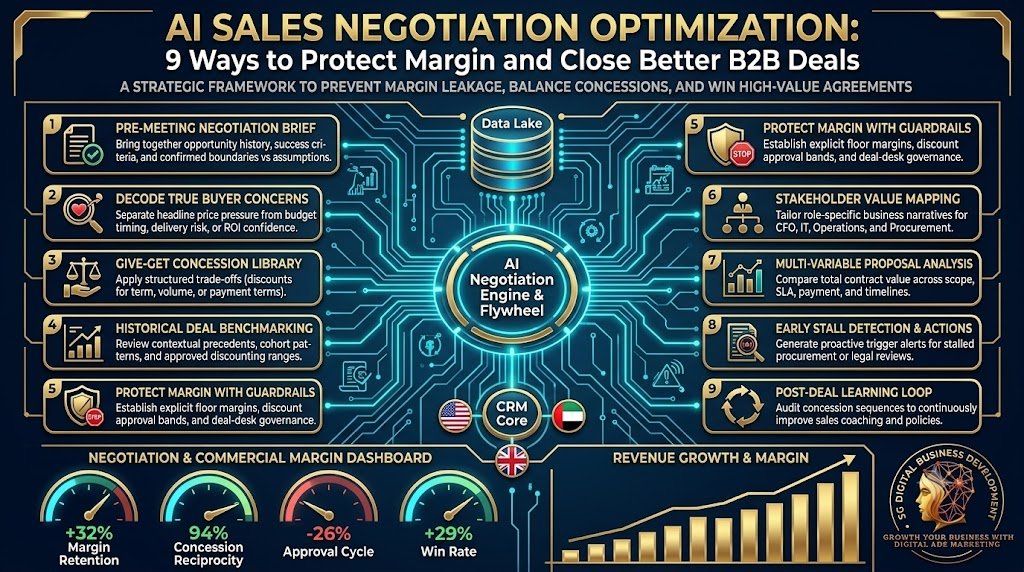
AI Sales Negotiation Optimization: 9 Ways to Protect Margin and Close Better B2B Deals.

AI Sales Negotiation Optimization: Protect B2B Margins. Introduction: B2B negotiations rarely fail because one person says the wrong sentence. They often lose momentum because teams enter discussions without a shared view of buyer priorities, commercial boundaries, stakeholder influence, or the value each concession creates. Sales representatives may discount too early, make promises that operations cannot deliver, or trade away contract terms without receiving anything meaningful in return. AI Sales Negotiation Optimization gives revenue teams a structured way to prepare for negotiations, understand deal patterns, evaluate trade-offs, and support consistent decisions. It combines CRM context, account research, conversation signals, pricing rules, and historical outcomes to help sellers make better-informed choices. It does not replace judgment or turn negotiation into a script. It helps representatives use evidence before committing the business to a price, timeline, scope, or contractual obligation. For B2B organizations with long sales cycles, multiple decision-makers, and complex contracts, the goal is not simply to win more deals. It is to win suitable deals on commercially sound terms, reduce avoidable concessions, and create agreements that customers can successfully implement. This guide explains how AI Sales Negotiation Optimization works, where it creates value, how to introduce it responsibly, and which metrics show whether it is improving outcomes. What Is AI Sales Negotiation Optimization? AI Sales Negotiation Optimization is the use of artificial intelligence and structured deal data to improve negotiation preparation, in-conversation decisions, concession management, and post-deal learning. It can analyze prior agreements, CRM records, call transcripts, pricing policies, buyer requirements, and deal outcomes to surface useful patterns for sales teams. A practical system may help a representative answer questions such as: In practice, AI Sales Negotiation Optimization connects these questions to the evidence and approval rules already used by the business. AI Sales Negotiation Optimization should be treated as decision support, not an autonomous authority. Recommendations need reliable data, clear policy limits, and human review—especially when decisions affect price, legal exposure, privacy, service commitments, or customer trust. Why Traditional B2B Negotiations Lose Value Many sales organizations rely on individual experience and informal coaching. Experienced sellers may negotiate effectively, but their methods are difficult to scale when knowledge remains in personal notes, memory, or private conversations. Newer representatives often copy the visible behavior of top performers without understanding why a concession was appropriate in one deal and harmful in another. Several recurring problems weaken negotiation outcomes. AI Sales Negotiation Optimization helps make these problems visible across deals instead of leaving every representative to solve them alone. 1. Sellers negotiate before they understand priorities A buyer asks for a lower price, and the representative immediately discusses a discount. But price may be a proxy for budget approval, perceived risk, implementation effort, procurement policy, or a comparison with another vendor. If the seller treats every request as a price problem, the discussion can become a discount exchange instead of a value conversation. 2. Concessions are made without a return A seller reduces the price to preserve momentum but does not request a longer term, larger initial scope, faster signature, reference participation, or a more predictable payment schedule. The buyer receives a benefit, while the seller receives no corresponding commitment. Repeated across a team, these small decisions can erode margin. 3. Commercial decisions are inconsistent Two representatives may handle similar deals differently because they have different experience, access to managers, or confidence in pricing policy. Inconsistency can confuse buyers and create internal fairness concerns. It also makes forecasting deal economics more difficult. 4. Internal approvals arrive too late A representative may agree verbally to a custom implementation plan or a nonstandard renewal clause before confirming that delivery, finance, security, or legal teams can support it. The deal then stalls while the company revises expectations. A strong negotiation process identifies approval requirements before commitments are made. 5. Teams do not learn from completed deals CRM systems may record the final contract value but omit the sequence of concessions, the buyer’s actual priorities, or the terms that helped reach agreement. Without those details, the organization cannot reliably distinguish a good negotiation from a deal that closed only after unnecessary value was surrendered. AI Sales Negotiation Optimization addresses these gaps by connecting preparation, decision rules, and learning across the deal lifecycle. 9 Ways AI Sales Negotiation Optimization Can Improve Results 1. Build a negotiation brief before the meeting A useful negotiation starts with a concise, evidence-based brief. AI Sales Negotiation Optimization can bring together the opportunity history, customer objectives, known stakeholders, product usage, prior proposals, open risks, and relevant account research. It can summarize what is confirmed, what is inferred, and what still needs to be asked. A strong brief should include: The brief is a core AI Sales Negotiation Optimization output because it turns scattered account information into a usable meeting plan. The brief should not present an inferred buyer motivation as a fact. For example, a model might flag that a delayed approval could indicate budget uncertainty, legal review, or competing priorities. The representative should validate the explanation directly rather than choose one based on a score. That distinction keeps AI Sales Negotiation Optimization useful without encouraging overconfidence in predictions. How to apply it: Generate the brief from approved CRM and document sources before a negotiation review. Ask the account owner to correct outdated details and identify assumptions that need validation. This makes preparation faster without removing the seller’s responsibility for accuracy. 2. Separate price pressure from the underlying concern Price is visible and easy to discuss, but it may not be the buyer’s most important issue. AI Sales Negotiation Optimization can help classify language in call notes, emails, and meeting transcripts into possible themes such as budget limits, implementation risk, uncertain return, procurement requirements, competitor comparison, or timing. AI Sales Negotiation Optimization is most useful here when it recommends clarifying questions rather than pretending to know the buyer’s intent. A representative might ask, “When you say the proposal is above budget, is the challenge the total investment, the timing of payment, or confidence

AI Sales Objection Handling
AI Growth Engine

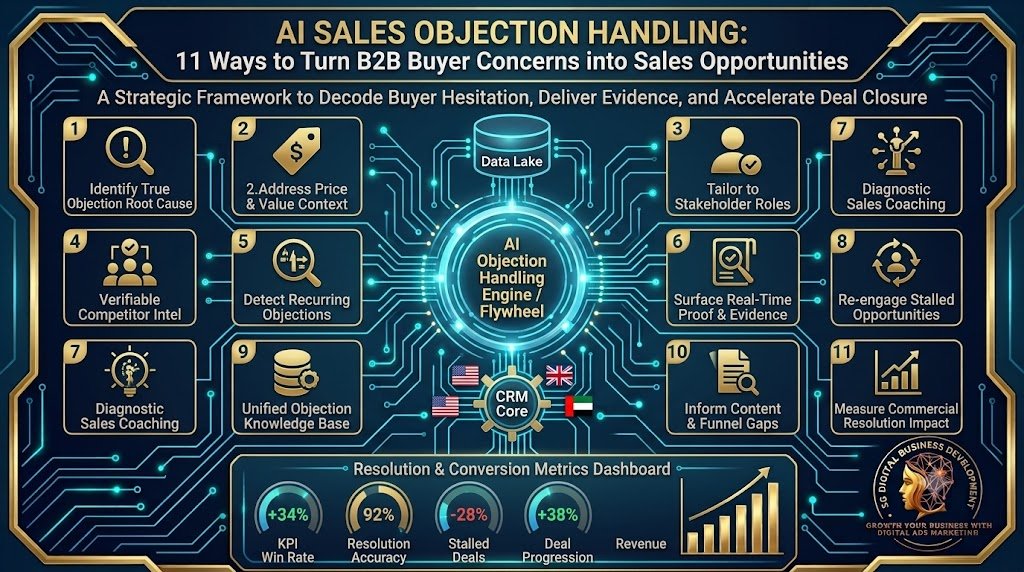
AI Sales Objection Handling: 11 Ways to Turn B2B Buyer Concerns into Sales Opportunities.

AI Sales Objection Handling: 11 Ways to Win More B2B Deals. Introduction: Why Buyer Objections Are Valuable Sales Signals A B2B prospect says your solution is too expensive. Another says the company is already working with a competitor. A third wants to wait until next quarter. A fourth agrees that the problem exists but questions whether your proposed solution will deliver measurable results. These responses can appear to be barriers to closing a deal. However, they often reveal something more important: what the buyer needs to understand before making a commercial decision. Price objections may indicate an unclear business case. Concerns about implementation may reveal operational risk. Requests to delay may signal weak urgency, competing priorities, or an incomplete understanding of the cost of inaction. Sales teams that recognize these signals can respond more intelligently than teams that rely on memorized scripts. This is where AI Sales Objection Handling becomes valuable. Artificial intelligence can help sales organizations analyze conversations, identify recurring buyer concerns, retrieve relevant evidence, recommend appropriate responses, and improve sales coaching. Instead of treating every objection as an isolated problem, businesses can develop a repeatable system for understanding and resolving buyer uncertainty. AI Sales Objection Handling should support evidence-based conversations. The objective is to help sales professionals understand the reason behind an objection and respond with relevant information, credible evidence, and thoughtful questions. At SG Digital Business Development, this capability fits into a broader growth system connecting AI intelligence, digital visibility, lead qualification, sales engagement, business development, and revenue performance. What Is AI Sales Objection Handling? AI Sales Objection Handling is the use of artificial intelligence to identify, classify, interpret, and respond to concerns raised by potential buyers during the sales process. These concerns may relate to: Traditional objection handling often depends on individual experience. An experienced salesperson may know how to respond to a procurement concern, while a newer representative may struggle to identify what the buyer is really asking. AI Sales Objection Handling can help make this knowledge more accessible across the sales organization. For example, a prospect might say: “We like the proposal, but the investment is higher than we expected.” A basic response might immediately offer a discount. A more thoughtful approach would investigate the underlying issue. Is the buyer comparing different service scopes? Is the budget genuinely constrained? Has the business impact been explained clearly? Does the prospect lack confidence in the expected outcome? AI Sales Objection Handling can help a representative identify these possibilities, review previous conversation context, and suggest questions that clarify the concern. It cannot reliably determine the buyer’s real motivation from a single sentence. The salesperson must validate the interpretation through conversation. The strongest model combines AI analysis with human judgment. Effective AI Sales Objection Handling keeps that human review in place. Why Traditional Objection Handling Often Fails Before implementing new technology, businesses need to understand why existing sales processes struggle. 1. Sales representatives rely on generic scripts Scripts can help new representatives establish a foundation, but rigid responses often fail when buyers have different priorities. A procurement manager concerned about contract terms requires a different conversation from a CFO questioning the expected return on investment. 2. Buyer concerns are recorded inconsistently One representative may record a lost opportunity as “price.” Another may record “competitor selected.” A third may provide no meaningful explanation. This makes it difficult for sales leadership to distinguish actual patterns from incomplete reporting. 3. Sales teams respond before understanding the problem When a buyer raises an objection, representatives may immediately defend the solution. However, the first objection is not always the underlying concern. A request for a lower price may reflect uncertainty about value rather than an absolute budget limit. 4. Valuable sales knowledge remains isolated Experienced representatives often develop effective ways to address common concerns. Without a structured knowledge-sharing process, these insights remain within individual conversations. 5. Coaching happens too late Managers may discover a repeated objection-handling problem only after several deals have stalled or been lost. Conversation analysis can help identify patterns earlier, allowing coaching to address specific behaviors rather than relying on general advice. An effective AI Sales Objection Handling process helps organizations address these weaknesses by connecting conversation data, sales knowledge, coaching, and measurable outcomes. 11 Ways AI Sales Objection Handling Can Improve B2B Sales 1. Identify the Real Reason Behind Buyer Objections The first priority is understanding what the buyer means. Consider these statements: Each statement can have several possible explanations. A price concern may involve budget restrictions, perceived value, competitor pricing, or uncertainty about implementation costs. A timing concern may reflect a genuine planning cycle or simply a lack of urgency. AI Sales Objection Handling can analyze the wording, conversation history, buyer role, and available CRM context to suggest possible objection categories. A representative can then ask a clarifying question rather than assuming the first interpretation is correct. This improves practical AI Sales Objection Handling outcomes. For example: “Would it be helpful to explore whether the main concern is the available budget, the expected return, or how the investment compares with your other priorities?” This question opens a conversation without pressuring the buyer. Practical implementation: Create a standardized objection taxonomy. Start with price, value, timing, trust, competition, implementation, authority, security, and fit. Let representatives correct AI-generated classifications so the system can be evaluated against real sales outcomes. 2. Improve Responses to Price and Budget Concerns Price objections are among the most common challenges in complex B2B sales. However, lowering the price is not always the best response. If the buyer does not understand the expected business impact, a discount may reduce margins without resolving the underlying concern. AI Sales Objection Handling can help representatives connect a proposed investment to relevant evidence, such as: Suppose a prospect questions the cost of a business development service. Rather than immediately offering a discount, the salesperson can clarify the expected commercial outcome, the work included in the engagement, and the metrics that would determine success. The business case must use defensible assumptions.

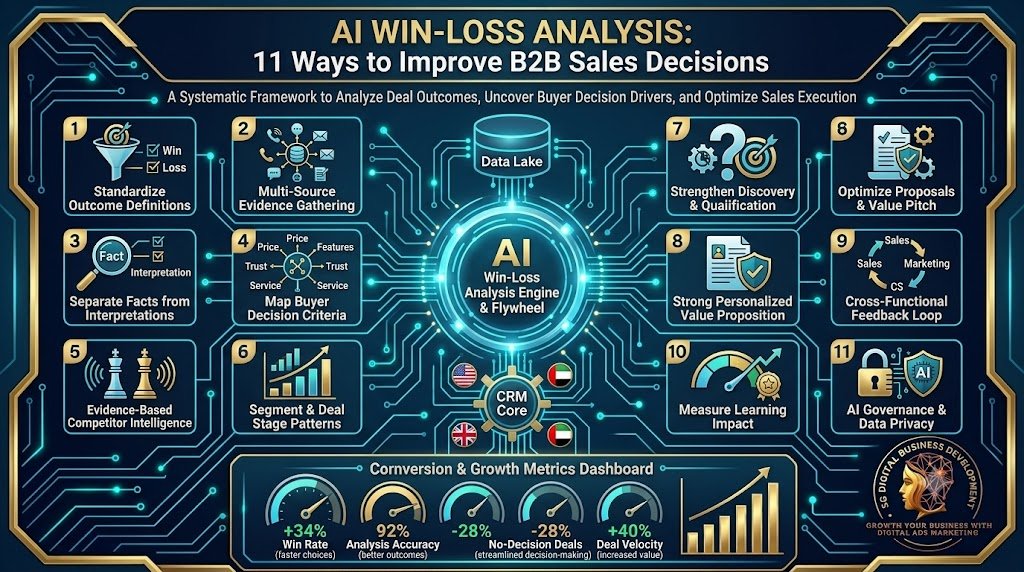
AI Win-Loss Analysis
AI Growth Engine

AI Win-Loss Analysis: 11 Ways to Improve B2B Sales Decisions.

AI Win-Loss Analysis: 11 Ways to Improve B2B Sales Decisions. Introduction B2B sales teams invest significant time in prospect research, discovery calls, demonstrations, proposals, negotiation, and follow-up. Yet when a deal is won or lost, the reason recorded in the customer relationship management system is often too vague to support a better decision. “Price,” “no decision,” “competitor,” or “timing” may describe part of the outcome, but rarely explain the full story. AI Win-Loss Analysis helps organizations examine sales outcomes more consistently by combining structured deal data with approved notes, customer feedback, call summaries, proposal history, and other relevant evidence. The purpose is to understand why buyers chose a provider, selected a competitor, delayed a purchase, or decided not to act—and then use those findings to improve sales execution. The technology is not a substitute for honest customer conversations or sound commercial judgment. AI can organize evidence, identify recurring patterns, and suggest questions for investigation. People still need to validate interpretations, protect confidential information, and distinguish a supported finding from a plausible explanation. This guide explains how B2B organizations can build a practical analysis process, use AI responsibly, connect findings to sales improvements, and measure whether those changes are helping. The focus is not on predicting every deal outcome. It is on learning systematically from the decisions buyers actually make. What Is AI Win-Loss Analysis? AI Win-Loss Analysis is a structured approach to examining completed or stalled sales opportunities with the help of artificial intelligence. It brings together information about the buyer’s goals, evaluation criteria, stakeholders, sales interactions, commercial proposal, alternatives considered, and final outcome. Traditional win-loss reviews may depend on a salesperson’s memory or a short CRM dropdown. That information can be incomplete or influenced by assumptions. A salesperson may attribute a loss to price when the buyer actually lacked confidence in implementation, could not secure internal approval, or did not see a strong enough difference between vendors. AI Win-Loss Analysis can help teams review approved records at scale, summarize customer interviews, categorize feedback, compare patterns across segments, and identify recurring questions for further research. It can also flag conflicting explanations, missing evidence, or patterns that deserve a closer look. The output should not be treated as an unquestionable verdict. A correlation between a certain sales behavior and a win does not prove that the behavior caused the outcome. Larger deals may receive more executive attention, for example, because they are already strategically important. Good analysis combines quantitative evidence with customer context and careful interpretation. A useful program answers four questions: What happened? What evidence supports the explanation? Which factors may have influenced the result? What should the organization change, test, or continue doing? Why B2B Companies Need a Better Learning Process B2B purchases are rarely decided by one factor. Buyers may evaluate business impact, implementation effort, security, integration requirements, vendor credibility, support, commercial terms, and internal consensus. Different stakeholders can weigh these criteria differently, and priorities may change during the evaluation. When a company records only the final outcome, it loses much of this context. Sales leaders may repeat the same coaching advice without knowing whether it addresses the real barrier. Marketing may create content around assumed objections. Product teams may interpret isolated comments as broad demand. Pricing teams may discount deals that were never primarily lost on price. A consistent learning process helps separate recurring issues from individual anecdotes. It can reveal whether a particular segment frequently struggles to understand the offer, whether buyers repeatedly ask for proof of a specific capability, or whether opportunities stall when a required stakeholder enters late. AI Win-Loss Analysis can make this review more efficient, especially when an organization has many opportunities and multiple sources of feedback. However, analysis quality depends on how well the underlying data represents the buyer’s experience. If customer feedback is rarely collected, AI cannot reliably reconstruct what buyers thought. The goal is not to blame individual sellers or manufacture a single reason for every result. The goal is to improve decisions across sales, marketing, product, customer success, and leadership by creating a dependable feedback loop. 1. AI Win-Loss Analysis: Standardize the Definition of a Win, Loss, and No Decision For AI Win-Loss Analysis, before analyzing outcomes, define what each outcome means. A won deal may mean a signed contract, a completed purchase order, or another formal commercial milestone. A lost deal may mean the buyer selected another provider, chose an internal solution, or explicitly rejected the proposal. A no-decision outcome means the purchase did not proceed during the defined evaluation period, but the underlying opportunity may not be permanently closed. Without consistent definitions, comparisons become misleading. One sales team may classify a stalled opportunity as lost after a month, while another leaves it open for a year. A competitor win may be recorded the same way as a project cancelled because the buyer’s budget disappeared, even though the implications differ substantially. Create outcome categories that reflect meaningful distinctions and provide guidance on when each should be used. Keep the list manageable enough for consistent adoption. Allow a secondary reason or explanatory note when the main category cannot capture the full context. Review a sample of closed opportunities with sales managers to check whether the definitions are being applied consistently. If teams disagree about categories, fix the taxonomy before building sophisticated reporting around it. 2. AI Win-Loss Analysis: Collect Evidence From Multiple Sources A CRM loss reason is one source of information, not the whole story. A stronger review may include discovery notes, approved call transcripts, proposal versions, email summaries, stakeholder feedback, implementation questions, customer interviews, and documented competitor comparisons. For AI Win-Loss Analysis, create a data map that explains which sources are available, who owns them, how current they are, and whether they may be used for analysis. Avoid collecting everything simply because it is technically accessible. The goal is to assemble the minimum relevant evidence required to understand the buying decision. AI Win-Loss Analysis can summarize these materials into a consistent deal narrative, but the

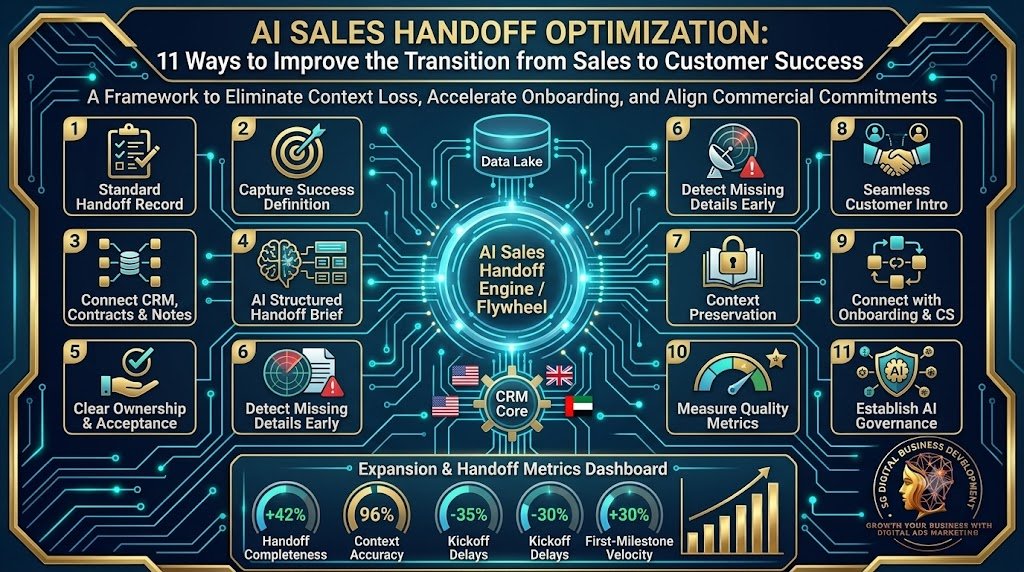
AI Sales Handoff Optimization
AI Growth Engine

AI Sales Handoff Optimization: 11 Ways to Improve the Transition from Sales to Customer Success.

AI Sales Handoff Optimization: 11 Ways to Improve Customer Transitions. Introduction Winning a B2B customer is an important milestone, but it is not the end of the customer journey. After a contract is signed, the organization must translate the promises made during sales into a practical onboarding plan, a clear set of responsibilities, and a successful first experience. When the transition is incomplete, customers may need to repeat information, expectations may conflict, implementation can slow down, and confidence can decline before the relationship has properly started. AI Sales Handoff Optimization helps organizations make this transition more consistent. It combines structured handoff requirements, customer relationship management data, meeting summaries, workflow automation, implementation context, and human review. The objective is not to remove the relationship from the process. It is to make sure the teams receiving a customer have the information they need to deliver what was agreed. AI Sales Handoff Optimization connects the sales process with onboarding, implementation, customer success, support, and account management. It records the customer’s goals, agreed scope, key stakeholders, commitments, risks, dependencies, and next steps. It also makes uncertainty visible instead of allowing assumptions to become promises. This guide explains how B2B companies can apply AI Sales Handoff Optimization, measure the customer transition, avoid common mistakes, and implement improvements over 90 days. What Is AI Sales Handoff Optimization? AI Sales Handoff Optimization is the use of artificial intelligence, connected customer data, and defined workflows to improve the transfer of customer context from sales to the teams responsible for onboarding, implementation, delivery, or ongoing success. AI Sales Handoff Optimization improves on a traditional handoff that may depend on a salesperson completing a CRM form, sending an email, or scheduling a meeting. The process can work when volume is low and the same people remain involved throughout the customer journey. As the organization grows, information becomes scattered across call recordings, email threads, proposals, CRM fields, project plans, and personal notes. AI Sales Handoff Optimization can summarize and organize that information, identify missing details, prepare a brief, and trigger the right tasks. It should not independently invent requirements, interpret an unconfirmed statement as a commitment, or silently overwrite important customer records. The best system combines three elements: a clear operating process, reliable source data, and AI assistance with human accountability. Without a defined process, automation simply moves confusion faster. Without reliable data, AI summaries can be misleading. Without an accountable owner, important details can remain unresolved. Why the Sales-to-Customer Handoff Matters Customers experience the business as one organization, even when several internal teams are involved. They do not necessarily distinguish between what sales promised and what implementation can deliver. If a customer has to explain the same business objective repeatedly, or learns after signing that a key requirement was never included, the relationship can start with avoidable friction. A weak handoff can cause several problems that AI Sales Handoff Optimization is designed to reduce. Implementation teams may lack the original business context. Customer success may not know what success means to the customer. Technical teams may discover dependencies late. Commercial teams may have to renegotiate expectations. Leaders may struggle to understand why onboarding delays are recurring. AI Sales Handoff Optimization addresses these risks by making the transition an explicit stage of the customer lifecycle, rather than an informal exchange of notes. The handoff should confirm what was sold, why the customer purchased, what outcomes matter, what remains unresolved, and who is responsible for each next action. AI Sales Handoff Optimization should not be judged only by how quickly a record moves from one team to another. A fast handoff that omits critical context is not successful. The goal is a timely, complete, accurate, and actionable transfer that helps the customer move toward the agreed outcome. 1. Define a Standard Handoff Record Start by defining the minimum information that must be available before a customer is formally handed over. The exact fields depend on the business model, but the record should be useful to the people who will deliver the service. A practical AI Sales Handoff Optimization record may include the customer’s primary business problem, desired outcomes, purchased products or services, agreed scope, key dates, commercial commitments, stakeholders, decision process, technical requirements, integrations, known risks, dependencies, and the next scheduled customer interaction. Separate confirmed facts from assumptions. For example, “The customer needs a CRM integration” is different from “The customer asked whether a CRM integration is possible.” The first may be an agreed requirement; the second may be an open question. A well-designed record makes that difference explicit. AI Sales Handoff Optimization can help extract candidate details from approved sources and place them into the correct fields. However, important information should be linked to its source or reviewed by the account owner. A generated summary should not be treated as a substitute for the contract, statement of work, or approved implementation plan. Keep the record focused. If every possible field is mandatory, employees may fill it with vague text just to complete the process. Require information according to the service, customer segment, and risk level. Use conditional fields when enterprise implementations require more detail than a small, standardized engagement. 2. Capture the Customer’s Definition of Success Sales teams often describe a solution in terms of features, deliverables, or commercial value. Customer success teams need to understand what the customer wants to accomplish and how progress will be recognized. During discovery, capture the customer’s stated goals in practical language. These may include reducing a manual process, launching a new capability, improving qualified lead generation, consolidating tools, or supporting a business expansion. Record the current situation when known, the desired future state, and any agreed measure of progress. Avoid converting a broad aspiration into a guaranteed outcome. If a customer says they want to increase conversion, that does not automatically mean the vendor has promised a particular percentage increase. Preserve the distinction between the customer’s objective, the provider’s commitment, and a result that depends on multiple factors. AI Sales Handoff Optimization can

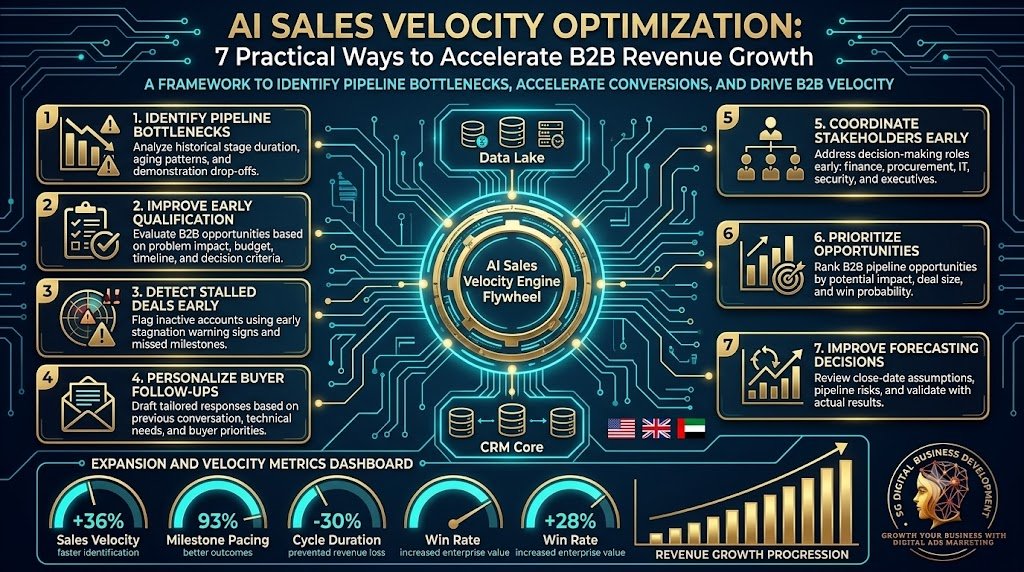
AI Sales Velocity Optimization
AI Growth Engine

Powerful AI Sales Velocity Optimization: 7 Ways to Accelerate B2B Revenue Growth.

Powerful AI Sales Velocity Optimization: 7 Ways to Accelerate B2B Revenue Growth Introduction B2B companies often try to grow revenue by generating more leads, increasing outreach, hiring additional sales representatives, and adding opportunities to the pipeline. These activities can help, but they do not guarantee faster revenue growth. If qualified opportunities remain inactive, proposals take too long to prepare, buying committees become involved late, or representatives spend weeks pursuing unsuitable prospects, a larger pipeline may still produce disappointing results. AI Sales Velocity Optimization helps sales and revenue teams understand where qualified opportunities slow down and how to remove avoidable friction. It combines CRM data, artificial intelligence, sales analytics, workflow design, and human judgment to help opportunities progress from qualification to a clear commercial decision. The goal is not to rush buyers or bypass necessary reviews. It is to reduce repeated work, unclear ownership, missing information, and delays that do not improve the buyer’s decision. For B2B organizations, AI Sales Velocity Optimization connects day-to-day execution with revenue performance. When a company knows why deals stall, it can allocate specialist support more intelligently, improve buyer communication, strengthen forecasts, and understand which process changes are worth scaling. This guide explains the formula, practical improvement strategies, data foundations, metrics, governance requirements, and a 90-day implementation plan. What Is Sales Velocity, and How Does AI Improve It? AI Sales Velocity Optimization uses sales velocity as a measure of how quickly a business converts qualified opportunities into revenue potential. A common formula is: Sales Velocity = (Number of Qualified Opportunities × Average Deal Value × Win Rate) ÷ Average Sales Cycle Length Imagine a company with 40 qualified opportunities, an average deal value of $8,000, a 25% win rate, and a 40-day average sales cycle. Its illustrative sales velocity calculation is (40 × $8,000 × 0.25) ÷ 40, or $2,000 per day. This is a directional productivity metric, not a promise that the company will collect that amount every day. Teams should define the opportunity population and measurement period consistently. The formula highlights four levers. The number of qualified opportunities reflects pipeline volume. Average deal value captures the typical commercial value of a win. Win rate indicates how efficiently opportunities convert. Sales-cycle length measures the time between the agreed starting point and the closed outcome. Changing one lever can affect another: pursuing larger enterprise deals may raise deal value while increasing the number of stakeholders and approval steps. AI Sales Velocity Optimization examines these factors together instead of treating cycle time as the only goal. A shorter cycle is not automatically better if it results from premature disqualification, heavy discounts, or skipping important technical checks. Sustainable improvement means helping suitable buyers reach informed decisions with less unnecessary delay. Why AI Sales Velocity Optimization Matters for B2B Companies Slow progression can create delayed revenue, higher acquisition costs, unreliable forecasts, poor use of seller capacity, and a frustrating buyer experience. When opportunities remain open for months without clear milestones, sales representatives spend time maintaining records and chasing status instead of solving buyer problems. Managers may repeatedly change close dates without knowing whether the underlying deal has improved. The impact is often distributed across departments. Marketing may be blamed for lead quality when the real issue is slow qualification. Sales may be blamed for conversion when pricing approval takes too long. Technical teams may receive urgent requests because requirements were not gathered early. Procurement may appear to be the bottleneck even though the buying process was never mapped with the customer. A disciplined AI Sales Velocity Optimization program begins by separating avoidable friction from necessary diligence. Measure AI Sales Velocity Optimization consistently. Security, legal, financial, and technical reviews can protect both the buyer and seller. The objective is to prepare for these steps earlier, assign clear owners, and avoid rework—not to eliminate safeguards or pressure customers into decisions. 1. Diagnose Pipeline Bottlenecks Before Automating Map the stages from qualification and discovery through demonstration, technical validation, proposal, negotiation, procurement, and close. Define entry and exit criteria for every stage. Then measure median time in each stage, conversion between stages, repeated stage changes, close-date movement, proposal turnaround, and time between buyer questions and seller responses. CRM data can show where delays cluster, but it rarely explains every cause on its own. Review actual opportunities and speak with representatives, sales engineers, finance, legal, and other people involved. These situations require different interventions. For example, a team might discover that proposals repeatedly return for revisions because implementation requirements are missing from discovery. The answer may be an improved discovery checklist and earlier technical consultation—not more follow-up emails. Another team may find that discounts require multiple rounds of approval. A documented approval matrix could remove internal waiting while preserving commercial controls. AI Sales Velocity Optimization can summarize notes, compare stage patterns, and flag recurring delays for investigation. Treat the results as hypotheses, validate them with people who understand the deals, and select one bottleneck with measurable business impact. Assign an owner, record the baseline, make a targeted change, and check whether the result improves progression without harming quality. 2. Improve Qualification at the Start Weak qualification creates downstream waste. A representative may prepare a custom demonstration and detailed proposal before confirming that the prospect has a meaningful business problem, a credible reason to act, a viable budget path, or access to the people who will decide. When these facts emerge late, the team may have to restart discovery or abandon work already completed. Use a consistent qualification framework that captures the buyer’s problem, expected outcome, urgency, current process, technical requirements, decision-makers, procurement steps, budget ownership, implementation constraints, and next agreed action. The framework should guide a useful conversation, not become a form that sellers complete without understanding the answers. AI Sales Velocity Optimization can summarize discovery notes, identify unanswered questions, and suggest follow-up questions. It can also compare an opportunity with an ideal customer profile. However, models may misunderstand a conversation or infer details that were never confirmed. Representatives must verify summaries and

Scroll to Top