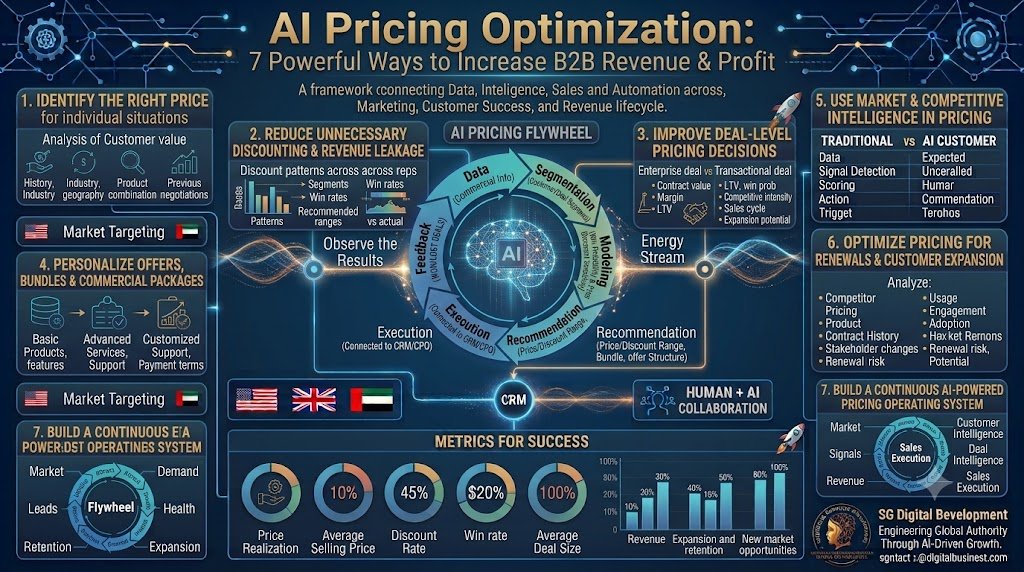
AI Pricing Optimization: 7 Powerful Ways to Increase B2B Revenue & Profit.
AI Pricing Optimization: 7 Powerful Ways to Increase B2B Revenue & Profit. Introduction Pricing is one of the most important decisions a B2B company makes. It influences revenue, margins, customer acquisition, deal velocity, sales performance and long-term profitability. Yet pricing decisions are often still based on a combination of historical prices, spreadsheets, competitor observations, sales experience and manual approval processes. That becomes increasingly difficult as businesses manage more customers, products, services, markets, contracts and sales opportunities. This is where AI pricing optimization can change the way businesses approach commercial decisions. Instead of relying only on static price lists or historical averages, AI can analyze customer behavior, deal characteristics, market conditions, competitive signals, discounts, purchase history and other variables to help businesses make more informed pricing decisions. McKinsey’s 2026 research describes a shift from human-led pricing supported by analytics toward AI-orchestrated pricing systems that can use data, recommendations, workflow automation and human oversight at greater scale. Its survey of more than 400 B2B pricing executives found substantial expected adoption of generative and agentic AI in pricing over the following one to three years. The opportunity is not simply to charge higher prices. The objective is to determine the right commercial price for the right customer, offer, market, situation and moment. That can mean: This article explains 7 powerful ways AI pricing optimization can improve B2B revenue and profitability, how the technology works, where it fits into the revenue lifecycle and how companies can implement it responsibly. What Is AI Pricing Optimization? AI pricing optimization is the use of artificial intelligence, machine learning, customer data, market intelligence and commercial analytics to determine, recommend or improve pricing decisions. Traditional pricing often begins with: Cost + margin + competitor price + management judgment An AI-powered approach can consider a much larger set of variables. These may include: The system can then identify patterns and provide pricing recommendations. For example, an AI system might determine that a particular customer segment consistently accepts a specific price range while another segment requires a different offer structure. It may also identify that certain discounts improve win rates while others simply reduce margin without materially increasing conversion. That distinction is extremely valuable. Why Pricing Optimization Matters in B2B B2B pricing is often complicated. A company may sell: The same product or service may therefore have different commercial economics depending on the customer and context. Consider two deals Deal A Contract value: $100,000Discount: 5%Expected margin: Strong Deal B Contract value: $100,000Discount: 25%Expected margin: Significantly lower Revenue reporting may show similar contract values. Profitability does not. This is why pricing should not be viewed only as a sales conversion mechanism. It is part of the revenue system. McKinsey’s 2026 B2B sales research describes pricing as one of the commercial workflows where AI can connect customer context, historical deal data, recommendations and execution. How AI Pricing Optimization Works A typical AI pricing system combines several layers. 1. Data The system collects relevant commercial information. Examples include: 2. Segmentation AI identifies customer and deal segments. Examples: 3. Modeling Machine learning models identify patterns between pricing variables and commercial outcomes. These may include: 4. Recommendation The system can recommend: 5. Execution Recommendations can be connected to: 6. Feedback Closed deals provide new information. The system learns from: This creates a continuous pricing intelligence loop. 7 Powerful Ways AI Pricing Optimization Can Improve B2B Revenue 1. Identify the Right Price for Each Customer and Deal One of the most important applications of AI pricing optimization is determining a more appropriate price for individual commercial situations. Traditional pricing often starts with a standard price. AI can introduce more context. The system can analyze: This does not necessarily mean every customer receives a different price. Instead, AI can help determine where pricing flexibility may be appropriate. Example Suppose a B2B company has three customer groups: Segment A High valueLow price sensitivityLong contract potential Segment B Medium valueModerate price sensitivityHigh competition Segment C Lower valueHigh price sensitivityShort contracts A single pricing strategy may not maximize commercial performance across all three. AI can identify patterns in historical transactions and help sales teams understand where pricing flexibility creates value and where it simply reduces margin. The result Sales teams can approach negotiations with greater context. Instead of asking: “How much discount should I give?” they can ask: “What commercial structure is appropriate for this customer and opportunity?” That is a much stronger pricing question. 2. Reduce Unnecessary Discounting and Revenue Leakage Discounting is one of the most common sources of pricing leakage in B2B. Sales teams may discount because: Some discounts are commercially justified. Others may not be. AI pricing optimization can analyze historical deals to identify patterns in discount behavior. For example, the system may find that: AI-powered discount guidance An AI system can provide a recommended range. For example: Recommended discount: 5–8% Typical range for similar deals: 4–9% Discount above 12%: Approval required This gives sellers context before they negotiate. The objective is not to eliminate sales judgment. It is to give salespeople better information. McKinsey’s 2026 pricing research specifically identifies discount guidance, deal scoring and pricing workflow support as areas where AI can improve commercial decision-making. 3. Improve Deal-Level Pricing Decisions Not every deal should be evaluated using the same pricing logic. An enterprise opportunity with a large contract and long-term expansion potential is different from a small transactional opportunity. AI can evaluate deal-level variables such as: This creates a deal quality score. Example A sales representative receives an enterprise opportunity. The proposed deal is: $500,000 annual contract20% discountThree-year agreement AI analyzes comparable historical deals and identifies: The system may recommend reconsidering the discount. The salesperson can then enter the negotiation with stronger evidence. Pricing becomes part of deal intelligence This creates a connection between: AI Account Intelligence → AI Sales Pipeline → AI Revenue Intelligence → AI Pricing Optimization The result is a more connected commercial workflow. 4. Personalize Offers, Bundles and Commercial Packages Pricing is not always about the number on the invoice. The