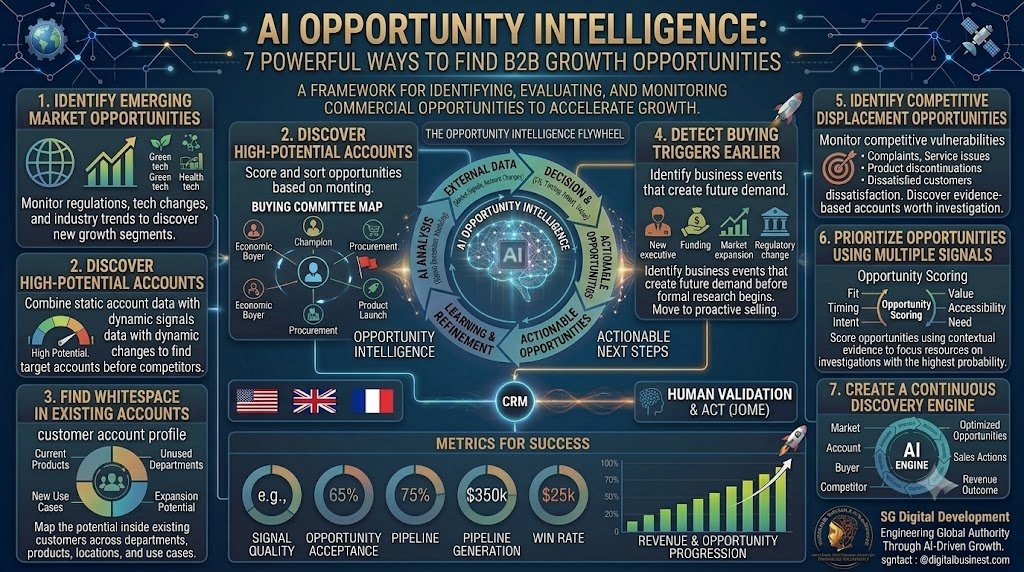
AI Opportunity Intelligence: 7 Powerful Ways to Find B2B Growth Opportunities.
AI Opportunity Intelligence: 7 Powerful Ways to Find B2B Growth Opportunities. Introduction B2B companies rarely have a shortage of possible customers. The challenge is identifying which opportunities matter, why they matter and when the business should act. A company may have thousands of potential accounts. It may have hundreds of leads. It may have dozens of market segments. It may monitor competitors, hiring activity, company news, technology changes, product launches and industry developments. Yet sales teams can still miss valuable opportunities. Why? Because opportunity discovery is often fragmented. Marketing sees one signal. Sales sees another. Business development sees another. Customer success may know about an expansion opportunity that sales has not identified. Market intelligence may identify an emerging segment that has not yet reached the pipeline. The organization has information. But it lacks a connected way to turn information into commercial opportunity. This is where AI opportunity intelligence becomes valuable. AI opportunity intelligence uses artificial intelligence to identify, evaluate, prioritize and monitor potential business opportunities using internal data, external signals, account information, buyer behavior, market intelligence and commercial context. The goal is not simply to generate more leads. The goal is to discover better opportunities earlier. The progression is: Signals → Opportunity Intelligence → Prioritization → Action → Pipeline → Revenue McKinsey’s 2026 B2B research describes opportunity identification and account planning as part of the commercial workflows that can be redesigned around AI. Its research highlights the potential for AI to combine external signals with proprietary data to identify emerging needs, target accounts and opportunities before competitors. This represents an important change in B2B growth. Instead of asking: “How many leads did we generate?” companies can increasingly ask: “Which new commercial opportunities are emerging, and how quickly can we identify and act on them?” This article explores seven powerful AI opportunity intelligence strategies that can help B2B companies identify growth opportunities, uncover whitespace, detect buying triggers and focus sales resources where they can create the most value. What Is AI Opportunity Intelligence? AI opportunity intelligence is the use of artificial intelligence to analyze market, account, buyer, customer and commercial signals to identify potential business opportunities. These opportunities can include: Traditional opportunity discovery often depends on: These sources remain valuable. AI changes how they can be connected. For example, a business might discover: Individually, these signals may not be enough. Together, they may represent an emerging opportunity. AI can help connect the signals. That is the foundation of opportunity intelligence. AI Opportunity Intelligence vs Traditional Lead Generation Lead generation generally focuses on finding people or companies that may fit a target profile. Opportunity intelligence goes further. Lead generation asks: Opportunity intelligence asks: This distinction is important. A database can provide thousands of contacts. But a sales organization may only have capacity to investigate a small number of opportunities. AI opportunity intelligence can help prioritize that limited capacity. The objective is: Fewer low-value investigations → More focused opportunity discovery. Why AI Opportunity Intelligence Matters in 2026 B2B markets are changing quickly. Companies change: Each change can create commercial implications. McKinsey’s 2026 B2B Pulse research, based on nearly 4,000 buyers and sellers across 13 countries, describes a shift toward AI-enabled commercial workflows that connect data, decision logic, human judgment and AI agents across activities including opportunity identification and account planning. The implication is significant. Opportunity discovery does not have to remain a periodic exercise. AI can continuously monitor relevant signals. For example: Monday A company announces a new market expansion. Tuesday It begins hiring for a relevant department. Wednesday Its website launches a new product page. Thursday Several employees begin researching a related category. The organization may now represent a stronger commercial opportunity than it did one week earlier. A traditional database may still show the same account record. AI opportunity intelligence can identify the change. 7 Powerful AI Opportunity Intelligence Strategies 1. Identify Emerging Opportunities From Market Signals Markets continuously generate signals. Examples include: AI can monitor these signals at scale. Instead of manually reviewing thousands of sources, businesses can use AI to identify events that may have commercial relevance. Example A company announces a major expansion into the United States. For a B2B technology provider, that event may create opportunities involving: The announcement itself is not the opportunity. The opportunity is the business need created by the change. That distinction is fundamental. AI opportunity intelligence should therefore connect: Event → Business Change → Potential Need → Commercial Opportunity This is more valuable than simply collecting news. 2. Discover High-Potential Accounts Before Competitors Not every account in an ICP is equally valuable. Traditional account prioritization often uses: These attributes are useful. But opportunity potential can change quickly. AI can combine static account characteristics with dynamic signals. Potential signals include: Example Imagine two accounts. Account A Account B Account B may represent the more interesting opportunity at this moment. AI opportunity intelligence can help surface that difference. The objective is not to predict the future perfectly. It is to identify where new evidence suggests that sales attention may be worthwhile. 3. Find Whitespace Opportunities Inside Existing Accounts Opportunity intelligence is not only about finding new customers. Existing customers can contain substantial untapped potential. Whitespace can exist across: For example, a company may already purchase one service. But AI identifies: This may indicate expansion potential. Account whitespace model Existing customer ↓ Current products ↓ Unused departments ↓ Unused use cases ↓ New business needs ↓ Expansion opportunity This connects AI opportunity intelligence with: The commercial advantage is that the business already has a relationship. The opportunity is to understand where additional value may exist. 4. Detect Buying Triggers Earlier Some opportunities become visible only after the buyer begins actively researching. Others can be identified earlier through business changes. Potential buying triggers include: These events can create a need before a prospect ever submits a form. Example A company hires a new Chief Revenue Officer. That executive may begin reviewing: The hiring event does not prove a purchase is coming. But it may justify