AI Growth Engine

Strategic insights on how Artificial Intelligence is transforming ad performance and digital ROI.

AI sales coaching
AI Growth Engine

AI Sales Coaching: 7 Powerful Ways to Improve B2B Sales Performance.

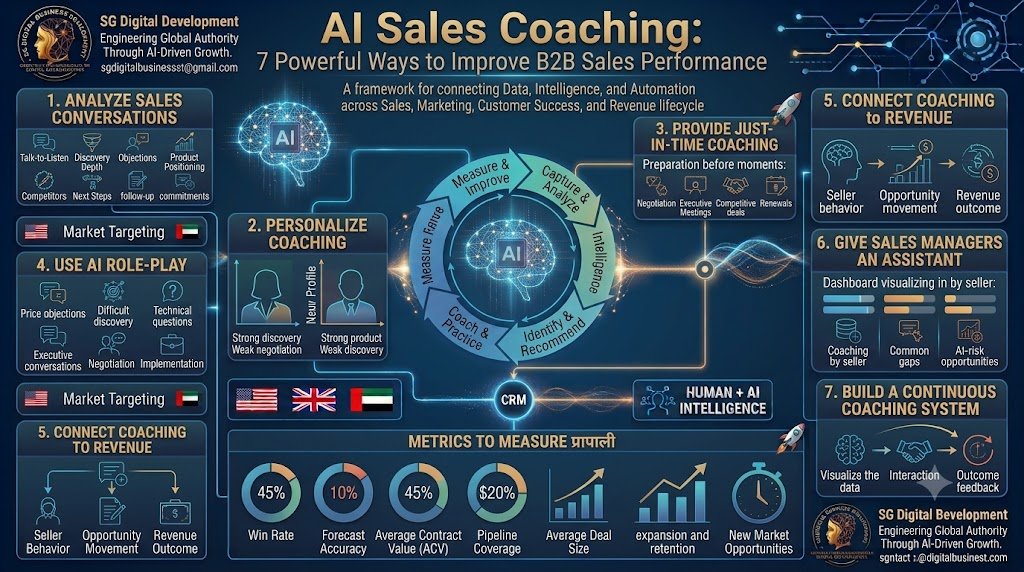
AI Sales Coaching: 7 Powerful Ways to Improve B2B Sales Performance. Introduction Sales performance depends on more than having a good product, a large pipeline or a sophisticated CRM. It depends on what salespeople actually do during customer interactions. How effectively do they discover customer needs? How well do they communicate value? How confidently do they handle objections? Do they ask the right questions? Do they involve the right stakeholders? Do they follow up consistently? Do they know when to advance an opportunity and when to slow down? Traditionally, sales managers have been responsible for helping sellers improve these skills. But traditional coaching has a major limitation: managers cannot observe every customer interaction. A manager may listen to a handful of calls, review pipeline reports and conduct periodic one-to-one meetings. That creates only a partial view of seller performance. AI sales coaching changes this model. AI can analyze sales interactions, identify patterns, surface potential skill gaps, provide personalized recommendations and help managers focus their coaching time where it can have the greatest impact. The result is a shift from occasional coaching to a more continuous sales improvement system. McKinsey’s 2026 B2B research describes this transition directly: AI can analyze customer interactions and performance data, identify coaching opportunities and provide targeted guidance, allowing managers to spend less time diagnosing performance and more time on high-impact coaching. This does not mean replacing sales managers. In fact, the strongest model is the opposite. AI handles more of the observation, analysis and pattern recognition. Managers spend more time on judgment, motivation, deal strategy, relationship development and personalized coaching. This article explores 7 powerful AI sales coaching strategies B2B companies can use to improve seller capability, create more consistent execution and build a stronger revenue organization. What Is AI Sales Coaching? AI sales coaching is the use of artificial intelligence to analyze sales activity, customer interactions, seller behavior and revenue outcomes in order to provide personalized coaching insights and recommendations. Traditional sales coaching often depends on: These approaches remain valuable. However, they can be limited by time and scale. A sales manager may oversee 8, 10, 15 or even more sellers. It is difficult to personally observe every conversation. AI can expand the manager’s visibility. Depending on the systems and data available, AI can analyze: AI can then help identify patterns. For example: A seller may be strong at discovery but weak at closing. Another may explain products well but struggle with objections. Another may create strong initial engagement but fail to follow up consistently. Another may spend too much time presenting before understanding customer requirements. Instead of providing the same training to everyone, AI sales coaching can help identify where individual improvement may matter most. Why AI Sales Coaching Matters in B2B B2B sales environments are becoming more complex. Salespeople increasingly need to manage: At the same time, sales managers have limited time. They need to: This creates a coaching capacity problem. AI can help by making performance information easier to analyze. Salesforce describes AI-guided selling as a way to surface relevant actions, accounts and information while reducing manual effort. The broader opportunity is to connect those insights to coaching. Instead of asking: “How is this seller performing?” a manager can increasingly ask: “What specific behavior is affecting this seller’s results, and what coaching intervention should happen next?” That is a much more actionable question. AI Sales Coaching vs Traditional Sales Coaching Traditional coaching is usually periodic. A manager might conduct: AI can make coaching more continuous. Traditional model Observe → Review → Discuss → Train AI-supported model Capture → Analyze → Identify → Recommend → Coach → Measure → Improve This does not make traditional coaching obsolete. Instead, AI can make the traditional process more informed. Managers can enter coaching conversations with evidence rather than relying only on memory. For example: Instead of saying: “You need to improve your discovery calls.” A manager could say: “Across your recent conversations, customers frequently discuss business impact before you ask about measurable outcomes. Let’s work on changing the order of your discovery questions.” That is more specific. And specificity makes coaching more actionable. 7 Powerful AI Sales Coaching Strategies 1. Analyze Sales Conversations to Identify Skill Gaps One of the most powerful applications of AI sales coaching is conversation analysis. AI can analyze customer interactions and identify patterns across large numbers of calls. Depending on the system, analysis may include: The goal is not to score sellers for the sake of scoring them. The goal is to identify behaviors that may influence outcomes. For example, suppose a sales organization discovers that successful discovery calls frequently contain: AI can identify whether those behaviors appear consistently across the sales team. Managers can then coach sellers on specific gaps. From opinion to evidence Without AI, a manager might remember one difficult sales call and conclude that a seller needs improvement. With AI, the manager can analyze a broader sample of interactions. That creates a stronger evidence base. McKinsey’s research describes this as one of the emerging AI coaching opportunities: AI can evaluate customer interactions against sales-skill and product-knowledge models and surface coaching opportunities at both individual and organizational levels. The result is a more systematic coaching process. 2. Personalize Coaching for Every Seller Not every salesperson needs the same coaching. This sounds obvious, but many organizations still use generalized training. For example, the entire sales team might receive a workshop on: “How to Handle Customer Objections.” But individual sellers may have very different challenges. Seller A: Seller B: Seller C: Seller D: A generalized training session may help everyone slightly. Personalized coaching can focus on the specific behavior most relevant to each seller. AI can help managers identify these differences. Personalized coaching example Seller: Account Executive Observed strength: Customer discovery Potential development area: Commercial negotiation Observed pattern: Pricing discussions introduced early in several opportunities Coaching recommendation: Practice value-based negotiation before discussing discounts. Suggested exercise: Simulate three pricing objections. This is more useful than giving the seller another generic
AI sales productivity
AI Growth Engine

AI Sales Productivity: 7 Powerful Ways to Increase B2B Seller Performance.

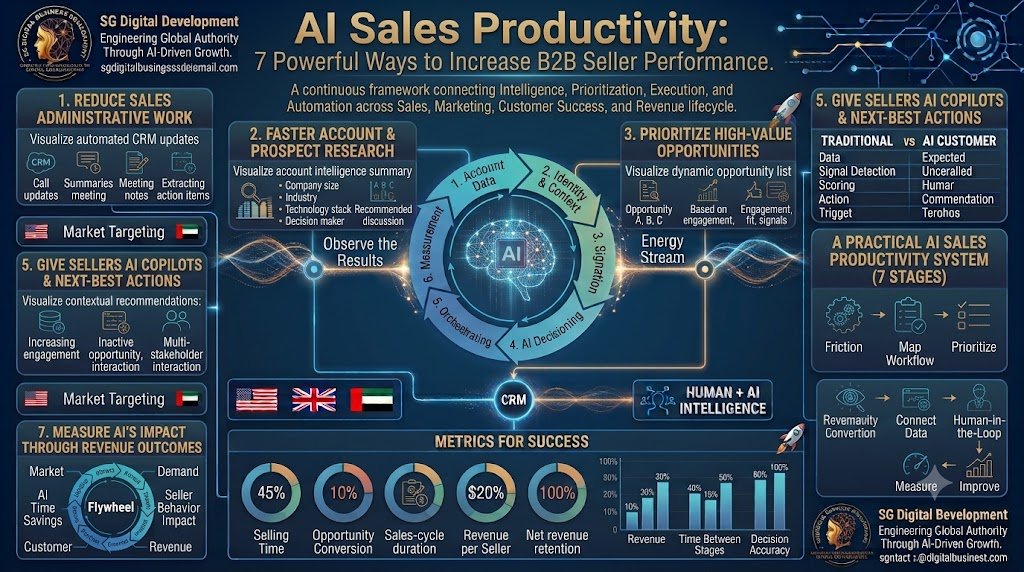
AI Sales Productivity: 7 Powerful Ways to Increase B2B Seller Performanc. Introduction B2B sales teams are under constant pressure to generate more pipeline, manage more opportunities, personalize more interactions and close revenue faster. Yet many sellers still spend a significant amount of their working day on activities that do not directly create customer value. They research accounts manually. They update CRM records. They prepare for meetings. They search for information across multiple systems. They write follow-up emails. They summarize conversations. They build reports. They look for buying signals. They decide which opportunity deserves attention next. They move information between disconnected tools. This creates a productivity problem. The challenge is not necessarily that salespeople are unwilling to work harder. The challenge is that too much of their capacity can be consumed by administrative work, fragmented information and repetitive processes. That is where AI sales productivity becomes increasingly important. AI can help sales teams research prospects faster, summarize account information, prioritize opportunities, prepare for meetings, generate personalized communication, identify next-best actions and automate repetitive workflows. But the goal should not simply be to make sellers perform more activities. The real goal is to help sellers spend more time on the activities that require human judgment, relationship building, commercial thinking and customer conversations. Recent 2026 sales research reflects this shift. Salesforce reports that sales organizations are increasingly using AI and agents to reduce administrative friction, prospect more efficiently and give sellers more productive time. McKinsey similarly describes a move toward AI-enabled commercial workflows in which AI handles more searching, synthesizing, drafting and administrative work while sellers focus on relationship building, problem solving and judgment. This article explains 7 powerful AI sales productivity strategies B2B companies can use to increase seller capacity, improve sales execution and create a more efficient revenue engine. What Is AI Sales Productivity? AI sales productivity is the use of artificial intelligence to help sales professionals spend more time on high-value selling activities while reducing repetitive, manual and administrative work. Traditional sales productivity often focuses on questions such as: These metrics can be useful, but they do not tell the entire story. A salesperson can complete hundreds of activities without creating meaningful revenue progress. AI changes the productivity conversation. Instead of measuring productivity only by activity volume, businesses can increasingly measure whether AI helps sellers: This creates an important distinction. Sales activity is not the same as sales productivity. A productive seller is not necessarily the person doing the most tasks. A productive seller is the person using their available time and information effectively to create meaningful commercial outcomes. Why AI Sales Productivity Matters in B2B Sales B2B selling has become increasingly complex. A typical enterprise opportunity may involve: Salespeople therefore need more information while having limited time to process it. AI can help reduce this information burden. For example, an AI system can combine: The seller does not necessarily need to read every piece of information individually. AI can organize the information and surface what matters. This is one of the most important principles behind AI sales productivity: AI should reduce the amount of work required to reach a high-quality sales decision. The objective is not to remove the salesperson. It is to increase the salesperson’s capacity. AI Sales Productivity vs AI Sales Automation These concepts are closely related but different. AI sales automation focuses primarily on automating sales processes. Examples include: AI sales productivity focuses on improving the effectiveness of the salesperson. Examples include: Automation asks: What work can be automated? Productivity asks: How can the salesperson spend more time doing valuable work? The two should work together. A company may automate a repetitive workflow while simultaneously giving the salesperson better intelligence to make the next decision. That combination is much more powerful than automation alone. AI Sales Productivity vs AI Sales Performance Management AI sales performance management is focused on measuring and improving seller performance. It may include: AI sales productivity has a different primary objective. It asks: How can we increase the amount of valuable selling capacity available to each seller? For example: If a seller spends two hours researching an account manually, AI may reduce that research workload significantly. If a seller spends hours preparing meeting notes, AI can summarize the relevant account context. If a seller struggles to identify which opportunity deserves attention, AI can prioritize opportunities using available signals. The result is not necessarily more activity. The result is more productive capacity. 7 Powerful AI Sales Productivity Strategies 1. Use AI to Reduce Sales Administrative Work One of the biggest opportunities for AI sales productivity is reducing repetitive administrative work. Salespeople often have to: Individually, these tasks may seem small. Collectively, they can consume substantial amounts of selling capacity. AI can assist by automatically summarizing conversations, extracting action items, preparing CRM updates and organizing sales information. For example, after a customer meeting, an AI system could identify: Customer priorities Commercial signals Next steps The salesperson can then review the information instead of rebuilding it manually. This creates a human-in-the-loop workflow. AI prepares the information. The salesperson verifies it. The CRM receives the structured information. The seller returns to customer-facing work. Why this matters Administrative automation is not valuable merely because it saves minutes. Its real value comes from returning attention to revenue-producing activities. That may include: The productivity principle is simple: Remove low-value friction so sellers can spend more time on high-value decisions. 2. Use AI for Faster Account and Prospect Research Research is essential to B2B sales. However, manual research can consume substantial time. A seller preparing for a prospect may need to understand: AI can accelerate this process by bringing multiple signals together. Instead of beginning with a blank screen, the salesperson can receive an account intelligence summary. For example: Account Overview Company: Example Enterprise Industry: B2B SaaS Growth signal: Expanding into North America Potential challenge: Increasing customer acquisition costs Technology signal: Recently expanded marketing technology stack Decision-maker role: Chief Revenue Officer Potential opportunity: Revenue optimization and AI-powered demand generation

AI sales performance management
AI Growth Engine

AI Sales Performance Management: 7 Powerful Ways to Improve B2B Sales Productivity.

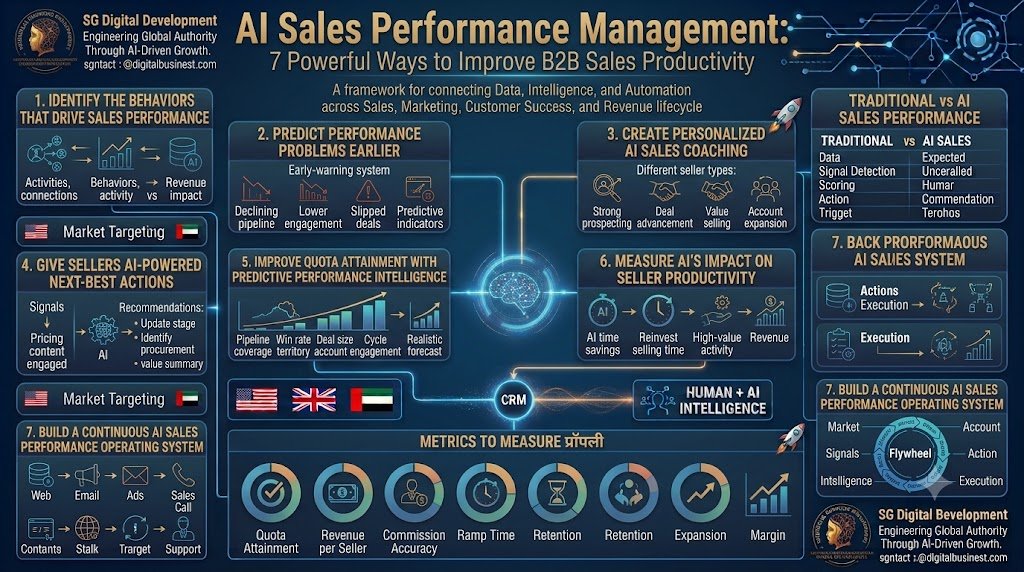
AI Sales Performance Management: 7 Powerful Ways to Improve B2B Sales Productivity. Introduction Sales performance management has traditionally focused on a relatively simple set of questions: Are salespeople hitting quota? Are deals closing? Which representatives are performing well? Which representatives are falling behind? But modern B2B sales organizations are becoming much more complex. Sales teams now work across multiple channels, customer segments, territories, products and buying groups. AI is also changing how sellers research accounts, prioritize opportunities, prepare for meetings, create sales content and manage follow-up. That creates a new challenge. Companies can no longer improve sales performance simply by measuring more activity. They need to understand which activities, behaviors and decisions actually create revenue outcomes. This is where AI sales performance management becomes important. AI sales performance management combines artificial intelligence, sales data, CRM information, predictive analytics, performance intelligence and automated coaching to help organizations understand and improve seller performance. Instead of only asking whether a salesperson achieved quota, companies can investigate: Gartner’s 2026 research argues that traditional sales productivity measurements can miss the behaviors that actually drive seller performance and highlights AI-driven measures such as account reach, account engagement and average interaction value. The shift is significant. Sales performance management is moving from reporting what happened toward understanding what is happening, why it is happening and what should happen next. This article explores seven powerful ways AI can help B2B companies improve sales productivity, coaching, quota attainment, forecasting and revenue performance. What Is AI Sales Performance Management? AI sales performance management is the use of artificial intelligence, predictive analytics, sales intelligence and automation to measure, understand and improve sales-team performance. Traditional sales performance management often depends on: These metrics remain useful. The limitation is that many of them are lagging indicators. For example, if a salesperson misses quota at the end of a quarter, management knows there was a performance problem. But the more useful question is: When did the problem begin? Perhaps the salesperson: AI can analyze these patterns earlier. That creates the foundation for a more proactive performance-management system. Why AI Sales Performance Management Matters in 2026 The role of the salesperson is changing. AI can increasingly support: Gartner reported in May 2026 that AI saves sellers an average of 4.8 hours per week, but 72% of surveyed sales organizations reported low reinvestment of those time savings into high-value activities. This creates what Gartner describes as a sales productivity gap. Saving time is not the same thing as increasing revenue productivity. If AI saves three hours but those hours are not redirected toward valuable customer-facing work, the business may not see meaningful commercial improvement. Therefore, companies need a system for measuring: AI Efficiency → Seller Capacity → Seller Behavior → Customer Impact → Revenue That is a major role for AI sales performance management. AI Sales Performance Management vs Traditional Performance Management Traditional systems often emphasize historical performance. AI-powered systems can combine historical, behavioral and predictive information. Traditional Sales Performance AI-Powered Sales Performance Quota attainment Predictive quota performance Activity volume Activity quality and impact Historical reports Real-time performance intelligence Manual coaching AI-assisted coaching Periodic reviews Continuous performance monitoring Lagging indicators Leading + lagging indicators Generic sales guidance Personalized recommendations Manual opportunity reviews AI-powered opportunity analysis Static dashboards Dynamic performance insights Manager intuition Data-supported decision making The objective is not to replace sales managers. Instead, AI gives managers more context. A manager can spend less time collecting information and more time helping sellers improve. 7 Powerful Ways to Use AI Sales Performance Management 1. Identify the Behaviors That Actually Drive Sales Performance One of the biggest problems with traditional sales performance measurement is confusing activity with productivity. A salesperson may make 100 calls. Another salesperson may make 40 calls. The first seller appears more active. But what if the second seller generates significantly more qualified opportunities? Activity volume alone does not explain performance. AI sales performance management can analyze relationships between seller behaviors and commercial outcomes. It can examine: This helps identify which activities actually matter. Moving Beyond Activity Metrics Instead of asking: How many calls did the salesperson make? A modern system can ask: Which seller behaviors increased the probability of advancing opportunities? That is a much more useful question. Gartner’s 2026 research recommends looking at metrics such as account reach, account engagement and average interaction value to understand the value of seller interactions rather than relying solely on traditional activity measures. This creates a stronger performance-management model. 2. Use AI to Predict Performance Problems Earlier Traditional performance management often reacts after performance has already declined. AI can help identify risk earlier. For example, an AI model may detect that a seller is showing: Individually, these signals may not look serious. Together, they can indicate a potential performance problem. AI sales performance management can identify these patterns before they become visible in quarterly results. Example Suppose a salesperson has historically created $500,000 of qualified pipeline each month. During the current month: The salesperson has not yet missed quota. A traditional system may show normal performance. An AI system may flag the emerging risk. That allows the manager to intervene earlier. 3. Create Personalized AI Sales Coaching Sales coaching is one of the most important responsibilities of frontline sales managers. But managers often have limited time. They may manage: AI can help managers prioritize coaching. Instead of giving every seller generic advice, AI can identify specific development opportunities. For example: Seller A Strong prospecting but weak opportunity progression. Coaching focus: Discovery and deal advancement. Seller B Strong closing performance but excessive discounting. Coaching focus: Value selling and negotiation. Seller C Strong existing-account relationships but low expansion. Coaching focus: Cross-sell and expansion discovery. Seller D High activity but weak conversion. Coaching focus: Account prioritization and qualification. This creates personalized coaching. Salesforce’s sales-performance guidance also emphasizes AI-powered coaching and personalized resources connected to seller workflows and performance data. 4. Give Sellers AI-Powered Next-Best Actions Knowing that a seller is underperforming is useful. Knowing what the seller should do

AI sales compensation
AI Growth Engine

AI Sales Compensation: 7 Powerful Ways to Optimize B2B Sales Incentives.

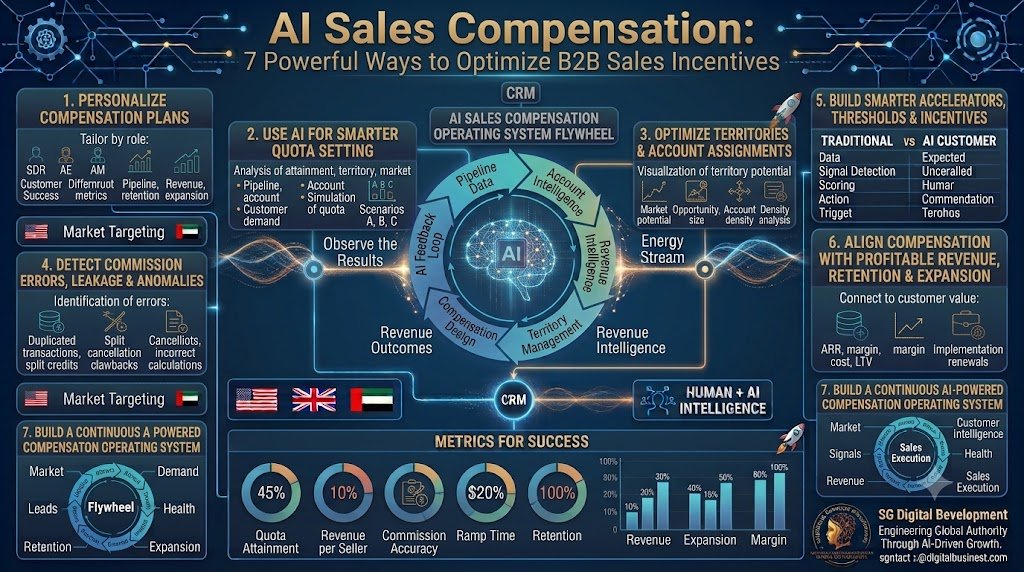
AI Sales Compensation: 7 Powerful Ways to Optimize B2B Sales Incentives Introduction Sales compensation has always been one of the strongest levers for influencing seller behavior. What sales teams are rewarded for often determines what they prioritize. If compensation rewards revenue volume, sellers naturally focus on closing revenue. If it rewards new logos, acquisition becomes the priority. If it rewards expansion, account growth becomes more important. If it rewards profitable revenue and retention, sales behavior can shift toward higher-quality deals and longer-term customer value. The challenge is that modern B2B sales environments have become much more complicated. Sales teams now operate across multiple customer segments, territories, products, channels and buying groups. AI is also changing how sellers prospect, research accounts, create content, qualify opportunities and manage customer interactions. That creates a new question: How should companies design sales compensation when AI is changing the way sales work gets done? This is where AI sales compensation becomes strategically important. Instead of treating compensation as a fixed annual spreadsheet exercise, companies can use AI, sales data, CRM information, revenue intelligence and predictive analytics to continuously understand whether compensation plans are producing the desired business outcomes. Modern sales performance management increasingly connects compensation with territories, quotas, scenario planning, seller behavior, forecasting, analytics and governance. Gartner’s 2026 research describes sales performance management as covering areas including territory and quota planning, incentive compensation, risk modeling, seller analytics and performance intelligence. This means compensation is no longer simply about calculating commissions. It is becoming part of the broader AI-powered revenue operating system. In this guide, we will explore seven powerful ways companies can use AI sales compensation to improve incentive design, quota planning, sales performance, profitability and revenue growth. What Is AI Sales Compensation? AI sales compensation is the use of artificial intelligence, predictive analytics, sales data and automation to design, manage, analyze and optimize compensation plans for sales teams. Traditional compensation management usually relies on historical performance data, spreadsheets, predefined formulas and periodic management reviews. AI-powered compensation can go further. It can analyze: The objective is not simply to pay commissions faster. The objective is to understand whether the compensation structure is encouraging the right revenue-producing behaviors. For example, an AI model may identify that a sales team is consistently receiving strong compensation for low-margin deals while higher-value expansion opportunities receive comparatively little incentive. Management can then investigate whether the compensation structure is unintentionally influencing seller behavior. That is the strategic opportunity behind AI sales compensation. Why AI Sales Compensation Matters in 2026 Sales compensation is becoming more complex because the sales environment itself is changing. AI is already being incorporated into prospecting, account research, content creation, forecasting and seller workflows. Salesforce’s 2026 State of Sales research reports that sales teams increasingly view AI and AI agents as major growth tools. At the same time, compensation teams are beginning to incorporate AI into planning and decision-making. CaptivateIQ’s 2026 incentive compensation research reports that more than eight in ten organizations surveyed are using AI in some capacity, while only a smaller proportion report extensive use. The report also highlights AI’s growing role in plan design, quota setting and compensation strategy. This creates an important distinction. AI should not simply make compensation administration faster. It should help companies make better compensation decisions. For example: A traditional approach may ask: How much commission did each salesperson earn last quarter? An AI-driven approach can ask: Which compensation structures are producing the most profitable and sustainable revenue, for which sellers, territories, customer segments and sales motions? That is a much more strategic question. AI Sales Compensation vs Traditional Sales Compensation Traditional compensation management generally follows a periodic cycle: AI sales compensation can make this process more dynamic. Instead of relying exclusively on historical averages, AI can analyze multiple signals simultaneously. Traditional Approach AI-Powered Approach Historical performance Predictive performance modeling Static quotas Dynamic quota analysis Manual territory planning Data-driven territory optimization Spreadsheet calculations Automated calculations Periodic reviews Continuous monitoring Basic commission reporting Performance intelligence Revenue-focused incentives Revenue + profitability + retention Manual anomaly detection AI-powered risk detection Annual plan changes Scenario-based plan modeling Limited seller visibility Real-time compensation insights The goal is not to remove human judgment. Instead, AI can give sales operations, finance and sales leadership better information for making compensation decisions. 7 Powerful Ways to Use AI Sales Compensation 1. Personalize Compensation Plans by Role, Segment and Sales Motion One of the biggest weaknesses of traditional compensation planning is assuming that one structure can work equally well across every sales role. It usually cannot. An SDR, account executive, account manager, enterprise seller and customer expansion representative may have very different responsibilities. Their sales cycles can also vary dramatically. For example: Giving every role the same compensation logic can create unintended incentives. AI sales compensation can analyze performance patterns across different roles and segments. AI can help identify: This allows companies to design more role-specific compensation plans. Example Suppose an enterprise sales team sells contracts with long sales cycles. Paying the majority of variable compensation immediately on early-stage pipeline creation may encourage volume rather than quality. An AI-supported analysis could reveal that closed revenue, customer retention and expansion are stronger indicators of long-term account value. Management could then redesign the plan around those outcomes. The important point is that AI is helping identify the relationship between incentives and business results. 2. Use AI for Smarter Quota Setting Quota planning is one of the most important parts of sales compensation. If quotas are unrealistic, sellers can become disengaged. If quotas are too low, companies may underutilize their revenue capacity. Gartner’s 2026 research specifically highlights quota allocation quality as an important sales performance issue. Poor quota design can increase sales costs and damage seller motivation, while attainment distributions can help organizations evaluate whether quota allocation is working effectively. AI can make quota planning more data-driven. Instead of using only last year’s revenue, AI can analyze: This creates a more comprehensive picture of expected sales capacity. AI Quota Scenario Modeling AI can

AI pricing optimization
AI Growth Engine

AI Pricing Optimization: 7 Powerful Ways to Increase B2B Revenue & Profit.

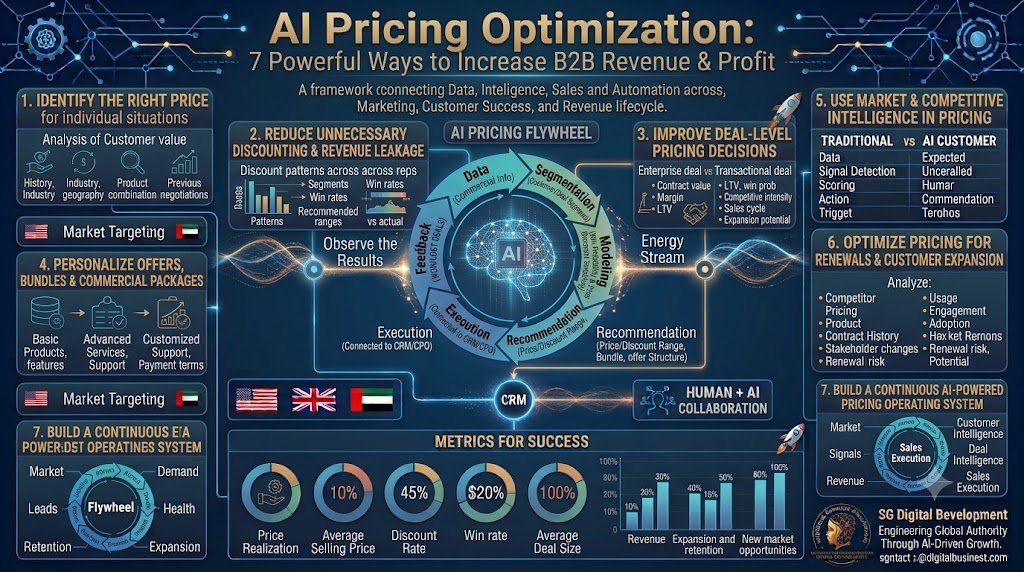
AI Pricing Optimization: 7 Powerful Ways to Increase B2B Revenue & Profit. Introduction Pricing is one of the most important decisions a B2B company makes. It influences revenue, margins, customer acquisition, deal velocity, sales performance and long-term profitability. Yet pricing decisions are often still based on a combination of historical prices, spreadsheets, competitor observations, sales experience and manual approval processes. That becomes increasingly difficult as businesses manage more customers, products, services, markets, contracts and sales opportunities. This is where AI pricing optimization can change the way businesses approach commercial decisions. Instead of relying only on static price lists or historical averages, AI can analyze customer behavior, deal characteristics, market conditions, competitive signals, discounts, purchase history and other variables to help businesses make more informed pricing decisions. McKinsey’s 2026 research describes a shift from human-led pricing supported by analytics toward AI-orchestrated pricing systems that can use data, recommendations, workflow automation and human oversight at greater scale. Its survey of more than 400 B2B pricing executives found substantial expected adoption of generative and agentic AI in pricing over the following one to three years. The opportunity is not simply to charge higher prices. The objective is to determine the right commercial price for the right customer, offer, market, situation and moment. That can mean: This article explains 7 powerful ways AI pricing optimization can improve B2B revenue and profitability, how the technology works, where it fits into the revenue lifecycle and how companies can implement it responsibly. What Is AI Pricing Optimization? AI pricing optimization is the use of artificial intelligence, machine learning, customer data, market intelligence and commercial analytics to determine, recommend or improve pricing decisions. Traditional pricing often begins with: Cost + margin + competitor price + management judgment An AI-powered approach can consider a much larger set of variables. These may include: The system can then identify patterns and provide pricing recommendations. For example, an AI system might determine that a particular customer segment consistently accepts a specific price range while another segment requires a different offer structure. It may also identify that certain discounts improve win rates while others simply reduce margin without materially increasing conversion. That distinction is extremely valuable. Why Pricing Optimization Matters in B2B B2B pricing is often complicated. A company may sell: The same product or service may therefore have different commercial economics depending on the customer and context. Consider two deals Deal A Contract value: $100,000Discount: 5%Expected margin: Strong Deal B Contract value: $100,000Discount: 25%Expected margin: Significantly lower Revenue reporting may show similar contract values. Profitability does not. This is why pricing should not be viewed only as a sales conversion mechanism. It is part of the revenue system. McKinsey’s 2026 B2B sales research describes pricing as one of the commercial workflows where AI can connect customer context, historical deal data, recommendations and execution. How AI Pricing Optimization Works A typical AI pricing system combines several layers. 1. Data The system collects relevant commercial information. Examples include: 2. Segmentation AI identifies customer and deal segments. Examples: 3. Modeling Machine learning models identify patterns between pricing variables and commercial outcomes. These may include: 4. Recommendation The system can recommend: 5. Execution Recommendations can be connected to: 6. Feedback Closed deals provide new information. The system learns from: This creates a continuous pricing intelligence loop. 7 Powerful Ways AI Pricing Optimization Can Improve B2B Revenue 1. Identify the Right Price for Each Customer and Deal One of the most important applications of AI pricing optimization is determining a more appropriate price for individual commercial situations. Traditional pricing often starts with a standard price. AI can introduce more context. The system can analyze: This does not necessarily mean every customer receives a different price. Instead, AI can help determine where pricing flexibility may be appropriate. Example Suppose a B2B company has three customer groups: Segment A High valueLow price sensitivityLong contract potential Segment B Medium valueModerate price sensitivityHigh competition Segment C Lower valueHigh price sensitivityShort contracts A single pricing strategy may not maximize commercial performance across all three. AI can identify patterns in historical transactions and help sales teams understand where pricing flexibility creates value and where it simply reduces margin. The result Sales teams can approach negotiations with greater context. Instead of asking: “How much discount should I give?” they can ask: “What commercial structure is appropriate for this customer and opportunity?” That is a much stronger pricing question. 2. Reduce Unnecessary Discounting and Revenue Leakage Discounting is one of the most common sources of pricing leakage in B2B. Sales teams may discount because: Some discounts are commercially justified. Others may not be. AI pricing optimization can analyze historical deals to identify patterns in discount behavior. For example, the system may find that: AI-powered discount guidance An AI system can provide a recommended range. For example: Recommended discount: 5–8% Typical range for similar deals: 4–9% Discount above 12%: Approval required This gives sellers context before they negotiate. The objective is not to eliminate sales judgment. It is to give salespeople better information. McKinsey’s 2026 pricing research specifically identifies discount guidance, deal scoring and pricing workflow support as areas where AI can improve commercial decision-making. 3. Improve Deal-Level Pricing Decisions Not every deal should be evaluated using the same pricing logic. An enterprise opportunity with a large contract and long-term expansion potential is different from a small transactional opportunity. AI can evaluate deal-level variables such as: This creates a deal quality score. Example A sales representative receives an enterprise opportunity. The proposed deal is: $500,000 annual contract20% discountThree-year agreement AI analyzes comparable historical deals and identifies: The system may recommend reconsidering the discount. The salesperson can then enter the negotiation with stronger evidence. Pricing becomes part of deal intelligence This creates a connection between: AI Account Intelligence → AI Sales Pipeline → AI Revenue Intelligence → AI Pricing Optimization The result is a more connected commercial workflow. 4. Personalize Offers, Bundles and Commercial Packages Pricing is not always about the number on the invoice. The

AI revenue attribution
AI Growth Engine

AI Revenue Attribution: 7 Powerful Ways to Connect Marketing, Sales & Revenue.

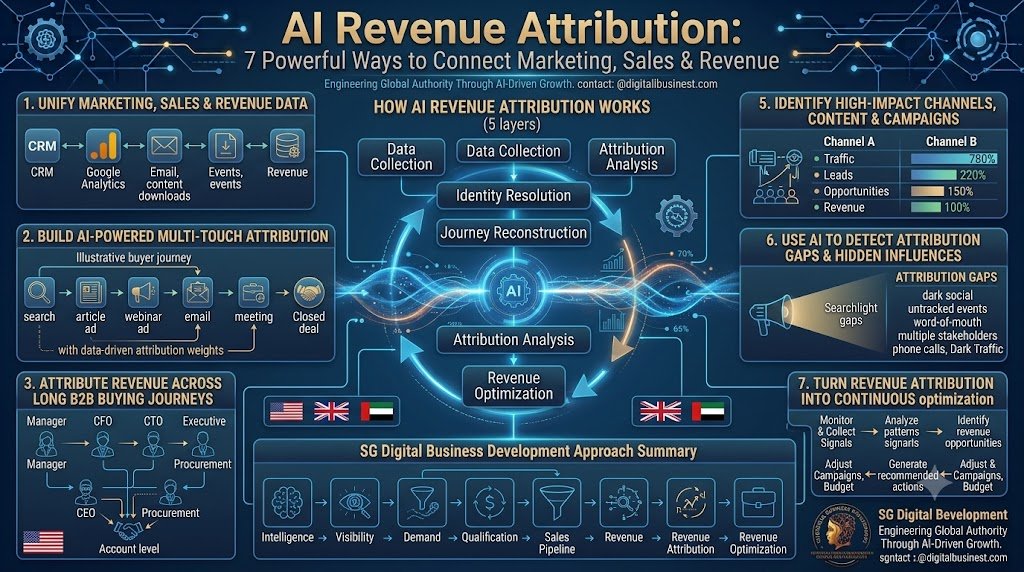
AI Revenue Attribution: 7 Powerful Ways to Connect Marketing, Sales & Revenue. Introduction B2B companies generate revenue through journeys that rarely follow a straight line. A prospect may discover a company through Google, encounter its content in AI search, click a LinkedIn post, return through an email, attend a webinar, speak with a salesperson, revisit the website several times and eventually become a customer. Then another question appears: Which of those activities actually contributed to the revenue? That is where AI revenue attribution becomes increasingly important. Traditional reporting often separates marketing performance, sales performance, customer activity and revenue data into different systems. Marketing may report leads and campaign conversions. Sales may report opportunities and closed deals. Customer success may report renewals and expansion. Finance ultimately reports revenue. The problem is that revenue does not happen inside one department. It happens across the customer journey. Modern attribution systems attempt to connect those interactions to business outcomes. HubSpot, for example, now provides attribution reporting across contacts, deals and revenue, while Google Analytics provides data-driven attribution that uses machine learning to evaluate how different interactions influence key events. For B2B organizations, the challenge is even greater because buying journeys can involve multiple people, channels, campaigns and offline interactions. Gartner’s 2026 research highlights the complexity directly: B2B organizations struggle to demonstrate marketing ROI across complex, multichannel buying journeys, while multitouch attribution tools are increasingly being used to address that problem. AI can help businesses move from basic attribution reporting toward a more connected revenue intelligence system. Instead of asking only: “Which channel generated the lead?” companies can begin asking: This article explains 7 powerful ways AI revenue attribution can connect marketing, sales and revenue, and how businesses can build a more reliable attribution system without treating attribution as perfect or absolute truth. What Is AI Revenue Attribution? AI revenue attribution is the use of artificial intelligence, machine learning, customer data and attribution models to understand how marketing, sales and customer interactions contribute to revenue outcomes. Traditional attribution assigns credit to touchpoints according to predefined rules. AI can make the system more adaptive. Instead of relying exclusively on a fixed model, an AI-powered system can analyze large amounts of customer journey data to identify patterns across: The goal is not simply to give every touchpoint a number. The goal is to understand the relationship between customer interactions and business outcomes. Google describes attribution models as rules or algorithms used to assign credit to interactions along the path toward an important action. Its data-driven attribution uses machine learning to compare converting and non-converting paths and estimate the contribution of interactions. In B2B, however, revenue attribution requires an even broader perspective. A single person rarely represents the entire buying journey. An account might have: The revenue event happens at the account level, while the interactions occur across multiple people. That makes AI revenue attribution particularly useful for organizations selling complex B2B products and services. Why Traditional Attribution Often Falls Short Attribution has existed for years. Businesses have used first-touch, last-touch, linear, time-decay and other models to distribute credit. The problem is not that these models are useless. The problem is that no single model can perfectly explain every B2B buying journey. HubSpot currently supports multiple attribution models, including first touch, last touch, linear, time decay and empirical attribution. Each model answers a slightly different question. First-touch attribution First-touch attribution gives credit to the first tracked interaction. It can help answer: Where did this customer initially discover us? But it may ignore everything that happened afterward. Last-touch attribution Last-touch attribution gives credit to the interaction closest to conversion. It can help answer: What happened immediately before conversion? But the final interaction may not explain the entire journey. Linear attribution Linear attribution distributes credit across multiple interactions. This provides a broader view but assumes each interaction deserves equal weight. Time-decay attribution Time-decay models give more credit to interactions closer to conversion. This can be useful when recent interactions are especially relevant. Data-driven attribution Data-driven models use observed data and machine learning to estimate contribution. Google’s current data-driven attribution methodology evaluates converting and non-converting paths and uses algorithmic calculations to distribute credit. The important point is simple: Attribution is a measurement framework, not an objective record of causality. That distinction matters. A touchpoint receiving 30% attribution does not necessarily mean it caused exactly 30% of the revenue. Instead, the number represents the logic of the selected attribution methodology. That is why advanced B2B organizations increasingly need attribution and experimentation. Gartner’s 2026 research specifically recommends combining attribution and testing to improve marketing measurement. How AI Revenue Attribution Works A modern AI revenue attribution system generally connects five layers. 1. Data collection The system collects customer and business interaction data. Examples include: 2. Identity resolution The system attempts to connect interactions to: This is especially important in B2B. 3. Journey reconstruction AI can organize interactions into customer or account journeys. For example: Search → Website → Content → Webinar → Sales Meeting → Opportunity → Proposal → Closed Won 4. Attribution analysis The system applies an attribution methodology to estimate contribution. This can include: 5. Revenue optimization The final step is turning measurement into action. Instead of simply reporting: Campaign A influenced $500,000 the business can ask: What should we do differently because Campaign A appears to influence revenue? That is where AI can turn attribution into an operating system for growth. 7 Powerful Ways AI Revenue Attribution Can Improve B2B Growth 1. Unify Marketing, Sales & Revenue Data One of the biggest problems in B2B measurement is fragmentation. Marketing data may exist in an advertising platform. Website data may exist in analytics. Sales activity may exist in a CRM. Customer information may exist in another platform. Revenue data may sit with finance. When these systems are disconnected, attribution becomes incomplete. AI revenue attribution starts by creating a connected data foundation. The system should ideally connect: Marketing → Engagement → Lead → Account → Opportunity → Customer → Revenue This allows

AI revenue enablement
AI Growth Engine

AI Revenue Enablement: 7 Powerful Ways to Improve B2B Sales Performance.

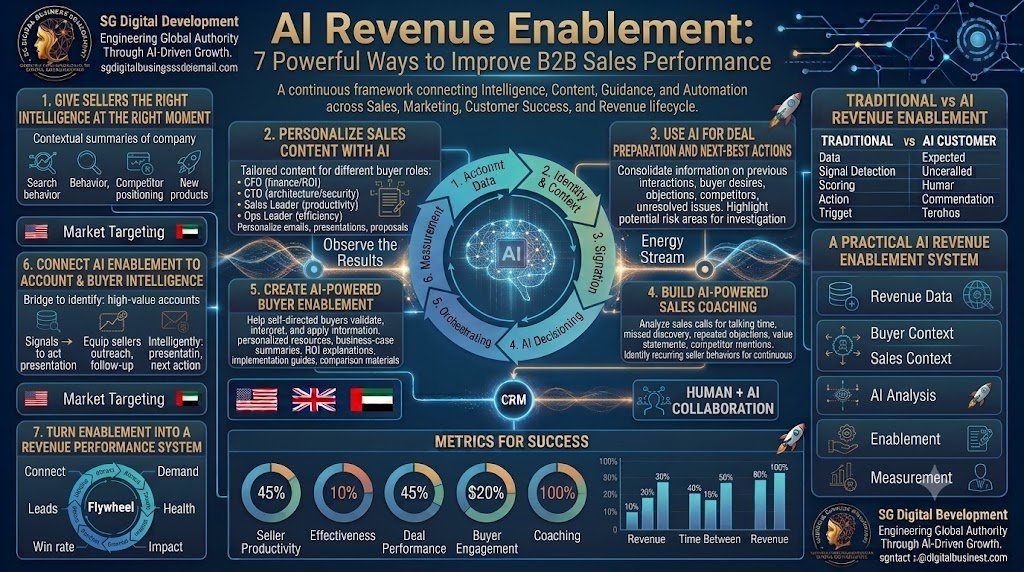
AI Revenue Enablement: 7 Powerful Ways to Improve B2B Sales Performance. Introduction B2B sales teams have more information available to them than ever before. They have CRM data, account intelligence, buyer intent signals, sales conversations, customer information, content libraries, competitive intelligence and analytics. Yet having more information does not automatically make selling easier. Salespeople still need to answer practical questions every day: This is where AI revenue enablement becomes important. Traditional revenue enablement often depends on training programs, sales playbooks, content libraries, onboarding sessions, coaching meetings and periodic performance reviews. Those activities still have value. But modern B2B buying journeys are becoming more digital, self-directed and AI-assisted. Gartner reported in 2026 that 67% of surveyed B2B buyers preferred a rep-free experience, while 45% said they had used generative AI during a recent purchase. That changes what sellers need to do. Sales teams increasingly need to help buyers validate information, understand business value, compare alternatives, build internal consensus and move confidently through complex buying decisions. At the same time, sellers need better intelligence inside their own workflows. AI can help deliver that intelligence. Forrester’s September 2026 research describes the evolution of AI in revenue enablement from basic efficiency and content-generation use cases toward seller productivity, coaching, practice and competency development. This means revenue enablement is evolving from a collection of training and content activities into a more connected commercial capability. In this guide, we will explore 7 powerful AI revenue enablement strategies that can help B2B companies improve seller readiness, deal execution, buyer support, coaching, personalization and revenue performance. What Is AI Revenue Enablement? AI revenue enablement is the use of artificial intelligence, data, automation and intelligent workflows to equip revenue teams with the information, guidance, content, coaching and insights they need to perform better throughout the buyer and customer journey. Traditional revenue enablement may include: AI can make these capabilities more dynamic. Instead of asking a salesperson to search through a large content library, an AI system can identify the relevant resource based on: The difference is important. Traditional enablement often asks: What resources are available? AI revenue enablement can ask: What does this seller and buyer need right now? That moves enablement closer to the actual flow of the deal. AI Revenue Enablement vs Traditional Revenue Enablement Traditional enablement is often structured around scheduled activities. For example: Training ↓ Certification ↓ Content Library ↓ Sales Playbook ↓ Manager Coaching ↓ Performance Review AI revenue enablement can create a more continuous model. Buyer Signal ↓ AI Analysis ↓ Contextual Recommendation ↓ Seller Action ↓ Outcome ↓ Learning The system can then use the outcome to improve future recommendations. Traditional Enablement AI Revenue Enablement Static playbooks Dynamic guidance Periodic training Continuous learning Large content libraries Contextual recommendations Manual deal research AI-assisted preparation Generic messaging Buyer-specific messaging Scheduled coaching Continuous coaching Manual analysis Automated insight generation Activity metrics Revenue-linked metrics Gartner’s 2026 research argues that sales enablement needs to move beyond static content and training toward AI-driven support embedded in sellers’ workflows. Why AI Revenue Enablement Matters B2B sales is becoming more complex. A typical buying process can involve: The seller therefore needs more than a product presentation. The seller needs context. AI revenue enablement can help provide that context. It can help sellers: It can help managers: It can help buyers: The goal is therefore not simply to make salespeople faster. The goal is to make revenue execution more intelligent. How AI Revenue Enablement Works A mature AI revenue enablement system connects several layers. 1. Revenue Data The system uses information from sources such as: 2. Buyer Context The system tries to understand: 3. Sales Context The system also understands: 4. AI Analysis AI identifies patterns and creates useful recommendations. For example: This account has engaged with pricing information but has not interacted with implementation resources. That may suggest the seller should address implementation risk. 5. Enablement Action The system can recommend: 6. Measurement The organization measures whether the recommendation influenced: This creates a continuous improvement loop. 7 Powerful AI Revenue Enablement Strategies 1. Give Sellers the Right Intelligence at the Right Moment One of the biggest problems with traditional enablement is that useful information often exists somewhere, but sellers have to find it themselves. A salesperson might have access to: The problem is not necessarily lack of content. It is lack of context. AI can change this by delivering information based on the current situation. For example, imagine a salesperson preparing for a meeting with a financial-services company. AI could summarize: The salesperson starts the meeting with context rather than spending an hour gathering information. In-workflow intelligence The most valuable enablement happens where the seller is already working. Instead of: Search the enablement portal. the experience becomes: Here are the three resources most relevant to this opportunity. Instead of: Review the entire account. the experience becomes: These are the five changes that matter for this account. Instead of: Find a response to this objection. the experience becomes: Here are two approved responses and a relevant customer example. This is a major shift from content availability to contextual intelligence. 2. Personalize Sales Content with AI B2B buyers do not all have the same priorities. A CFO may care about: A CTO may care about: A sales leader may care about: A customer-success leader may care about: Sending everyone the same presentation is therefore inefficient. AI can help sellers personalize content based on: For example: A generic case study can become a more targeted resource emphasizing the outcomes most relevant to a specific buyer. Content personalization can include: The objective is not to generate unlimited content. The objective is to deliver the most relevant content. 3. Use AI for Deal Preparation and Next-Best Actions Deal preparation is one of the strongest opportunities for AI revenue enablement. Before an important meeting, sellers need to understand: AI can consolidate this information. Example Suppose an opportunity has been open for 90 days. AI identifies: Instead of simply reporting these facts, the system can highlight

AI market intelligence
AI Growth Engine

AI Market Intelligence: 7 Powerful Ways to Find B2B Growth Opportunities.

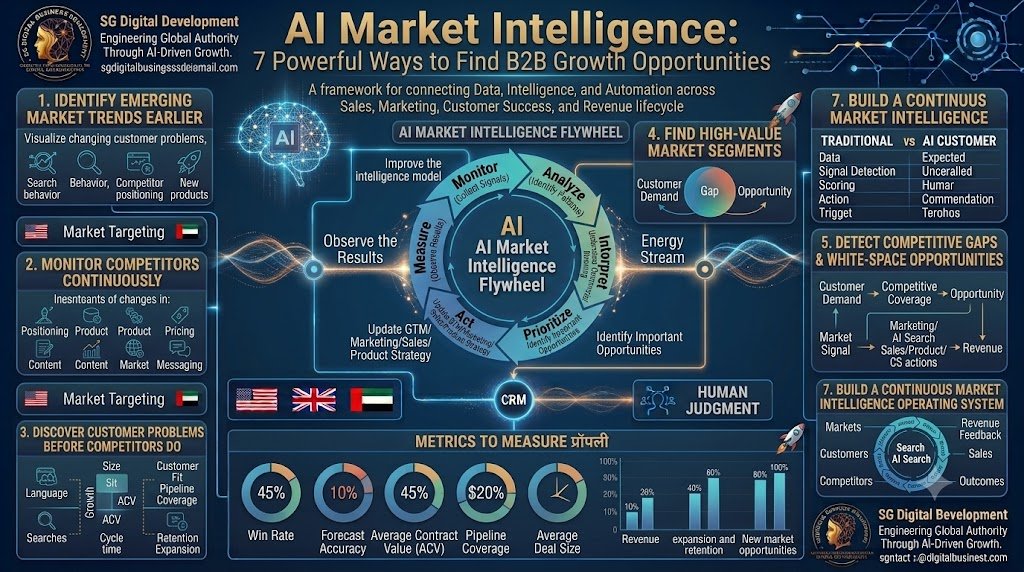
AI Market Intelligence: 7 Powerful Ways to Find B2B Growth Opportunities. Introduction B2B companies make thousands of decisions about markets, customers, competitors, products, pricing and growth. The quality of those decisions depends heavily on the quality of the intelligence behind them. A company may need to determine: Traditionally, businesses have answered these questions through market research, analyst reports, surveys, spreadsheets, competitor monitoring and manual analysis. Those methods remain useful. But the volume and speed of market information have changed. Customer conversations happen across digital channels. Competitors change positioning quickly. Search behavior evolves. New products appear. Pricing changes. AI search influences discovery. Industry conversations move faster. This creates an opportunity for AI market intelligence. AI market intelligence uses artificial intelligence, data analysis, automation and contextual intelligence to help businesses understand markets, competitors, customers and emerging opportunities. Instead of analyzing market information periodically, companies can build systems that continuously monitor relevant signals. The objective is not simply to collect more data. It is to turn market data into actionable commercial intelligence. McKinsey’s 2026 research on B2B pricing identifies market and competitive intelligence as one of the areas where AI adoption is already relatively mature, while also describing the broader shift toward AI-orchestrated commercial processes. At the same time, McKinsey’s 2026 B2B research emphasizes that companies are increasingly using AI to rewire commercial workflows around customer and market intelligence rather than simply adding isolated AI tools. For B2B organizations, this means market intelligence can become a continuous operating capability rather than an occasional research exercise. In this guide, we will explore 7 powerful AI market intelligence strategies for identifying market trends, understanding competitors, discovering customer demand and finding new B2B growth opportunities. What Is AI Market Intelligence? AI market intelligence is the use of artificial intelligence, data, automation and analytical systems to collect, organize, analyze and interpret information about markets, customers, competitors and business opportunities. Traditional market intelligence may involve: AI can help bring these information sources together and analyze them continuously. An AI market intelligence system may monitor: The objective is to answer questions such as: What is changing? Why is it changing? Who is affected? What opportunity does this create? What should the business do next? That final question is particularly important. Intelligence becomes valuable when it improves decisions. AI Market Intelligence vs Traditional Market Research Market research and market intelligence are closely related, but they are not identical. Market research often focuses on answering a specific question. For example: How large is the market for this product? Market intelligence is broader. It continuously monitors the environment surrounding the business. For example: Which customer needs are changing, which competitors are responding, and where are new opportunities emerging? AI can make this intelligence more continuous. Traditional Market Intelligence AI Market Intelligence Periodic research Continuous monitoring Manual data collection Automated data gathering Static reports Dynamic intelligence Human-led analysis AI-assisted analysis Historical information Historical + emerging signals Competitor snapshots Competitor monitoring Broad segments Dynamic segments Manual interpretation Pattern detection Scheduled reviews Real-time or frequent alerts AI does not eliminate human analysis. Instead, it can reduce the time required to find patterns and give teams more time to interpret what those patterns mean. Why AI Market Intelligence Matters B2B markets are becoming more complex. A business can face changes in: A market opportunity that looks attractive today may change quickly. This is why businesses need intelligence that is both broad and current. AI market intelligence can help businesses: Identify emerging demand Discover customer problems before they become obvious. Monitor competitors Track changes in positioning, products and commercial activity. Improve market selection Determine which industries or regions deserve more attention. Improve customer targeting Identify segments with stronger commercial potential. Detect opportunities earlier Find signals that may indicate emerging demand. Improve positioning Understand how competitors and customers describe a problem. Support GTM strategy Connect market intelligence directly to marketing and sales decisions. The result is a more informed growth system. How AI Market Intelligence Works A practical AI market intelligence system can be organized into six layers. Layer 1: Data Collection Collect relevant information from: Layer 2: Data Organization AI organizes information into useful categories. For example: Layer 3: Pattern Detection AI looks for: Layer 4: Contextual Analysis The system asks: What does this signal mean for this business? This is where context becomes important. HubSpot’s 2026 GTM research similarly emphasizes that AI becomes more useful when it has business context, including knowledge about customers, markets and how teams operate. Layer 5: Opportunity Identification AI can classify signals into areas such as: Layer 6: Action The final output may be: The objective is: Data → Intelligence → Opportunity → Action 7 Powerful AI Market Intelligence Strategies 1. Identify Emerging Market Trends Earlier Markets rarely change overnight. They usually produce signals first. Customers start discussing a new problem. Search behavior changes. New competitors appear. Existing companies launch new products. Industry publications begin covering a topic. AI can help identify these signals earlier. What can AI monitor? Depending on the business, an intelligence system can track: The goal is not to react to every new trend. The goal is to identify patterns that are relevant to the business. From isolated signals to trends One mention of a new customer problem may not mean much. But if the same problem appears across: the signal becomes stronger. AI can help connect these occurrences. That can give leadership an earlier indication that something is changing. 2. Monitor Competitors Continuously Competitor intelligence is one of the most obvious applications of AI market intelligence. Businesses need to understand: Traditional competitor research might happen quarterly. AI can help businesses monitor relevant changes more frequently. Competitive intelligence signals An AI system can track changes in: Positioning How is the competitor describing its value? Product What has changed? Pricing Are pricing structures or offers changing? Content Which topics are competitors emphasizing? Market Which industries or regions are they targeting? Messaging Which customer problems are they focusing on? Why continuous monitoring matters A competitor does not need

AI go-to-market strategy
AI Growth Engine

AI Go-To-Market Strategy: 7 Powerful Ways to Build a B2B Growth Engine.

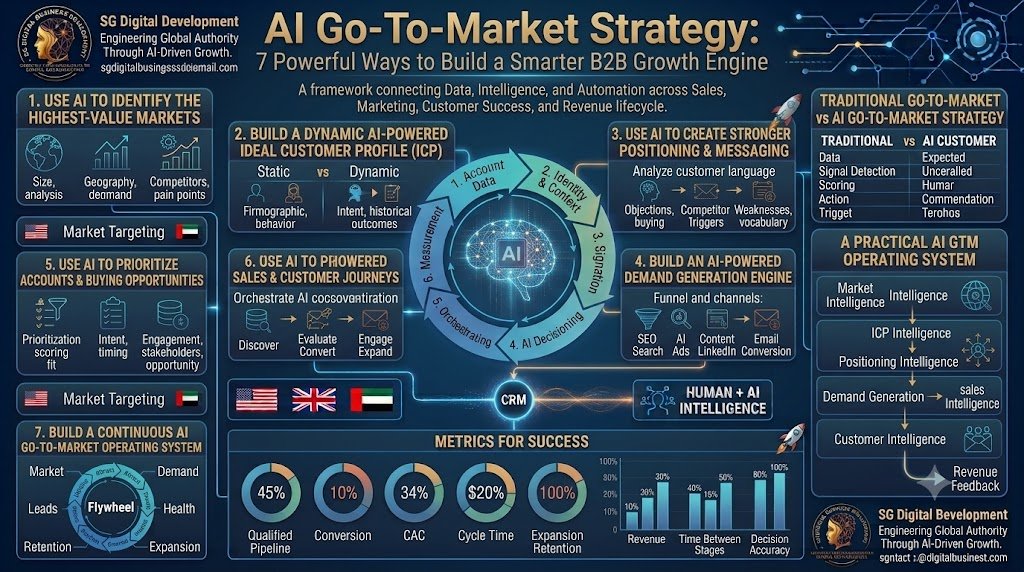
AI Go-To-Market Strategy: 7 Powerful Ways to Build a Smarter B2B Growth Engine. Introduction B2B companies have more data, more marketing channels and more sales technology than ever before. Yet many businesses still struggle with one fundamental question: Who should we target, what should we offer them, where should we reach them, and how should we turn that attention into revenue? That is a go-to-market problem. A traditional go-to-market strategy usually brings together: AI is changing how businesses can approach each of these areas. An AI go-to-market strategy uses artificial intelligence, customer intelligence, market data, automation and predictive analysis to make GTM decisions more informed, connected and responsive. Instead of creating a GTM plan once and reviewing it every few months, businesses can build systems that continuously analyze: This creates a shift from a static GTM plan to an adaptive growth system. The change is already visible in current B2B research. McKinsey’s 2026 research describes companies redesigning commercial workflows around AI and emphasizes end-to-end commercial impact journeys rather than simply adding isolated AI tools. HubSpot similarly recommends that GTM teams begin with specific business problems and measurable outcomes rather than adopting AI simply because the technology is available. For B2B companies, this creates a major opportunity. Instead of asking: How can we use AI in marketing? businesses can ask: How can AI improve the entire way we go to market? In this guide, we will explore 7 powerful AI go-to-market strategy approaches that can help businesses identify better markets, understand ideal customers, improve positioning, generate demand, strengthen sales execution and create a more connected B2B growth engine. What Is an AI Go-To-Market Strategy? An AI go-to-market strategy is a GTM framework that uses artificial intelligence, data, automation and predictive intelligence to improve how a business identifies markets, targets customers, communicates value, generates demand, converts opportunities and grows existing accounts. Traditional GTM planning often relies on research conducted at specific points in time. For example: An AI-powered model can make this process continuous. The system can continually evaluate: Market Which markets are becoming more attractive? Customers Which companies are most likely to need the solution? Intent Which accounts are showing buying signals? Positioning Which messages are producing engagement? Demand Which channels are generating qualified opportunities? Sales Which opportunities are progressing? Customers Which accounts are likely to renew or expand? This creates a feedback loop. Market Intelligence → Customer Intelligence → Demand → Sales → Customer Growth → Revenue Data → New Intelligence That is the foundation of an AI-driven GTM system. Why AI Is Changing Go-To-Market Strategy Traditional GTM models often depend on assumptions. A company might define its ideal customer based on: These are useful starting points. But they do not always explain who is actually ready to buy. AI allows businesses to combine traditional customer characteristics with behavioral and contextual signals. For example: A company may fit the ICP perfectly but show no buying activity. Another company may be slightly outside the traditional ICP but demonstrate: The second account may deserve more immediate attention. This is one reason AI can change GTM from static segmentation to dynamic prioritization. AI Go-To-Market Strategy vs Traditional GTM Traditional GTM AI Go-To-Market Strategy Periodic market research Continuous market intelligence Static ICP Dynamic ICP Broad segmentation Signal-based prioritization Fixed messaging Adaptive messaging Campaign-based demand generation Continuous demand intelligence Manual account research AI-assisted account intelligence Standard sales sequences Context-aware sales workflows Historical reporting Predictive intelligence Separate departmental data Connected GTM intelligence Periodic strategy reviews Continuous optimization The goal is not to eliminate strategic planning. Instead, AI can make GTM planning more responsive to changing market conditions. How an AI Go-To-Market Strategy Works A practical AI GTM system can be organized into seven layers. 1. Market Intelligence Analyze: 2. Customer Intelligence Understand: 3. Positioning Intelligence Analyze: 4. Demand Generation Use insights to improve: 5. Sales Intelligence Support: 6. Customer Intelligence Monitor: 7. Revenue Feedback Connect outcomes back to the GTM system. This means the strategy can continuously improve. 7 Powerful AI Go-To-Market Strategy Approaches 1. Use AI to Identify the Highest-Value Markets The first question in any GTM strategy should be: Where should we compete? A business can have an excellent product and still struggle if it targets the wrong market. Traditional market research can identify: AI can help analyze these signals at greater scale. An AI-powered market intelligence system can evaluate: This can help identify markets where multiple positive signals overlap. Market scoring A company could evaluate potential markets based on: Market attractiveness Is demand increasing? Customer fit Does the business solve a meaningful problem? Competitive intensity How difficult is differentiation? Buying readiness Are potential customers actively looking for solutions? Commercial value Can the company acquire and serve these customers profitably? AI can help bring these factors together. Example Imagine a B2B AI consultancy considering three markets: Instead of selecting one based only on intuition, the company can analyze: The output becomes a market opportunity map. This does not replace strategic judgment. It improves the evidence available for that judgment. 2. Build a Dynamic AI-Powered Ideal Customer Profile An ICP should not remain a static document. Markets change. Customers change. Products change. Buying behavior changes. Therefore, the ideal customer profile should evolve as new data becomes available. AI can help create a dynamic ICP using: The most valuable insight may come from comparing: Customers you thought were ideal with Customers that actually produce strong commercial outcomes. For example, a business may believe its ideal customers are companies with 500+ employees. But after analyzing revenue, retention and expansion, AI may reveal that companies with 100–300 employees generate: That information can change the GTM strategy. Dynamic ICP scoring A dynamic ICP can include: Firmographic fit How closely does the account match the target profile? Problem fit How relevant is the company’s problem? Intent Is the account showing buying signals? Engagement How much meaningful interaction is occurring? Commercial potential What is the potential value? Historical similarity How closely does the account resemble successful customers? This creates a

AI revenue operations
AI Growth Engine

AI Revenue Operations: 7 Powerful Ways to Align Sales, Marketing & Revenue

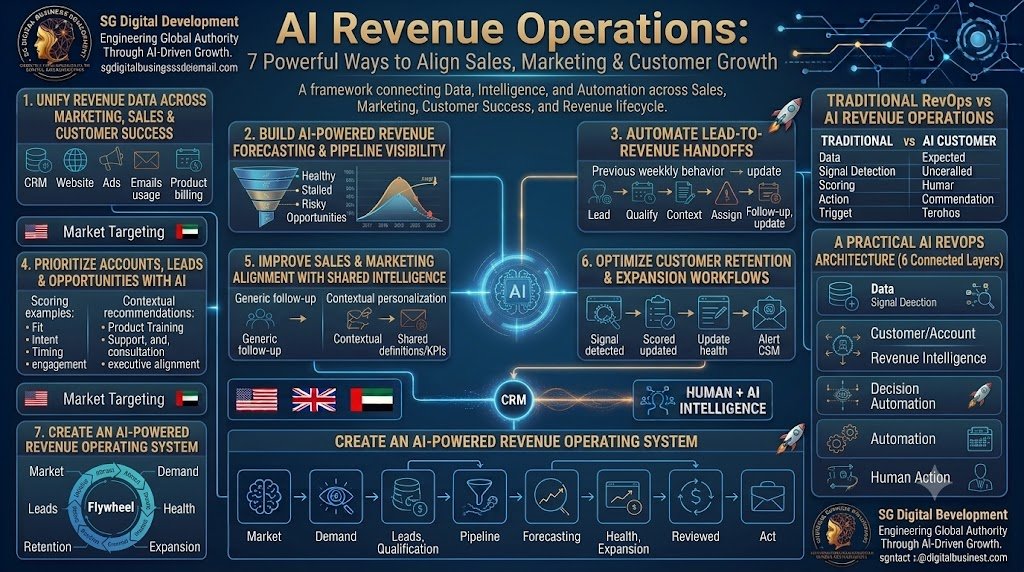
AI Revenue Operations: 7 Powerful Ways to Align Sales, Marketing & Customer Growth Introduction B2B revenue rarely depends on one department. Marketing creates demand. Sales converts opportunities. Customer success protects relationships and creates expansion opportunities. Finance measures revenue. Operations connects the systems behind all of them. Yet many businesses still operate these functions as separate systems. Marketing may measure leads. Sales may measure opportunities. Customer success may measure retention. Finance may measure recognized revenue. Leadership may look at all of these numbers and still struggle to understand what is actually happening across the revenue lifecycle. This is where AI revenue operations becomes increasingly important. Revenue operations, commonly called RevOps, is designed to connect the teams, processes, data and technology involved in generating and retaining revenue. Salesforce describes RevOps as a framework that aligns revenue-related activities across functions such as marketing, sales, customer success and finance. AI adds another layer. Instead of simply connecting systems, businesses can use AI to analyze large volumes of revenue data, identify patterns, prioritize accounts and opportunities, automate workflows, detect risks and recommend next actions. Recent industry research is also moving toward this broader model. HubSpot describes revenue intelligence as an AI-driven approach that connects revenue data across the customer lifecycle so RevOps teams can forecast, prioritize and act on insights. The result is a shift from disconnected departmental optimization toward a connected revenue system. In this guide, we will explore 7 powerful AI revenue operations strategies that B2B companies can use to connect marketing, sales, customer success, account intelligence, pipeline management and revenue growth. What Is AI Revenue Operations? AI revenue operations is the use of artificial intelligence, connected data, automation and revenue processes to coordinate the teams and systems responsible for generating, converting, retaining and expanding revenue. Traditional RevOps focuses heavily on alignment. AI revenue operations adds intelligence and automation to that alignment. Instead of simply asking: What happened? an AI-powered RevOps system can help answer: This changes the role of RevOps from reporting and coordination toward continuous revenue optimization. A connected RevOps system can bring together: AI can then analyze these signals to identify patterns and recommend actions. The objective is not to replace revenue teams. The objective is to give them better intelligence and better operating systems. Why AI Revenue Operations Matters for B2B Companies As companies grow, their revenue systems become more complicated. More channels create more data. More products create more customer journeys. More salespeople create more CRM activity. More customers create more retention and expansion opportunities. More technology creates more disconnected systems. This creates a common problem: data exists everywhere, but actionable revenue intelligence exists nowhere. Salesforce identifies fragmented data, inconsistent processes and communication breakdowns as common obstacles RevOps is designed to address. AI revenue operations addresses this by creating a connected layer between data, people, processes and revenue outcomes. 1. It connects revenue teams Marketing, sales and customer success can work from shared revenue definitions and customer information. 2. It improves visibility Leadership can see how demand generation, pipeline, conversion, retention and expansion connect. 3. It reduces manual work Repetitive reporting, routing, data enrichment and workflow tasks can be automated. 4. It improves prioritization AI can help identify which accounts, leads and opportunities deserve attention. 5. It connects acquisition with retention Revenue does not end when a contract is signed. Customer health, renewals, expansion and lifetime value also matter. 6. It creates a feedback loop Revenue outcomes can feed information back into marketing, sales and customer success. That creates a more intelligent revenue engine. AI Revenue Operations vs Traditional RevOps Traditional RevOps and AI revenue operations share the same fundamental objective: connecting revenue-generating functions. The difference is the level of intelligence and automation. Traditional RevOps AI Revenue Operations Connects systems Connects and analyzes systems Standardizes processes Continuously optimizes processes Reports performance Identifies patterns and risks Uses dashboards Uses predictive and contextual intelligence Routes leads Prioritizes leads based on signals Tracks pipeline Identifies pipeline risk and opportunity Supports forecasting Improves forecasting with connected signals Automates workflows Dynamically triggers workflows Reviews customer data Predicts customer needs and risks Human-led decisions Human + AI decision support The goal is not to eliminate human judgment. In fact, human judgment remains essential for strategic decisions, complex relationships and high-value commercial conversations. The opportunity is to remove unnecessary manual analysis so revenue teams can spend more time acting on meaningful opportunities. How AI Revenue Operations Works A useful AI revenue operations architecture can be viewed as six connected layers. Layer 1: Data The system collects information from: Layer 2: Customer and Account Intelligence AI combines these signals to understand: Layer 3: Revenue Intelligence The system analyzes: Layer 4: Decision Intelligence AI identifies: Layer 5: Automation The system can trigger: Layer 6: Human Action Revenue teams make decisions and execute: This creates a continuous loop: Data → Intelligence → Decision → Action → Revenue Outcome → New Data That loop is the foundation of AI revenue operations. 7 Powerful AI Revenue Operations Strategies 1. Unify Revenue Data Across Marketing, Sales & Customer Success The first requirement for effective AI revenue operations is connected data. AI cannot produce reliable revenue intelligence if important information is fragmented across disconnected systems. Imagine a B2B company where: but none of those systems communicate effectively. Each team sees a different version of the customer. This makes revenue optimization difficult. AI revenue operations begins by creating a unified revenue data layer. What should be connected? Depending on the company, this can include: The goal is not to collect data simply because it exists. The goal is to connect data that helps explain revenue performance. Create a single customer view A unified customer profile might show: Account Company information and firmographic data. Marketing Campaign engagement, content consumption and website behavior. Sales Meetings, opportunities, pipeline stage and sales activity. Customer Success Health score, product engagement, support activity and renewal status. Revenue Contract value, recurring revenue, expansion and lifetime value. AI can then analyze the complete picture. This is one of the biggest

Scroll to Top