AI Growth Engine

Strategic insights on how Artificial Intelligence is transforming ad performance and digital ROI.

AI account intelligence
AI Growth Engine

AI Account Intelligence: 7 Powerful Ways to Identify & Grow B2B Accounts.

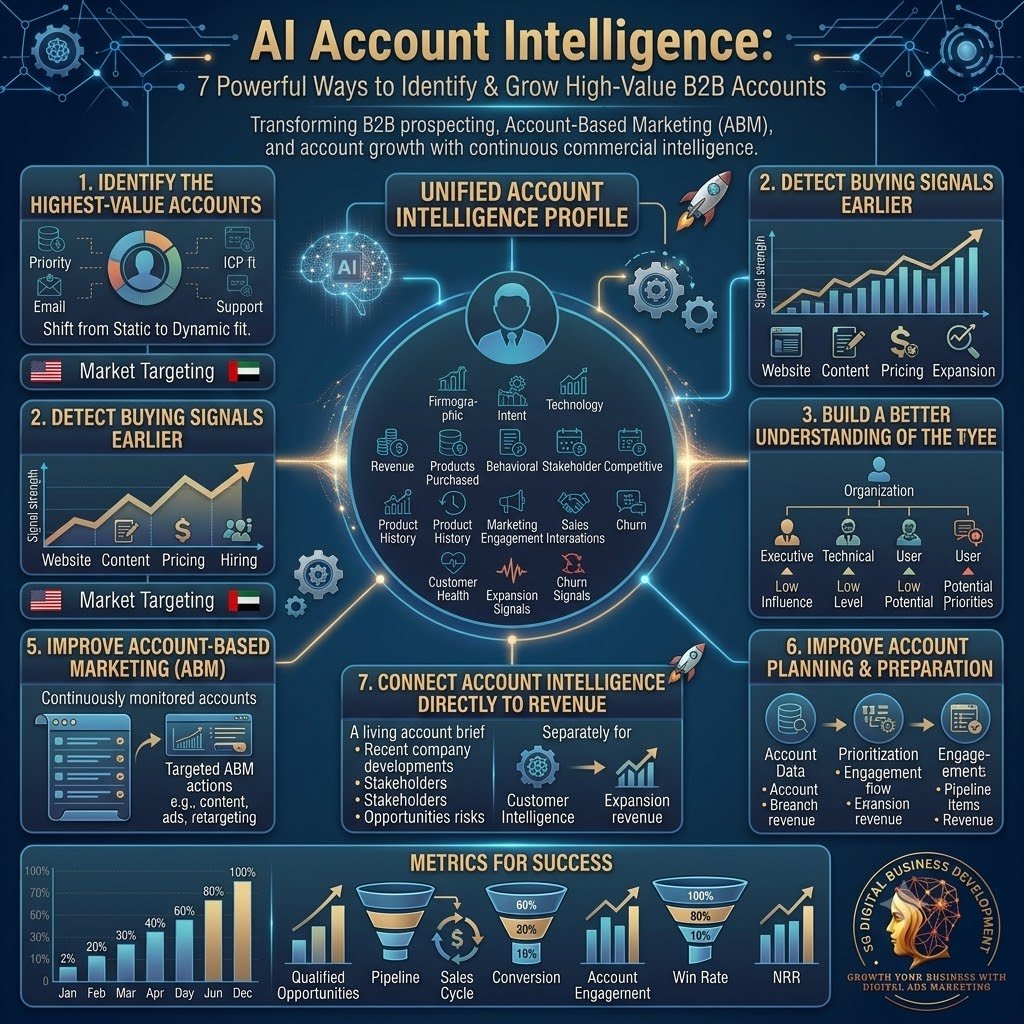
AI Account Intelligence: 7 Powerful Ways to Identify & Grow High-Value B2B Accounts Introduction B2B companies rarely have a shortage of potential accounts. The real challenge is knowing which accounts deserve attention now. A sales team may have thousands of companies in its database. Marketing may have hundreds of target accounts. Business development representatives may have hundreds of contacts available for outreach. But not every account has the same potential. Some accounts fit the ideal customer profile but are not actively looking for a solution. Some are actively researching a problem but have not yet engaged with the company. Some have recently hired a new executive, launched a new initiative, expanded into a new market, or changed their technology stack. Others may already be customers with significant expansion potential. The difference is timing, context, intent, fit, and opportunity. This is where AI account intelligence becomes increasingly important. AI account intelligence combines company information, behavioral signals, engagement data, buying intent, technology information, stakeholder information, and predictive analysis to create a more complete picture of a B2B account. Instead of asking only: “Is this company a potential customer?” businesses can ask: “Why does this account matter, what is happening inside the account, how strong are the buying signals, who may influence the decision, and what should we do next?” That shift can transform B2B prospecting and account-based growth. Recent 2026 account-intelligence research describes the category as combining firmographic, technographic, contact, engagement, and intent data into an account-level view that can be prioritized and activated through CRM and revenue workflows. For SG Digital, this creates an important connection between AI visibility, lead generation, lead qualification, sales intelligence, customer intelligence, and revenue growth. What Is AI Account Intelligence? AI account intelligence is the use of artificial intelligence, company data, behavioral signals, intent data, predictive analytics, and automation to understand, prioritize, and engage B2B accounts. Traditional account research may involve manually checking: That research can provide useful information. But it can also become outdated quickly. AI account intelligence introduces a more dynamic approach. Instead of creating a static account profile once, the system can continuously analyze changing signals and help determine which accounts deserve attention. An account intelligence profile may include: The goal is not to collect information simply because it exists. The goal is to transform information into commercial intelligence. Why AI Account Intelligence Matters for B2B Growth B2B buying is increasingly complex. A major purchase may involve: At the same time, buying activity can happen across many channels. Potential buyers may: This creates an enormous amount of potential signal. The problem is that sales teams cannot manually analyze every signal from every account. AI account intelligence can help convert this complexity into a prioritized account view. A modern account intelligence system can help answer: Who should we target? Based on: Who should we target now? Based on: Who should we contact? Based on: What should we say? Based on: What should we do next? Based on: This transforms account targeting from a static list into a dynamic decision system. AI Account Intelligence vs Traditional Account Research Traditional account research remains useful. However, manual research can become difficult to maintain when account volumes increase. Traditional Account Research AI Account Intelligence Manual AI-assisted Often periodic Continuously updated Static account profiles Dynamic account profiles Individual research Large-scale analysis Human prioritization AI-assisted prioritization Limited signals Multiple signal sources Reactive Predictive Research-heavy Intelligence-driven Often disconnected from workflows Connected to CRM and activation The objective is not to eliminate human research. It is to make human research more focused. Instead of spending thirty minutes determining whether an account is worth pursuing, a sales representative can begin with an AI-generated account intelligence profile and spend more time understanding the actual business opportunity. How AI Account Intelligence Works A practical system can be organized into several layers. 1. Account Data The first layer contains basic company information. This can include: This establishes the basic account profile. 2. Technology Intelligence Technographic information can reveal the technology environment surrounding an account. For example: Technology information can help identify compatibility, replacement opportunities, integration opportunities, and potential business requirements. 3. Behavioral Intelligence Behavioral signals may include: These signals can indicate changing levels of interest. 4. Intent Intelligence Intent signals can indicate that an account may be actively researching a problem, category, competitor, or solution. However, intent should not automatically be interpreted as a guaranteed buying decision. Intent is a signal. It becomes more useful when combined with fit, engagement, account context, and other evidence. 5. Stakeholder Intelligence B2B deals involve people. AI account intelligence can help identify: Understanding the buying committee can make account engagement more precise. 6. Predictive Intelligence AI can then analyze the combined signals. Potential predictions include: 7. Activation Finally, intelligence should lead to action. For example: High-fit + high-intent account → Sales research task High-fit + strong engagement → Personalized outreach Existing customer + expansion signals → Account expansion workflow Strategic account + leadership change → Account plan update This final layer is critical. Intelligence that never changes an action has limited commercial value. 7 Powerful Ways AI Account Intelligence Can Drive B2B Growth 1. Identify the Highest-Value Accounts The first major application is account prioritization. Many businesses use an ideal customer profile. For example: B2B SaaS company, 100–1,000 employees, United States, technology sector, recurring revenue model. That provides useful targeting criteria. But thousands of companies may fit that description. AI account intelligence can add another layer. Instead of asking: “Does this account fit our ICP?” the system can ask: “Which ICP accounts are showing signals that make them especially relevant right now?” AI can combine: This creates a more dynamic priority model. Example Imagine 2,000 companies fit the basic ICP. AI identifies 150 accounts that also show: The sales team now has a more focused account universe. The objective is not simply generating more prospects. It is allocating limited sales capacity more intelligently. 2. Detect Buying Signals Earlier Buying signals can appear before a buyer contacts sales. An account
AI customer intelligence
AI Growth Engine

AI Customer Intelligence: 7 Powerful Ways to Turn Customer Data Into B2B Growth.

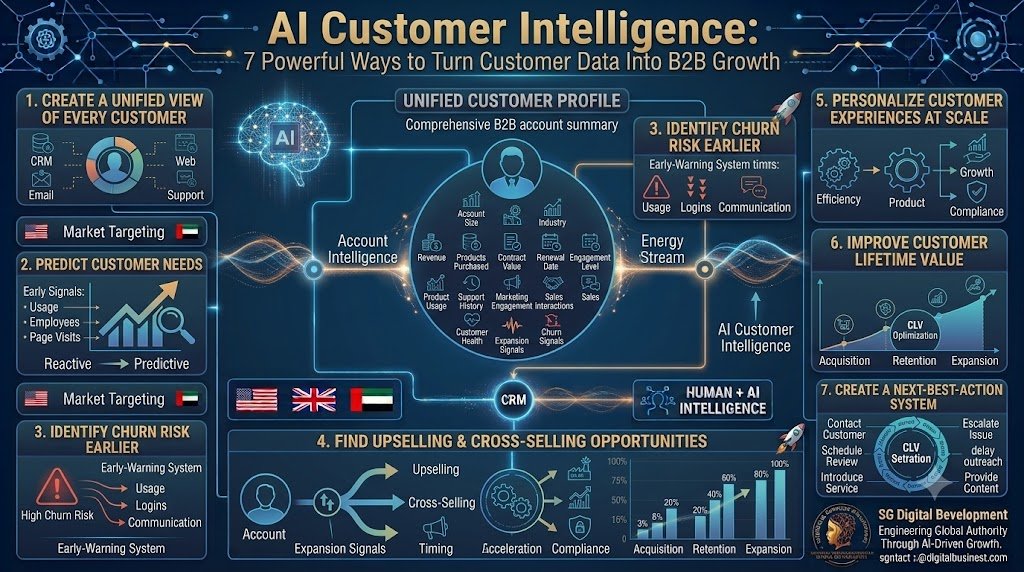
AI Customer Intelligence: 7 Powerful Ways to Turn Customer Data Into B2B Growth Introduction B2B companies have more customer data than ever before. CRM records, website visits, sales conversations, email engagement, product usage, customer support interactions, campaign responses, purchase history, renewal activity, and account-level behavior can all reveal valuable information about customers. The problem is that having customer data is not the same as understanding customers. Many businesses still operate with fragmented customer information spread across CRM platforms, marketing systems, spreadsheets, analytics tools, customer success platforms, support systems, and sales databases. This makes it difficult to answer some of the most important questions in modern B2B growth: This is where AI customer intelligence becomes increasingly important. AI customer intelligence combines customer data, behavioral signals, artificial intelligence, predictive analytics, machine learning, automation, and business intelligence to create a more complete understanding of customers and accounts. Instead of simply reporting what happened, an AI-powered customer intelligence system can help businesses identify what is happening, why it may be happening, what could happen next, and what action should be taken. For B2B companies, this creates an opportunity to connect customer intelligence directly with retention, customer lifetime value, expansion, customer success, sales, and revenue growth. What Is AI Customer Intelligence? AI customer intelligence is the use of artificial intelligence, customer data, predictive analytics, behavioral signals, and automation to understand customers and predict their needs, risks, opportunities, and likely next actions. Traditional customer analytics often focuses on historical reporting. For example: Customer X purchased $50,000 of services last year. AI customer intelligence goes further. It can potentially identify: Customer X has increased product usage, added new users, engaged with expansion-related content, opened several commercial emails, and recently discussed a related business problem with the account team. These signals may indicate increasing expansion potential. That difference is important. Traditional reporting tells a business what happened. AI customer intelligence helps the business understand what the data may mean and determine what to do next. McKinsey describes AI-powered customer decisioning as an approach that can combine integrated customer data, predictive models, recommendation engines, and generative AI to determine more relevant customer interactions. For B2B organizations, the concept can be applied across the entire customer lifecycle. AI customer intelligence can connect: The result is a more connected commercial system. Why AI Customer Intelligence Matters for B2B Companies B2B customer relationships are rarely based on one interaction. A prospect may discover a company through search, visit the website, consume content, speak with sales, request a proposal, become a customer, use the product or service, contact support, renew, expand, and eventually become an advocate. Every stage generates information. The challenge is converting that information into usable intelligence. Without an intelligence layer, companies often have isolated data points. Marketing sees engagement. Sales sees opportunities. Customer success sees health scores. Finance sees revenue. Support sees tickets. Leadership sees reports. But the customer experiences only one relationship with the company. AI customer intelligence can help connect those perspectives. From customer data to customer intelligence There is a useful progression: Customer Data → Customer Insights → Customer Intelligence → Customer Action → Revenue Impact Customer data is the raw material. Customer insights explain patterns. Customer intelligence adds prediction, prioritization, context, and recommendations. Customer action converts intelligence into operational decisions. Revenue impact is the business outcome. This is why AI customer intelligence should not be treated as another analytics dashboard. Its value comes from connecting intelligence to action. AI Customer Intelligence vs Traditional Customer Analytics Traditional customer analytics remains valuable. Businesses still need dashboards, reports, historical analysis, segmentation, and performance measurement. However, AI changes the operating model. Traditional Customer Analytics AI Customer Intelligence Primarily historical Historical + predictive Reports customer behavior Interprets customer behavior Manual segmentation Dynamic segmentation Static dashboards Continuously updated intelligence Reactive Proactive Rule-based alerts Predictive signals Separate data sources Connected customer context Human analysis required AI-assisted analysis Reports what happened Helps identify what may happen next Insights often separate from action Intelligence connected to workflows This does not mean AI replaces customer-facing teams. Instead, AI can help those teams spend more time acting on meaningful signals and less time searching for them. How AI Customer Intelligence Works A practical AI customer intelligence system can be organized into several layers. 1. Customer Data The system collects relevant customer information. This may include: 2. Data Unification The next step is connecting customer information. A company may have five different systems containing information about the same account. AI cannot create reliable intelligence if the underlying customer identity and data relationships are inconsistent. Data quality therefore becomes a fundamental part of the system. Salesforce’s 2026 research on marketers in India similarly highlights unified customer data as an important foundation for AI-powered engagement, while its sales research notes that incomplete, duplicate, and inaccurate data can limit AI effectiveness. 3. AI Analysis Once data is available, AI can analyze patterns across customer behavior. Models may identify: 4. Prediction The system can then estimate future outcomes. For example: 5. Recommendation The system can recommend an action. For example: Schedule executive review. Or: Introduce advanced service package. Or: Customer engagement is declining; initiate retention workflow. 6. Activation Finally, the intelligence becomes operational. It can trigger: This is where intelligence becomes commercially valuable. 7 Powerful Ways AI Customer Intelligence Can Drive B2B Growth 1. Create a Unified View of Every Customer The first major opportunity is creating a more complete customer profile. A B2B account may interact with a company through multiple departments and channels. Sales may know the commercial history. Marketing may know the content engagement. Customer success may know product adoption. Support may know service problems. Finance may know payment behavior. AI customer intelligence can bring these signals together. Instead of viewing an account as a CRM record, the company can develop a broader account intelligence profile. A unified profile might include: This provides context for better decisions. Why this matters Without context, individual signals can be misleading. A customer opening three emails might not mean much. But if

AI customer journey orchestration
AI Growth Engine

AI Customer Journey Orchestration: 7 Powerful Ways to Transform B2B CX.

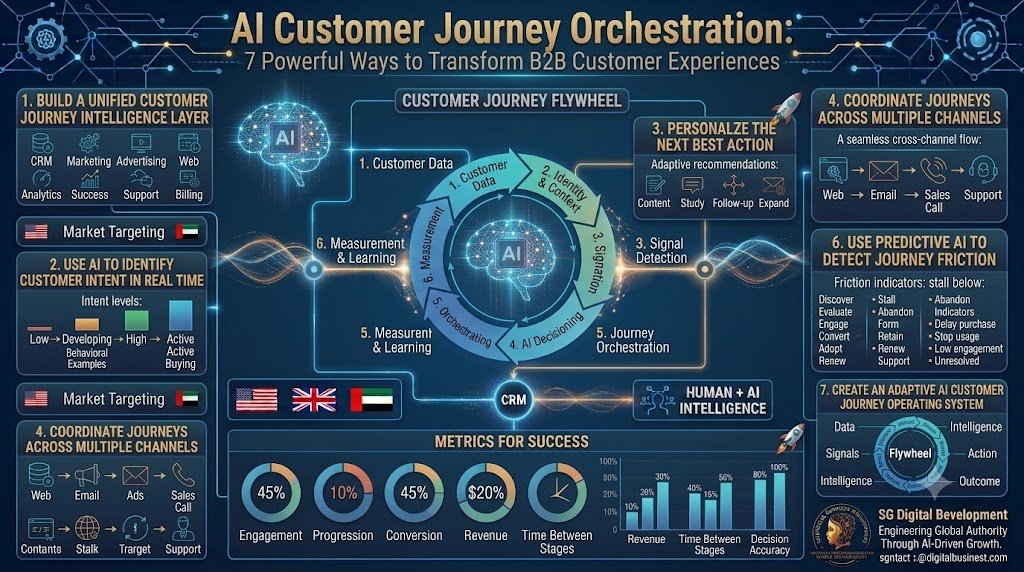
AI Customer Journey Orchestration: 7 Powerful Ways to Transform B2B Customer Experiences Introduction B2B customer journeys are becoming more complex. A modern buyer may discover a company through Google, encounter its content in AI search, visit the website, watch a video, interact with a sales representative, download a resource, return weeks later, speak with another stakeholder and eventually become a customer. After the purchase, the journey continues. Customers interact with onboarding teams, customer success managers, support teams, account managers, billing departments and sales teams. The challenge is that these interactions are often managed through separate systems. Marketing has one view. Sales has another. Customer success has another. Support has another. The customer, however, experiences only one company. This is why AI customer journey orchestration is becoming an important part of modern B2B growth strategy. Instead of treating the customer journey as a collection of disconnected campaigns and touchpoints, AI customer journey orchestration connects customer data, behavioral signals, decision-making and actions across the lifecycle. The objective is not simply to automate more messages. It is to determine: That creates a more dynamic customer experience. McKinsey describes this shift as a move from predefined customer journeys toward dynamic, cross-channel orchestration in which AI agents can help make moment-to-moment decisions. Adobe’s 2026 B2B research similarly reports that more than half of surveyed B2B organizations expect agentic AI to coordinate sales, marketing and service journeys in real time. For B2B companies, this creates a significant opportunity. In this guide, we will explore 7 powerful AI customer journey orchestration strategies that can help businesses create more connected, personalized and revenue-focused customer experiences. What Is AI Customer Journey Orchestration? AI customer journey orchestration is the use of artificial intelligence, customer data, automation and real-time decision-making to coordinate interactions across the customer lifecycle. Traditional journey automation usually follows predefined rules. For example: If a prospect downloads an ebook → send an email after two days. That workflow can be useful. But real customer behavior is rarely that predictable. A prospect may: The optimal next action may change after every interaction. AI customer journey orchestration allows the system to respond to these changing signals. Instead of following one fixed journey, the system can continuously evaluate context and determine the next appropriate action. This creates a model closer to: Observe → Understand → Decide → Act → Learn rather than: Trigger → Wait → Send → Wait → Send Why AI Customer Journey Orchestration Matters in 2026 B2B organizations are dealing with increasingly complex customer journeys. Customers expect: At the same time, companies have more customer data than ever. The challenge is connecting that data. Adobe’s 2026 B2B research found that only 41% of surveyed organizations reported having a unified customer-data foundation capable of supporting AI at scale, while 56% expected agentic AI to coordinate sales, marketing and service journeys in real time. This highlights an important issue. AI capability is increasing faster than many organizations’ ability to connect their data and workflows. That means successful orchestration requires more than adding an AI tool. Businesses need: AI Customer Journey Orchestration vs Traditional Journey Automation Traditional automation is usually designed around predefined paths. AI orchestration is designed around changing context. Traditional Automation AI Customer Journey Orchestration Rule-based journeys Context-aware journeys Fixed paths Adaptive paths Scheduled actions Signal-driven actions Static segmentation Dynamic segmentation Manual optimization AI-assisted optimization Campaign-centric Customer-centric Channel-specific Cross-channel Historical analysis Real-time decision support Limited personalization Contextual personalization Human-defined next step AI-assisted next-best action This does not mean traditional automation becomes useless. Rules are still valuable. The difference is that AI can sit above the rules and help determine which workflow should be activated based on current customer context. How AI Customer Journey Orchestration Works A practical system can be organized into six layers. 1. Customer Data The system collects relevant information. This may include: 2. Identity and Context The system attempts to understand who the customer or prospect is and what context surrounds the interaction. For B2B organizations, context may include: Without context, personalization can become superficial. 3. Signal Detection AI identifies meaningful changes. For example: 4. AI Decisioning The system determines what the signal may mean. For example: Pricing-page visit + high account fit + recent product research = potential buying intent Or: Usage decline + support increase + upcoming renewal = potential retention risk AI can then recommend the next action. 5. Journey Orchestration The system coordinates the appropriate response. That may include: 6. Measurement and Learning The system measures the outcome. Did engagement improve? Did the prospect progress? Did the customer adopt the product? Did the opportunity advance? Did the customer renew? The results can then inform future decision-making. 7 Powerful AI Customer Journey Orchestration Strategies 1. Build a Unified Customer Journey Intelligence Layer The first step is connecting customer information. Many organizations have data distributed across: This fragmentation makes it difficult to understand the complete customer journey. A unified intelligence layer can bring these signals together. Example Suppose an account: Individually, each event is useful. Together, they provide a much stronger indication of buying intent. AI can connect the events. That creates a more complete customer picture. Why this matters Without unified data, AI may optimize individual interactions. With unified data, AI can optimize the journey. That is a major difference. 2. Use AI to Identify Customer Intent in Real Time Intent is one of the most valuable signals in a B2B journey. The challenge is that intent can appear through many behaviors. A prospect may: AI can analyze these signals together. Instead of treating every website visitor equally, the system can identify patterns associated with higher-intent journeys. Intent levels A practical framework could include: Low intent General information consumption. Developing intent Repeated engagement with relevant content. High intent Pricing, product, comparison or commercial engagement. Active buying intent Direct interaction with sales, demo requests or high-value account activity. The objective is not to assume that every signal means a purchase is imminent. The objective is to prioritize attention. 3. Personalize the Next Best

AI customer success automation
AI Growth Engine

AI Customer Success Automation: 7 Powerful Ways to Scale B2B Success.

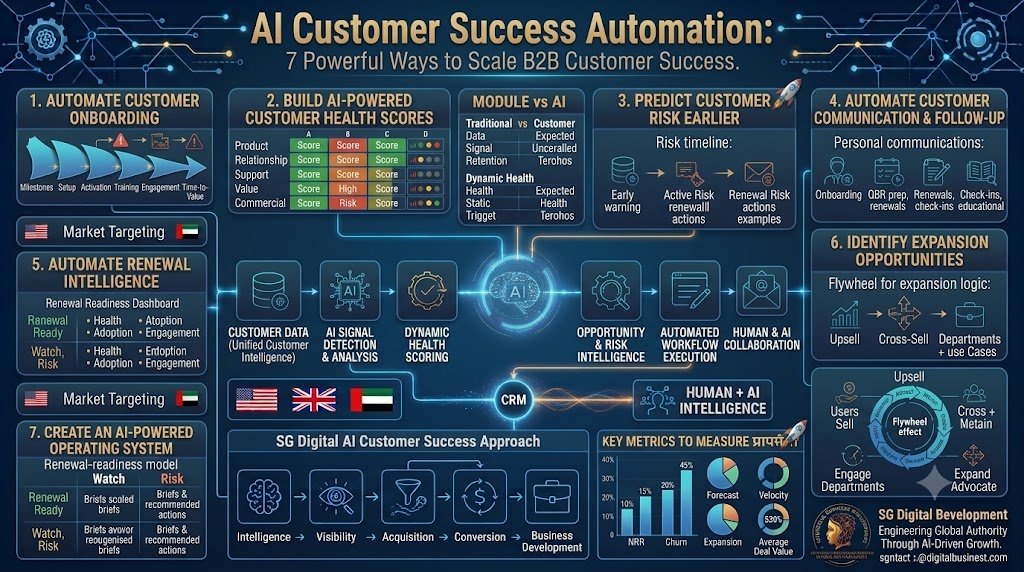
AI Customer Success Automation: 7 Powerful Ways to Scale B2B Customer Success. Introduction B2B customer success becomes more difficult as a company grows. A business may start with a small number of customers that can be managed through direct relationships, regular meetings and manual follow-ups. But as the customer base expands, the same approach becomes increasingly difficult to maintain. Customer success teams must monitor account health, understand customer behavior, track product or service adoption, identify risks, prepare reviews, manage onboarding, support renewals and discover opportunities for expansion. The problem is not necessarily a lack of customer data. The problem is turning that data into timely action. This is where AI customer success automation becomes increasingly important. Instead of relying entirely on manual account reviews, spreadsheets and reactive customer communication, businesses can use AI to analyze customer signals, identify risks, prioritize accounts, automate repetitive workflows and help customer success teams focus on higher-value conversations. Modern B2B AI systems can bring together information from CRM platforms, product usage, customer communications, support interactions, billing information and engagement signals. AI can then help transform these signals into customer health insights, risk alerts, recommended actions and personalized workflows. This does not mean replacing customer success managers. The stronger model is human and AI collaboration. AI can monitor, analyze, prioritize and prepare. Human customer success professionals can interpret context, build relationships, make strategic decisions and handle sensitive customer conversations. McKinsey’s 2026 research on B2B sales and growth similarly describes AI moving into core commercial workflows, including customer intelligence, next-best-opportunity identification and relationship management. In this guide, we will examine 7 powerful AI customer success automation strategies that B2B companies can use to improve customer experience, retention, renewals, expansion and revenue. What Is AI Customer Success Automation? AI customer success automation is the use of artificial intelligence to monitor customer data, identify patterns, predict customer needs, prioritize accounts and automate customer-success workflows. Traditional customer success often depends heavily on manual processes. A customer success manager might need to: As the customer base grows, this becomes difficult to manage consistently. AI customer success automation can assist by continuously analyzing available signals and turning them into actionable recommendations. For example, an AI system might identify that: Instead of expecting a customer success manager to discover every signal manually, AI can surface the relevant information. The human team can then decide what action should happen next. That distinction is important. The goal is not simply to automate communication. The goal is to automate customer intelligence and workflow execution while keeping strategic customer relationships human-led. Why AI Customer Success Automation Matters in 2026 Customer success is becoming increasingly connected to revenue. Retention protects existing revenue. Expansion creates additional revenue. Customer advocacy can create referrals and new opportunities. Renewals protect recurring revenue. Customer success therefore sits at the intersection of customer experience and commercial performance. TSIA’s 2026 research describes customer success as increasingly focused on demonstrating economic value and operating as a strategic function rather than simply maintaining customer relationships. AI can support that transition by helping customer success teams understand what is happening across the customer base. Instead of asking: Which customers need attention? Teams can increasingly ask: Which customers need attention, why do they need it, what is the likely business impact and what should we do next? That is a much more valuable question. AI Customer Success Automation vs Traditional Customer Success Traditional customer success is often reactive. A customer complains. A CSM investigates. A renewal date approaches. The team prepares. A customer stops engaging. Someone notices later. An expansion opportunity appears. The account manager identifies it manually. AI customer success automation introduces a more proactive operating model. Traditional Customer Success AI Customer Success Automation Manual account reviews Continuous signal monitoring Spreadsheet-based tracking Connected customer intelligence Reactive risk management Predictive risk identification Manual health scoring AI-assisted health scoring Generic follow-ups Contextual personalization Manual QBR preparation AI-assisted QBR preparation Individual account prioritization Portfolio-level prioritization Manual expansion discovery AI-assisted opportunity detection Calendar-based workflows Signal-based workflows Separate data sources Unified customer intelligence The objective is not to remove human judgment. The objective is to give customer success teams better information before they act. How AI Customer Success Automation Works A practical AI customer success system can be viewed as a six-stage process. 1. Data Collection The system collects relevant customer signals. These may include: The more reliable the underlying data, the more useful the resulting intelligence becomes. 2. Customer Signal Analysis AI analyzes customer behavior and identifies patterns. For example: A customer may have historically logged into a platform five times per week. That activity suddenly falls to once per week. At the same time, support tickets increase and a key stakeholder stops attending meetings. Individually, each signal may not be decisive. Together, they could represent a meaningful change in customer health. AI can help connect these signals. 3. Customer Health Scoring The system can convert multiple signals into a customer health assessment. A health model may consider: The result can be a dynamic health score or customer-risk classification. Importantly, a health score should not be treated as absolute truth. It is a decision-support mechanism. 4. Opportunity and Risk Detection AI can identify patterns associated with: The customer success team can then prioritize accounts. 5. Workflow Automation Once a signal is identified, an automated workflow can begin. For example: Usage decline → AI detects risk → CSM receives alert → AI prepares account summary → CSM reviews → personalized outreach is sent. Or: Feature adoption → AI detects expansion signal → account is prioritized → AI prepares opportunity brief → sales/CS team coordinates expansion conversation. This is where AI customer success automation becomes more than analytics. It connects intelligence with execution. 6. Human Review The final step should often involve human judgment. AI may identify a potential risk. The customer success manager decides whether the risk is real. AI may recommend an expansion opportunity. The account team determines whether the timing is appropriate. AI may draft an email. A human reviews

AI customer retention
AI Growth Engine

AI Customer Retention: 7 Powerful Ways to Reduce B2B Churn.

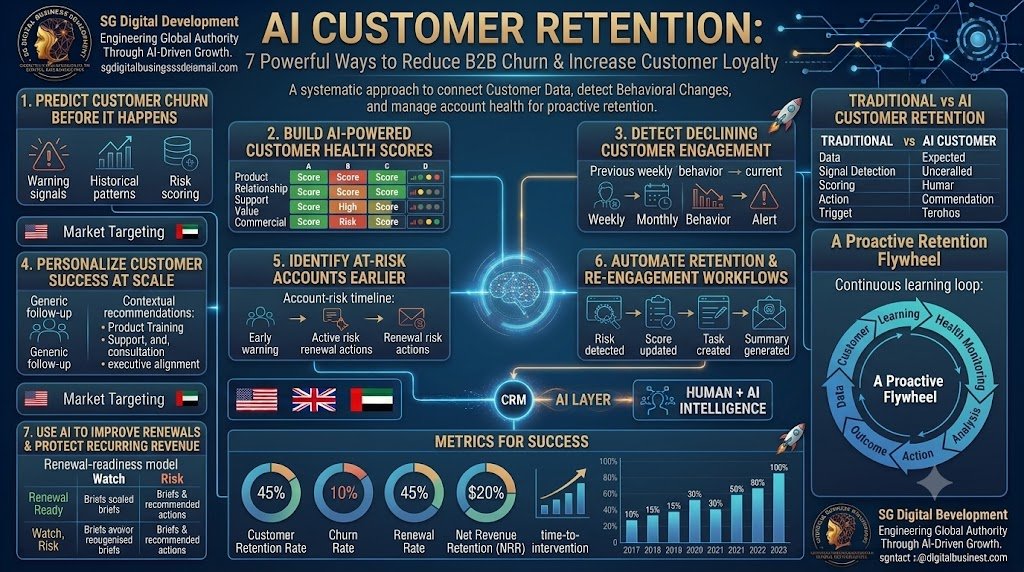
AI Customer Retention: 7 Powerful Ways to Reduce B2B Churn & Increase Customer Loyalty. Introduction Winning a B2B customer is only the beginning of the revenue relationship. After the contract is signed, the business still has to deliver value, maintain engagement, support adoption, manage expectations and demonstrate that the relationship is worth continuing. That makes customer retention one of the most important components of a sustainable B2B revenue strategy. The challenge is that customer churn rarely begins on the day a customer cancels. In many cases, warning signs appear much earlier. Product usage may decline. Key stakeholders may become less engaged. Support issues may remain unresolved. A customer may stop attending meetings. A champion may leave the organization. Business priorities may change. The customer may fail to achieve the outcome that originally justified the purchase. These signals can exist across different systems, teams and conversations. This is where AI customer retention becomes valuable. AI can help businesses bring together customer data, usage patterns, engagement signals, CRM information, support interactions and commercial indicators to identify accounts that may require attention. Research into B2B customer success identifies customer health as an important mechanism for proactive retention, combining factors such as relationship quality, product usage and customer value realization. The objective is not to predict churn and then automatically bombard customers with messages. The objective is to identify risk earlier, understand why the risk may exist, and give customer-facing teams enough context to take a useful action. In 2026, the direction of B2B retention is increasingly moving from reactive reporting toward proactive systems that combine health monitoring, risk detection, intervention workflows and organizational learning. This article explains 7 powerful AI customer retention strategies B2B companies can use to reduce avoidable churn, improve customer health, strengthen relationships and protect recurring revenue. What Is AI Customer Retention? AI customer retention is the use of artificial intelligence, customer data and predictive analysis to identify retention risks, understand customer behavior and help businesses take proactive action to maintain valuable customer relationships. Traditional retention processes often depend on: These methods can work, but they can also leave organizations reacting after important warning signs have already appeared. AI customer retention adds a continuous intelligence layer. Instead of asking only: “Which customers are renewing this month?” the business can ask: “Which customers are showing behavioral or commercial signals that may require attention right now?” That distinction changes retention from a calendar-based activity into an ongoing customer intelligence process. AI can analyze combinations of signals such as: No single signal necessarily proves that a customer is going to churn. The value comes from understanding patterns across multiple signals. Why Customer Retention Matters in B2B Customer retention matters because B2B relationships often develop over time. A customer may initially purchase one service or product and gradually increase its relationship with the provider. Over time, the customer may: When a customer leaves, the business can lose not only the current contract but also potential future revenue. This is why retention connects directly with customer lifetime value. Your AI Customer Lifetime Value strategy asks: How much long-term economic value could this customer generate? Your AI Customer Expansion strategy asks: Where can this customer relationship grow? Your AI Customer Retention strategy asks: What can we do to protect the relationship and prevent avoidable revenue loss? Together, these three areas form an important customer revenue intelligence layer. AI Customer Retention vs Traditional Retention Traditional customer retention often relies on scheduled reviews. For example: Quarterly review → customer health discussion → renewal preparation → account action AI customer retention can create a more continuous process: Customer activity → signal detection → risk analysis → prioritization → intervention → outcome measurement The difference is not simply automation. It is the ability to process a larger volume of customer information consistently. Traditional Retention AI Customer Retention Periodic reviews Continuous monitoring Manual account analysis AI-assisted analysis Static health scores Dynamic health signals Renewal-focused Relationship-focused Reactive intervention Proactive intervention Limited data sources Multiple data sources Generic follow-up Contextual recommendations Manual prioritization Risk-based prioritization AI does not eliminate customer success teams. Instead, it can help them determine where their attention is most valuable. How AI Customer Retention Works An effective AI customer retention system usually combines several data layers. 1. Customer Relationship Data This may include: 2. Product or Service Usage Depending on the business, this could include: 3. Engagement AI can evaluate: 4. Support Support data can provide important context: 5. Commercial Signals These can include: 6. Relationship Signals AI can also help identify: The goal is to create a more complete view of customer health. 7 Powerful AI Customer Retention Strategies 1. Predict Customer Churn Before It Happens One of the most obvious applications of AI customer retention is churn-risk prediction. A traditional approach may identify a customer as at risk when they say: “We are considering not renewing.” At that point, the company may already be late. AI can instead look for patterns that appear earlier. For example: A single signal is not necessarily enough. But several signals appearing together can justify a closer review. An AI model can assign an account a risk score based on historical patterns and current customer behavior. For example: Low Risk Stable usage + strong engagement + healthy relationship. Moderate Risk Some engagement decline + unresolved issues + lower product adoption. High Risk Sharp usage decline + negative engagement + unresolved problems + approaching renewal. The score should not be treated as certainty. It should be treated as a prioritization signal. This distinction is critical. A model can tell a customer success team: “This account deserves attention.” The customer success team still needs to determine: “Why?” and: “What should we do?” 2. Build AI-Powered Customer Health Scores Customer health scores have traditionally been built using manually selected rules. For example: The problem is that the same weighting may not work for every customer segment. AI customer retention can help identify which combinations of signals historically correlate with retention or churn. A modern

AI customer expansion
AI Growth Engine

AI Customer Expansion: 7 Powerful Ways to Grow B2B Revenue.

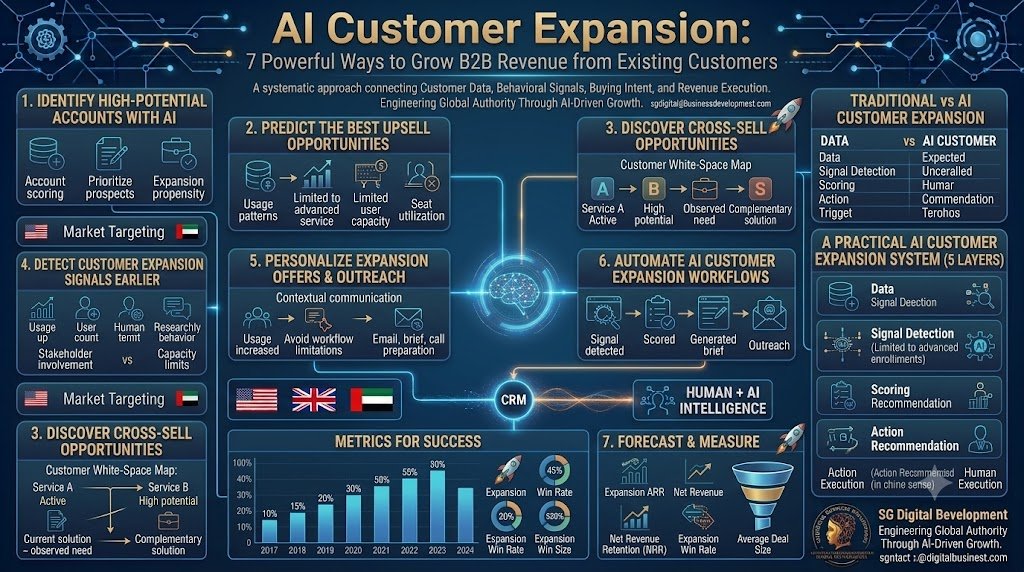
AI Customer Expansion: 7 Powerful Ways to Grow B2B Revenue from Existing Customers Introduction For many B2B companies, revenue growth is still heavily associated with acquiring new customers. Sales teams build prospect lists. Marketing generates demand. SDRs contact new accounts. Paid advertising brings new visitors. Business development teams search for new opportunities. But there is another revenue opportunity that is often much closer to the business: the customers who already buy from you. Existing customers already understand your company, have experience with your products or services, have established relationships with your team and may already have internal use cases that can support additional purchases. The challenge is knowing which customers are ready to expand, what they are likely to buy, and when the conversation should happen. This is where AI customer expansion becomes increasingly valuable. AI can analyze customer behavior, product usage, CRM information, support interactions, engagement patterns, account changes and other business signals to identify potential expansion opportunities. Instead of asking account managers to manually inspect hundreds of accounts, AI can help prioritize the accounts most likely to have a relevant growth opportunity. In 2026, AI-powered customer expansion is moving beyond simple automated recommendations. Modern systems can connect customer data, detect behavioral changes, identify buying signals and recommend next actions for sales and customer success teams. Gartner, for example, describes AI-powered listening as a way to improve the targeting of cross-sell and upsell opportunities. The objective is not to sell more to every customer. The objective is to understand customers better and identify situations where additional products, services, capacity or functionality can genuinely create more value. This article explains 7 powerful AI customer expansion strategies B2B companies can use to grow revenue from existing accounts. What Is AI Customer Expansion? AI customer expansion is the use of artificial intelligence, customer data and predictive analysis to identify, prioritize and act on opportunities to increase revenue from existing customers. Expansion can happen in several ways: Traditional customer expansion often depends heavily on account-manager experience. A salesperson might know that a particular customer is growing rapidly. A customer success manager might notice increased usage. A support representative might hear a customer asking for a capability that is not included in their current plan. These signals can be valuable, but they are often fragmented across different systems. AI can bring those signals together. For example, an AI customer expansion system could identify an account where: Individually, these signals may not mean much. Together, they could indicate a meaningful expansion opportunity. That is the fundamental value of AI customer expansion: connecting fragmented customer signals to identify commercially relevant opportunities. Why Customer Expansion Matters in B2B Customer expansion is different from new customer acquisition. When acquiring a new customer, a company typically has to generate awareness, establish credibility, identify a business problem, create demand, overcome objections, compete against alternatives and complete a sales process. An existing customer starts from a different position. There is already a commercial relationship. There is already customer history. There may already be product adoption. There may already be trust. And the company has access to information about the customer’s needs. That makes the existing customer base an important source of potential revenue growth. Customer expansion also connects directly with customer lifetime value. A company can increase customer lifetime value by retaining customers longer, increasing their purchase frequency, expanding their product usage or increasing the value of their contracts. AI customer expansion focuses particularly on identifying those growth opportunities. Research and industry analysis in 2026 increasingly highlights AI’s ability to identify expansion opportunities by combining product usage, engagement, service interactions and account information. However, expansion should not become aggressive selling. A strong expansion strategy begins with customer value. The question should be: “What additional solution could help this customer achieve a business outcome they are already pursuing?” Not: “What else can we sell this customer?” That distinction is critical. AI Customer Expansion vs Traditional Account Expansion Traditional expansion often relies on periodic account reviews. An account manager may review customers once a month or once a quarter and ask: The problem is that important signals can appear between reviews. A customer may suddenly increase usage. A new executive may join the company. A customer may hire 100 new employees. A support conversation may reveal a capacity problem. A customer may begin using a feature associated with a higher plan. An existing customer may visit a product page several times. An AI customer expansion system can continuously analyze these signals instead of waiting for the next scheduled account review. Traditional Expansion AI Customer Expansion Periodic account reviews Continuous signal monitoring Manual analysis Automated analysis Individual account-manager judgment AI-assisted prioritization Limited data sources Multiple data sources Static customer segments Dynamic account scoring Reactive outreach Signal-based outreach Generic expansion campaigns Personalized recommendations Manual opportunity discovery Automated opportunity detection AI does not eliminate the account manager. Instead, it can help the account manager spend more time on the customers and conversations that matter most. How AI Customer Expansion Works An effective AI customer expansion system generally combines several layers of data. 1. Customer and CRM Data This can include: 2. Product or Service Usage For technology companies, this could include: For service businesses, comparable signals could include: 3. Engagement Data AI can analyze: 4. Support and Service Data Support interactions can contain commercially important information. Customers may mention: Recent research and industry commentary increasingly points to service and support interactions as potential sources of expansion signals. 5. External Business Signals AI can also incorporate signals such as: The more relevant signals an organization can connect responsibly, the more context its expansion models can potentially provide. 7 Powerful AI Customer Expansion Strategies 1. Identify High-Potential Accounts with AI Not every customer has the same expansion potential. Some accounts may be stable but unlikely to increase spending. Others may be growing rapidly and already showing multiple signs of additional demand. AI customer expansion systems can help identify these differences. An AI model can create an expansion

AI customer lifetime value
AI Growth Engine

AI Customer Lifetime Value: 7 Powerful Ways to Increase B2B Customer Value

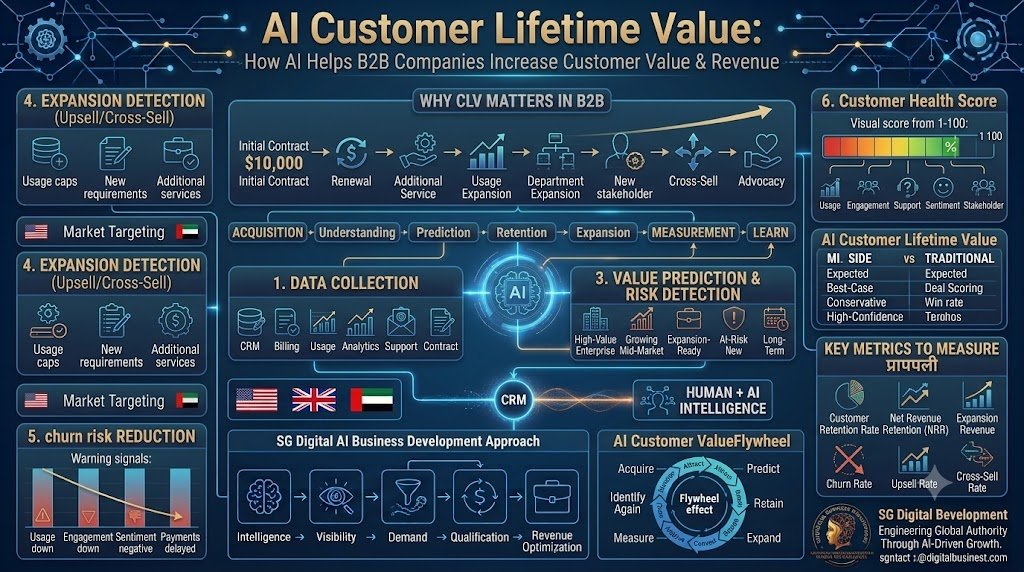
AI Customer Lifetime Value: How AI Helps B2B Companies Increase Customer Value & Revenue Introduction B2B growth is often measured by how many new customers a company acquires. But acquisition is only one part of the revenue equation. A company can generate hundreds of leads, close new accounts and still struggle to build predictable long-term revenue if customers do not renew, expand or remain engaged. That is why AI customer lifetime value is becoming an important concept for modern B2B growth. Customer lifetime value, commonly abbreviated as CLV or LTV, represents the economic value a customer may generate throughout the relationship with a business. In B2B markets, calculating that value can be more complicated than simply multiplying an average order value by the number of purchases. A B2B customer may: AI can help businesses analyze these patterns and identify opportunities to improve the long-term value of customer relationships. Instead of asking only: “How much did this customer buy?” businesses can begin asking: “What is this customer likely to be worth over the entire relationship, what could increase that value, and what risks could reduce it?” That shift connects customer success, sales, marketing, revenue operations and business development. This article explains how AI customer lifetime value works, how AI can improve retention and expansion, and how B2B companies can build a customer-value system that connects acquisition with long-term revenue growth. What Is AI Customer Lifetime Value? AI customer lifetime value refers to using artificial intelligence, predictive analytics and customer data to estimate, understand and improve the long-term economic value of individual customers or customer segments. Traditional customer lifetime value calculations often use relatively simple formulas. For example: Customer Lifetime Value = Average Customer Revenue × Expected Customer Lifespan More advanced models may incorporate: AI can take this analysis further by incorporating a much broader range of signals. These may include: The objective is not simply to calculate one LTV number. The objective is to understand customer value dynamically. Why Customer Lifetime Value Matters in B2B B2B customer relationships can last for months or years. A customer who initially purchases a small service may eventually become a major account. For example: A company may initially purchase a $10,000 service. After a successful first year, it may: The initial transaction therefore does not represent the full commercial opportunity. Customer lifetime value provides a broader perspective. Instead of optimizing only for the first transaction, businesses can optimize for: Acquisition → Activation → Retention → Expansion → Advocacy AI can help identify where customers are within this lifecycle and what actions may increase long-term value. AI Customer Lifetime Value vs Traditional CLV Traditional CLV models can still be useful. They provide a structured way to estimate customer economics. However, traditional calculations can become limited when customer behavior changes rapidly. A static calculation may not fully capture: AI can make customer value analysis more dynamic. Traditional CLV AI Customer Lifetime Value Historical calculation Dynamic prediction Periodic analysis Continuous analysis Limited variables Multiple customer signals Segment-based Account-level potential Reactive Predictive Revenue-focused Revenue + retention + expansion Manual reporting Automated intelligence The objective is not to replace traditional financial analysis. It is to complement it with more detailed customer intelligence. How AI Customer Lifetime Value Works An AI-powered customer value system can be organized into several stages. 1. Customer Data Collection The system collects relevant information from multiple sources. This can include: The more connected the data environment, the more complete the customer profile can become. 2. Customer Segmentation AI can identify patterns among customers. For example, it may distinguish between: This allows businesses to avoid treating every customer identically. 3. Value Prediction AI can estimate future customer value using historical and current signals. Potential factors include: The result can be a dynamic customer-value estimate. 4. Risk Detection AI can identify patterns associated with declining customer value. Examples include: These signals can trigger proactive intervention. 5. Expansion Detection AI can also identify positive signals. For example: These can indicate potential expansion opportunities. 7 Powerful Ways AI Can Increase B2B Customer Lifetime Value 1. Predict High-Value Customers Earlier Not every customer has the same long-term commercial potential. AI can analyze customer characteristics and identify patterns associated with higher future value. For example, a customer may initially generate modest revenue but demonstrate: These characteristics may indicate future growth potential. Sales and customer-success teams can then prioritize relationship development accordingly. The goal is not to ignore smaller customers. The goal is to understand where different levels of commercial potential exist. 2. Predict and Reduce Churn Risk Customer churn can reduce lifetime value significantly. AI can help detect warning signals before a customer formally decides to leave. Potential signals include: An AI system can combine multiple signals to identify accounts that deserve attention. For example: Usage declining Key stakeholder no longer engaging Support issues increasing Renewal approaching could create a higher-priority retention alert. The system does not need to decide automatically that the customer will churn. Instead, it can prompt the customer-success team to investigate. 3. Identify Upsell Opportunities Upselling means encouraging an existing customer to purchase a higher-value version of a product or service. AI can help identify when a customer may be ready. Potential signals include: Timing matters. An upsell offer delivered too early may be irrelevant. An offer delivered when the customer is already experiencing a need may be much more relevant. AI can help identify these moments. 4. Identify Cross-Sell Opportunities Cross-selling involves offering complementary products or services. AI can analyze patterns among similar customers. For example: Customers who purchase Service A may frequently purchase Service B after a particular period. AI can identify that relationship. The business can then develop a relevant expansion strategy. Instead of sending generic: “Would you like to buy another service?” the business can approach the customer with a more contextual proposition. This can improve the relevance of expansion conversations. 5. Personalize Customer Experiences Customer lifetime value is influenced by the quality and relevance of the customer relationship. AI can help personalize:

AI sales forecasting
AI Growth Engine

AI Sales Forecasting: How to Predict B2B Revenue with AI.

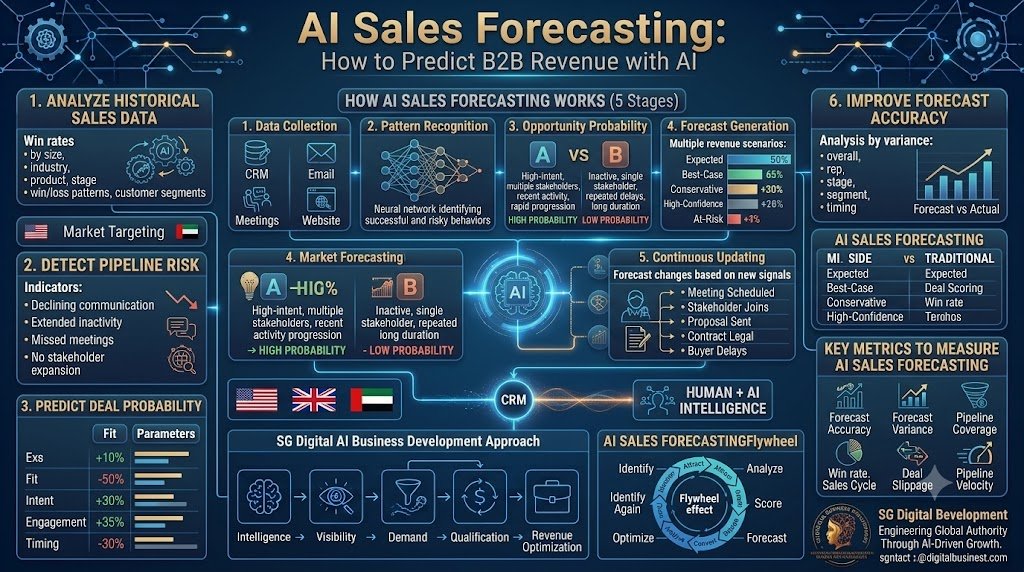
Introduction B2B companies are under constant pressure to answer one important question: How much revenue are we likely to generate? Traditional sales forecasting often depends on spreadsheets, historical averages, sales-representative judgment, CRM updates and periodic pipeline reviews. These methods can provide useful information, but they can also become difficult to manage when sales pipelines become larger, buying journeys become more complex and customer behavior changes quickly. AI sales forecasting introduces a more dynamic approach. Instead of relying only on historical performance and manually updated forecasts, businesses can use artificial intelligence to analyze pipeline activity, opportunity data, buyer behavior, historical sales patterns, engagement signals and other commercial information to identify patterns that may influence future revenue. For B2B organizations, this can transform forecasting from a periodic reporting exercise into an ongoing revenue intelligence process. AI can help sales teams identify opportunities that deserve attention, detect deals showing signs of risk, recognize changes in buyer engagement and create more informed revenue scenarios. However, AI does not eliminate the need for sales leadership or human judgment. The most effective approach combines machine intelligence with accurate CRM data, clear sales processes and experienced commercial decision-making. This article explains how AI sales forecasting works, why it matters, how it connects with AI sales pipelines and revenue intelligence, and how B2B companies can build a practical forecasting system. What Is AI Sales Forecasting? AI sales forecasting is the use of artificial intelligence, machine learning, predictive analytics and business data to estimate future sales performance and revenue outcomes. A traditional forecast might ask: “Which deals do our sales representatives expect to close this quarter?” An AI-supported forecasting system can ask a much broader set of questions: The objective is not simply to produce another sales number. The objective is to create a more complete understanding of future revenue probability, pipeline health and commercial risk. Why B2B Companies Need Better Sales Forecasting B2B sales cycles can involve multiple decision-makers, long procurement processes, technical evaluations, budgets, legal reviews and changing priorities. A deal that appears likely to close can sometimes move backward or remain inactive for weeks. At the same time, an opportunity that initially appears uncertain can accelerate when buyer engagement increases. This creates a major forecasting challenge. A sales manager may have dozens or hundreds of opportunities across different stages. Manually reviewing every opportunity in detail is difficult. AI can help analyze these opportunities continuously. Traditional forecasting often depends on: AI-supported forecasting can additionally analyze: This creates a more dynamic view of potential revenue. How AI Sales Forecasting Works An AI forecasting system generally combines multiple data sources and analyzes relationships between them. The process can be simplified into five stages. 1. Data Collection The system collects relevant commercial information. This may include: The quality of this data matters enormously. If CRM records are incomplete or outdated, the forecasting model may produce unreliable outputs. 2. Pattern Recognition AI analyzes historical and current information to identify patterns. For example, the system may discover that certain combinations of signals historically correlate with successful deals. It may identify patterns such as: It can also identify risk patterns. For example: These patterns can contribute to opportunity-level forecasting. 3. Opportunity Probability AI can estimate the likelihood of different opportunities progressing. Instead of treating every opportunity in the same stage as equally valuable, an AI-supported system can consider additional signals. For example: Opportunity A Opportunity B A traditional stage-based forecast might give both opportunities significant weight. An AI system can distinguish between their different risk profiles. 4. Forecast Generation The system can then produce forecasts based on available opportunity and historical information. Forecast categories may include: This allows management teams to examine different revenue scenarios. 5. Continuous Updating One of the major advantages of AI forecasting is that forecasts can be updated as new information becomes available. For example, a forecast may change when: This creates a more dynamic forecasting environment. 7 Powerful Ways AI Improves B2B Sales Forecasting 1. Analyze Historical Sales Data Historical data provides an important foundation for forecasting. AI can analyze previous sales activity and identify patterns across: For example, a company might discover that enterprise opportunities sourced through a particular channel have a significantly longer sales cycle than smaller opportunities. That information can improve future forecasts. Instead of applying one generic probability to every opportunity, the business can incorporate historical patterns into its forecasting process. 2. Detect Pipeline Risk One of the most valuable applications of AI is identifying potential risk before a deal is officially lost. Pipeline risk can appear in subtle ways. An opportunity may still be marked as “active” inside a CRM while buyer engagement has already declined. AI can help identify patterns associated with potential risk. Examples include: The purpose is not to automatically declare a deal lost. Instead, AI can flag the opportunity for human review. A sales manager can then ask: “What changed in this opportunity?” That can lead to earlier intervention. 3. Predict Deal Probability Not every opportunity has the same probability of producing revenue. AI can analyze multiple variables to estimate deal probability. Potential variables include: This creates a more detailed opportunity view. For example: Opportunity Deal Value Pipeline Stage AI Risk Signal Forecast Consideration A $40,000 Proposal Low Strong B $75,000 Negotiation Medium Review C $120,000 Proposal High Conservative D $25,000 Discovery Medium Longer-term The exact calculations will depend on the company’s data and forecasting system. The important point is that AI can help move forecasting beyond a simple stage-based model. 4. Identify Stalled Opportunities Pipeline stagnation can significantly affect revenue. An opportunity may remain in the same stage for: depending on the sales cycle. AI can compare opportunity duration with historical patterns. If similar opportunities normally progress within 14 days but one has remained in the same stage for 45 days, the system can flag it. Sales leadership can then investigate. Possible actions might include: This helps keep the pipeline more realistic. 5. Monitor Buyer Intent Signals Revenue forecasting becomes more useful when it incorporates signals from

AI revenue optimization
AI Growth Engine

AI Revenue Optimization: How to Increase B2B Sales, Conversion Rates & Customer Value.

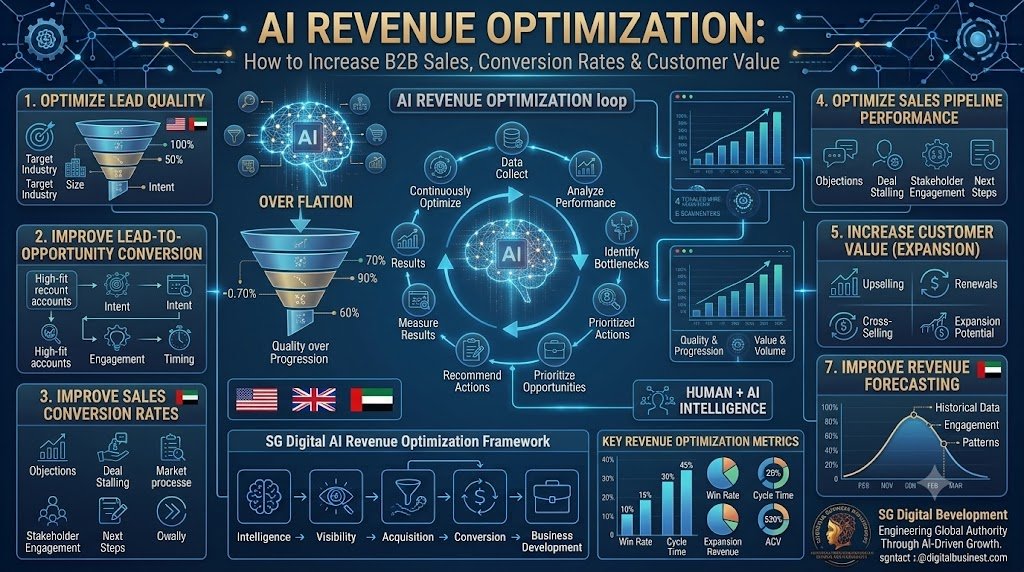
Introduction AI revenue optimization is becoming an important strategy for B2B companies that want to improve sales performance, increase conversion rates, reduce revenue leakage and generate more value from existing customer relationships. Traditional revenue growth often depends on increasing lead volume, hiring more salespeople or spending more money on advertising. Those strategies can work. But there is another opportunity: improving the efficiency of the revenue system that already exists. A B2B company may already have website traffic, leads, sales opportunities, customers, CRM data, sales conversations and marketing campaigns. The question is whether the business is extracting the maximum possible value from those assets. This is where AI revenue optimization becomes relevant. AI can analyze large volumes of revenue data, identify patterns, surface bottlenecks, prioritize opportunities and help teams determine where improvement may have the greatest commercial impact. Instead of asking only: “How can we generate more leads?” businesses can begin asking: These questions move the focus from volume to efficiency. For B2B companies targeting markets such as the USA, UK and UAE, this can create an opportunity to build a more connected revenue engine across marketing, sales, business development and customer growth. This guide explains how AI revenue optimization works, where businesses can use it, which metrics matter, how it connects with AI sales pipelines and revenue intelligence, and how to build a practical optimization system. What Is AI Revenue Optimization? AI revenue optimization is the use of artificial intelligence, revenue data and automated analysis to identify opportunities for improving the efficiency and performance of a company’s revenue-generating processes. It can be applied across the customer journey. That includes: The objective is not simply to automate sales. It is to determine where revenue performance can be improved and help teams act on those opportunities. For example, imagine a company generating 1,000 monthly leads. Increasing that number to 1,500 may sound attractive. But if only 20 of the original 1,000 become customers, increasing volume without improving qualification or conversion may create more work without producing proportional revenue. AI revenue optimization asks a different question: Can the business improve the percentage of valuable leads that become customers? That shift can be commercially important. Why AI Revenue Optimization Matters for B2B Companies B2B revenue systems contain many interconnected variables. A typical journey may involve: Search → Website → Lead → Qualification → Sales Conversation → Opportunity → Proposal → Negotiation → Customer → Expansion A weakness at any stage can affect the final result. For example: Revenue optimization looks at the complete system. AI becomes useful because modern B2B organizations generate large amounts of information across these stages. That information may exist in: AI can help connect those signals and identify patterns that would be difficult to detect manually. AI Revenue Optimization vs Revenue Growth Revenue growth and revenue optimization are related but not identical. Revenue Growth Focuses on generating more revenue. Examples: Revenue Optimization Focuses on improving the efficiency and value of the existing revenue system. Examples: The strongest B2B growth strategy often combines both. You can generate more demand while simultaneously improving the efficiency of converting that demand into revenue. How AI Revenue Optimization Works A practical AI revenue optimization system can be viewed as a continuous loop. Step 1: Collect Data Bring together relevant revenue information. This may include: Step 2: Analyze Performance AI examines patterns across the available data. Step 3: Identify Bottlenecks The system looks for areas where performance is weaker than expected. Step 4: Prioritize Opportunities Not every improvement has equal commercial value. AI can help identify which opportunities deserve attention first. Step 5: Recommend Actions The system can surface potential next steps. Step 6: Measure Results The business measures whether the intervention improved performance. Step 7: Continuously Optimize Successful changes become part of the revenue process. The cycle becomes: Data → Analysis → Opportunity → Action → Measurement → Optimization 7 Powerful Ways AI Can Optimize B2B Revenue 1. Optimize Lead Quality More leads do not automatically mean more revenue. Lead quality matters. AI can analyze lead characteristics and engagement signals to identify patterns associated with qualified opportunities. Potential signals include: Instead of treating every lead equally, sales teams can prioritize leads according to relevance and potential value. This can improve sales productivity. A representative who has 100 leads does not necessarily need to contact all 100 with equal urgency. AI can help determine which leads deserve immediate attention. 2. Improve Lead-to-Opportunity Conversion The transition from lead to opportunity is one of the most important points in a B2B funnel. A company may generate thousands of leads but create relatively few qualified opportunities. AI can analyze historical conversion patterns and identify factors associated with successful progression. For example, successful opportunities might commonly involve: These patterns can inform qualification. The objective is not to assume every future buyer will behave exactly like previous buyers. The objective is to use historical evidence as an additional decision signal. 3. Improve Sales Conversion Rates Conversion optimization is not limited to websites. It also applies to sales conversations. AI can analyze sales activity to help businesses understand: This can reveal opportunities to improve sales processes. For example: If successful deals consistently involve three or more stakeholder conversations while unsuccessful deals involve only one contact, sales teams may want to improve multi-stakeholder engagement. That is an actionable revenue insight. 4. Optimize Sales Pipeline Performance Your sales pipeline contains potential future revenue. But pipeline value is not the same as pipeline quality. AI can help evaluate: This allows revenue teams to identify: The result is a more focused pipeline management process. 5. Increase Customer Value Revenue optimization does not stop when a customer signs a contract. Existing customers can generate additional revenue through: AI can analyze account activity to identify potential expansion signals. For example: A customer may begin using more of a service, engage with additional product information or ask about capabilities outside their current contract. Those signals may indicate expansion potential. The account team can then decide whether a conversation

AI revenue intelligence
AI Growth Engine

AI Revenue Intelligence: How AI Helps B2B Companies Forecast, Optimize & Grow Revenue.

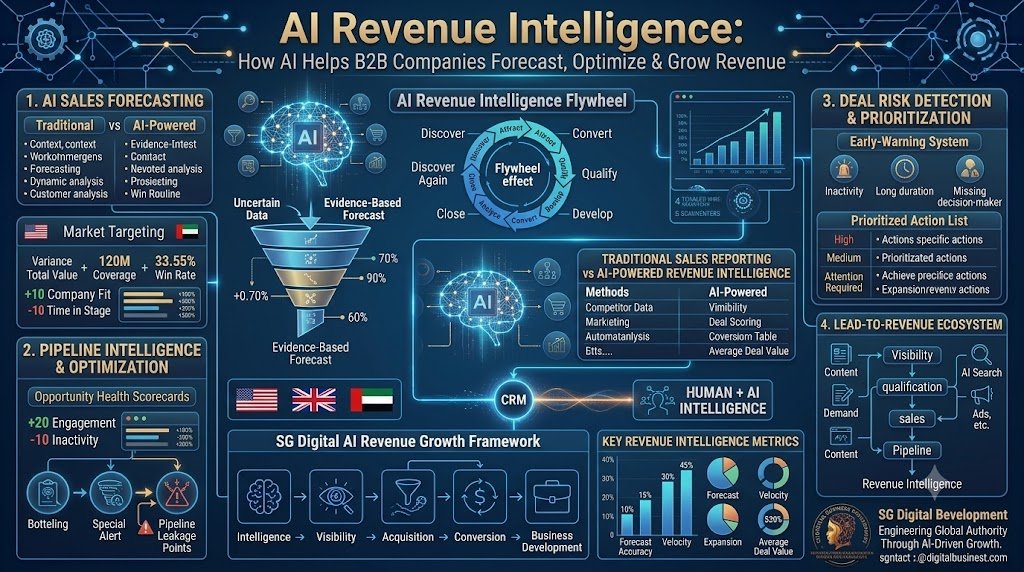
Introduction AI revenue intelligence is changing how B2B companies understand sales performance, identify revenue opportunities, manage pipeline risk and make forecasting decisions. Traditional sales reporting tells businesses what happened. Modern revenue intelligence aims to help teams understand what is happening now, what may happen next and which actions deserve attention. For B2B companies operating across competitive markets such as the USA, UK and UAE, this distinction matters. Sales teams are dealing with longer buying journeys, multiple stakeholders, fragmented customer data, increasing digital touchpoints and buyers who often research vendors before speaking with a salesperson. An effective AI revenue intelligence system connects these signals. It can combine CRM activity, sales conversations, email engagement, pipeline movement, lead qualification, account activity and other available business signals to help sales and revenue teams identify opportunities, detect risks and prioritize actions. Revenue intelligence is therefore not simply another dashboard. It is an approach to making revenue decisions using connected data, artificial intelligence and actionable sales intelligence. In this guide, we will explore how AI revenue intelligence works, how it supports forecasting, how it improves pipeline management, how it identifies revenue opportunities, how it connects marketing and sales, and how B2B companies can build a practical revenue intelligence system. What Is AI Revenue Intelligence? AI revenue intelligence is the use of artificial intelligence, data analysis and connected revenue signals to help B2B companies understand, predict and improve revenue performance. Instead of relying exclusively on manually updated CRM records, spreadsheets or sales representative opinions, an AI-powered system can analyze multiple signals across the customer journey. These signals may include: The objective is not to remove humans from revenue decisions. The objective is to give sales and business development teams better information so they can make better decisions faster. Modern revenue intelligence is increasingly described as a forward-looking layer that connects revenue data and uses AI to surface risks, opportunities and recommended actions rather than simply producing historical reports. Why AI Revenue Intelligence Matters for B2B Companies B2B revenue generation is rarely a straight line. A prospect may discover a company through Google or AI search, visit the website, download information, speak with a salesperson, involve another stakeholder, compare competitors, request pricing and then disappear for three weeks. A traditional CRM may record only some of these events. This creates a major visibility problem. A sales manager may see: Opportunity → Proposal → $50,000 → 60% probability But the underlying reality could be very different. The buyer may not have responded for 14 days. The decision-maker may never have joined the conversation. A competitor may have entered the evaluation. The prospect may have stopped engaging. The next step may not actually be scheduled. AI revenue intelligence attempts to identify these patterns. Instead of asking only: “What deals are in our pipeline?” the business can begin asking: This changes revenue management from simple reporting toward continuous intelligence. AI Revenue Intelligence vs Traditional Sales Reporting Traditional sales reporting is valuable. Businesses still need dashboards, CRM reports, revenue summaries and historical performance analysis. The difference is that reporting generally describes data, while AI revenue intelligence attempts to interpret that data and turn it into actionable insight. Traditional Sales Reporting AI Revenue Intelligence Primarily historical Historical + current + predictive Shows pipeline value Evaluates pipeline health Tracks opportunity stages Analyzes deal signals Relies heavily on CRM updates Can analyze multiple data sources Static reports Continuously updated intelligence Human interpretation required AI can surface patterns and risks Focuses on what happened Helps identify what may happen next Limited recommendations Can suggest next actions Modern revenue intelligence systems can combine predictive AI, generative AI and workflow automation to move from reporting toward insights and action. The distinction is important. A dashboard might show that an opportunity has been open for 90 days. Revenue intelligence can help identify that the opportunity has: The second view is much more actionable. How AI Revenue Intelligence Works A practical AI revenue intelligence system typically follows a five-step process. 1. Collect Revenue Data The system first needs access to relevant business information. This may include: The goal is to create a connected view of revenue activity. 2. Clean and Organize the Data AI cannot produce reliable insights from severely fragmented or inaccurate information. Data quality therefore matters. A revenue intelligence system may help identify: Good data creates a stronger foundation for analysis. 3. Analyze Revenue Signals The AI layer evaluates available signals. For example: A prospect opens several emails, attends a product demonstration, brings another stakeholder into a meeting and requests implementation information. Individually, each event may appear relatively ordinary. Together, they can represent a meaningful change in buying intent. AI can help connect these events. 4. Identify Opportunities and Risks Once signals are analyzed, the system can identify patterns. Potential positive signals include: Potential risk signals include: These signals can then be used to prioritize sales activity. 5. Recommend or Trigger Actions The final stage is action. AI revenue intelligence becomes much more valuable when insights lead to practical next steps. For example: Signal: Decision-maker has not engaged. Recommendation: Identify and engage the relevant stakeholder. Or: Signal: Opportunity has stalled for 21 days. Recommendation: Trigger a structured re-engagement sequence. Or: Signal: Multiple buying signals detected. Recommendation: Increase sales priority and schedule an executive-level conversation. This creates a closed loop: Data → Intelligence → Decision → Action → Outcome AI Revenue Intelligence for Sales Forecasting Forecasting is one of the most important applications of revenue intelligence. Traditional forecasting often depends heavily on: These inputs can be useful, but they may not capture the full picture. AI-powered forecasting can incorporate a wider range of signals. For example: The result can be a more evidence-based forecast. Importantly, AI forecasting should not be treated as an infallible prediction. It is a decision-support system. Sales leaders should understand what signals influence a forecast and retain human judgment for unusual deals, strategic accounts and situations where the available data is incomplete. AI Revenue Intelligence and Pipeline Forecasting Pipeline value alone does not equal

Scroll to Top