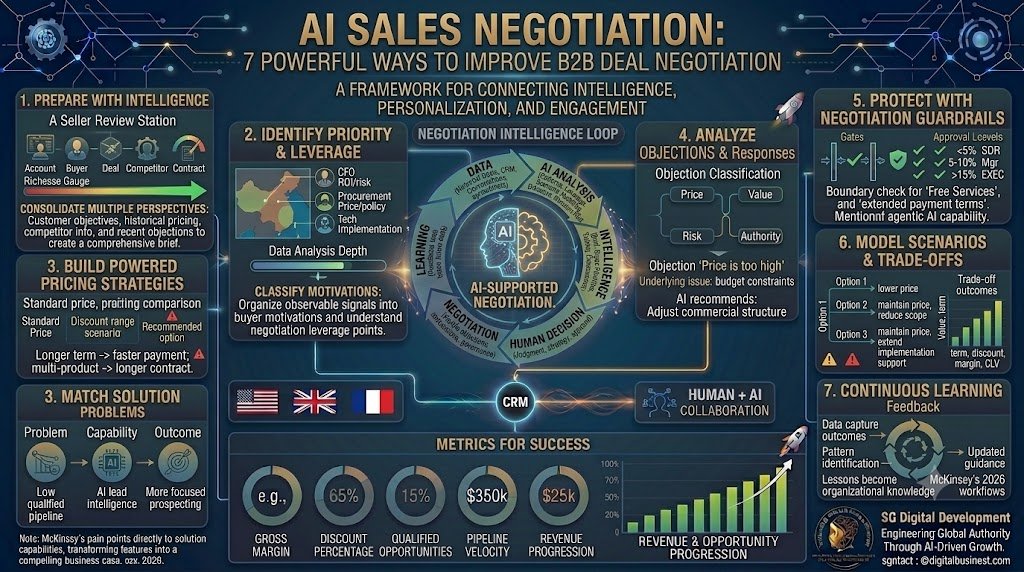
AI Sales Negotiation: 7 Powerful Ways to Improve B2B Deal Negotiation.
AI Sales Negotiation: 7 Powerful Ways to Improve B2B Deal Negotiation. Introduction B2B sales negotiations have traditionally depended heavily on the experience, preparation and judgment of individual sales representatives. A seller enters a negotiation with information about the customer, the opportunity, the product, the competition and the expected commercial terms. But much of that information is often fragmented. Some of it sits in the CRM. Some is contained in previous sales conversations. Some is buried in emails. Some exists in pricing spreadsheets. Some is known only by the account executive. And some is based on the seller’s personal experience negotiating similar deals. This creates a problem. Two sales representatives can negotiate similar opportunities and reach very different commercial outcomes. One may recognize that a buyer has strong urgency and limited alternatives. Another may offer a discount too early. One may understand the customer’s real buying criteria. Another may negotiate primarily around price. One may know exactly which concessions are acceptable. Another may give away value without receiving anything meaningful in return. An AI sales negotiation strategy can help reduce these inconsistencies by giving sales teams better intelligence before and during important commercial conversations. AI can analyze historical transactions, customer characteristics, deal context, pricing information, buyer signals and competitive factors to help sellers prepare for negotiations. It can help identify: The purpose is not to let AI make every negotiation decision. The more practical model is human-led negotiation supported by AI intelligence. That distinction is important. Current 2026 research from McKinsey describes AI applications across pricing and negotiation, including deal scoring, discount guidance, pricing recommendations and negotiation support. McKinsey also emphasizes human oversight for higher-risk commercial decisions. The result is a new approach to B2B negotiation: Better intelligence → Better preparation → Better decisions → Better commercial outcomes This article explores seven powerful ways businesses can use an AI sales negotiation strategy to improve preparation, pricing, objection handling, concessions, deal governance and negotiation performance. What Is AI Sales Negotiation? AI sales negotiation is the use of artificial intelligence, sales data, pricing intelligence and buyer information to help sales teams prepare for, manage and improve B2B commercial negotiations. Traditional negotiation preparation might involve: An AI-assisted process can bring these activities together. The system can analyze: It can then provide the seller with a structured negotiation brief. For example: Opportunity Enterprise SaaS prospect Deal value $180,000 annual contract Primary buyer priority Implementation speed Major concern Internal adoption Competitive pressure Two competing vendors Historical pricing benchmark Similar accounts typically receive 8–12% discount Recommended negotiation position Protect implementation and service value; avoid discounting those components without reciprocal commitment Potential concession Additional onboarding support in exchange for longer contract term This type of intelligence does not replace the salesperson. It gives the salesperson a stronger foundation for the conversation. Why AI Sales Negotiation Matters for B2B Companies Negotiation is one of the areas where small decisions can have significant financial consequences. A modest discount may appear harmless on one deal. Across hundreds of deals, however, unnecessary discounting can create substantial revenue and margin leakage. The same applies to: The problem is not that concessions are always bad. Concessions can be strategically useful. The problem is making concessions without understanding their value. An effective AI sales negotiation system can help sales teams distinguish between: Necessary concessions and avoidable concessions This is one reason AI-powered pricing and negotiation is receiving increasing attention. McKinsey’s 2026 research on B2B pricing found that organizations are increasingly exploring generative AI and agentic AI for pricing activities, including configuration, quoting, deal pricing, discount approval and negotiation-related workflows. The broader opportunity is to move from: Negotiation based primarily on individual judgment to: Negotiation supported by structured commercial intelligence. 7 Powerful Ways to Use AI Sales Negotiation 1. Use AI to Prepare for Every Negotiation Preparation is one of the strongest use cases for AI. Before a negotiation, the seller needs to understand the opportunity from multiple perspectives. An AI system can consolidate the information required to create a negotiation brief. The brief can include: Instead of spending an hour searching through different systems, the seller can begin with a structured summary. Example Suppose a technology company is negotiating a three-year agreement. The buyer has requested a 20% discount. A simple sales process might respond: We can probably offer 15% if you sign this month. An AI-supported preparation process could provide more context: The salesperson now has a much better foundation. The negotiation is no longer simply: “How much discount can we give?” It becomes: “What does the buyer value, what does the seller need, and what should each concession be worth?” Build a negotiation intelligence brief SG Digital could structure this into an AI Negotiation Brief containing: Deal summary Buyer priorities Commercial objectives Negotiation risks Pricing benchmark Likely objections Recommended responses Concession options Approval requirements Next-best actions This can become a repeatable component of the AI-powered sales process. 2. Identify Buyer Priorities and Negotiation Leverage Not every buyer negotiates for the same reason. A procurement team may prioritize price. A technical stakeholder may prioritize implementation risk. An executive may prioritize strategic outcomes. A finance leader may prioritize total cost. An operational buyer may prioritize speed. Understanding the underlying motivation is essential. An AI sales negotiation system can analyze available buyer information to identify likely priorities. The system can use: The goal is not to guess hidden psychological characteristics. The goal is to organize observable business signals into useful negotiation context. Example A buyer repeatedly asks about: The seller may conclude that implementation risk is more important than headline price. That creates another negotiation possibility. Instead of immediately reducing price, the seller might offer: in exchange for: The negotiation becomes value-based rather than discount-based. The AI leverage map A useful AI-generated framework can include: Area Buyer Signal Seller Consideration Price Requests discount Protect target margin Timing Urgent deployment Potential urgency leverage Implementation High concern Offer structured support Competition Multiple vendors Strengthen differentiation Contract Wants flexibility Trade flexibility for commitment Scope Requests additional work Define