AI Growth Engine

Strategic insights on how Artificial Intelligence is transforming ad performance and digital ROI.

AI sales pipeline health
AI Growth Engine

AI Sales Pipeline Health: 7 Powerful Ways to Improve B2B Pipeline Performance.

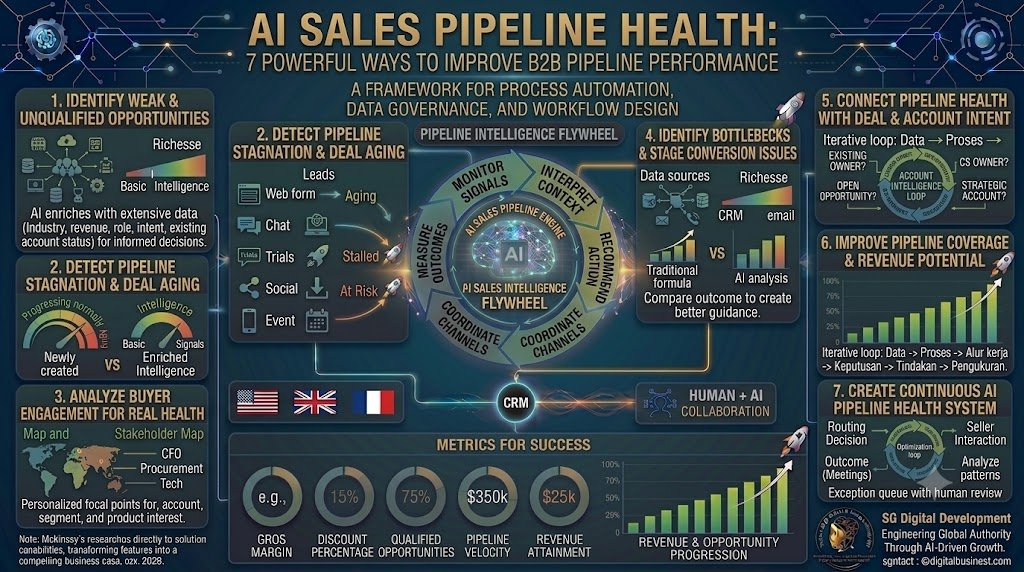
AI Sales Pipeline Health: 7 Powerful Ways to Improve B2B Pipeline Performance. Introduction A sales pipeline can look healthy on a dashboard while hiding serious problems underneath. A company may have millions of dollars in open opportunities, dozens of active deals and strong-looking pipeline coverage. Yet if many opportunities are stalled, poorly qualified, missing decision-makers or unlikely to close, the pipeline may not actually support the company’s revenue target. This is why AI sales pipeline health is becoming an important part of modern B2B revenue management. Traditional pipeline reviews often depend on sales representatives updating CRM fields and managers manually reviewing opportunities. That process can identify obvious problems, but it becomes difficult to maintain as sales teams grow and pipelines become more complex. AI can analyze much larger volumes of information and identify patterns across: The result is a more dynamic view of pipeline health. Instead of asking only: “How much pipeline do we have?” sales leaders can ask: These questions matter because healthy pipeline is not simply about volume. It is about quality, movement, buyer engagement, timing, coverage and probability of conversion. In this guide, we explore 7 powerful AI sales pipeline health strategies that B2B companies can use to improve pipeline visibility, identify risks earlier, increase sales velocity and create a more reliable revenue engine. What Is AI Sales Pipeline Health? AI sales pipeline health refers to using artificial intelligence to continuously evaluate the quality, movement, risk and potential of sales opportunities within a B2B pipeline. Traditional pipeline management often focuses on metrics such as: These metrics remain useful. However, they do not always reveal whether opportunities are genuinely healthy. AI can analyze additional signals such as: This allows companies to build a more comprehensive view of pipeline health. A simple model is: Pipeline Health = Quality + Engagement + Momentum + Coverage + Conversion Potential Each component can provide a different perspective. Quality Are the opportunities properly qualified? Engagement Are buyers actively participating? Momentum Are opportunities progressing? Coverage Does the pipeline provide sufficient potential against the revenue target? Conversion potential How likely are opportunities to become revenue? AI can help evaluate these factors continuously rather than only during weekly or monthly pipeline reviews. Why Pipeline Health Matters for B2B Companies Revenue targets are often built around assumptions about pipeline conversion. For example, a company may need $5 million in closed revenue and believe it requires $20 million of pipeline. But the same $20 million of pipeline can have very different revenue potential depending on its quality. Consider two scenarios. Pipeline A Pipeline B The headline pipeline number is identical. The underlying health is not. This is why revenue leaders need to move beyond pipeline quantity. A healthy pipeline should provide evidence that opportunities can realistically progress toward revenue. The 7 Powerful AI Sales Pipeline Health Strategies 1. Identify Weak and Unqualified Opportunities The first step in improving AI sales pipeline health is identifying opportunities that should not receive the same attention as genuinely qualified deals. Sales pipelines frequently contain opportunities that were created because: But interest is not always purchase intent. AI can evaluate opportunity signals against historical patterns to identify potentially weak opportunities. Signals can include: This can help sales teams separate: Potential pipeline from qualified pipeline. Why removing weak opportunities can improve pipeline health Some companies hesitate to remove old or weak opportunities because a large pipeline feels reassuring. But inflated pipeline can create several problems. It can: A smaller but healthier pipeline may provide more useful information than a large pipeline filled with uncertain opportunities. AI can help identify which opportunities deserve deeper review. 2. Detect Pipeline Stagnation and Deal Aging Healthy opportunities should generally demonstrate movement. That does not mean every deal must move quickly. Complex enterprise purchases can legitimately take months. The important question is whether the opportunity’s behavior is consistent with its expected sales cycle. AI can analyze: This allows the system to detect potential stagnation. Example Suppose a company normally closes qualified opportunities within 90 days. An opportunity has been open for 160 days. The close date has moved three times. The buyer has not attended a meeting for four weeks. The seller has recorded the opportunity as likely to close this quarter. A traditional CRM view may show only the current opportunity stage. AI can identify the mismatch between the stated opportunity status and observed behavior. Pipeline aging analysis AI can segment opportunities into categories such as: This creates a clearer picture of pipeline movement. 3. Analyze Buyer Engagement to Measure Real Pipeline Health An opportunity is ultimately driven by buyer behavior. This makes buyer engagement one of the most important signals in pipeline health. AI can combine multiple engagement signals, including: The goal is not to assume that every engagement signal means a purchase will happen. Instead, AI can identify patterns that help sales teams understand whether an opportunity is actively progressing. Buyer engagement is more than activity volume A prospect opening ten emails does not necessarily have stronger buying intent than a prospect who attends one strategic meeting with the economic buyer. Therefore, AI should evaluate context, not simply count activities. For example: Weak signal: Multiple marketing emails opened. Potentially stronger signal: The buyer asks for implementation requirements and requests a proposal involving procurement. This distinction is important. AI sales pipeline health should therefore combine activity data with buyer context. 4. Identify Pipeline Bottlenecks and Stage Conversion Problems A healthy pipeline should move opportunities through defined stages. If opportunities consistently become stuck at one stage, the problem may not be individual seller performance. It may indicate a structural bottleneck. For example: Lead → Qualified → Discovery → Proposal → Negotiation → Closed Suppose the company discovers that many opportunities progress successfully through discovery but frequently stall after proposals. AI can analyze historical data to identify patterns. Potential causes might include: The pipeline stage itself does not explain the problem. The underlying signals do. Stage conversion analysis AI can compare: Opportunities entering stage against Opportunities progressing to
AI sales call analysis
AI Growth Engine

Best AI Sales Call Analysis: Accelerate B2B Deals Fast.

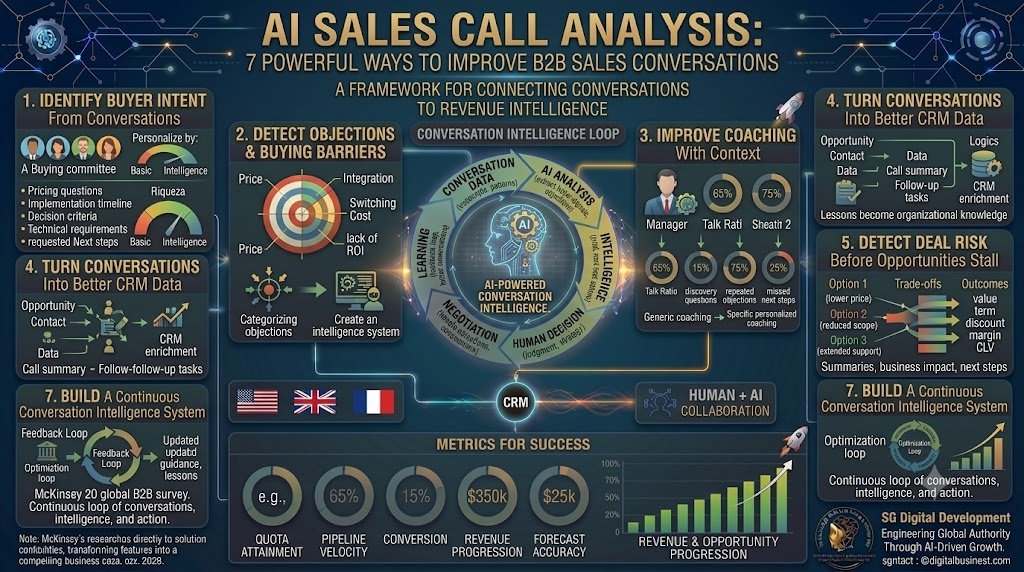
AI Sales Call Analysis: 7 Powerful Ways to Improve B2B Sales Conversations. Introduction B2B sales conversations contain some of the most valuable information in the entire revenue process. A sales call can reveal what a buyer actually wants, which business problem is creating urgency, who is involved in the buying decision, what objections are emerging, how competitors are being evaluated, and whether an opportunity is genuinely progressing. Yet much of this information has traditionally remained trapped inside meeting recordings, notes, CRM fields and the memory of individual sales representatives. That creates a major problem. Sales leaders may have hundreds or thousands of customer conversations taking place every month, but manually reviewing every conversation is impossible. Managers may listen to a small sample of calls, sellers may summarize conversations differently, and important buying signals can disappear before they reach the CRM. This is where AI sales call analysis becomes increasingly important. AI can analyze sales conversations at scale, identify patterns across calls, extract buyer signals, detect objections, summarize conversations, identify next steps and provide structured intelligence that sales teams can use to improve execution. Instead of treating sales calls simply as meetings between a seller and a prospect, companies can treat them as a continuous source of revenue intelligence. For B2B companies, this creates opportunities to improve: The goal is not to replace the salesperson. The goal is to help sales teams understand conversations more accurately and turn conversation data into better decisions. In this guide, we explore 7 powerful AI sales call analysis strategies that B2B companies can use to improve sales conversations, identify buying signals, reduce deal risk and accelerate revenue growth. What Is AI Sales Call Analysis? AI sales call analysis is the use of artificial intelligence to analyze sales conversations and extract actionable information from calls, meetings and customer interactions. Depending on the system, analysis can include: Traditional call recording gives a company a recording. AI sales call analysis turns that recording into structured intelligence. For example, a sales call might contain a statement such as: “We are currently evaluating three vendors and need to make a decision before the end of the quarter.” A traditional workflow may simply store the call recording. An AI-powered workflow can identify: That information can then become part of the broader revenue workflow. This is what makes conversation intelligence strategically valuable. Why Sales Conversations Are a Major Source of Revenue Intelligence Many companies analyze website traffic, advertising performance, CRM data and pipeline activity. But the actual conversation between a buyer and seller can contain information that those systems cannot fully capture. A website may tell you what a prospect viewed. A CRM may tell you which opportunity stage the prospect occupies. An advertising platform may tell you which campaign generated the lead. But a sales conversation can reveal why the buyer is interested, what problem they are trying to solve, what concerns are preventing a purchase and how they intend to make a decision. That creates several important intelligence categories. Buyer intelligence What does the buyer care about? Intent intelligence How serious is the buyer about solving the problem? Deal intelligence What is happening inside the opportunity? Competitive intelligence Which alternatives or competitors are being considered? Product intelligence Which capabilities matter most to prospects? Sales intelligence Which conversations and behaviors are associated with successful opportunities? Customer intelligence What recurring needs, concerns and expectations are emerging across customers? AI can connect these signals across many conversations instead of leaving them isolated inside individual meetings. 7 Powerful AI Sales Call Analysis Strategies 1. Identify Buyer Intent From Sales Conversations One of the most valuable applications of AI sales call analysis is identifying buyer intent. Not every prospect who books a meeting has the same level of buying intent. One prospect may be researching options. Another may be actively comparing vendors. Another may have a defined budget and implementation deadline. Another may only be collecting information. These differences are critical. AI can analyze conversation patterns and identify signals associated with different levels of buyer intent. Signals can include: For example, compare these two statements: Low-intent signal: “We are just exploring what solutions are available.” Higher-intent signal: “We want to shortlist two vendors this month and begin implementation next quarter.” The second conversation contains significantly more actionable information. AI can identify such patterns automatically. Turning conversation signals into intent scores Companies can build intent models around signals such as: Research stage → Evaluation stage → Shortlist stage → Decision stage → Purchase stage The exact model depends on the business. The important point is that AI can help sales teams understand where buyers appear to be in their decision process. Why this matters When sales teams understand buyer intent more accurately, they can prioritize conversations and follow-ups more effectively. A high-intent opportunity may require immediate action. A low-intent prospect may require education and nurturing. This helps sales teams move beyond treating every conversation equally. 2. Detect Objections and Buying Barriers Sales conversations frequently contain objections that determine whether a deal progresses. Common B2B objections include: The problem is that objections are not always entered into CRM systems accurately. A salesperson may record: “Follow up next week.” But the real conversation may have revealed: “The CFO thinks the current solution is expensive and wants a quantified ROI case before approving the project.” Those are very different pieces of information. AI sales call analysis can identify the actual objection. Create an objection intelligence system Companies can categorize objections across conversations. For example: Objection Frequency Potential impact Price High High Implementation Medium Medium Integration Medium High Security Low High Timing High Medium This allows sales leadership to identify patterns. If dozens of prospects repeatedly raise the same objection, the issue may not be individual seller performance. It could indicate: AI therefore turns individual objections into organizational intelligence. 3. Improve Sales Coaching With Conversation Intelligence Sales managers cannot realistically listen to every sales call. This creates a scaling problem. A manager may coach sellers based on: AI changes

AI sales coverage planning
AI Growth Engine

AI Sales Coverage Planning: 7 Powerful Ways to Improve B2B Sales Coverage.

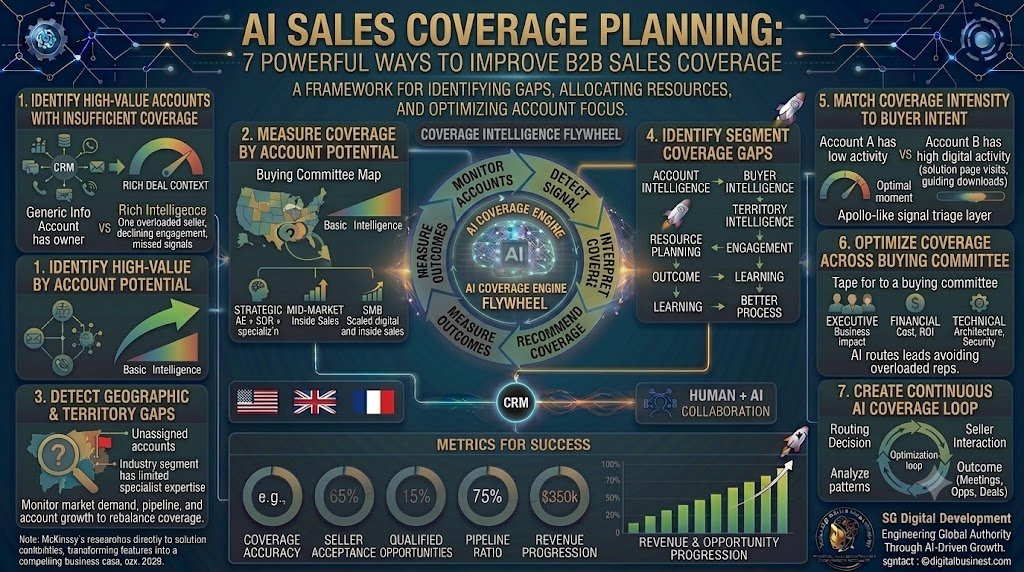
AI Sales Coverage Planning: 7 Powerful Ways to Improve B2B Sales Coverage. Introduction A sales organization can have enough salespeople and still have a coverage problem. The issue may not be headcount. It may be that the right accounts are not receiving enough attention. A strategic enterprise account may have no dedicated seller. A high-growth territory may have insufficient coverage. A valuable industry segment may have only one representative. A large group of accounts may technically have an owner but receive almost no meaningful sales activity. A seller may be responsible for hundreds of accounts while another manages a much smaller portfolio. These situations create a fundamental B2B sales question: Are the right opportunities receiving the right level of sales coverage? That is where AI sales coverage planning becomes valuable. AI sales coverage planning uses artificial intelligence, account intelligence, buyer signals, territory information, pipeline data, seller capacity and revenue objectives to evaluate whether a business has appropriate coverage across its market. Instead of looking only at the number of sellers, businesses can examine: This creates a more strategic approach to sales coverage. A traditional coverage review might happen once or twice a year. An AI-enabled approach can continuously monitor changes in: The objective is not to maximize the number of accounts touched. It is to create the right level of commercial coverage for the right opportunities. This article explains seven powerful ways businesses can use AI sales coverage planning to identify coverage gaps, improve seller allocation, prioritize accounts and strengthen B2B revenue performance. What Is AI Sales Coverage Planning? AI sales coverage planning is the use of artificial intelligence and sales data to determine whether accounts, territories, segments and opportunities have sufficient sales attention and resources. Coverage can mean different things depending on the sales model. For an enterprise organization, coverage may include: For an SMB sales organization, coverage may involve: For a digital agency, coverage may involve: The underlying question remains similar: “Are our sales resources positioned where the commercial opportunity exists?” A modern AI sales coverage planning system can evaluate multiple signals simultaneously. For example: Account potential Buyer intent Pipeline Seller capacity Territory opportunity Strategic importance = Coverage requirement This creates a more dynamic model than simply assigning every account to a salesperson. Why AI Sales Coverage Planning Matters Sales coverage directly affects revenue potential. An account cannot be developed effectively if nobody has enough time or expertise to engage it. A territory cannot be exploited fully if seller capacity is insufficient. A strategic industry cannot become a growth engine if the organization has no specialist coverage. At the same time, excessive coverage can reduce productivity. Suppose a company has: A simple model may assign 100 accounts per seller. But the commercial potential may not be evenly distributed. Perhaps: Equal account distribution would not necessarily create equal commercial coverage. AI sales coverage planning can help organizations identify these differences. It can analyze account potential, engagement and seller capacity to determine where attention should be concentrated. AI Sales Coverage Planning vs Territory Planning Territory planning and coverage planning are closely related. But they answer different questions. Territory planning asks: “How should accounts be grouped and assigned?” Coverage planning asks: “Does each group have enough appropriate sales coverage?” For example: A company may create a healthcare enterprise territory. Coverage planning then determines whether that territory needs: A well-designed territory can still have poor coverage. That is why both disciplines matter. AI Sales Coverage Planning vs Resource Planning Resource planning determines how resources should be allocated. Coverage planning focuses specifically on whether the market is sufficiently covered. For example: Resource planning → Determines where two additional sales engineers should be allocated. Coverage planning → Identifies which territories currently lack technical coverage. The two processes should work together. Coverage identifies the requirement. Resource planning determines how to satisfy it. 7 Powerful Ways to Use AI Sales Coverage Planning 1. Identify High-Value Accounts With Insufficient Coverage One of the most important applications of AI sales coverage planning is identifying valuable accounts that are not receiving enough sales attention. A CRM may show an account owner. That does not necessarily mean the account is meaningfully covered. An account may have: AI can combine these signals. For example: Account value: High Buyer intent: High Current engagement: Low Pipeline: Emerging Coverage: One overloaded seller This creates a potential coverage gap. The organization can then decide whether the account requires: The important point is that ownership does not equal coverage. Coverage should reflect actual commercial attention. 2. Measure Coverage by Account Potential Equal account coverage is not always the same as effective coverage. A better approach is to connect coverage requirements with opportunity. AI can classify accounts according to potential. Strategic Accounts High revenue potential and high strategic value. Growth Accounts Strong opportunity with significant expansion potential. Development Accounts Promising but less mature opportunities. Scalable Accounts Lower complexity that can be supported through efficient digital processes. Each category can have a different coverage model. For example: Strategic Dedicated AE + specialist + executive support Growth AE + SDR Development SDR + automated engagement Scalable Digital or inside-sales workflow This allows the organization to match sales investment with commercial opportunity. 3. Detect Geographic and Territory Coverage Gaps Territories can change quickly. A market may grow. A competitor may leave. New companies may enter. Buyer demand may shift. A territory that once had sufficient coverage can become under-covered. AI sales coverage planning can monitor these changes. Signals can include: For example: A region shows: That combination may indicate a coverage problem. AI can surface the pattern for management review. The organization can then consider: 4. Identify Segment Coverage Gaps Geography is only one dimension of sales coverage. Many B2B companies organize sales by industry or customer segment. Examples include: A company may have strong geographic coverage but weak industry coverage. For example: A healthcare segment may contain $30M of potential opportunity but only one seller with limited healthcare expertise. That is a coverage issue. AI can compare: Segment

AI sales resource planning
AI Growth Engine

AI Sales Resource Planning: 7 Powerful Ways to Optimize B2B Sales Resources.

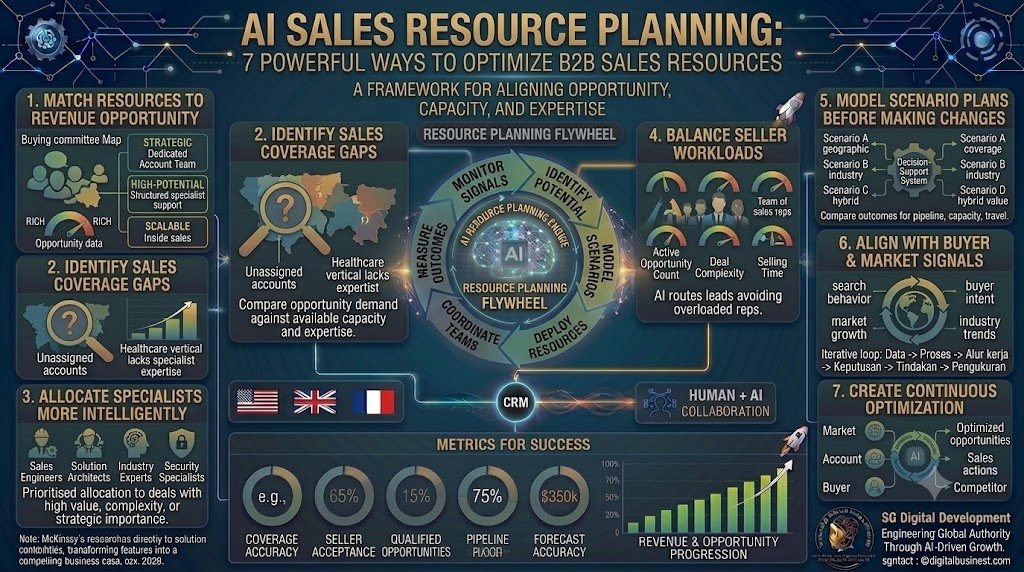
AI Sales Resource Planning: 7 Powerful Ways to Optimize B2B Sales Resources. Introduction B2B sales organizations rarely have unlimited resources. There are only so many: The challenge is deciding where those resources should be deployed. A high-value enterprise opportunity may require an account executive, sales engineer, executive sponsor and specialist. A smaller opportunity may require only a sales development representative and standard sales process. A strategic account may deserve significant investment even before an opportunity formally exists. Meanwhile, another territory may have too many sellers competing for too few opportunities. This creates a resource-allocation problem. Traditional sales planning often addresses pieces of this problem through spreadsheets, territory plans, headcount models and management judgment. But sales conditions change continuously. Pipeline changes. Accounts change. Buyer intent changes. Seller capacity changes. New opportunities appear. Existing deals accelerate or slow down. New markets open. Competitors change the environment. This is where AI sales resource planning becomes valuable. AI sales resource planning uses artificial intelligence, sales data, account intelligence, capacity information, pipeline signals and business rules to help organizations determine where sales resources should be deployed and how those resources should be adjusted as conditions change. Instead of asking only: “How many salespeople do we need?” sales leaders can ask: “Which resources should be deployed, where, when and against which opportunities to create the strongest commercial coverage?” That is a much more dynamic question. Current 2026 sales-planning research increasingly describes AI as a way to connect planning activities such as capacity, territory, quota and forecasting rather than treating them as isolated processes. This article explains seven powerful ways businesses can use AI sales resource planning to improve resource allocation, seller productivity, account coverage and B2B revenue performance. What Is AI Sales Resource Planning? AI sales resource planning is the use of artificial intelligence and data-driven modeling to determine how sales resources should be allocated across accounts, territories, segments, opportunities and sales activities. Sales resources can include: The objective is to align available resources with commercial opportunity. A traditional approach may look like: Revenue target ↓ Headcount plan ↓ Territory assignment ↓ Seller allocation ↓ Quarterly review An AI-enabled approach can be more dynamic: Market signals ↓ Account potential ↓ Pipeline ↓ Buyer intent ↓ Seller capacity ↓ Specialist availability ↓ Revenue opportunity ↓ Resource allocation ↓ Continuous adjustment This does not mean AI should independently make every staffing decision. Leadership still defines strategy, budgets, organizational structure and governance. AI helps analyze the available evidence and model how different resource decisions could affect sales performance. Why AI Sales Resource Planning Matters Sales resources are expensive. A company may spend substantial amounts on: Yet resources are not always allocated according to opportunity. One territory may have excellent account potential but insufficient coverage. Another may have several sellers competing for a relatively small opportunity pool. A specialist may spend most of the quarter supporting low-value opportunities while strategic enterprise deals wait for expertise. An account executive may manage too many complex opportunities simultaneously. These are not simply productivity problems. They are allocation problems. AI sales resource planning can help sales leaders evaluate resource requirements using a wider range of signals. For example: The result can be a more evidence-based resource strategy. AI Sales Resource Planning vs Sales Capacity Planning These concepts overlap but are not identical. Sales capacity planning focuses primarily on how much productive selling capacity the organization has or needs. Questions include: AI sales resource planning is broader. It asks: “Given the resources we have, where should they be deployed?” For example: A company may have sufficient total sales capacity but still have poor allocation. It may have: Capacity answers: How much? Resource planning answers: Where and how should it be used? Both disciplines should work together. AI Sales Resource Planning vs Sales Territory Planning Territory planning determines how accounts and geographic or market coverage are organized. Resource planning determines what resources should support those territories. For example: Territory Planning → Defines the enterprise healthcare territory. Resource Planning → Determines whether that territory needs: This distinction is important because a territory is not simply a list of accounts. It is a commercial environment requiring appropriate resources. 7 Powerful Ways to Use AI Sales Resource Planning 1. Match Sales Resources to Revenue Opportunity The first major application of AI sales resource planning is matching resources to the commercial potential of accounts and opportunities. Not every account deserves the same level of investment. Consider three accounts. Account A Small business with limited potential. Account B Mid-market company with strong product fit. Account C Large enterprise with significant expansion potential and multiple buying centers. Allocating the same resources to all three may not be efficient. AI can analyze: The organization can then create differentiated resource models. Tier 1 High-value strategic accounts → Dedicated account resources Tier 2 High-potential growth accounts → Structured specialist support Tier 3 Lower-complexity accounts → Scalable sales process This does not mean low-value accounts should receive poor service. It means resource intensity can be aligned with commercial complexity and opportunity. 2. Identify Sales Coverage Gaps One of the most useful applications of AI sales resource planning is identifying where the organization does not have enough coverage. A coverage gap can occur when: AI can compare opportunity requirements against available resources. For example: Enterprise pipeline $20M Current AE capacity $12M Estimated coverage gap $8M The organization now has an evidence-based reason to examine resource allocation. The same approach can be applied to specialist resources. For example: Technical opportunity demand 80 active opportunities Available sales engineers 5 High-complexity opportunities 30 This may indicate a support bottleneck. Resource planning can therefore extend beyond account executives. 3. Allocate Specialist Resources More Intelligently Many B2B sales organizations have specialist resources. Examples include: These resources can become bottlenecks. Suppose ten enterprise deals all require technical validation. If every seller receives equal access to the same sales engineer, the system may not reflect commercial priorities. AI sales resource planning can help prioritize specialist support using signals such as: This can help

AI sales process optimization
AI Growth Engine

AI Sales Process Optimization: 7 Powerful Ways to Improve B2B Sales Performance.

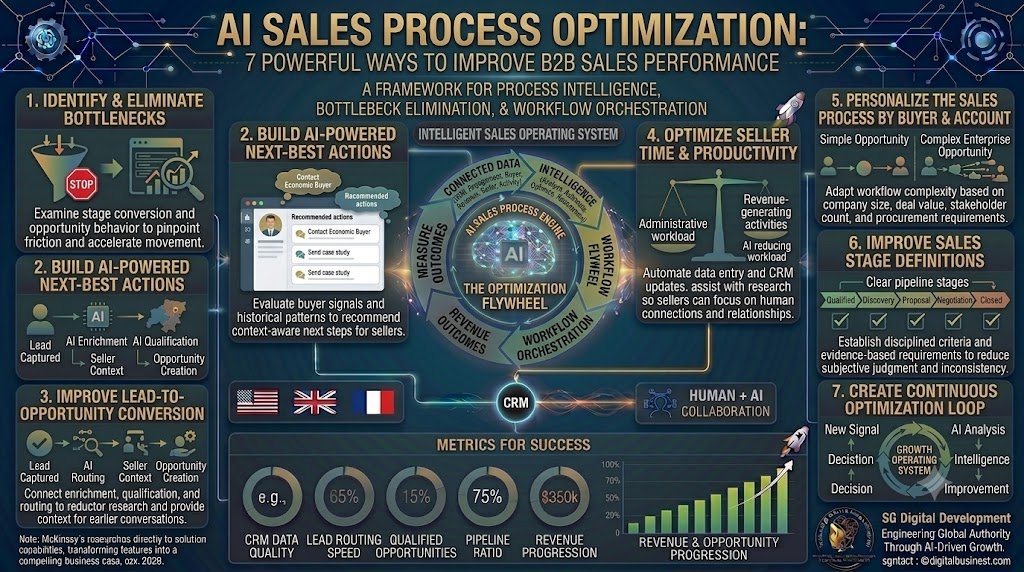
AI Sales Process Optimization: 7 Powerful Ways to Improve B2B Sales Performance. Introduction B2B sales processes often become complicated long before companies realize they have a process problem. A typical sales organization may have separate workflows for: Each workflow may work reasonably well on its own. The problem appears when they do not work well together. A lead may be qualified but routed slowly. A salesperson may have a qualified opportunity but lack the information required for the next conversation. A proposal may be created efficiently but fail to address the buyer’s actual priorities. A deal may look healthy in the CRM while important buyer signals are being missed. Sales representatives can spend hours performing administrative tasks while high-value selling activities receive less attention. This is where AI sales process optimization becomes strategically important. Rather than adding another isolated AI tool, businesses can use AI to examine the entire sales process, identify friction, automate repetitive work, surface important signals and recommend better actions. The goal is not simply to make salespeople work faster. The goal is to make the sales process itself more intelligent. A modern AI sales process optimization strategy can connect: Lead → Qualification → Routing → Engagement → Discovery → Opportunity → Proposal → Negotiation → Close AI can then help determine what should happen at each stage. The most effective systems combine automation with human judgment. AI can analyze data, identify patterns and recommend actions. Sales professionals can then use those insights to build relationships, handle complex conversations and make strategic decisions. This article explores seven powerful ways businesses can use AI sales process optimization to improve B2B sales performance. What Is AI Sales Process Optimization? AI sales process optimization is the use of artificial intelligence, automation, analytics and sales intelligence to improve the way a B2B sales organization moves prospects from initial interest to revenue. Traditional sales process optimization usually involves: AI adds another layer. It can continuously analyze large volumes of sales information and identify patterns that may be difficult to detect manually. For example, AI can analyze: This creates a more dynamic approach to process improvement. Instead of reviewing the sales process once per quarter, organizations can create a continuous optimization loop. Data → Analysis → Recommendation → Action → Outcome → Learning That is the foundation of AI sales process optimization. Why AI Sales Process Optimization Matters A sales process can become inefficient in many different ways. Consider a company generating hundreds of B2B leads each month. Marketing produces demand. Sales receives the leads. But then: The company may believe it has a lead-generation problem. The actual problem may be process friction. AI sales process optimization helps organizations look across the complete system rather than optimizing one isolated activity. The objective is to answer questions such as: This changes the conversation from: “How can we give salespeople more tools?” to: “How can we build a better sales system?” AI Sales Process Optimization vs AI Sales Automation These concepts are closely related but not identical. AI sales automation focuses primarily on automating tasks. Examples include: AI sales process optimization goes further. It examines whether the workflow itself is designed effectively. For example: Automation asks: “Can we automate this follow-up?” Optimization asks: “Should this follow-up happen at all, when should it happen, which buyer should receive it, and what should trigger the next step?” Automation improves execution. Optimization improves the system. The strongest B2B sales organizations use both. 7 Powerful Ways to Use AI Sales Process Optimization 1. Identify and Eliminate Sales Process Bottlenecks One of the most valuable applications of AI sales process optimization is identifying where opportunities slow down. A sales funnel may appear healthy at a high level. But detailed analysis may reveal problems. For example: Lead → Meeting: strong Meeting → Opportunity: strong Opportunity → Proposal: weak Proposal → Negotiation: strong Negotiation → Close: weak The organization now knows where to investigate. AI can examine factors associated with those slowdowns. Possible signals include: This creates a much more granular view of the sales process. Instead of saying: “Our sales cycle is too long.” sales leaders can ask: “Which stage creates the largest amount of avoidable delay, and what conditions are associated with that delay?” That is a much more actionable question. Example Suppose a company discovers that opportunities frequently stall after the initial proposal. AI analysis may reveal that stalled opportunities commonly have: The solution may not be another automated email. The solution may be a multi-threading workflow and stronger proposal process. That is process optimization. 2. Build AI-Powered Next-Best Actions Salespeople constantly make decisions. Should I call this prospect? Should I follow up today? Should I involve an executive? Should I send a case study? Should I schedule another discovery meeting? Should I introduce pricing? Should I move this opportunity forward? Traditional CRM systems mostly record what has already happened. AI can help recommend what should happen next. This is a major component of AI sales process optimization. A next-best-action system can evaluate: It can then recommend an action. For example: “Contact the economic buyer.” Or: “Send the implementation case study before the next meeting.” Or: “Opportunity has not progressed for 14 days. Review decision process.” Or: “Buyer engagement has increased. Schedule a discovery follow-up.” The objective is not to remove seller judgment. It is to reduce the amount of time salespeople spend figuring out what deserves attention. 3. Improve Lead-to-Opportunity Conversion The transition from lead to opportunity is one of the most important parts of the B2B sales process. Poor conversion can happen because: AI sales process optimization can connect these activities. A modern workflow might look like: Lead captured ↓ AI enrichment ↓ AI qualification ↓ AI routing ↓ Seller context briefing ↓ Personalized outreach ↓ Buyer engagement ↓ Opportunity creation Each step provides information to the next. For example, AI can summarize: The salesperson begins the conversation with context rather than starting from zero. That can reduce unnecessary research and improve consistency. 4. Optimize Seller

AI lead routing
AI Growth Engine

AI Lead Routing: 7 Powerful Ways to Route B2B Leads to the Right Sales Rep.

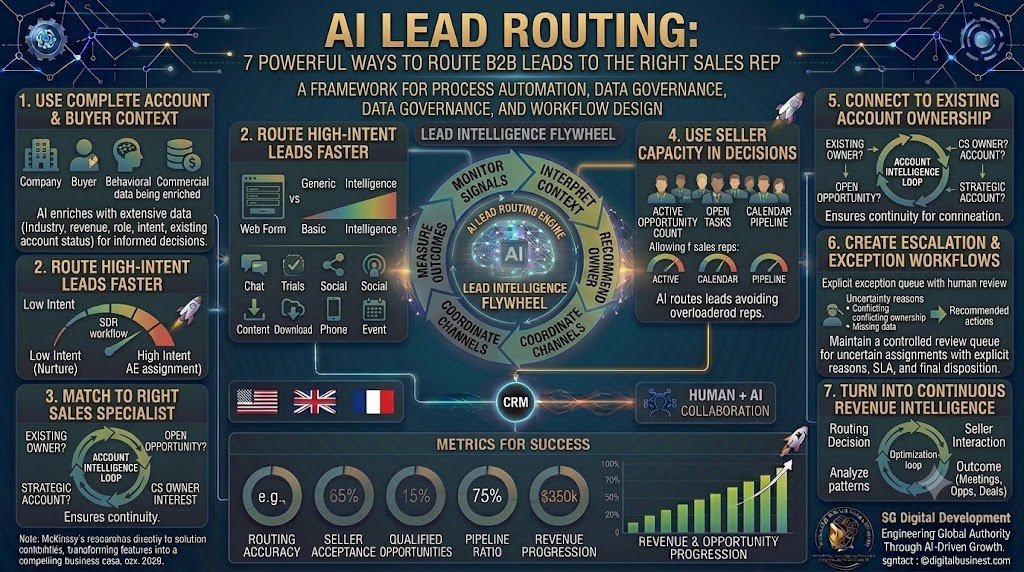
AI Lead Routing: 7 Powerful Ways to Route B2B Leads to the Right Sales Rep. Introduction Generating a B2B lead is only the beginning of the sales process. What happens immediately after the lead arrives can have a major impact on whether that lead becomes a conversation, an opportunity or a lost record inside the CRM. A lead may need to be: When those steps are handled manually, delays and ownership problems can appear quickly. A high-value enterprise prospect may enter the CRM and wait in a general queue. A lead from an existing account may be assigned to the wrong salesperson. A prospect in a specialized industry may reach a representative without the relevant expertise. A high-intent buyer may receive the same response process as a low-intent inquiry. This is where AI lead routing becomes strategically important. AI lead routing uses artificial intelligence, customer data, account intelligence, behavioral signals, business rules and sales capacity information to determine where an incoming lead should go and what should happen next. Instead of simply asking: “Which salesperson gets the next lead?” a modern routing system can evaluate: That makes AI lead routing much more than an automated round-robin system. It becomes part of the organization’s revenue infrastructure. Recent 2026 guidance on AI lead routing emphasizes that routing should combine ownership rules, approved enrichment, CRM evidence, capacity and clear exception handling rather than turning assignment into an unexplained AI decision. This guide explains seven powerful ways businesses can use AI lead routing to improve B2B lead distribution, seller productivity, speed-to-lead and revenue execution. What Is AI Lead Routing? AI lead routing is the use of artificial intelligence and automated decision logic to determine which salesperson, sales team, territory or workflow should receive an incoming lead. Traditional lead routing usually relies on static rules. For example: If the lead is located in California, assign it to Salesperson A. Or: If company size is above 500 employees, assign it to the enterprise team. Or: Send every new lead to the next salesperson in a round-robin queue. These rules can work when the sales organization is simple. But B2B organizations often have much more complex requirements. A lead may need to be routed according to: AI lead routing can analyze multiple signals simultaneously. The goal is not simply to route leads faster. The goal is to route the right lead to the right owner with the right context at the right time. Why AI Lead Routing Matters in 2026 B2B buyers increasingly interact with companies across multiple digital channels. A lead might arrive through: Each source can provide different information. A website demo request may contain explicit buying intent. A content download may indicate early research. A partner referral may already have a relationship attached to it. An existing customer inquiry may need to remain with the account owner rather than entering a new-business queue. Static routing systems often struggle with this complexity. Modern AI lead routing can use the available context to determine which workflow should apply. The 2026 routing landscape increasingly emphasizes enrichment before routing, account-level ownership, capacity-aware assignment and auditable decisions. This creates a more intelligent connection between marketing activity and sales execution. AI Lead Routing vs Traditional Lead Routing Traditional routing usually follows predefined rules. For example: Lead enters CRM ↓ Check geography ↓ Check company size ↓ Assign representative That approach is predictable, but it can be limited. AI-enabled routing can introduce additional layers. Lead enters CRM ↓ Enrich account ↓ Identify existing ownership ↓ Analyze intent ↓ Evaluate account value ↓ Evaluate seller fit ↓ Evaluate capacity ↓ Apply routing policy ↓ Assign owner ↓ Trigger next-best action The difference is not simply automation. It is the amount of context used to make the decision. Traditional rules remain useful. In fact, critical ownership and compliance rules should often remain deterministic. AI is most valuable where interpretation and prioritization are required. That combination can create a more reliable routing architecture. 7 Powerful Ways to Use AI Lead Routing 1. Route Leads Using Complete Account and Buyer Context The first major application of AI lead routing is using more than the information submitted through the lead form. A typical form may contain: That is useful, but incomplete. AI can help enrich the lead with additional information. For example: Company Information Buyer Information Behavioral Information Commercial Information The routing system can then make a more informed decision. For example: A VP of Marketing from a 2,000-person SaaS company has visited the pricing page three times, downloaded an enterprise guide and belongs to an account with an existing opportunity. That lead should probably not enter the same workflow as an anonymous early-stage content download. Context changes routing. This is one of the central advantages of AI lead routing. 2. Route High-Intent Leads Faster Speed matters when a buyer has actively raised their hand. Not every lead requires the same response speed. Consider three leads. Lead A Downloads a general industry report. Lead B Requests a product comparison. Lead C Requests a pricing discussion and mentions an implementation timeline. All three are leads. But they represent different levels of buying intent. AI can analyze available signals and place leads into different routing paths. Low Intent Automated nurture ↓ Medium Intent Sales development workflow ↓ High Intent Immediate sales assignment This allows sales teams to prioritize attention. The purpose of AI lead routing is not necessarily to send every lead to a salesperson instantly. It is to determine which leads deserve which level of sales attention. That distinction helps prevent sales teams from becoming overwhelmed by low-value inbound volume. 3. Match Leads to the Right Sales Representative The “right salesperson” is not always the person who happens to be next in a round-robin queue. B2B sales teams often have different specializations. A company may have representatives focused on: A lead should ideally reach someone capable of understanding the buyer’s situation. AI can evaluate: This creates a fit-based routing model. For example: A healthcare enterprise lead

AI sales quota planning
AI Growth Engine

AI Sales Quota Planning: 7 Powerful Ways to Set Smarter B2B Sales Quotas.

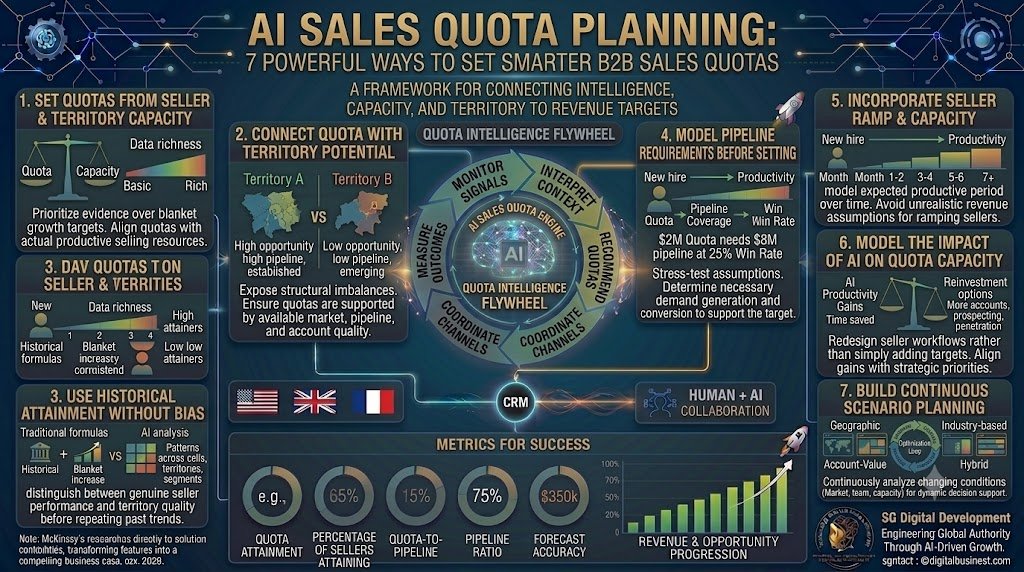
AI Sales Quota Planning: 7 Powerful Ways to Set Smarter B2B Sales Quotas. Introduction Sales quotas sit at the center of the B2B revenue organization. They influence seller behavior, hiring plans, territory design, compensation, forecasting and ultimately the company’s revenue expectations. Yet quota setting is often still treated as a top-down financial exercise. Leadership establishes a revenue target. That target is divided across regions. Regions are divided across teams. Teams are divided across sellers. The result becomes an individual quota. The problem is that mathematical allocation does not automatically create an achievable sales target. A quota can be numerically correct while being commercially unrealistic. One seller may receive a territory with substantial market opportunity, strong pipeline and high-value accounts. Another may receive a territory with limited opportunity, longer sales cycles and fewer qualified prospects. Both sellers could receive identical quotas. That is where AI sales quota planning becomes increasingly valuable. AI can help revenue organizations evaluate quota decisions using a broader set of variables, including: Instead of asking only: “How should we divide the corporate revenue target?” sales leaders can ask: These questions turn quota planning from a simple allocation exercise into a revenue planning discipline. Gartner’s September 2026 guidance specifically argues that hunter quotas should be tested against seller capacity and that organizations should incorporate AI gains when computing capacity. This guide explains seven powerful ways businesses can use AI sales quota planning to create more evidence-based, transparent and adaptable quota structures. What Is AI Sales Quota Planning? AI sales quota planning is the use of artificial intelligence, predictive analytics, machine learning and connected sales data to help organizations establish, distribute, evaluate and adjust sales quotas. Traditional quota planning often starts with a company-level revenue target. For example: Annual revenue target: $50 million The organization might then allocate: Those numbers are then distributed across teams and sellers. The process may appear logical. But it does not necessarily answer whether the assigned quotas are supported by: AI can help introduce those variables into the planning process. An AI-assisted quota model might evaluate: Seller Data Territory Data Pipeline Data Revenue Data Productivity Data This creates a more complete view of quota feasibility. Why Traditional Quota Planning Can Fail Quota planning becomes difficult when organizations confuse revenue ambition with seller capacity. Suppose a company wants 25% revenue growth. Leadership may increase every seller’s quota by 25%. That is simple. But what if the market opportunity has not increased by 25%? What if the territories are already highly penetrated? What if sellers are overloaded? What if new hires require six months to ramp? What if the sales cycle has increased? What if win rates have declined? What if AI has changed seller productivity? A blanket quota increase does not answer these questions. The result can be quotas that look reasonable at the corporate level but are difficult to support at the seller level. Gartner’s 2026 research highlights this issue by emphasizing capacity-based quota setting rather than simply allocating corporate growth targets downward. The underlying principle is straightforward: A revenue target should be connected to the capacity and opportunity required to produce it. AI Sales Quota Planning vs Traditional Quota Planning Traditional quota planning commonly uses: AI sales quota planning can incorporate these variables plus: This does not mean AI automatically determines the quota. Instead, AI can provide a richer analytical foundation for leadership decisions. The final quota still depends on business strategy. For example, leadership may intentionally assign an aggressive quota because the company wants to expand into a new market. AI can help model what would need to happen for that quota to become achievable. That is more useful than simply labeling the quota as aggressive. 7 Powerful Ways to Use AI Sales Quota Planning 1. Set Quotas From Seller and Territory Capacity The first major application of AI sales quota planning is connecting quotas with actual selling capacity. Consider two sellers. Seller A Seller B Giving both sellers identical quotas may not reflect their actual commercial circumstances. AI can evaluate: The result can be a more evidence-based quota recommendation. This does not mean every seller must receive a different quota. Organizations may deliberately maintain quota consistency within roles. But AI can test whether the underlying opportunity supports that consistency. 2. Connect Quota With Territory Potential Quota planning and territory planning should not operate independently. A territory represents the market opportunity available to a seller. The quota represents the revenue expectation placed on that opportunity. If those two variables are disconnected, quota planning becomes fragile. For example: Territory A Territory B Assigning the same quota to both territories creates a structural imbalance. AI sales quota planning can analyze territory potential and determine how quota assumptions compare with the available opportunity. This can also help identify whether a quota problem is actually a territory problem. If the quota appears too high, the organization may need to ask: Quota planning therefore becomes part of a broader commercial architecture. 3. Use Historical Attainment Without Repeating Historical Bias Historical attainment is useful. But it should not be copied blindly into future quotas. Suppose a seller consistently achieved 110% of quota. That could indicate: Similarly, a seller consistently achieving 70% could reflect: AI can analyze multiple variables to distinguish these possibilities. Instead of simply saying: “This seller achieved 110%, so increase the quota.” the organization can investigate why. This is an important principle of AI sales quota planning: Historical performance should be evidence, not an automatic formula. AI can identify patterns across: That creates a more contextual view of attainment. 4. Model Pipeline Requirements Before Setting the Quota A quota should have a pipeline logic behind it. Suppose a seller receives a $2 million annual quota. The next question should be: “How much qualified pipeline is required to support that target?” The answer depends on factors such as: For example, if the organization historically requires approximately 4x qualified pipeline coverage, a $2 million quota may require roughly $8 million of qualified pipeline. But if win rates

AI sales capacity planning
AI Growth Engine

AI Sales Capacity Planning: 7 Powerful Ways to Optimize B2B Sales Capacity.

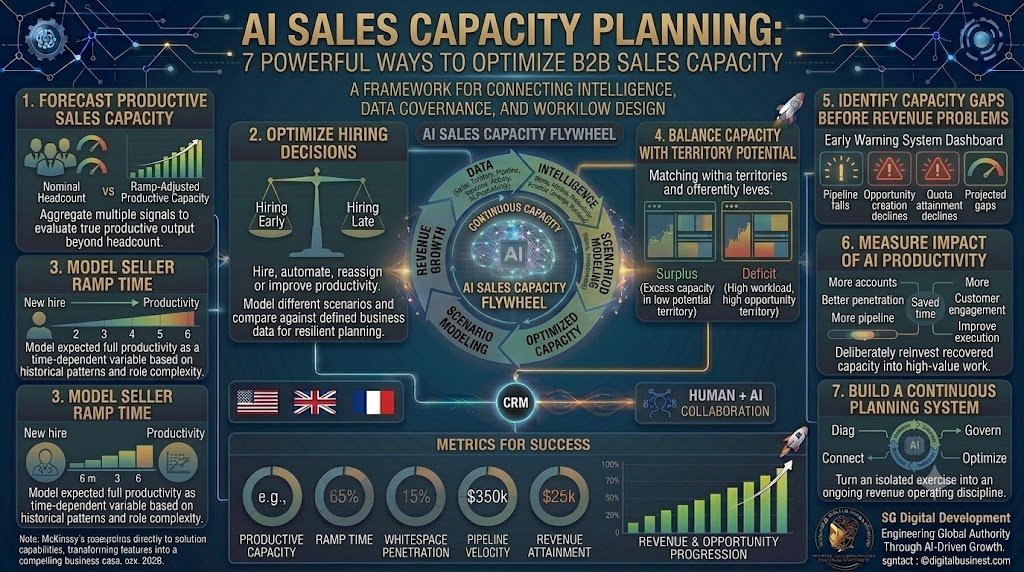
AI Sales Capacity Planning: 7 Powerful Ways to Optimize B2B Sales Capacity. Introduction Every B2B revenue target eventually creates the same question: Does the sales organization have enough productive capacity to achieve it? Hiring more salespeople is an obvious answer, but it is not always the right answer. A company can add headcount and still miss its revenue target. Why? Because sales capacity is influenced by far more than the number of people on the team. It depends on: This is why AI sales capacity planning is becoming increasingly important for modern B2B organizations. Traditional capacity planning often depends on spreadsheets, historical assumptions and annual headcount exercises. AI can make the process more dynamic. Instead of asking only: “How many salespeople do we need?” sales leaders can ask: These questions turn sales capacity planning into a strategic revenue discipline. Modern sales planning increasingly connects capacity, territory, quota and scenario modeling rather than treating each as an isolated exercise. Gartner’s 2026 sales performance management research identifies sales capacity planning, quota planning and territory optimization as connected capabilities. AI can help companies analyze those relationships continuously. This guide explains seven powerful ways organizations can use AI sales capacity planning to build a more productive, scalable and predictable B2B sales organization. What Is AI Sales Capacity Planning? AI sales capacity planning is the use of artificial intelligence, predictive analytics, machine learning and connected sales data to estimate, manage and optimize the productive capacity of a sales organization. Traditional sales capacity planning may calculate capacity using a simplified formula: Number of sellers × quota × expected attainment That can provide a starting point. But it leaves out important variables. A more realistic model may need to consider: AI sales capacity planning can bring these variables together. Instead of looking at capacity as a single number, companies can model capacity across time, roles, territories and scenarios. For example: Q1 New hires rampingExisting sellers productivePipeline developing ↓ Q2 New hires approaching productivityPipeline increasingCapacity expanding ↓ Q3 Full productivityPotential attritionMarket changes ↓ Q4 Revenue targetCapacity requirementsHiring or reallocation decisions This creates a more realistic view of what the sales organization can actually produce. Why Traditional Sales Capacity Planning Is Becoming Less Reliable Traditional models often make several assumptions. For example: These assumptions can create problems. A new salesperson may require six months to reach meaningful productivity. An experienced enterprise seller may generate substantially more revenue than a newly hired representative. A territory may contain insufficient opportunity to support its assigned quota. Another territory may contain more demand than its seller can effectively cover. And AI can change how much time sellers spend on research, administrative tasks, prospecting preparation and proposal work. Recent 2026 sales-planning analysis highlights this issue: AI may reduce friction in seller workflows, but organizations still need to determine whether those productivity gains should translate into more accounts, stronger account penetration, different staffing levels or other uses of capacity. The key is to model capacity rather than assume it. AI Sales Capacity Planning vs Traditional Capacity Planning Traditional planning often answers: “How many sellers do we need?” AI-powered planning can answer a broader set of questions: “How much productive capacity will we have, where will it exist, when will it become available, and what revenue can it realistically support?” That difference is significant. Traditional planning may use: AI sales capacity planning can incorporate: The result is a more dynamic capacity model. 7 Powerful Ways to Use AI Sales Capacity Planning 1. Forecast Productive Sales Capacity The first major application of AI sales capacity planning is forecasting how much productive capacity the organization will actually have. Headcount alone is not capacity. Consider a company with 20 sales representatives. If five are new hires, three are ramping, two are expected to leave and several experienced sellers are carrying overloaded territories, the organization does not truly have the same productive capacity as 20 fully productive representatives. AI can analyze historical performance and current conditions to estimate: This helps leadership distinguish between nominal headcount and productive capacity. That distinction is critical. A company may have enough employees on paper but still have a capacity shortage. 2. Optimize Hiring and Headcount Decisions Hiring is one of the most expensive decisions in sales. Hiring too early creates unnecessary cost. Hiring too late creates capacity gaps. AI sales capacity planning can help model both scenarios. Suppose a company expects to add $10 million in new annual revenue. Leadership could evaluate: Scenario A Hire 10 representatives immediately. Scenario B Hire 5 representatives now and 5 later. Scenario C Improve seller productivity before adding headcount. Scenario D Reallocate existing capacity across territories. Scenario E Use AI automation to reduce administrative workload and reinvest seller time into revenue-generating activities. AI can compare these scenarios using available business data. Potential variables include: This helps companies avoid treating headcount as the automatic solution to every capacity problem. 3. Model Seller Ramp Time New sellers do not become fully productive on day one. Ramp time can significantly affect revenue planning. Consider a new salesperson with a six-month ramp. If the company hires that person in January, the full-year revenue contribution may be substantially lower than the quota assigned to a fully ramped seller. AI sales capacity planning can incorporate: AI can then model expected productivity over time. For example: Month 1 Low productivity ↓ Month 2 Early pipeline development ↓ Month 3 Increasing opportunity creation ↓ Month 4 Growing conversion ↓ Month 5 Higher productive capacity ↓ Month 6+ Expected full productivity The exact pattern will vary by organization. The important point is that capacity should be modeled as a time-dependent variable. 4. Balance Capacity With Territory Potential Capacity cannot be evaluated independently from territory design. A seller may have significant capacity but insufficient market opportunity. Another seller may have more opportunity than they can realistically manage. This creates two different problems. Capacity surplus The seller has more available capacity than the territory requires. Capacity deficit The territory contains more opportunity than the seller can reasonably cover.

AI sales territory planning
AI Growth Engine

AI Sales Territory Planning: 7 Powerful Ways to Optimize B2B Sales Territories.

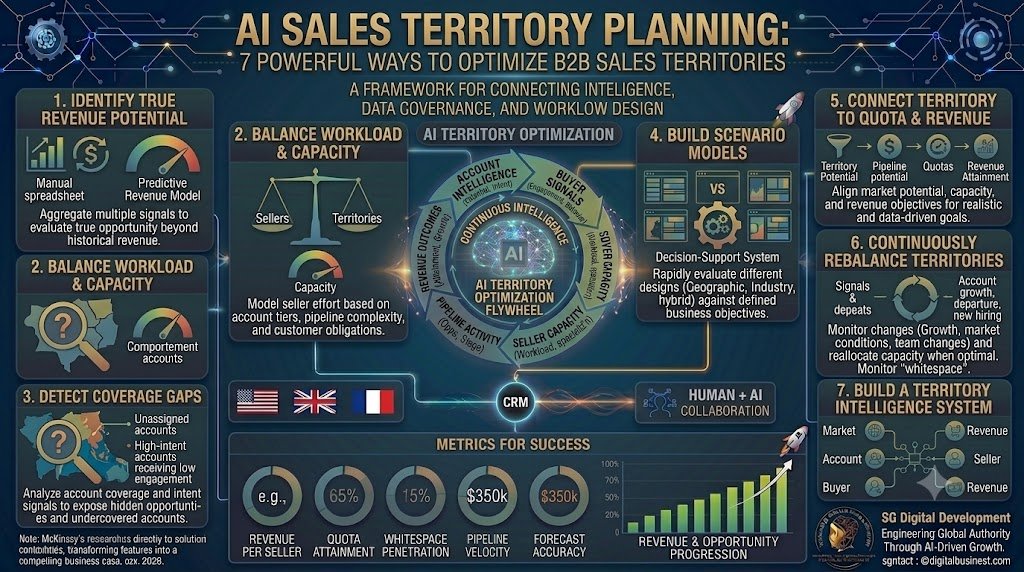
AI Sales Territory Planning: 7 Powerful Ways to Optimize B2B Sales Territories. Introduction Sales territory planning has traditionally been treated as an annual spreadsheet exercise. Sales leaders divide accounts by geography, industry, company size, named-account lists, or existing relationships. Sales operations teams then assign representatives, calculate quotas, review account coverage, and make adjustments when problems become obvious. That model is becoming increasingly difficult to manage. B2B markets change continuously. New accounts enter the market. Existing accounts grow or contract. Buyer intent changes. Sales representatives join or leave. Territories become overloaded. Some accounts receive too much attention while valuable opportunities remain untouched. At the same time, AI is giving sales organizations the ability to analyze far more signals than traditional territory planning processes can handle manually. AI sales territory planning uses account data, market potential, buyer intent, historical performance, seller capacity, pipeline activity, customer characteristics and other business signals to help sales leaders design and continuously evaluate territories. Instead of asking only: “How many accounts should each salesperson receive?” sales leaders can ask: This changes territory planning from a static administrative process into an ongoing revenue optimization discipline. For B2B companies, the objective is not simply to distribute accounts evenly. The objective is to create a territory structure that aligns market opportunity, account coverage, seller capacity, revenue potential and sales execution. This guide explains seven powerful ways companies can use AI sales territory planning to build more intelligent and adaptable sales coverage. What Is AI Sales Territory Planning? AI sales territory planning is the use of artificial intelligence, machine learning, predictive analytics and connected sales data to help organizations design, evaluate and optimize sales territories. A traditional territory model might primarily consider: AI can introduce a much broader set of variables. For example, an AI-assisted territory planning system could analyze: The result is not simply an automated territory map. It is a decision-support system that helps revenue leaders understand whether their current sales coverage matches the opportunity available in the market. Modern territory planning is increasingly connected to quota planning and capacity planning as well. Salesforce, for example, describes account targets as a data-driven baseline for quota planning and emphasizes evaluating whether assigned quota is supported by the potential of the accounts within a territory. That relationship is important. A territory can look balanced by account count while being extremely unbalanced by revenue potential. Ten small accounts do not necessarily equal ten enterprise accounts. Likewise, two territories with the same number of opportunities may require completely different amounts of seller effort. AI sales territory planning helps expose these differences. Why Traditional Sales Territory Planning Is Becoming More Difficult The problem with traditional territory planning is not that spreadsheets are inherently bad. The problem is that the underlying market is dynamic. A territory designed six months ago may no longer represent current opportunity. Accounts grow. Markets contract. Competitors enter. New products launch. Buyer behavior changes. Salespeople change roles. Pipeline moves. Customer relationships develop. Intent signals appear. And new accounts continuously enter the addressable market. Gartner’s 2026 guidance on sales operations emphasizes the need to continuously evaluate processes, technology, workforce requirements and operational risks as AI changes how sales organizations operate. AI sales territory planning fits into this broader transformation. Instead of treating territory design as a once-a-year project, companies can create an operating system for continuously evaluating: Opportunity → Coverage → Capacity → Ownership → Performance That creates a more responsive sales organization. AI Sales Territory Planning vs Traditional Territory Planning Traditional territory planning often relies on predefined rules. For example: Territory A Territory B The structure may look balanced. But the underlying opportunity might not be. Territory A could contain: Meanwhile, Territory B could contain more accounts but less commercial potential. AI sales territory planning allows companies to evaluate the territory using multiple dimensions rather than account count alone. The question becomes: “How much opportunity and workload does each territory actually contain?” That is a much more useful question for revenue planning. 7 Powerful Ways to Use AI Sales Territory Planning 1. Identify the True Revenue Potential of Every Territory The first major application of AI sales territory planning is understanding territory potential. Many organizations evaluate territories using historical revenue. That can be misleading. A territory that generated low revenue last year may contain significant untapped potential. Likewise, a territory that historically generated high revenue may be approaching saturation. AI can evaluate multiple variables simultaneously to estimate opportunity. These variables can include: This creates a more complete picture of territory potential. Example Imagine two sales territories. Territory A Territory B A traditional model may view Territory B as larger because it contains more accounts. An AI-powered model may identify Territory A as significantly more valuable because the commercial potential is greater. This distinction matters when allocating sellers. The objective is not to make account counts equal. The objective is to align sales capacity with opportunity. 2. Balance Territory Workload and Seller Capacity A territory can become problematic when the amount of work required exceeds the seller’s realistic capacity. Consider a territory containing: Another territory might contain: Both territories could have one salesperson. But their workloads are completely different. AI can help sales operations evaluate territory workload based on more than account volume. Potential inputs include: This creates a more realistic capacity model. The objective is not to give every seller exactly the same number of accounts. The objective is to give each seller a manageable territory with enough commercial opportunity to justify the assigned capacity. 3. Detect Territory Coverage Gaps One of the most valuable applications of AI sales territory planning is identifying accounts that are not receiving enough sales attention. Coverage gaps can happen for many reasons. A company may have: These problems can remain hidden inside a CRM. AI can analyze account coverage patterns and identify anomalies. For example, an AI system might identify: “Thirty-seven high-potential accounts have received no meaningful sales engagement during the past 60 days.” That insight can trigger a territory review. The sales organization

AI sales operations
AI Growth Engine

AI Sales Operations: 7 Powerful Ways to Transform B2B Sales Operations.

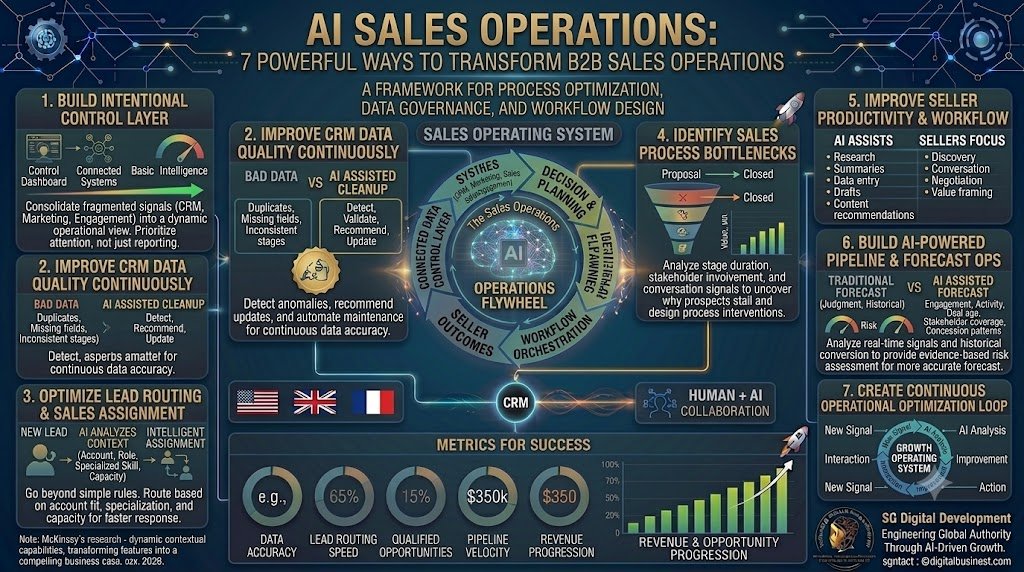
AI Sales Operations: 7 Powerful Ways to Transform B2B Sales Operations. Introduction Sales operations has traditionally been the infrastructure behind the sales organization. While sales representatives focus on prospects, customers and deals, sales operations teams manage many of the systems and processes that make selling possible. They may be responsible for: As B2B sales becomes more complex, these responsibilities are becoming increasingly difficult to manage manually. Sales organizations now operate across more channels, more data sources and more technology systems than before. At the same time, buyers are using AI to research vendors, compare solutions and move through buying journeys differently. This creates a new challenge. Sales operations can no longer simply maintain the existing sales process. It increasingly needs to help redesign how the sales organization works. This is where AI sales operations becomes important. An effective AI sales operations strategy uses artificial intelligence, automation, analytics, CRM data and workflow intelligence to improve the infrastructure supporting the sales organization. The objective is not simply to automate administrative tasks. It is to create a sales operating system that can: Gartner’s 2026 research describes sales operations as needing to evolve around AI-driven growth, process optimization, technology planning, workforce capabilities and operational risk management. Gartner has also reported that AI can save sellers substantial time, but that organizations need to deliberately reinvest that capacity into higher-value activities rather than assuming efficiency automatically produces revenue. That distinction is central to modern AI sales operations. The goal is not: Automate more work. The goal is: Design better sales operations. This article explains seven powerful ways businesses can use AI sales operations to build a more efficient, intelligent and scalable B2B sales organization. What Is AI Sales Operations? AI sales operations is the use of artificial intelligence, automation, analytics and connected business data to improve the processes, systems, workflows and decision support that enable a B2B sales organization. Traditional sales operations often relies on: These systems can work. But they can become difficult to scale as sales complexity increases. An AI sales operations system adds an intelligence layer. Instead of simply recording: Opportunity has been inactive for 14 days. The system may identify: This opportunity has exceeded the typical activity interval for its stage, has no recent buyer engagement and is approaching its expected close date. The first is a data point. The second is an operational insight. That distinction is important. AI sales operations is not about replacing the CRM. It is about making the information inside the CRM and other business systems more useful. Why AI Sales Operations Matters in 2026 Sales organizations are increasingly dealing with fragmented systems. A typical B2B organization may use: Each platform may contain useful information. The challenge is connecting that information into an operating model. McKinsey’s 2026 B2B research identifies fragmented data, weak insights, manual processes and disconnected teams as barriers to capturing value from AI. Its research argues that companies making stronger use of AI are increasingly redesigning workflows rather than simply adding AI tools on top of existing processes. This is exactly where AI sales operations can create value. Instead of adding another isolated AI tool, companies can use AI to connect: Data → Process → Workflow → Decision → Action → Measurement That creates a more intelligent sales operating system. 7 Powerful Ways to Use AI Sales Operations 1. Build an Intelligent Sales Operations Control Layer The first opportunity is to create a centralized intelligence layer across the sales organization. A sales operations team may currently need to check several systems to understand what is happening. For example: This creates operational fragmentation. An AI sales operations layer can help bring relevant signals together. Example A sales manager asks: Which opportunities need attention this week? Instead of manually reviewing hundreds of CRM records, the system can analyze: It can then surface a prioritized operational view. For example: High-priority opportunities Watchlist Healthy The AI is not making the final sales decision. It is helping sales operations identify where human attention is most valuable. This creates a fundamental shift: From reporting what happened to identifying what needs attention next. 2. Improve CRM Data Quality With AI CRM data is one of the foundations of sales operations. But CRM systems often contain: This creates downstream problems. Bad data affects: An AI sales operations system can help identify data-quality problems continuously. AI can detect: For example: 27 opportunities have remained in “Proposal” stage for more than twice the normal duration. That is more useful than simply reporting the number of opportunities in the proposal stage. AI-assisted CRM cleanup A practical workflow can be: Detect → Validate → Recommend → Human approve → Update For low-risk fields, some updates may be automated. For commercially important fields, human approval can remain necessary. The objective is not to allow AI to modify the CRM without control. The objective is to make CRM maintenance continuous rather than an occasional cleanup exercise. 3. Optimize Lead Routing and Sales Assignment Lead routing is one of the most important operational processes in B2B sales. A lead may need to be assigned based on: Traditional routing may use fixed rules. For example: US lead → US sales team. Rules remain useful. But AI can introduce more context. An AI sales operations system could consider: This can make assignment more intelligent. Example Two sales representatives both cover the same region. Representative A specializes in enterprise SaaS. Representative B specializes in SMB technology companies. A large enterprise SaaS opportunity may be better routed to A. The AI does not need to replace the company’s routing rules. It can operate within them while adding additional intelligence. Lead routing workflow New lead ↓ AI analyzes account ↓ Determine fit ↓ Check ownership ↓ Evaluate seller specialization ↓ Check capacity ↓ Assign ↓ Notify seller ↓ Track response This creates a more responsive operating system. 4. Identify Sales Process Bottlenecks Sales operations exists partly to identify where the sales process is breaking down. Traditional reporting may show: Lead → Opportunity →

Scroll to Top