AI Revenue Attribution: 7 Powerful Ways to Connect Marketing, Sales & Revenue.
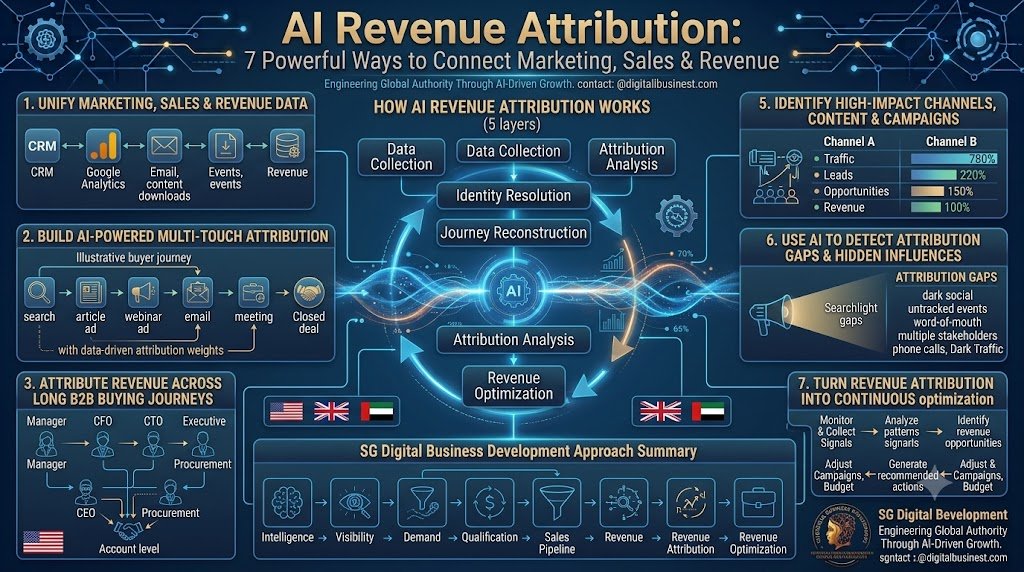
AI Revenue Attribution: 7 Powerful Ways to Connect Marketing, Sales & Revenue. Introduction B2B companies generate revenue through journeys that rarely follow a straight line. A prospect may discover a company through Google, encounter its content in AI search, click a LinkedIn post, return through an email, attend a webinar, speak with a salesperson, revisit the website several times and eventually become a customer. Then another question appears: Which of those activities actually contributed to the revenue? That is where AI revenue attribution becomes increasingly important. Traditional reporting often separates marketing performance, sales performance, customer activity and revenue data into different systems. Marketing may report leads and campaign conversions. Sales may report opportunities and closed deals. Customer success may report renewals and expansion. Finance ultimately reports revenue. The problem is that revenue does not happen inside one department. It happens across the customer journey. Modern attribution systems attempt to connect those interactions to business outcomes. HubSpot, for example, now provides attribution reporting across contacts, deals and revenue, while Google Analytics provides data-driven attribution that uses machine learning to evaluate how different interactions influence key events. For B2B organizations, the challenge is even greater because buying journeys can involve multiple people, channels, campaigns and offline interactions. Gartner’s 2026 research highlights the complexity directly: B2B organizations struggle to demonstrate marketing ROI across complex, multichannel buying journeys, while multitouch attribution tools are increasingly being used to address that problem. AI can help businesses move from basic attribution reporting toward a more connected revenue intelligence system. Instead of asking only: “Which channel generated the lead?” companies can begin asking: This article explains 7 powerful ways AI revenue attribution can connect marketing, sales and revenue, and how businesses can build a more reliable attribution system without treating attribution as perfect or absolute truth. What Is AI Revenue Attribution? AI revenue attribution is the use of artificial intelligence, machine learning, customer data and attribution models to understand how marketing, sales and customer interactions contribute to revenue outcomes. Traditional attribution assigns credit to touchpoints according to predefined rules. AI can make the system more adaptive. Instead of relying exclusively on a fixed model, an AI-powered system can analyze large amounts of customer journey data to identify patterns across: The goal is not simply to give every touchpoint a number. The goal is to understand the relationship between customer interactions and business outcomes. Google describes attribution models as rules or algorithms used to assign credit to interactions along the path toward an important action. Its data-driven attribution uses machine learning to compare converting and non-converting paths and estimate the contribution of interactions. In B2B, however, revenue attribution requires an even broader perspective. A single person rarely represents the entire buying journey. An account might have: The revenue event happens at the account level, while the interactions occur across multiple people. That makes AI revenue attribution particularly useful for organizations selling complex B2B products and services. Why Traditional Attribution Often Falls Short Attribution has existed for years. Businesses have used first-touch, last-touch, linear, time-decay and other models to distribute credit. The problem is not that these models are useless. The problem is that no single model can perfectly explain every B2B buying journey. HubSpot currently supports multiple attribution models, including first touch, last touch, linear, time decay and empirical attribution. Each model answers a slightly different question. First-touch attribution First-touch attribution gives credit to the first tracked interaction. It can help answer: Where did this customer initially discover us? But it may ignore everything that happened afterward. Last-touch attribution Last-touch attribution gives credit to the interaction closest to conversion. It can help answer: What happened immediately before conversion? But the final interaction may not explain the entire journey. Linear attribution Linear attribution distributes credit across multiple interactions. This provides a broader view but assumes each interaction deserves equal weight. Time-decay attribution Time-decay models give more credit to interactions closer to conversion. This can be useful when recent interactions are especially relevant. Data-driven attribution Data-driven models use observed data and machine learning to estimate contribution. Google’s current data-driven attribution methodology evaluates converting and non-converting paths and uses algorithmic calculations to distribute credit. The important point is simple: Attribution is a measurement framework, not an objective record of causality. That distinction matters. A touchpoint receiving 30% attribution does not necessarily mean it caused exactly 30% of the revenue. Instead, the number represents the logic of the selected attribution methodology. That is why advanced B2B organizations increasingly need attribution and experimentation. Gartner’s 2026 research specifically recommends combining attribution and testing to improve marketing measurement. How AI Revenue Attribution Works A modern AI revenue attribution system generally connects five layers. 1. Data collection The system collects customer and business interaction data. Examples include: 2. Identity resolution The system attempts to connect interactions to: This is especially important in B2B. 3. Journey reconstruction AI can organize interactions into customer or account journeys. For example: Search → Website → Content → Webinar → Sales Meeting → Opportunity → Proposal → Closed Won 4. Attribution analysis The system applies an attribution methodology to estimate contribution. This can include: 5. Revenue optimization The final step is turning measurement into action. Instead of simply reporting: Campaign A influenced $500,000 the business can ask: What should we do differently because Campaign A appears to influence revenue? That is where AI can turn attribution into an operating system for growth. 7 Powerful Ways AI Revenue Attribution Can Improve B2B Growth 1. Unify Marketing, Sales & Revenue Data One of the biggest problems in B2B measurement is fragmentation. Marketing data may exist in an advertising platform. Website data may exist in analytics. Sales activity may exist in a CRM. Customer information may exist in another platform. Revenue data may sit with finance. When these systems are disconnected, attribution becomes incomplete. AI revenue attribution starts by creating a connected data foundation. The system should ideally connect: Marketing → Engagement → Lead → Account → Opportunity → Customer → Revenue This allows