B2B AI Search Visibility
AI Growth Engine

Why Your B2B Brand Is Invisible in ChatGPT: 15 AI Search Visibility Problems to Fix in 2026.

Your domain may have backlinks. Your Google Search Console may show impressions. But a potential customer can still ask ChatGPT: “What are the best B2B companies for this service?” …and your company may not appear. That is a new kind of visibility problem. For years, B2B marketing was largely built around one basic model: Buyer searches Google → buyer sees results → buyer clicks website → buyer evaluates company. That model still matters. But it is no longer the entire discovery journey. B2B AI Search Visibility. B2B buyers are increasingly using AI assistants to research categories, compare vendors, understand problems and build shortlists before visiting a company’s website. G2’s 2026 research found that 71% of surveyed B2B software buyers rely on AI chatbots somewhere in their software research, while 51% say they start that research with an AI chatbot more often than Google. The report also found that AI chatbots have become the leading source influencing which vendors make software shortlists among its surveyed buyers. Forrester’s June 2026 research similarly reports that generative-AI conversational search tools are now a meaningful interaction for 87% of B2B buyers surveyed. That creates an important question for every B2B company: If your ideal customer asks an AI assistant for recommendations in your category, will your company be visible? This is where B2B AI Search Visibility becomes important. AI Search Visibility isn’t simply about getting your website to rank. It is about increasing the probability that AI systems can: And there is another important difference. Traditional search often gives the user a list of websites. AI search can give the user a synthesized answer. That means the competition is no longer only: Who ranks #1? It can also become: Whose information gets used to construct the answer? For B2B companies that depend on high-value leads, this shift deserves serious attention. What Is B2B AI Search Visibility? B2B AI Search Visibility is a company’s ability to be discovered, understood, represented, cited or recommended within AI-powered search and answer experiences. These can include: The objective isn’t necessarily to make an AI system say: “Company X is the best company.” That would be unrealistic and difficult to control. The objective is to build enough relevance, clarity, authority and supporting evidence that AI systems have strong reasons to understand and potentially surface your company when the query is relevant. Think about it as a new layer of digital discoverability. Traditional SEO asks: Can Google understand and rank this page? B2B AI Search Visibility asks: Can AI systems understand this company well enough to include it in a useful answer? Those questions overlap. But they are not identical. B2B AI Search Visibility. Why B2B AI Search Visibility Matters in 2026 The buyer journey is changing. G2’s 2026 research reports that AI chatbots are being used for category discovery, competitor comparisons and commercial-intent research, with many buyers using AI to accelerate their purchasing decisions. This means a potential buyer may now follow a journey such as: Problem ↓ ChatGPT research ↓ Category discovery ↓ Vendor shortlist ↓ Comparison ↓ Website verification ↓ Sales conversation Traditional analytics may only see the final website visit. But the buyer’s decision may have already been influenced before that visit. This is why B2B companies should not think about AI Search as simply another traffic source. B2B AI Search Visibility. It can influence which companies enter consideration in the first place. 15 B2B AI Search Visibility Problems You Need to Fix 1. AI Systems Cannot Clearly Understand What Your Company Does This is one of the most basic problems. Visit a B2B website and look at the homepage. Can someone immediately answer: What does this company do? Who does it help? What problems does it solve? What services does it provide? Which industries does it serve? If the answer is unclear to a human, it can also be difficult for machines to build a precise understanding of the company. Avoid vague positioning such as: “Driving digital transformation through innovative solutions.” Instead: We help B2B companies generate qualified leads through SEO, AI Search Visibility, paid acquisition and conversion-focused websites. Specific language creates stronger context. Your company name, service categories, industries and outcomes should be consistently described across your website. B2B AI Search Visibility. 2. Your Website Uses Generic Marketing Language Words such as: may sound impressive. But they provide little factual context. AI systems need meaningful information. Instead of saying: “We deliver cutting-edge digital solutions.” Explain: “We provide B2B SEO, AI Search Visibility, website conversion optimization and lead-generation services for companies looking to increase qualified inbound opportunities.” Now the relationship between: company → service → audience → outcome is much clearer. That clarity supports both traditional SEO and B2B AI Search Visibility. 3. Your Service Pages Are Too Thin A single paragraph saying: “We offer B2B SEO services.” isn’t enough. A strong service page should explain: What is the service? Who is it for? What problems does it solve? How does the process work? What does the client receive? What makes the approach different? What results should clients measure? What evidence supports the claims? What questions do buyers normally ask? The more useful context your website provides, the easier it becomes for search systems and potential buyers to understand the business. B2B AI Search Visibility. 4. Your Website Doesn’t Demonstrate First-Hand Expertise AI search increasingly rewards useful, trustworthy information. Your website should demonstrate that your company understands the subject it claims to specialize in. That can include: Don’t simply publish generic AI-generated summaries. Thousands of websites can say the same thing. Your competitive advantage is experience and evidence. B2B AI Search Visibility. 5. Your Case Studies Are Missing Case studies can play a major role in B2B authority. Suppose your website says: “We help B2B companies generate qualified leads.” A buyer may ask: “Have you actually done this?” A case study answers that question. Structure it around: Client problem ↓ Initial situation ↓ Strategy ↓ Implementation ↓ Challenges ↓ Result ↓ Business impact Case studies provide

B2B SEO Traffic
AI Growth Engine

Why Your B2B SEO Traffic Isn’t Turning Int o Sales: 19 Problems to Fix in 2026.

Introduction Your website is getting organic traffic. Your Google Search Console is showing impressions. Some of your pages are ranking. Your blogs are bringing visitors. But there is still one frustrating question: Why isn’t that B2B SEO traffic turning into sales? This is one of the biggest problems facing B2B companies in 2026. A business can spend months publishing articles, improving rankings, building backlinks and targeting keywords, yet the sales pipeline may barely move. B2B SEO Traffic The obvious conclusion is usually: “We need more traffic.” But more traffic isn’t necessarily the answer. If the traffic you’re already receiving isn’t reaching your commercial pages, understanding your offer, trusting your company and taking the next step, increasing traffic can simply increase the number of visitors who leave without becoming leads. That is why successful B2B SEO should not be measured only by: Those metrics matter. But they are only part of the picture. The real question is: Is your organic visibility attracting the right business buyers and moving them toward a sales conversation? Modern B2B SEO is increasingly focused on qualified visibility, buyer intent and revenue rather than traffic volume alone. Current 2026 B2B SEO guidance similarly emphasizes that lower-volume, higher-intent searches can be more valuable than broad traffic because B2B buying journeys are longer and involve multiple decision-makers. B2B SEO Traffic. This guide explains 19 reasons your B2B SEO traffic may not be turning into sales and, more importantly, what you can do about each problem. What Is B2B SEO Traffic? B2B SEO traffic is organic website traffic generated when business buyers search for information, solutions, vendors, services or products related to their professional needs. It can come from searches such as: But not all organic visitors have the same commercial value. Someone searching: “What is SEO?” has a different intent from someone searching: “B2B SEO agency pricing” The first may be researching. The second may be evaluating vendors. That distinction is fundamental. Why More B2B SEO Traffic Doesn’t Automatically Mean More Sales Imagine your website receives: 10,000 organic visitors per month. But only 1% reach a commercial page. That means only: 100 visitors are meaningfully entering your sales journey. Now imagine another website receives: 2,000 organic visitors. But 10% reach relevant commercial pages. That’s: 200 potentially valuable visitors. The second website has less traffic but potentially more commercial opportunity. B2B SEO Traffic This is why B2B SEO should be designed around: relevance + intent + conversion rather than traffic alone. 19 Reasons Your B2B SEO Traffic Isn’t Turning Into Sales 1. You’re Targeting High-Volume Keywords Instead of Buyer Keywords One of the biggest B2B SEO mistakes is choosing keywords because they have large search volumes. A keyword with thousands of searches may look attractive. But ask: Who is searching it? Why are they searching it? What do they want next? For example: “SEO” may generate enormous interest. But: “B2B SEO consultant for SaaS companies” may generate fewer searches while attracting a much more commercially relevant audience. In B2B, a small number of highly relevant searches can be more valuable than thousands of unrelated visitors. Your keyword strategy should therefore prioritize business relevance and search intent. 2. Your Content Attracts Researchers Instead of Buyers Educational content is useful. But if your entire SEO strategy focuses on informational searches, you may build an audience without building a pipeline. Consider: “What is lead generation?” versus: “B2B lead generation agency” The first is educational. The second is commercial. You need both. Informational content can create awareness. Commercial content can capture evaluation-stage demand. Transactional content can capture people who are ready to act. A healthy B2B SEO strategy connects all three. 3. Your Blog Topics Don’t Connect to Your Services Imagine someone reads: How AI Is Changing Search in 2026 Interesting article. But what happens next? If the page ends with: “Thanks for reading.” the opportunity is lost. Instead, connect the topic to a relevant commercial resource. For example: AI Search article ↓ AI Search Visibility Service ↓ AI Search Case Study ↓ AI Search Audit Now the blog becomes part of a sales journey. Your content should not exist as isolated pages. It should support the buyer journey. B2B SEO Traffic. 4. Your Search Intent Doesn’t Match the Landing Page Someone searches: B2B website lead generation agency and lands on your homepage. That’s not necessarily terrible. But it may not be ideal. A stronger experience could send them to: B2B Website Lead Generation Service where they immediately see: Search intent should influence the destination page. When the visitor sees exactly what they expected, friction decreases. 5. Your Commercial Pages Are Too Weak Many companies invest heavily in blog content but barely improve their service pages. That creates an imbalance. You might have: 100 excellent blog posts but weak commercial pages. The blogs attract traffic. The service pages fail to convert it. Your commercial pages should answer: Who is this for? What problem does it solve? Why does the problem matter? What exactly do you provide? How does the process work? What evidence do you have? How long does it take? What happens next? Why should the visitor contact you? Without these answers, B2B SEO traffic has nowhere meaningful to go. 6. Your Value Proposition Is Too Generic Consider: “We provide innovative digital marketing solutions.” It sounds professional. But it doesn’t tell the buyer much. Compare it with: We help B2B companies turn organic search and AI Search visibility into qualified sales opportunities. The second statement is more specific. It tells the visitor: Who you help What you do What outcome you pursue Your website should make that clear quickly. 7. Your Website Talks About Features Instead of Business Outcomes A B2B buyer doesn’t necessarily care about your entire technical stack. They care about the business problem. Instead of: Advanced SEO implementation explain: Improve visibility for the searches your potential customers use when evaluating solutions. Instead of: Conversion-focused web development explain: Turn relevant website visitors into more qualified enquiries. Instead of: AI-powered content

B2B Buyer Intent Signals
AI Growth Engine

21 B2B Buyer Intent Signals That Show a Company Is Ready to Buy in 2026.

Introduction A company can visit your website five times and still never become a customer. Another company can visit once, read one service page, check a case study, and request a meeting the same day. So what is the difference? Intent. This is why simply measuring website traffic, impressions, clicks and pageviews is no longer enough for B2B businesses. A visitor who reads a general educational article is not necessarily ready to buy. A visitor who searches for your pricing, compares your service with competitors, studies your case studies and then requests an audit is very different. The second visitor is giving you commercial signals. Those signals can help marketing and sales teams understand who is actually moving toward a buying decision. These are commonly described as B2B Buyer Intent Signals. In 2026, this matters even more because B2B buyers are using multiple channels before contacting a company. AI search is becoming an important part of research, while buyers still use Google, websites, reviews, colleagues, industry sources and vendor content to validate decisions. G2’s 2026 research, for example, reports that 71% of surveyed B2B software buyers rely on AI chatbots during software research, while 51% say they start research with an AI chatbot more often than Google. At the same time, buying decisions are becoming more collaborative. Forrester’s 2026 research says the typical business buying decision involves 13 internal stakeholders and nine external influencers, particularly for complex purchases. That means your future customer may be researching your business long before anyone fills out your contact form. The question is: Can you identify the signals that show the prospect is getting closer to a buying decision? This guide explains 21 B2B Buyer Intent Signals that can help you identify high-potential accounts, prioritize leads and build a more effective sales pipeline. What Are B2B Buyer Intent Signals? B2B Buyer Intent Signals are observable actions, behaviors or business changes that indicate a company may be researching, evaluating or preparing to purchase a product or service. These signals can come from: The important point is that one signal rarely proves buying intent. For example, someone visiting a pricing page could simply be researching the market. B2B Buyer Intent Signals But when that same visitor: the combined pattern becomes much more meaningful. This is why modern B2B Buyer Intent Signals should be evaluated together rather than treated as isolated events. Why Buyer Intent Matters More Than Lead Volume Imagine two businesses. Business A 1,000 leads 80 qualified leads 12 sales opportunities 3 customers Business B 400 leads 120 qualified leads 35 sales opportunities 9 customers Business B generated 60% fewer leads but three times as many customers. That is the difference between measuring lead volume and measuring buying intent. More leads can create: Better intent detection can help your team focus on prospects who are showing stronger buying behavior. That is why B2B Buyer Intent Signals should become part of the conversation between marketing and sales. 21 B2B Buyer Intent Signals You Should Monitor in 2026 1. Repeated Visits to Your Website One of the simplest B2B Buyer Intent Signals is repeated website activity. A visitor who comes once may be casually researching. A company that returns repeatedly may be evaluating you. Pay particular attention when repeat visits include: The combination matters more than the number of visits alone. B2B Buyer Intent Signals. For example: Visit 1: Blog Visit 2: Service page Visit 3: Case study Visit 4: Pricing Visit 5: Contact page That progression suggests significantly stronger intent than five visits to unrelated blog posts. 2. Pricing Page Visits Pricing is one of the strongest commercial B2B Buyer Intent Signals because people generally look at pricing when they are trying to determine whether a solution is commercially viable. A pricing-page visitor may be: Don’t automatically assume they are ready to buy. But pricing activity deserves more attention than generic content engagement. If someone visits pricing multiple times and then requests information, the signal becomes stronger. 3. Case Study Engagement Case studies are particularly valuable because they help buyers answer: “Can this company actually solve a problem like mine?” A prospect who reads several case studies may be moving from education toward validation. Watch for combinations such as: Service page → case study → testimonial → contact That is a much stronger journey than: Blog → blog → blog Case-study engagement is therefore one of the useful B2B Buyer Intent Signals for businesses selling higher-value services. 4. Competitor Comparison Searches When a prospect searches: “Company A vs Company B” or: “Best B2B SEO agency” or: “Alternative to [competitor]” the intent is usually more commercial than a general educational query. Comparison behavior indicates evaluation. This is why comparison content can be strategically valuable. Create pages that help prospects understand: Don’t make unsupported claims about competitors. Instead, create genuinely useful comparison content. B2B Buyer Intent Signals. 5. Searches for Your Brand Plus a Service Suppose someone searches: “SG Digital Business Development AI SEO” instead of simply: “AI SEO” The first query contains brand awareness plus service intent. That’s an important combination. Branded commercial searches can indicate that a prospect has already encountered your company and is now evaluating a specific offering. Track branded queries alongside non-branded queries in your search data. 6. Multiple Stakeholders Visiting Your Website This is one of the more interesting B2B Buyer Intent Signals. Imagine your analytics shows activity associated with multiple people from the same company. One person visits your service page. Another looks at your case studies. Another visits pricing. This could indicate that the account is being evaluated internally. Forrester’s 2026 research highlights how complex B2B buying groups can include many internal and external participants. That means account-level analysis can sometimes be more useful than looking at individual leads in isolation. B2B Buyer Intent Signals. 7. A Prospect Starts Asking Specific Questions There is a major difference between: “Can you tell me more?” and: “Can you implement this across our 15-country website?” The second question contains context. Specific questions

B2B Lead Qualification
AI Growth Engine

Why B2B Companies Get Website Enquiries but No Sales: 15 Lead Qualification Problems to Fix in 2026.

Introduction Your website is generating enquiries. People are filling out your forms. Some are booking calls. Others are sending emails asking about your services. On paper, everything looks positive. But then the sales process starts. Some prospects disappear. Some don’t have the budget. Some are looking for something completely different. Some aren’t decision-makers. Some aren’t ready to buy for another year. And some simply wanted free advice. This creates one of the most frustrating problems in B2B marketing: You are generating leads, but very few of them are becoming genuine sales opportunities. The natural reaction is often to generate even more leads. More traffic. More Google Ads. More LinkedIn posts. More cold outreach. More blogs. But if your qualification process is weak, increasing lead volume can actually create another problem: your sales team spends more time chasing people who were never likely to become customers. This is why B2B Lead Qualification deserves as much attention as lead generation. A lead is not automatically a sales opportunity. A prospect becomes more valuable when there is evidence of: Modern B2B teams increasingly distinguish between marketing-qualified leads and sales-qualified leads. LinkedIn describes an MQL as a prospect showing meaningful interest but not necessarily being ready to buy, while an SQL is further along and ready for direct sales engagement. B2B Lead Qualification. That distinction matters because your marketing team and sales team should not be judged by the same definition of a “lead.” The goal is not: Generate as many contacts as possible. The goal is: Generate, identify and prioritize the prospects most likely to become profitable customers. This article explains 15 common B2B Lead Qualification problems that can cause enquiries to stall before becoming sales and how to build a stronger qualification system in 2026. What Is B2B Lead Qualification? B2B Lead Qualification is the process of evaluating whether a potential business customer is a good fit for your company and whether there is enough evidence that a sales conversation is worth pursuing. A simple qualification process can examine: Fit Does the company match your ideal customer profile? Need Does the prospect actually have a problem your service solves? Authority Is the person involved in the buying decision? Intent Are they actively considering a solution? Timing Do they intend to act within a realistic timeframe? Commercial fit Does the potential engagement make sense financially for both sides? These factors don’t have to be identical for every company. A consultancy selling a high-value transformation project may use different qualification criteria from a SaaS company selling a monthly subscription. The important point is to define your criteria before leads start arriving. Without clear criteria, salespeople can interpret “qualified” differently. One salesperson may consider anyone who downloads a guide a good lead. Another may require a discovery call. Another may only consider a prospect qualified after budget and timing are discussed. That inconsistency makes B2B Lead Qualification difficult to measure. Lead vs MQL vs SQL: What’s the Difference? The terms can become confusing. Here’s a practical way to think about them. Lead Someone has entered your marketing or sales ecosystem. They may have: But you don’t yet know whether they’re a strong fit. Marketing Qualified Lead An MQL has demonstrated enough relevant interest or fit to justify further marketing or sales attention. LinkedIn notes that MQL scoring can incorporate firmographic information, job role, behavior and buying signals. Sales Qualified Lead An SQL has moved further through the funnel and has been assessed as worth direct sales engagement. Salesforce similarly describes an SQL as a prospect that has progressed beyond marketing qualification and demonstrated clearer buying intent. The exact definitions should be customized to your business. What matters is that marketing and sales agree on the rules. 15 B2B Lead Qualification Problems That Can Destroy Your Sales Pipeline 1. You Have Never Defined Your Ideal Customer Profile This is the foundation problem. If you don’t know exactly who you want to sell to, it becomes almost impossible to determine whether a lead is qualified. Your ideal customer profile can include: For example, saying: “We work with businesses.” is not useful. A stronger definition might be: “We help established B2B companies that already have a website and digital presence but need to increase qualified inbound opportunities.” Now your marketing can target a more specific audience. And your sales team has a clearer qualification benchmark. Strong B2B Lead Qualification starts with knowing who should qualify. 2. You’re Treating Every Enquiry as a Sales Opportunity A contact form submission is not the same as a sales opportunity. Someone may contact you because they: If every submission immediately becomes “sales qualified,” your pipeline becomes inflated. A better approach is: Enquiry ↓ Initial qualification ↓ Relevant prospect ↓ Sales conversation ↓ Opportunity This simple distinction can dramatically improve pipeline visibility. 3. Your Qualification Questions Are Too Weak Many forms ask only: Name Email Message That may be enough for a basic contact form. But if you sell a high-value B2B service, you may need additional context. For example: What service are you interested in? What problem are you trying to solve? What is your website? When are you looking to start? What is the approximate project scope? You don’t need to turn the form into an interrogation. But one or two useful questions can give your sales team much better context. The goal of B2B Lead Qualification isn’t to make the form difficult. It is to collect enough information to understand whether the conversation is relevant. 4. You’re Not Checking Company Fit A person can be interested in your service without their company being a good customer. For example, imagine your ideal clients are established B2B businesses. A lead might be interested but operate: Interest alone doesn’t equal fit. This is why qualification should evaluate both: Person fit and: Company fit Firmographic factors such as company size, industry, revenue and location can be useful inputs to lead scoring. 5. You Don’t Know Whether the Person Has Decision-Making Authority Another common

B2B Website Lead Generation
AI Growth Engine

B2B Website Lead Generation: Why Your Website Is Not Converting Visitors Into Qualified Leads in 2026.

Introduction Your B2B website may already be receiving visitors. Google Search Console may be showing impressions and clicks. Your blog content may be ranking for multiple keywords. Your LinkedIn posts may be bringing people to your website. You may even have service pages, case studies, testimonials and a clear contact form. But there is still one frustrating problem: The number of qualified enquiries is lower than it should be. This is where many B2B companies make the wrong decision. They assume they need more traffic. So they publish more articles. They target more keywords. They increase advertising budgets. They post more frequently on LinkedIn. But if the existing visitors are not being converted, increasing traffic may simply increase the number of people who leave without contacting you. This is why B2B Website Lead Generation should not be treated as a simple traffic problem. It is a complete journey. A potential buyer needs to: Discover your business ↓ Understand your offer ↓ Trust your expertise ↓ See evidence ↓ Understand the next step ↓ Take action ↓ Become a qualified lead The problem can occur at any stage. Your website might attract the wrong audience. Your headline might be unclear. Your service page might not match search intent. Your CTA might be too generic. Your case studies might be difficult to find. Your form might ask for too much information. Your offer might not provide enough reason to contact you. Or your website might simply fail to communicate why a prospect should choose you instead of another company. That is why effective B2B Website Lead Generation requires more than SEO. It requires the combination of: Search visibility + relevant traffic + strong positioning + trust + conversion + lead qualification. This guide explains the major reasons B2B websites fail to convert visitors into qualified leads and what you can do to improve the entire journey. What Is B2B Website Lead Generation? B2B Website Lead Generation is the process of using your website to attract relevant business visitors and convert them into identifiable prospects who may become customers. A conversion could be: But there is an important distinction. A website can generate enquiries without generating qualified leads. For example, imagine a website receives 50 enquiries in a month. If 35 are irrelevant, 10 have no budget and only 5 are genuine prospects, the website may appear successful from a basic analytics perspective. But from a business perspective, the result is weak. The objective of B2B Website Lead Generation should therefore be: Attract the right people and give them a compelling reason to start a relevant business conversation. Why Website Traffic Doesn’t Automatically Become Leads Traffic is only the beginning. Imagine two companies. Company A 10,000 monthly visitors50 qualified enquiries Company B 3,000 monthly visitors50 qualified enquiries Company B receives significantly less traffic but generates the same number of qualified opportunities. Now imagine Company B improves its conversion rate. The company may be able to generate substantially more enquiries without dramatically increasing traffic. This is why businesses should not ask only: “How much traffic are we getting?” They should also ask: “How much of that traffic has genuine commercial intent?” and: “What percentage of relevant visitors become enquiries?” That is the foundation of effective B2B Website Lead Generation. 1. Your Website Doesn’t Clearly Explain Who You Help The first problem is often positioning. A visitor should understand your business quickly. They should know: Who is this for? What problem does it solve? What outcome can I expect? A headline such as: “Innovative Digital Solutions for Modern Businesses” sounds professional. But it doesn’t communicate much. A stronger positioning statement might be: We Help B2B Companies Generate More Qualified Leads Through AI Search, SEO and Conversion-Focused Websites. Now the visitor immediately understands: Clear positioning makes B2B Website Lead Generation easier because the right visitor can recognize themselves immediately. 2. Your Homepage Talks About Your Company Instead of the Buyer Many B2B websites begin with: “We are a leading digital marketing company with years of experience…” The visitor may not care yet. They are thinking: “Can you solve my problem?” Your homepage should therefore lead with the customer’s problem. Instead of explaining everything about your company first, explain: Then introduce your company and expertise. The buyer should feel: “This company understands my situation.” That feeling can be extremely valuable for B2B Website Lead Generation. 3. Your Service Pages Are Too Generic One page called: Digital Marketing Services may contain: This creates a problem. The page has too many topics and not enough depth. Instead, build dedicated commercial pages where appropriate. For example: B2B SEO Explain the SEO strategy specifically for B2B companies. AI Search Visibility Explain how businesses can improve their visibility in AI-generated search results. B2B Lead Generation Explain the lead-generation process. Website Conversion Optimization Explain how traffic can be converted into enquiries. Each page should have its own: This makes your website stronger for B2B Website Lead Generation and search visibility. 4. Your CTA Is Too Generic One of the most common CTAs is: Contact Us There is nothing inherently wrong with it. But it doesn’t explain what happens next. Compare: Contact Us with: Request Your B2B Growth Audit The second CTA creates a clearer expectation. Other examples include: The best CTA depends on your offer. The principle is simple: Make the next action specific. Specific CTAs can make B2B Website Lead Generation easier because the visitor understands what they are requesting. 5. Your Website Doesn’t Give Visitors a Reason to Act Now A visitor may think: “This looks interesting. I’ll come back later.” And then they never return. Your website needs to communicate why taking the next step is useful. For example: B2B Growth Audit The visitor receives: Now the action has tangible value. The offer doesn’t need to be complicated. It simply needs to answer: “Why should I contact you instead of leaving this page?” 6. Your Website Doesn’t Show Enough Proof B2B buyers are cautious. They may be considering a

B2B Lead Generation
AI Growth Engine

B2B Lead Generation in 2026: 21 Strategies to Turn Website Visitors Into Qualified Sales Leads.

Introduction Your website gets visitors. Your Google Search Console shows impressions. Your blog posts are ranking for different keywords. Your LinkedIn content is reaching business owners and decision-makers. You may even be getting website enquiries occasionally. But there is one question that matters more than traffic: Are enough of the right people becoming qualified sales leads? For many B2B companies, the answer is no. The problem is rarely that nobody needs the service. The problem is that the company’s digital marketing system does not consistently move potential buyers from discovery to trust to enquiry. This is where a strong B2B Lead Generation strategy becomes important. Modern B2B buyers do a significant amount of research before contacting a company. They may: By the time they contact a business, they may already know a surprising amount about the company. That means your website cannot simply say: “We provide digital marketing services.” It needs to answer: Who do you help? What problem do you solve? Why should someone trust you? What makes your approach different? What result can the buyer expect? What should they do next? This is why effective B2B Lead Generation is not just about running advertisements or publishing blogs. It is a complete system. Search Visibility ↓ Qualified Traffic ↓ Relevant Content ↓ Trust ↓ Commercial Offer ↓ Conversion ↓ Qualified Lead ↓ Sales Conversation ↓ Client The purpose of this guide is to explain 21 practical strategies that can help turn a B2B website into a stronger lead-generation asset in 2026. What Is B2B Lead Generation? B2B Lead Generation is the process of attracting potential business customers and converting them into identifiable prospects who may eventually become sales opportunities. A lead might: However, not every lead is valuable. A website can generate 100 enquiries and still have a poor marketing system if 90 of those enquiries are irrelevant. The real objective is qualified B2B Lead Generation. A qualified lead should have some combination of: This distinction is critical. The goal isn’t simply: More leads. The goal is: More relevant leads. Why B2B Lead Generation Is Different From B2C Lead Generation B2B buying decisions are often more complicated. A B2C customer might discover a product, compare the price and purchase immediately. B2B buyers can involve: The sales cycle can therefore involve multiple conversations. That means B2B Lead Generation must support the buyer before the sales conversation begins. Your content and website should help answer: The more uncertainty you remove, the easier it becomes for qualified prospects to take the next step. 21 B2B Lead Generation Strategies for 2026 1. Build Your Website Around a Specific Buyer One of the biggest mistakes companies make is trying to speak to everyone. A website that says: “We help businesses grow online.” is too broad. A stronger position could be: We help B2B companies generate qualified leads through AI SEO, search visibility, paid acquisition and conversion-focused websites. The second statement gives the visitor a clearer understanding of: Your B2B Lead Generation strategy becomes much stronger when your website knows exactly who it is speaking to. 2. Create a Strong Commercial Homepage Your homepage should not simply introduce your company. It should function as a conversion gateway. A strong B2B homepage can include: Clear headline Who you help and what outcome you provide. Supporting statement How you achieve that outcome. Primary CTA What the visitor should do next. Proof Case studies, results and testimonials. Services Your main commercial solutions. Process How engagement works. FAQs Answers to common objections. Final CTA A clear next step. Your homepage doesn’t need to explain everything. It needs to help the right visitor decide: “I should explore this company further.” 3. Create Dedicated Service Pages A common B2B website problem is putting every service on one page. For example: SEO + Google Ads + Web Design + AI + Social Media + Consulting all appear on a single services page. This makes it difficult to build strong commercial relevance. Instead, create dedicated pages where appropriate: Each page should explain: Problem → Solution → Process → Evidence → CTA This improves both SEO and B2B Lead Generation potential. 4. Target Commercial Search Intent Not every keyword is equally valuable. Compare: What is B2B marketing? with: B2B lead generation agency and: B2B lead generation services The first is primarily educational. The second and third have much stronger commercial intent. Your keyword strategy should include: Informational keywords “What is B2B lead generation?” Problem keywords “Why is my B2B website not generating leads?” Commercial keywords “B2B lead generation agency” Service keywords “B2B lead generation services” Transactional keywords “Hire B2B lead generation agency” This creates a complete B2B Lead Generation search funnel. 5. Publish Problem-Based Content One of the best ways to attract potential buyers is to solve the problems they are already experiencing. Examples: These topics attract people who already recognize that something isn’t working. That makes problem-based content particularly valuable for B2B Lead Generation. 6. Connect Every Blog to a Commercial Page Publishing a blog is not enough. The article needs somewhere to send interested readers. For example: Blog “Why Your B2B Website Gets Traffic but No Qualified Leads” ↓ Service B2B Website Conversion Optimization ↓ Case Study Website Conversion Results ↓ Offer Request a B2B Growth Audit This is how content can contribute to B2B Lead Generation instead of becoming isolated traffic. Every important article should have at least one logical commercial next step. 7. Create a Specific Lead Magnet A generic: “Download our ebook.” may not be compelling. A more specific offer can be: B2B Website Conversion Checklist or: 25-Point B2B Lead Generation Audit or: AI Search Visibility Checklist The more specific the resource is to the buyer’s problem, the more useful it can become. A lead magnet should solve a small problem while demonstrating your expertise. 8. Use an Audit as a Conversion Offer For service businesses, an audit can be a strong commercial offer. Instead of: Contact Us try: Request a B2B Lead Generation Audit The audit could

B2B Search Intent Mistakes
AI Growth Engine

Why Your SEO Traffic Is Not Turning Into Sales: 15 B2B Search Intent Mistakes to Fix in 2026.

Introduction Your SEO traffic is increasing. Google Search Console shows more impressions. Your website is receiving clicks. Your blog content is being published consistently. Some of your pages may even be ranking on the first page. Yet your sales pipeline is not growing at the same rate. You may have thousands of visitors but only a handful of enquiries. This is one of the biggest problems in B2B SEO. And the immediate reaction is usually: “We need more traffic.” But more traffic may not solve the problem. The real issue could be B2B Search Intent . A person searching: “What is AI SEO?” is not necessarily ready to hire an AI SEO agency. A person searching: “Best AI SEO agencies” is much closer to evaluating providers. Someone searching: “Hire AI SEO agency” is closer still. The topic is similar. The intent is different. And that difference can have a major impact on revenue. This is why B2B Search Intent should become a core part of your SEO strategy in 2026. At SG Digital Business Development, we connect search visibility with commercial intent, website conversion, digital authority and lead generation. The goal isn’t simply: More visitors. The goal is: More relevant visitors who have a reason to become customers. Your SEO traffic is increasing month over month. Google Search Console shows a steady upward climb in total impressions. Your corporate website is receiving a higher volume of clicks, your content marketing team is publishing blog posts with consistent regularity, and some of your core pages might even be sitting comfortably on the first page of search results. Yet, your sales pipeline is not growing at a matching rate. You may find yourself looking at thousands of monthly visitors on your analytics dashboard while receiving only a handful of qualified enquiries. This disconnect is one of the most frustrating and persistent problems in modern B2B search engine optimization. When leadership notices this gap, the immediate, default reaction is usually: “We need more traffic. Let’s double our output.” However, simply driving more raw traffic will rarely solve the underlying structural issue. The real root cause of stagnant revenue despite rising visitor numbers is a fundamental misalignment with B2B Search Intent . To understand why this happens, consider how different queries signal entirely different commercial readiness. A person searching for: The topic or core subject matter across these queries is strikingly similar, but the underlying intent is entirely different. That difference in intent has a monumental, direct impact on your bottom-line revenue. This is precisely why fixing B2B Search Intent must become a foundational cornerstone of your 2026 organic growth strategy. At SG Digital Business Development, our core philosophy is to connect raw search visibility directly with commercial intent, website conversion efficiency, digital authority, and high-value lead generation. The goal of a professional enterprise SEO campaign is never simply to accumulate more visitors; the ultimate goal is to attract more relevant, qualified visitors who possess both the budget and the business justification to become paying customers. B2B Search Intent Mistakes. What Is B2B Search Intent ? In simple terms, B2B Search Intent represents the underlying business motivation, goal, or reason why a corporate user performs a specific query on a search engine. When a professional sits down at their keyboard, they are trying to accomplish a precise objective. The searcher may want to: Comprehending B2B Search Intent allows digital strategists to determine what exact type of page, layout, and content format should rank for a given query. For instance, search intent generally falls into distinct functional categories: These distinct types of searches can never be treated identically within a cohesive enterprise content architecture. If you feed an informational searcher a hard sales pitch, or force a transactional buyer to read a 3,000-word history lesson, you create friction that destroys conversion rates. Why B2B Search Intent Matters in Modern Digital Strategy To fully grasp the financial gravity of search intent, imagine two competing B2B websites in the same industry sector: At a quick glance during a casual review, Website A appears vastly more successful due to its higher traffic volume. But suppose you look deeper into the business metrics: Website A generates only 8 qualified enquiries per month, while Website B consistently generates 30 high-value corporate enquiries. Which website actually features the superior, more profitable SEO strategy? Obviously, Website B. This scenario demonstrates why chasing raw traffic metrics in isolation is a dangerous trap. Recognizing and avoiding B2B Search Intent helps businesses sharply distinguish between hollow traffic volume and genuine, revenue-ready commercial demand. When your enterprise focuses strictly on vanity traffic metrics, you build an audience of casual observers rather than high-value corporate decision-makers who control budgets and signing authority. The Comprehensive Anatomy of 15 B2B Search Intent 1. You Chase Search Volume Instead of Buyer Intent A keyword with 20,000 monthly searches can look exceptionally attractive on a standard SEO report. However, you must always pause to ask: Who is actually typing this query? If the vast majority of searchers are university students, entry-level job seekers, or casual consumers with no purchasing power, that keyword will generate zero commercial value for your business. Conversely, a keyword with only 300 monthly searches can be infinitely more valuable if those searches are conducted exclusively by C-level executives, founders, and procurement directors. Always evaluate audience demographics, core problems, commercial relevance, and buying stages before selecting your content targets.B2B Search Intent . 2. You Treat Every Keyword as an Informational Keyword This is one of the most widespread B2B Search Intent committed by marketing teams in the technology and SaaS sectors. A company publishes a continuous stream of basic articles, such as “What Is B2B Lead Generation?”, followed by “How Does B2B Lead Generation Work?”, and finally “Why Is B2B Lead Generation Important?”. While all three pieces attract top-of-funnel readers, they completely fail to capture bottom-funnel revenue. You must balance educational pieces with pages tailored explicitly for commercial buyers, such as a B2B lead generation agency, B2B

Business Is Invisible in AI Search
AI Growth Engine

Why Your Business Is Invisible in AI Search: 15 Reasons ChatGPT, Gemini & AI Search Engines Don’t Recommend You in 2026.

Introduction: The New Reality of Digital Discovery Your business may already have a functional website. You may have invested heavily in traditional SEO campaigns over the years. You may publish insightful blog posts every single week. Your Google Search Console dashboard may consistently show thousands of organic impressions. Your corporate LinkedIn profile may be active and engaging. You may even rank comfortably for important keyword variations on traditional search engines. Yet, despite all these legacy metrics looking healthy, a potential enterprise customer can open an advanced conversational search platform and ask: “Which companies can help a B2B business generate qualified leads using advanced frameworks?” and your company may completely fail to appear in the generated output. This is becoming one of the most disruptive and expensive digital marketing problems business leaders must solve in 2026. Traditional search engine optimization and modern AI Search Visibility are fundamentally connected, but they operate on completely different technological principles. Traditional SEO focuses heavily on helping specific web pages rank higher within static keyword-based search engine results pages. In stark contrast, Business Is Invisible in AI Search focuses on whether your corporate entity, domain authority, executive expertise, service architectures, and brand signals are recognized, ingested, and surfaced when conversational AI systems generate synthesized answers, market summaries, and vendor recommendations. A modern B2B buyer may no longer search only for a flat list of competing blue links. Instead, they type complex, multi-layered queries and expect the artificial intelligence system to evaluate the entire market, synthesize options, identify credible service providers, and explain why specific businesses are relevant to their exact operational needs. That means your modern business needs significantly more than vanity traffic. It requires absolute digital clarity, verifiable authority, semantic relevance, and structural trust. At SG Digital Business Development, we approach Business Is Invisible in AI Search not as a separate tactical checklist, but as a core component of an integrated AI-driven growth ecosystem that seamlessly connects traditional SEO, deep content hubs, digital authority, website conversion engineering, lead generation pipelines, and precise business positioning. The ultimate objective is straightforward: Become entirely discoverable, mathematically understandable, deeply credible, and universally recommendable across all modern search touchpoints. What Is Business Is Invisible in AI Search and How Do LLMs Evaluate Brands? Business Is Invisible in AI Search problems usually stem from a fundamental misunderstanding of how large language models (LLMs) and generative retrieval engines process information. Unlike traditional search crawlers that scan meta tags and keyword strings to rank individual pages, AI search platforms utilize Retrieval-Augmented Generation (RAG), vector embeddings, and knowledge graphs to understand entities and concepts. When an AI engine constructs an answer, it doesn’t just look for a matching keyword. It evaluates semantic relationships across the entire web. Traditional search engines might display: Meanwhile, AI-driven conversational search experiences produce entirely different output formats: This structural shift transforms how forward-thinking brands approach digital visibility. For instance, a junior researcher might type a short, high-volume query such as: “AI SEO agency.” Conversely, an enterprise decision-maker with an active budget will ask a context-heavy prompt: “Which specialized agencies can help a B2B company improve its visibility across Google and conversational AI search while simultaneously generating qualified pipeline leads?” A business with strong Business Is Invisible in AI Search prevention strategies has a vastly superior opportunity to be understood within that complex contextual web. Achieving this requires building a dense, cross-referenced digital footprint around your brand identity, proprietary methodology, service definitions, target audience, geographic operations, historical case studies, and industry authority. Why AI Search Visibility Dictates Enterprise Success in 2026 The modern B2B buying journey has evolved far beyond simple keyword searches and direct landing page visits. A typical corporate buyer discovers, evaluates, and validates a vendor through an intricate, multi-channel discovery loop: $$\text{Google Discovery} \rightarrow \text{Professional LinkedIn Feed} \rightarrow \text{Conversational AI Search} \rightarrow \text{Industry Publication Review} \rightarrow \text{Verified Case Study} \rightarrow \text{Company Website Verification} \rightarrow \text{Sales Conversation}$$ Advanced AI platforms act as a powerful preliminary discovery and filtering layer. If your direct competitors are repeatedly mentioned and recommended in answers to critical industry questions while your brand remains entirely absent, those competitors capture the buyer’s attention before your team ever gets an opportunity to pitch. That is why maintaining strong Business Is Invisible in AI Search monitoring is no longer optional—it is a core pillar of corporate survival. Modern businesses must stop treating digital channels in isolation and adopt an integrated framework: $$\text{Traditional SEO} + \text{AI Search Visibility} + \text{Brand Authority} + \text{Conversion Architecture}$$ 15 Reasons Your Business Is Invisible in AI Search 1. Your Business Positioning Is Too Generic One of the primary root causes of why your Business Is Invisible in AI Search metrics remain poor is vague, corporate positioning. Consider a typical generic statement found on thousands of agency websites: “We provide innovative digital solutions for modern businesses.” What does that statement actually communicate to a semantic search engine or an AI model? Does the company provide enterprise SEO, cloud software, paid advertising, management consulting, custom web development, lead generation, or generative AI integration? The sentence sounds professional, but it contains zero commercial specificity. Business Is Invisible in AI Search. A powerful, AI-optimized positioning statement explicitly defines the relationship between the entity and its market: “We help B2B companies generate qualified sales leads through specialized AI SEO, conversational AI Search Visibility, Google Ads, and high-converting website architectures.” When your website clearly maps $\text{company} \rightarrow \text{target audience} \rightarrow \text{core services} \rightarrow \text{measurable outcome}$, AI algorithms can categorize and recommend your business with absolute precision. 2. Your Website Has Weak Topical Authority Publishing a single standalone blog post will never establish the deep topical authority required to dominate competitive generative search queries. If your company wants AI engines to recommend your services, you must build an interconnected topic ecosystem. For example, rather than writing a single article, your domain should feature comprehensive clusters covering: These articles must link to one another in a structured hierarchy, creating the dense topical depth that LLMs look for when determining

B2B Search Intent
AI Growth Engine

Why Your SEO Traffic Is Not Turning Into Sales: 15 B2B Search Intent Mistakes to Fix in 2026.

Introduction: The Real Reason Your Traffic Isn’t Converting Into Revenue Your SEO dashboard may look exceptionally good on paper. Your website receives daily impressions across dozens of queries. Your pages generate consistent clicks. Your blogs continue to rank on search engine results pages, and your overall organic traffic graph is climbing higher every single month. Yet, despite all these vanity metrics looking healthy, your sales pipeline isn’t growing at the same speed, and your bottom-line revenue remains stubbornly stagnant. This creates a frustrating, expensive question that keeps B2B founders and corporate directors awake at night: If people are finding my website every day, why aren’t they becoming paying clients? The core reason for this costly disconnect is a fundamental failure to master B2B Search Intent. Too many digital marketing strategies operate under the false assumption that organic traffic is automatically valuable simply because it comes from Google. In reality, a visitor searching for information about a broad problem is completely different from someone actively comparing enterprise solutions or looking to hire an agency immediately. Consider the massive gulf in commercial value between these two distinct queries: The first user is typically a student, a junior employee, or an independent researcher looking for basic educational definitions. The second user is a decision-maker with an active corporate budget, an urgent operational problem, and high B2B Search Intent who is ready to sign a high-ticket contract. If your SEO strategy treats all traffic equally, you will generate thousands of meaningless visits without capturing enough qualified opportunities. Modern digital growth requires aligning your entire content architecture with precise B2B Search Intent to ensure every single visitor has a clear, frictionless pathway to becoming a high-value client. Your SEO dashboard may look good. Your website receives impressions. Your pages generate clicks. Your blogs continue to rank. Organic traffic is increasing. Yet your sales pipeline isn’t growing at the same speed. This creates a frustrating question: If people are finding my website, why aren’t they becoming customers? One major reason is B2B Search Intent. SEO traffic is not automatically valuable simply because it comes from Google. A visitor searching for information about a problem is not necessarily ready to buy. A visitor comparing providers is different from someone searching for a definition. And someone searching for: “hire B2B lead generation agency” has a very different commercial intent from someone searching: “what is B2B lead generation?” If your SEO strategy treats all traffic equally, you may generate thousands of visits without generating enough qualified opportunities. This is why modern B2B SEO must focus on intent, relevance and conversion, not traffic alone. What Is B2B Search Intent? B2B Search Intent is the underlying psychological reason, operational objective, and commercial motivation that drives a business professional to perform a specific search query. Understanding this precise intent allows companies to stop blindly chasing traffic and start creating content that maps directly to the exact stage of the complex corporate buying journey. An enterprise buyer might search with varying degrees of B2B Search Intent, including: Although these searches may revolve around the same broad industry topic, they represent completely different commercial outcomes. Ignoring B2B Search Intent means you end up serving basic educational definitions to buyers who are ready to buy, or aggressively hard-selling to casual readers who only want a quick answer. Both mistakes destroy your conversion rates. Why B2B Search Intent Matters for Your Bottom Line Imagine your website receives 10,000 organic visitors every month, but most of those visitors land on basic blog posts looking for free information. Meanwhile, your competitor receives only 2,000 visitors, but their entire digital architecture is built entirely around high-converting B2B Search Intent. Because their web pages specifically target decision-makers with acute commercial needs, that competitor generates significantly more revenue and closed contracts despite receiving a fraction of your traffic. That is why digital success cannot be measured by traffic volume alone. True business success requires measuring: $$\text{Qualified Traffic} \rightarrow \text{Intent-Matched Content} \rightarrow \text{High-Value Conversions} \rightarrow \text{Closed Revenue}$$ When you master B2B Search Intent, you stop wasting ad and SEO budgets on empty clicks and start building a predictable machine for client acquisition. 15 B2B Search Intent Mistakes Killing Your Pipeline 1. You Optimize for High Search Volume Instead of Buyer Intent A generic keyword with 20,000 monthly searches may look attractive on a spreadsheet, but if none of those users are potential corporate buyers, that traffic has zero commercial value. Conversely, a niche keyword with only 300 monthly searches can generate massive enterprise revenue if those searches come directly from executives influenced by accurate B2B Search Intent mapping. Stop optimizing for vanity numbers; start optimizing for corporate wallets. 2. You Treat Informational and Commercial Keywords the Same Not every page on your domain should lead to a generic service pitch. Informational queries require deep educational frameworks, while commercial investigations demand proof, case studies, and comparison tables. Matching your content format precisely to the visitor’s underlying B2B Search Intent eliminates friction and builds instant trust with prospective clients. 3. Your Blog Targets People Who Will Never Buy A poorly targeted blog naturally attracts students, junior freelancers, job seekers, and direct competitors. If your business sells high-ticket enterprise services to CEOs, marketing directors, and founders, your content strategy must intentionally filter out irrelevant traffic and cater strictly to high-value B2B Search Intent. If your blog reads like a free textbook for college students, you will never attract paying clients. 4. Your Content Doesn’t Identify the Core Business Problem B2B buyers rarely browse for fun; they search because something is broken in their current operations. When they type problem-based queries into search engines, your content must immediately connect their operational headache to your proprietary solution using targeted B2B Search Intent signals. Show them you understand their pain better than they do, and they will trust you to fix it. 5. Your Articles Don’t Include Commercial Next Steps An educational blog post should never leave the reader stranded at a dead end. It must guide

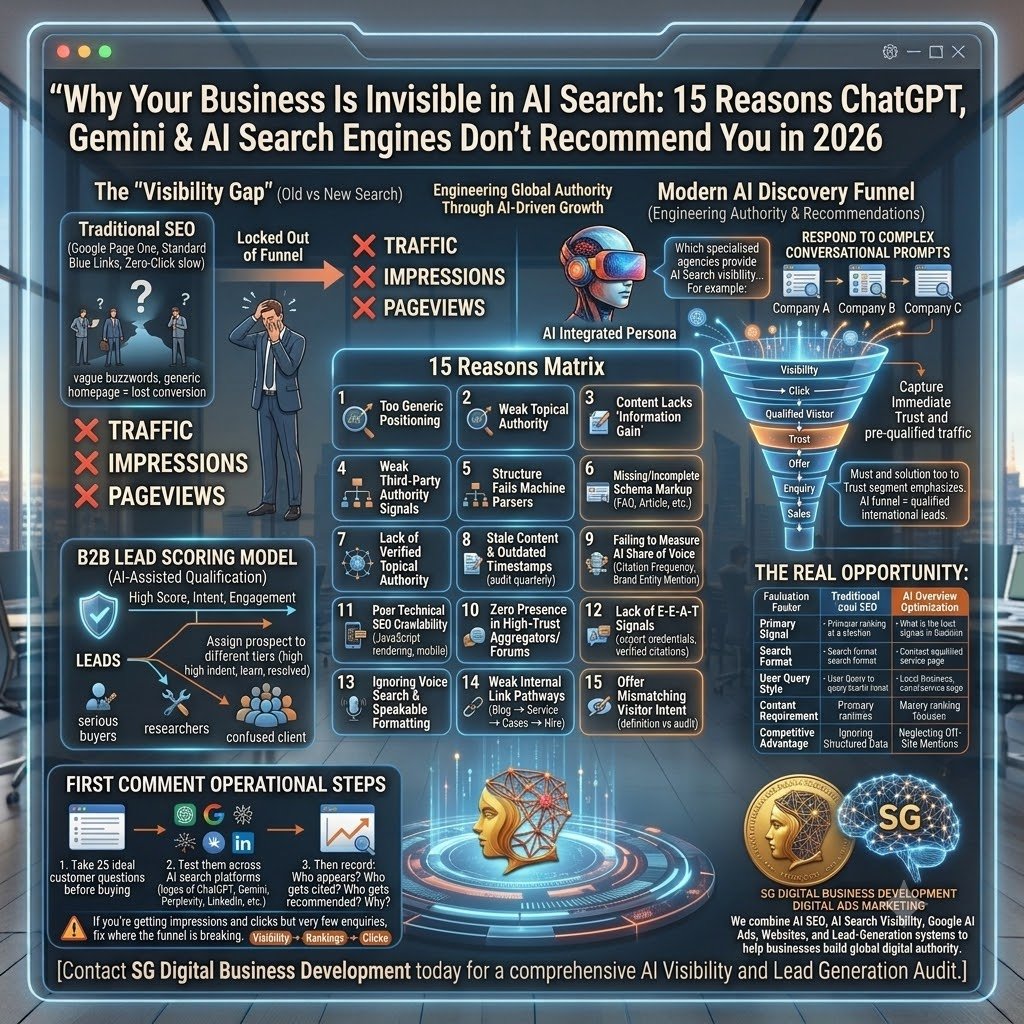
invisible in AI search
AI Growth Engine

Why Your Business Is Invisible in AI Search: 15 Reasons ChatGPT, Gemini & AI Search Engines Don’t Recommend You in 2026.

Introduction: The New Search Reality Traditional search engine optimization (SEO) built empires on a simple premise: rank among the top ten blue links, capture the click, and convert the visitor. For over two decades, digital marketers played a familiar game of matching keywords, building inbound links, and tweaking meta descriptions to please algorithmic crawlers. Today, that playbook is fundamentally shifting. With generative AI platforms like ChatGPT, Google Gemini, Perplexity, and Microsoft Copilot handling millions of high-intent B2B discovery sessions every single hour, users are no longer browsing pages of links. Instead, they are asking direct, multi-part questions and receiving synthesized, definitive answers instantly. If your business lacks strong invisible in AI search, you are not just losing traffic; you are completely locked out of the modern decision-making funnel. When a chief technology officer, procurement director, or corporate founder asks an AI assistant to recommend the top three software vendors, service providers, or digital agencies for a complex corporate migration, the AI does not offer them a ten-page results list. It delivers a curated, authoritative shortlist of immediate recommendations. Why do some brands dominate these AI recommendations while others remain entirely invisible? The answer lies in how large language models (LLMs) process, verify, and value data. In this comprehensive, deep-dive breakdown, we examine the 15 core reasons your business is missing from AI-generated answers in 2026, and how a rigorous data-driven feedback loop can transform your poor AI search visibility into a primary, cited authority that generates predictable, high-value B2B clients. 1. You Are Optimizing for Keywords Instead of Entities Traditional SEO trained marketers to obsess over exact-match keywords, search volume, and rigid keyword density ratios. While these metrics still hold baseline value for legacy crawlers, modern AI search engines operate on an entirely different cognitive plane. They do not match isolated strings of text; they map entities, attributes, and semantic relationships within knowledge graphs to determine invisible in AI search. 2. Absence of a Generative Engine Optimization (GEO) Strategy Most digital marketers are still deploying outdated strategies, focusing entirely on traditional Google rankings while completely ignoring how generative platforms retrieve and synthesize information. There is a massive operational chasm between classic SEO and Generative Engine Optimization (GEO). 3. Your Content Lacks “Information Gain” AI aggregators and large language models are remarkably efficient at spotting redundancy. If your corporate blog posts simply rehash what twenty other competitors have already published with minor wording variations, large language models have zero incentive to reference your site. 4. Weak Digital Authority Signals Across Third-Party Ecosystems AI models do not evaluate your website in a vacuum. When a user asks Gemini or Claude to recommend a service provider, the model cross-references your website’s claims with the sentiment, reviews, and discussions happening across the rest of the web. 5. Your Content Structure Fails Machine-Reading Parsers Human readers love narrative flair, creative introductions, and buried conclusions. AI scrapers and tokenizers despise them. If your content forces an algorithm to dig through layers of prose to find a core answer, it will look elsewhere. 6. Missing or Incomplete Schema Markup Search engines and AI models rely heavily on machine-readable code to understand the structural context, authorship, pricing, and relationships embedded within your web pages. 7. You Lack Verified Topical Authority Publishing one great article on B2B lead generation or enterprise software does not make your domain an authority in the eyes of an AI engine. Topical authority is accumulated through depth, breadth, and consistency. 8. Failure to Optimize for Conversational and Multi-Part Queries Users rarely type robotic, fragmented keywords into ChatGPT, Claude, or Perplexity. Instead, they speak and prompt conversationally, often asking complex, multi-layered questions that require nuanced, comparative answers. 9. Stale Content and Outdated Timestamps AI platforms—particularly real-time retrieval systems like Perplexity, ChatGPT Search, and Gemini with live web access—heavily weight content recency, freshness, and active maintenance when selecting sources. 10. Zero Presence in High-Trust Aggregators and Forums When enterprise buyers ask AI tools for software, agency, or service recommendations, LLMs frequently pull from massive user-generated knowledge bases, review platforms, and professional discussion communities. 11. Poor Technical SEO and Crawlability Bottlenecks Even the most brilliant piece of long-form content is useless if automated AI scrapers and web crawlers cannot efficiently crawl, render, and index your site infrastructure. 12. Lack of E-E-A-T Signals (Experience, Expertise, Authoritativeness, Trustworthiness) AI search engines are programmed to filter out low-credibility information aggressively to protect users from hallucinations, misinformation, and low-quality advisory content. 13. You Are Ignoring Voice Search and Speakable Formatting With a massive percentage of AI-assisted searches leveraging voice interfaces, smart assistants, and conversational audio outputs, formatting matters more than ever for auditory comprehension. 14. Failing to Measure AI Share of Voice (SOV) You cannot fix what you do not measure. Most businesses obsess over Google Search Console impressions and traditional rankings while remaining completely blind to their actual AI visibility and citation frequency. 15. The Absence of a Continuous Data-Driven Feedback Loop SEO, GEO, and AI visibility are not static, one-and-done implementation tasks; they require constant adaptation, performance tracking, and iterative refinement based on real-world data. AI Search Visibility vs Traditional SEO Traditional SEO asks: “Where does my page rank?” AI Search Visibility asks: “Does the AI system recognize my business as a relevant answer?” Both matter. A modern B2B strategy should therefore include: Google SEO AI SEO Brand Authority Entity Optimization Conversion Optimization The New B2B Discovery Journey The buyer journey is becoming more complicated. A potential customer may: Ask AI ↓ Receive recommendations ↓ Visit your website ↓ Verify your expertise ↓ Read case studies ↓ Check LinkedIn ↓ Compare competitors ↓ Request an audit ↓ Book a call Your website therefore has to do more than rank. It has to validate the recommendation. How SG Digital Business Development Approaches AI Search Visibility At SG Digital Business Development, AI Search Visibility should not be treated as a single technical trick. It is part of a broader digital authority system. That system can include: The objective is to

Scroll to Top