
Marketing Attribution: How to Measure What Really Drives Business Growth.
Businesses invest in search engine optimisation, paid advertising, social media, email, content, partnerships and sales activity to attract customers. Yet when a new customer arrives, one important question often remains unanswered: which marketing activity actually influenced the decision?
A prospect might first discover a company through a Google search, read an article a few days later, click a LinkedIn post, return through a paid advertisement and finally submit an enquiry after receiving an email. If the business credits only the final click, it may undervalue earlier interactions that helped build awareness and trust.
Marketing attribution provides a framework for understanding how different marketing touchpoints contribute to a conversion. It helps businesses examine the customer journey, interpret channel performance and make more informed budget decisions. It is not a formula that proves exactly why every customer bought. It is a way to organise evidence, make assumptions visible and improve decisions over time.
For companies operating in India and international markets, this discipline is useful when customers use several devices, channels and research sources before contacting a business. A sound marketing attribution approach connects campaign activity with enquiries, qualified opportunities and revenue instead of treating clicks and impressions as the final business outcome.
This guide covers marketing attribution models, reliable data, analytics, common mistakes and a practical measurement process.
What Is Marketing Attribution?
Marketing attribution is the process of assigning credit or analytical value to marketing interactions that occur before a desired action. That action may be a purchase, lead submission, consultation booking, app installation, subscription or another business outcome.
A touchpoint is an interaction between a potential customer and a business. Examples include an organic search visit, paid search click, social media engagement, email click, webinar attendance, referral visit or sales conversation.
Marketing attribution helps answer questions such as:
- Which channels introduce new prospects to the business?
- Which interactions help people evaluate a service?
- Which campaigns are associated with qualified enquiries?
- How do customers move between channels before converting?
- Where should the business investigate opportunities or inefficiencies?
The answers depend on tracking quality, the model, the conversion definition and available data. A report may show that a channel appeared in a customer journey, but that does not automatically prove the channel caused the purchase.
A useful marketing attribution programme combines quantitative reporting with business context. It should help decision-makers understand patterns, not create false certainty.
Why Marketing Attribution Matters to Business Decisions
Without a consistent measurement approach, companies can make budget decisions using incomplete evidence. A campaign that generates the final click may receive all the credit, while channels that introduced or educated the customer appear less valuable.
Budget is allocated using incomplete information
If a business evaluates channels only by last-click conversions, it may repeatedly fund channels that capture existing demand while reducing investment in activities that create awareness or consideration. Neither type of activity is automatically better. The right mix depends on the business objective and customer journey.
Teams report different versions of success
Marketing may report leads, sales may report accepted opportunities and finance may report revenue. If these teams use different definitions and reporting periods, leadership cannot easily connect campaign activity with commercial results.
Customer journeys remain unclear
A customer may interact with multiple channels before buying. Looking at one session or one click can hide the sequence of interactions that preceded the conversion.
Optimisation focuses on easy metrics
Clicks, impressions and low-cost traffic are useful diagnostic measures, but they are not substitutes for qualified enquiries, sales or profit. A measurement framework should connect activity to outcomes that matter to the organisation.
Marketing attribution gives teams a shared structure for discussing these questions. It does not replace judgement, experimentation or financial analysis.
Understand the Main Marketing Attribution Models
A marketing attribution model is a rule or method used to distribute credit across touchpoints. Different models answer different questions. No single model is universally correct for every organisation.
First-click marketing attribution
First-click marketing attribution assigns all conversion credit to the first recorded marketing interaction in the journey. This model can help identify channels that introduce people to a brand. If a prospect first arrives through an organic search article and later converts through a paid campaign, first-click reporting gives the initial organic interaction the credit.
Its limitation is that it ignores everything that happened afterwards. It can overstate the importance of the first recorded interaction and miss the work done by later channels.
Last-click marketing attribution
Last-click marketing attribution assigns all credit to the final recorded interaction before conversion, subject to the platform’s rules and tracking scope. It is easy to understand and can be useful when evaluating channels that capture immediate intent.
However, it may undervalue earlier interactions such as educational content, social engagement or brand discovery. A business using only last-click reporting should not interpret the result as a complete account of how demand was created.
Linear marketing attribution
Linear marketing attribution distributes credit equally across the recorded touchpoints in a journey. If four interactions are included, each receives one quarter of the credit.
This is simple and recognises that more than one interaction occurred. However, equal credit is an assumption. The first visit, a detailed product demonstration and a brief reminder advertisement may not have contributed equally to the decision.
Time-decay marketing attribution
Time-decay marketing attribution gives more credit to interactions closer to the conversion, according to a defined decay rule. This can be useful for journeys where recent interactions are believed to have a stronger relationship with the final decision. It still relies on an assumption about how influence changes over time.
Position-based marketing attribution
A position-based model gives greater weight to selected points in the journey, often the first and final interactions, with the remaining credit distributed among interactions in between.
This approach recognises both discovery and conversion activity. Its limitation is that the selected weighting is a rule, not proof that those touchpoints had that exact level of influence.
Data-driven marketing attribution
Data-driven approaches use available interaction and conversion data to estimate how different touchpoints relate to outcomes. The implementation and eligibility rules depend on the analytics or advertising platform.
A data-driven model can be more flexible than a fixed rule, but it depends on sufficient data, tracking quality, platform methodology and the events included in the analysis. It may also be difficult to compare directly with a different platform’s model.
When reviewing marketing attribution, document which model is being used and avoid comparing reports that use different rules as if they were identical.
Map the Customer Journey Before Choosing a Model
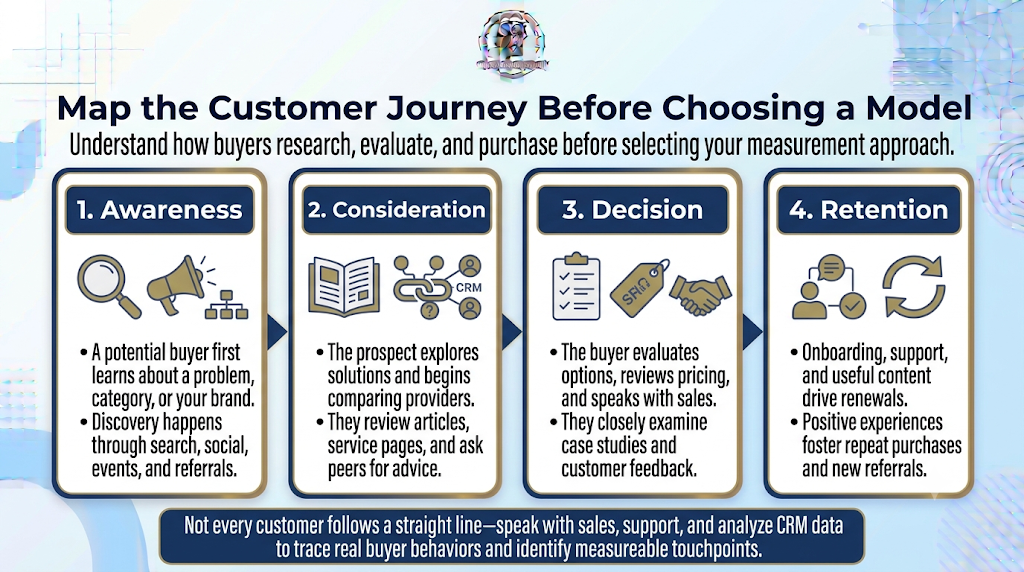
Before selecting a model, understand how customers research and buy from your business. A simple journey may include four stages.
Awareness
The person first becomes aware of a problem, category or brand. Discovery may happen through search, social media, video, a referral, an event or a recommendation.
Consideration
The prospect explores possible solutions. They may read articles, compare providers, visit service pages, watch demonstrations or ask colleagues for recommendations.
Decision
The person evaluates a shortlist, requests pricing, speaks with sales or reviews evidence such as case studies and customer feedback.
Retention and expansion
After the initial purchase, customer communication, onboarding, support and useful content may influence renewals, repeat purchases and referrals.
Not every customer follows these stages in a straight line. Some convert quickly; others return several times over weeks or months. A journey map should reflect real customer behaviour rather than an idealised diagram.
Speak with sales and customer service teams. Ask what prospects usually know before contacting the company, which questions they ask and what tends to delay a decision. Review customer interviews, CRM notes and analytics data where available.
The goal is to identify meaningful touchpoints and decide which ones can be measured responsibly.
Define Conversions and Business Outcomes
Marketing attribution is only as useful as the outcome being measured. If a company counts every page view or button click as a conversion, reports may look active while providing little insight into business performance.
Separate primary conversions from supporting events.
Primary conversions may include:
- A completed purchase.
- A qualified enquiry form.
- A consultation booking.
- A sales-accepted lead.
- A paid subscription.
- A confirmed appointment.
Supporting events may include viewing a pricing page, downloading a guide, clicking a phone number, starting a form, watching a product demonstration or subscribing to an email update.
Supporting events can help explain behaviour, but they should not automatically be counted as equivalent to revenue-generating outcomes.
For lead-generation businesses, define what makes an enquiry qualified. Criteria might include service fit, location, budget range, business type, timing or a confirmed need. Agree these criteria with the sales team and document them.
Where possible, connect the original marketing source with the later status of the lead. This allows reporting to move beyond form submissions and examine accepted leads, opportunities and revenue.
Prepare Your Tracking Foundation
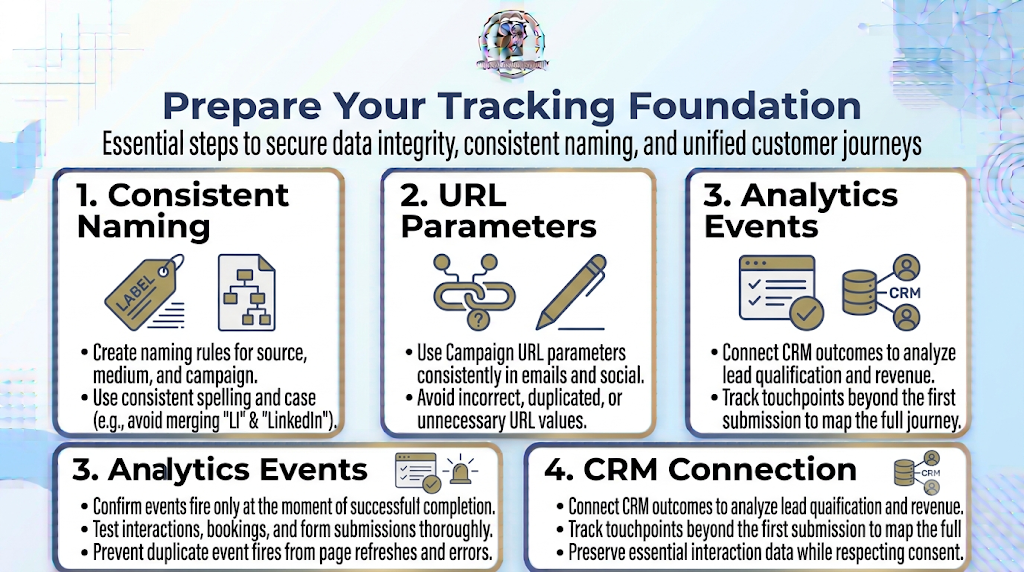
Before comparing channels, confirm that the underlying tracking is consistent. A sophisticated model cannot repair missing, duplicated or incorrectly labelled data.
Use consistent campaign naming
Create a naming convention for campaign source, medium, campaign name and other relevant parameters. Distinguish paid search from organic search and paid social from organic social.
Use consistent spelling and case. If one team labels a source as “LinkedIn”, another uses “linkedin” and a third uses “LI”, reports may split activity into separate rows.
Apply campaign parameters carefully
Campaign URL parameters can help analytics tools identify traffic from specific campaigns. Use them consistently in email links, social campaigns, partner placements and other tagged links where appropriate.
Avoid adding inconsistent or unnecessary values. Keep a record of naming rules so everyone involved can apply them correctly.
Check analytics events
Confirm that important events fire at the right moment. A form submission should be recorded after a successful submission, not merely when someone clicks the submit button.
Test purchases, bookings, phone interactions and other relevant actions. Check for duplicate event firing and ensure that confirmation pages or repeated refreshes do not inflate conversion counts.
Connect the CRM where appropriate
A CRM can preserve information about lead source, qualification, sales stage and revenue. Where integrations are available and privacy requirements are met, connecting CRM outcomes with marketing reporting can improve the quality of analysis.
Do not assume that a source recorded at the first form submission tells the complete story. A prospect may return through another channel before becoming a customer. Preserve useful journey information while respecting data minimisation and consent requirements.
How to Use Google Analytics 4 for Marketing Attribution
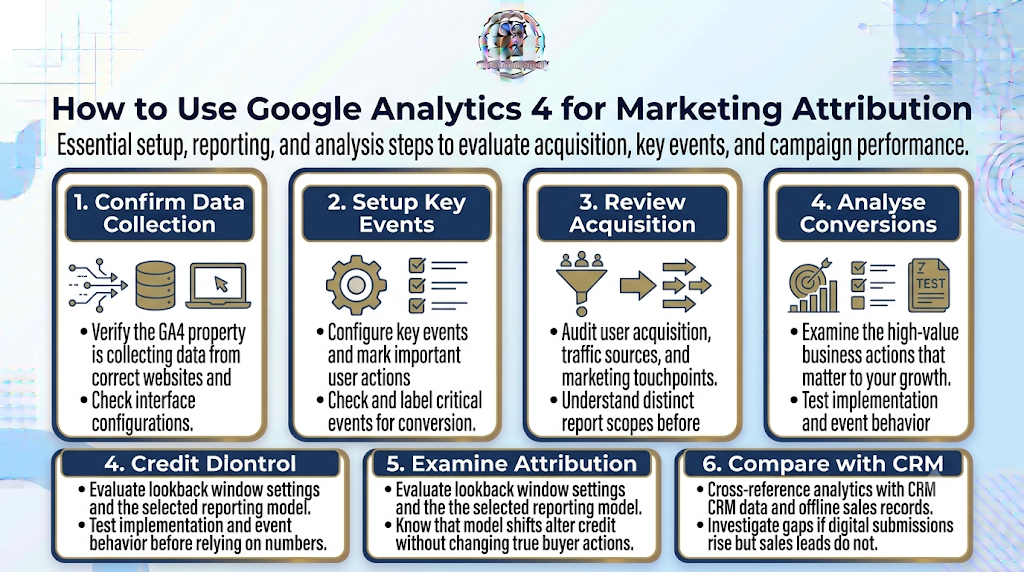
Google Analytics 4 provides reports and settings that help businesses examine acquisition, events, conversions and marketing attribution. The available views and options can change, so check the current interface and official documentation when configuring a property.
Start by confirming that the property is collecting data from the correct website or app. Check that key events are configured and that important actions are marked appropriately for reporting.
Review acquisition reports to understand how users or sessions arrive. Be clear about the scope of each report: user acquisition, traffic acquisition and marketing attribution reports do not necessarily answer the same question.
Use conversion or key-event reporting to examine the actions that matter to the business. Review the event configuration and test the implementation before relying on the numbers.
Where marketing attribution reports are available, check the selected reporting model and lookback settings. A change in model can change how credit is distributed without any underlying change in customer behaviour.
Compare analytics findings with CRM and sales records. If analytics reports a rise in form submissions but the sales team sees no increase in qualified opportunities, investigate the difference before increasing campaign spend.
Measure Paid Campaigns Beyond Clicks
Paid advertising platforms provide detailed campaign metrics, but platform-reported conversions should not automatically be treated as the full business result.
Review the relationship between spend, reach, clicks, landing page visits, completed actions, qualified leads and revenue. Each metric answers a different question.
For search advertising, examine whether search terms match the service and audience. For social advertising, review the audience, creative, offer and landing page. A campaign may generate inexpensive clicks but attract people who are not suitable customers.
Check that conversion tracking is configured consistently between the advertising platform and analytics system. Differences may arise because platforms use different marketing attribution windows, view-through rules, time zones, conversion definitions or modelling methods.
Do not add platform conversion totals together without checking for overlap. The same customer action may be claimed by more than one advertising platform.
Marketing attribution is most useful when teams understand the reporting rules behind each number and use a consistent source of truth for business outcomes.
Understand Organic Search and Content Contributions
Organic search can introduce people to a business long before they are ready to enquire. An informational article may answer an early question, while a service page may support the final evaluation.
If a company judges SEO only by last-click conversions, it may miss the contribution of content that helped a prospect understand a problem or compare options.
Use Search Console to examine organic search queries, impressions, clicks and landing pages. Use analytics to understand what visitors do after arriving, while recognising that the two systems have different measurement scopes.
Connect informational articles to relevant service pages through useful internal links. Track whether visitors move from educational content towards commercial information and meaningful actions.
Do not assume that every article should generate an immediate enquiry. Some content supports awareness, some supports evaluation and some answers questions for existing customers. Define the purpose of each content group and evaluate it accordingly.
Account for Offline and Long Sales Cycles
Some businesses complete sales away from the website. A prospect may submit a form, speak with a salesperson, attend a meeting, receive a proposal and sign a contract several weeks later.
If reporting stops at the initial form submission, the company may not know which channels create valuable customers.
A practical process can record the lead’s source, date, campaign information where available, qualification status, opportunity stage and final outcome. Sales teams should update records consistently.
For businesses that receive phone enquiries, use a suitable call-tracking process where lawful and appropriate. Make sure the business understands what is being recorded and provides any required notices.
Offline conversion imports or CRM integrations may be available in some advertising and analytics platforms. Their setup requirements differ. Validate identifiers, consent, data formatting and deduplication before sending information.
Long sales cycles also require suitable reporting windows. A campaign launched last week may not have produced closed revenue yet. Evaluate leading indicators while waiting for later commercial outcomes, and avoid judging every campaign on an identical short time frame.
Use Incrementality and Experiments Carefully
Marketing attribution reports describe how credit is assigned within observed journeys. They do not necessarily prove what would have happened if a particular campaign had not run.
Incrementality testing addresses a different question: did the marketing activity create additional outcomes compared with a reasonable alternative?
Depending on the business and channel, experiments may include geographic holdouts, audience holdouts, controlled campaign tests or time-based comparisons. Good tests need clear hypotheses, suitable comparison groups and enough data to interpret results.
Not every business has the traffic or budget for a large experiment. Smaller organisations can still use structured tests, such as comparing carefully matched markets or reviewing changes after a controlled campaign adjustment. Record other factors that could affect the result, including seasonality, pricing, stock availability and sales capacity.
Avoid claiming that an experiment proves more than its design can support. A simple before-and-after comparison may be useful operationally, but it does not isolate the effect of a campaign when many other factors changed.
Common Marketing Attribution Mistakes to Avoid
Treating one model as the truth
Every model makes assumptions. Use the model that supports the question being asked, and explain its limitations.
Mixing incompatible reports
Platforms may use different time zones, windows, conversion definitions and counting methods. Reconcile these differences before comparing totals.
Counting every interaction as a conversion
A page view or button click may be useful evidence of engagement, but it is not the same as a qualified lead or purchase.
Ignoring the CRM
Marketing reports that stop at form submissions may miss qualification, opportunity and revenue outcomes. Connect campaign activity to later stages where practical.
Overlooking privacy and consent
Collect only information that is needed, apply appropriate access controls and follow applicable privacy, cookie and advertising requirements. Do not send personal data to analytics or advertising systems unless platform rules and the legal basis permit it.
Making budget changes too quickly
Short reporting windows can be misleading, especially for high-value services with long sales cycles. Consider the time required for leads to mature and sales outcomes to appear.
Confusing correlation with causation
A channel appearing in a customer journey does not prove it caused the purchase. Combine reporting with customer research and experiments where feasible.
A Practical 30-Day Marketing Attribution Setup Plan
Week 1: Agree on business definitions
Bring marketing, sales and leadership together. Define primary conversions, qualified leads, opportunities and revenue outcomes. Agree on the reporting period and the questions the measurement process should answer.
Document the customer journey for one or two important services. Identify the touchpoints that can be tracked reliably and the ones that require qualitative research.
Week 2: Audit tracking and naming
Review analytics events, campaign parameters, forms, phone interactions and CRM fields. Test important actions from beginning to end.
Create a campaign naming guide. Correct inconsistent source and medium values where possible, and document any historical data that cannot be repaired.
Week 3: Build a useful report
Create a simple report that shows spend, traffic, primary conversions, qualified leads and opportunities by channel. Include the marketing attribution model, date range and important definitions.
Do not overload the report with every available metric. Choose measures that help the team make decisions and explain gaps in the data.
Week 4: Review findings and decide what to test
Look for patterns rather than treating a single report as a final verdict. Identify channels that introduce prospects, channels that assist evaluation and channels associated with final actions.
Choose one or two questions for further investigation. This might be whether a particular content group supports qualified leads, whether a paid campaign attracts suitable prospects or whether a landing page is losing visitors.
Record the hypothesis, action, owner, time frame and success measure. Review the results before making a larger budget decision.
How SG Digital Business Development Can Help
Effective growth measurement connects visibility, website activity, marketing campaigns and business outcomes. SG Digital Business Development helps businesses strengthen their digital presence and connect marketing activity with practical growth objectives.
Depending on your requirements, support may include SEO, digital marketing, Google and Meta advertising, website development, analytics planning and lead-generation strategy.
A useful starting point is to understand how your current channels are measured. Review whether campaign links are tagged consistently, whether important enquiries are tracked correctly and whether lead quality is visible beyond the initial form submission.
The next step is to identify gaps between marketing reports and actual business outcomes. Some businesses need clearer conversion definitions. Others need better CRM processes, cleaner campaign naming or a more useful reporting structure.
The objective is not to produce a complicated dashboard. It is to give decision-makers reliable information that helps them understand what is working, what remains uncertain and what should be tested next.
If your business invests in multiple marketing channels but struggles to understand which activities contribute to qualified opportunities, a structured measurement review can provide a clearer starting point.
Frequently Asked Questions
What is marketing attribution in digital marketing?
It is a method of analysing how marketing touchpoints are associated with a conversion. It helps businesses understand the interactions that occurred before an enquiry, purchase or other defined outcome.
Which marketing attribution model is best?
There is no universal best model. First-click can help examine discovery, last-click can show final recorded interactions, and multi-touch or data-driven approaches can provide a broader view. Select a model based on the business question and available data.
What is the difference between first-click and last-click marketing attribution?
First-click assigns credit to the first recorded interaction in a journey. Last-click assigns credit to the final recorded interaction before conversion, according to the platform’s rules. Each highlights a different part of the journey and omits other interactions.
Can Google Analytics 4 measure marketing attribution?
Google Analytics 4 provides acquisition, event and marketing attribution-related reporting. The available reports and settings depend on the property and current product features. Confirm event configuration and reporting scope before interpreting results.
Why do Google Ads and Analytics show different conversion numbers?
They may use different marketing attribution windows, counting methods, time zones, conversion definitions and modelling. Check configuration and compare like-for-like actions before investigating a discrepancy.
How does marketing attribution help with marketing budgets?
It can provide evidence about how channels participate in customer journeys. Businesses can use that evidence alongside cost, lead quality, revenue and experiments to make more informed budget decisions.
Is marketing attribution useful for small businesses?
Yes. A small business can begin with consistent campaign naming, correctly tracked enquiries, a simple CRM process and a monthly channel review. Complex modelling is not necessary to establish better measurement habits.
How should B2B companies measure long sales cycles?
Track the journey from initial enquiry through qualification, opportunity and closed revenue. Preserve useful source information and use reporting windows that reflect the actual time required for a sale.
Does marketing attribution prove that an advertisement caused a sale?
No. Marketing attribution assigns credit according to a model or measurement method. It does not automatically establish causation. Experiments and incrementality analysis can help investigate whether a campaign generated additional outcomes.
What should a marketing attribution report include?
A useful report can include channel, campaign, spend, visits, primary conversions, qualified leads, opportunities and revenue where available. It should also state the date range, attribution model, conversion definitions and known data limitations.
Conclusion: Make Better Decisions With Clearer Marketing Measurement
Businesses need more than a list of clicks and impressions to understand marketing performance. They need a consistent way to connect channel activity with customer journeys, qualified enquiries and commercial outcomes.
Marketing attribution can help create that understanding, provided the business defines conversions carefully, maintains reliable tracking and explains the assumptions behind its reports. First-click, last-click, multi-touch and data-driven approaches each offer a different perspective. None should be treated as a complete explanation of customer behaviour.
Start with a manageable process. Agree on business definitions, audit tracking, connect marketing records with sales outcomes and build a report that supports real decisions. Use customer feedback and controlled experiments to investigate questions that reporting alone cannot answer.
The purpose is not to give every channel a perfect score. It is to understand the available evidence, recognise uncertainty and invest more intelligently in activities that contribute to sustainable growth.
Want clearer visibility into which marketing activities generate valuable business opportunities? Contact SG Digital Business Development to discuss your digital growth and measurement requirements.
Visit: Contact SG Digital Business Development
Let’s build your digital future together. Contact SG Digital Business Development today and let’s engineer your global authority!