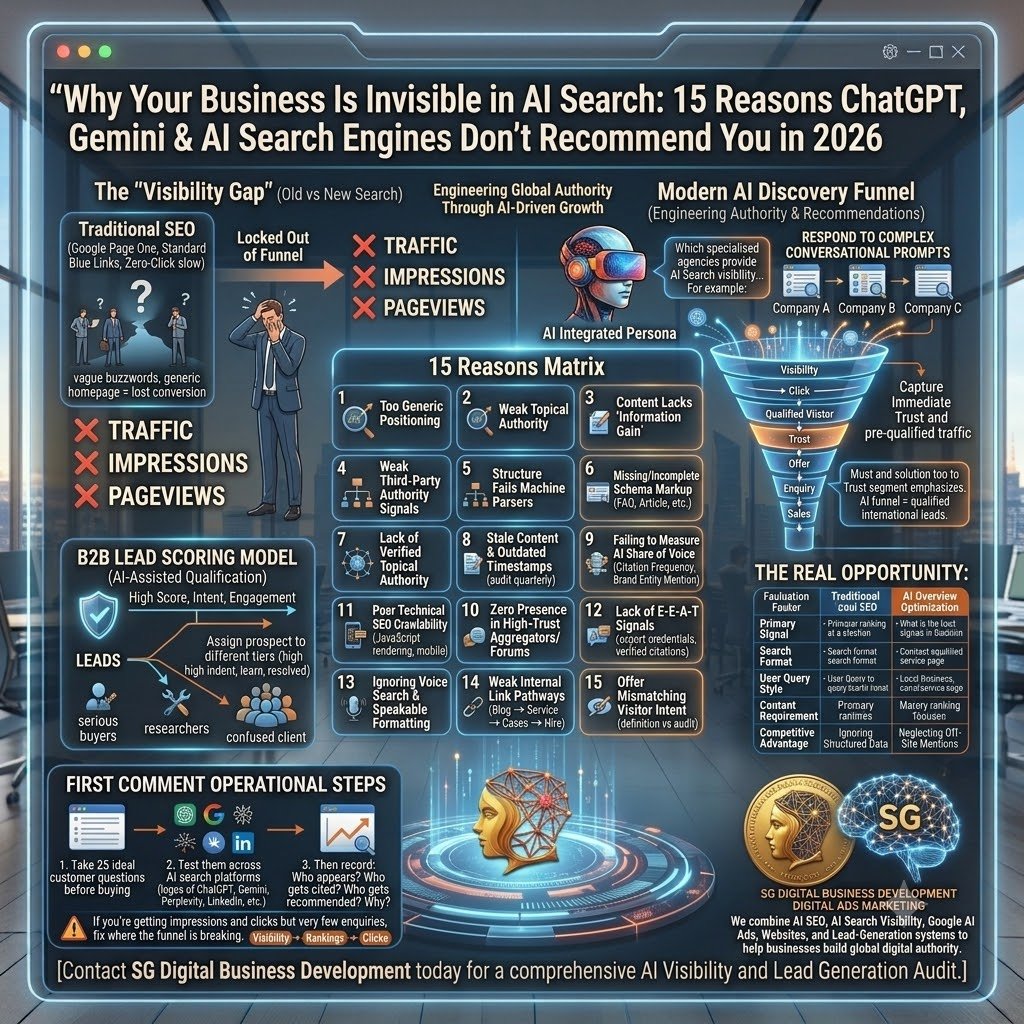
Why Your SEO Traffic Is Not Turning Into Sales: 15 B2B Search Intent Mistakes to Fix in 2026.
Introduction Your SEO traffic is increasing. Google Search Console shows more impressions. Your website is receiving clicks. Your blog content is being published consistently. Some of your pages may even be ranking on the first page. Yet your sales pipeline is not growing at the same rate. You may have thousands of visitors but only a handful of enquiries. This is one of the biggest problems in B2B SEO. And the immediate reaction is usually: “We need more traffic.” But more traffic may not solve the problem. The real issue could be B2B Search Intent . A person searching: “What is AI SEO?” is not necessarily ready to hire an AI SEO agency. A person searching: “Best AI SEO agencies” is much closer to evaluating providers. Someone searching: “Hire AI SEO agency” is closer still. The topic is similar. The intent is different. And that difference can have a major impact on revenue. This is why B2B Search Intent should become a core part of your SEO strategy in 2026. At SG Digital Business Development, we connect search visibility with commercial intent, website conversion, digital authority and lead generation. The goal isn’t simply: More visitors. The goal is: More relevant visitors who have a reason to become customers. Your SEO traffic is increasing month over month. Google Search Console shows a steady upward climb in total impressions. Your corporate website is receiving a higher volume of clicks, your content marketing team is publishing blog posts with consistent regularity, and some of your core pages might even be sitting comfortably on the first page of search results. Yet, your sales pipeline is not growing at a matching rate. You may find yourself looking at thousands of monthly visitors on your analytics dashboard while receiving only a handful of qualified enquiries. This disconnect is one of the most frustrating and persistent problems in modern B2B search engine optimization. When leadership notices this gap, the immediate, default reaction is usually: “We need more traffic. Let’s double our output.” However, simply driving more raw traffic will rarely solve the underlying structural issue. The real root cause of stagnant revenue despite rising visitor numbers is a fundamental misalignment with B2B Search Intent . To understand why this happens, consider how different queries signal entirely different commercial readiness. A person searching for: The topic or core subject matter across these queries is strikingly similar, but the underlying intent is entirely different. That difference in intent has a monumental, direct impact on your bottom-line revenue. This is precisely why fixing B2B Search Intent must become a foundational cornerstone of your 2026 organic growth strategy. At SG Digital Business Development, our core philosophy is to connect raw search visibility directly with commercial intent, website conversion efficiency, digital authority, and high-value lead generation. The goal of a professional enterprise SEO campaign is never simply to accumulate more visitors; the ultimate goal is to attract more relevant, qualified visitors who possess both the budget and the business justification to become paying customers. B2B Search Intent Mistakes. What Is B2B Search Intent ? In simple terms, B2B Search Intent represents the underlying business motivation, goal, or reason why a corporate user performs a specific query on a search engine. When a professional sits down at their keyboard, they are trying to accomplish a precise objective. The searcher may want to: Comprehending B2B Search Intent allows digital strategists to determine what exact type of page, layout, and content format should rank for a given query. For instance, search intent generally falls into distinct functional categories: These distinct types of searches can never be treated identically within a cohesive enterprise content architecture. If you feed an informational searcher a hard sales pitch, or force a transactional buyer to read a 3,000-word history lesson, you create friction that destroys conversion rates. Why B2B Search Intent Matters in Modern Digital Strategy To fully grasp the financial gravity of search intent, imagine two competing B2B websites in the same industry sector: At a quick glance during a casual review, Website A appears vastly more successful due to its higher traffic volume. But suppose you look deeper into the business metrics: Website A generates only 8 qualified enquiries per month, while Website B consistently generates 30 high-value corporate enquiries. Which website actually features the superior, more profitable SEO strategy? Obviously, Website B. This scenario demonstrates why chasing raw traffic metrics in isolation is a dangerous trap. Recognizing and avoiding B2B Search Intent helps businesses sharply distinguish between hollow traffic volume and genuine, revenue-ready commercial demand. When your enterprise focuses strictly on vanity traffic metrics, you build an audience of casual observers rather than high-value corporate decision-makers who control budgets and signing authority. The Comprehensive Anatomy of 15 B2B Search Intent 1. You Chase Search Volume Instead of Buyer Intent A keyword with 20,000 monthly searches can look exceptionally attractive on a standard SEO report. However, you must always pause to ask: Who is actually typing this query? If the vast majority of searchers are university students, entry-level job seekers, or casual consumers with no purchasing power, that keyword will generate zero commercial value for your business. Conversely, a keyword with only 300 monthly searches can be infinitely more valuable if those searches are conducted exclusively by C-level executives, founders, and procurement directors. Always evaluate audience demographics, core problems, commercial relevance, and buying stages before selecting your content targets.B2B Search Intent . 2. You Treat Every Keyword as an Informational Keyword This is one of the most widespread B2B Search Intent committed by marketing teams in the technology and SaaS sectors. A company publishes a continuous stream of basic articles, such as “What Is B2B Lead Generation?”, followed by “How Does B2B Lead Generation Work?”, and finally “Why Is B2B Lead Generation Important?”. While all three pieces attract top-of-funnel readers, they completely fail to capture bottom-funnel revenue. You must balance educational pieces with pages tailored explicitly for commercial buyers, such as a B2B lead generation agency, B2B