B2B Search Intent Mistakes
AI Growth Engine

Why Your SEO Traffic Is Not Turning Into Sales: 15 B2B Search Intent Mistakes to Fix in 2026.

Introduction Your SEO traffic is increasing. Google Search Console shows more impressions. Your website is receiving clicks. Your blog content is being published consistently. Some of your pages may even be ranking on the first page. Yet your sales pipeline is not growing at the same rate. You may have thousands of visitors but only a handful of enquiries. This is one of the biggest problems in B2B SEO. And the immediate reaction is usually: “We need more traffic.” But more traffic may not solve the problem. The real issue could be B2B Search Intent . A person searching: “What is AI SEO?” is not necessarily ready to hire an AI SEO agency. A person searching: “Best AI SEO agencies” is much closer to evaluating providers. Someone searching: “Hire AI SEO agency” is closer still. The topic is similar. The intent is different. And that difference can have a major impact on revenue. This is why B2B Search Intent should become a core part of your SEO strategy in 2026. At SG Digital Business Development, we connect search visibility with commercial intent, website conversion, digital authority and lead generation. The goal isn’t simply: More visitors. The goal is: More relevant visitors who have a reason to become customers. Your SEO traffic is increasing month over month. Google Search Console shows a steady upward climb in total impressions. Your corporate website is receiving a higher volume of clicks, your content marketing team is publishing blog posts with consistent regularity, and some of your core pages might even be sitting comfortably on the first page of search results. Yet, your sales pipeline is not growing at a matching rate. You may find yourself looking at thousands of monthly visitors on your analytics dashboard while receiving only a handful of qualified enquiries. This disconnect is one of the most frustrating and persistent problems in modern B2B search engine optimization. When leadership notices this gap, the immediate, default reaction is usually: “We need more traffic. Let’s double our output.” However, simply driving more raw traffic will rarely solve the underlying structural issue. The real root cause of stagnant revenue despite rising visitor numbers is a fundamental misalignment with B2B Search Intent . To understand why this happens, consider how different queries signal entirely different commercial readiness. A person searching for: The topic or core subject matter across these queries is strikingly similar, but the underlying intent is entirely different. That difference in intent has a monumental, direct impact on your bottom-line revenue. This is precisely why fixing B2B Search Intent must become a foundational cornerstone of your 2026 organic growth strategy. At SG Digital Business Development, our core philosophy is to connect raw search visibility directly with commercial intent, website conversion efficiency, digital authority, and high-value lead generation. The goal of a professional enterprise SEO campaign is never simply to accumulate more visitors; the ultimate goal is to attract more relevant, qualified visitors who possess both the budget and the business justification to become paying customers. B2B Search Intent Mistakes. What Is B2B Search Intent ? In simple terms, B2B Search Intent represents the underlying business motivation, goal, or reason why a corporate user performs a specific query on a search engine. When a professional sits down at their keyboard, they are trying to accomplish a precise objective. The searcher may want to: Comprehending B2B Search Intent allows digital strategists to determine what exact type of page, layout, and content format should rank for a given query. For instance, search intent generally falls into distinct functional categories: These distinct types of searches can never be treated identically within a cohesive enterprise content architecture. If you feed an informational searcher a hard sales pitch, or force a transactional buyer to read a 3,000-word history lesson, you create friction that destroys conversion rates. Why B2B Search Intent Matters in Modern Digital Strategy To fully grasp the financial gravity of search intent, imagine two competing B2B websites in the same industry sector: At a quick glance during a casual review, Website A appears vastly more successful due to its higher traffic volume. But suppose you look deeper into the business metrics: Website A generates only 8 qualified enquiries per month, while Website B consistently generates 30 high-value corporate enquiries. Which website actually features the superior, more profitable SEO strategy? Obviously, Website B. This scenario demonstrates why chasing raw traffic metrics in isolation is a dangerous trap. Recognizing and avoiding B2B Search Intent helps businesses sharply distinguish between hollow traffic volume and genuine, revenue-ready commercial demand. When your enterprise focuses strictly on vanity traffic metrics, you build an audience of casual observers rather than high-value corporate decision-makers who control budgets and signing authority. The Comprehensive Anatomy of 15 B2B Search Intent 1. You Chase Search Volume Instead of Buyer Intent A keyword with 20,000 monthly searches can look exceptionally attractive on a standard SEO report. However, you must always pause to ask: Who is actually typing this query? If the vast majority of searchers are university students, entry-level job seekers, or casual consumers with no purchasing power, that keyword will generate zero commercial value for your business. Conversely, a keyword with only 300 monthly searches can be infinitely more valuable if those searches are conducted exclusively by C-level executives, founders, and procurement directors. Always evaluate audience demographics, core problems, commercial relevance, and buying stages before selecting your content targets.B2B Search Intent . 2. You Treat Every Keyword as an Informational Keyword This is one of the most widespread B2B Search Intent committed by marketing teams in the technology and SaaS sectors. A company publishes a continuous stream of basic articles, such as “What Is B2B Lead Generation?”, followed by “How Does B2B Lead Generation Work?”, and finally “Why Is B2B Lead Generation Important?”. While all three pieces attract top-of-funnel readers, they completely fail to capture bottom-funnel revenue. You must balance educational pieces with pages tailored explicitly for commercial buyers, such as a B2B lead generation agency, B2B
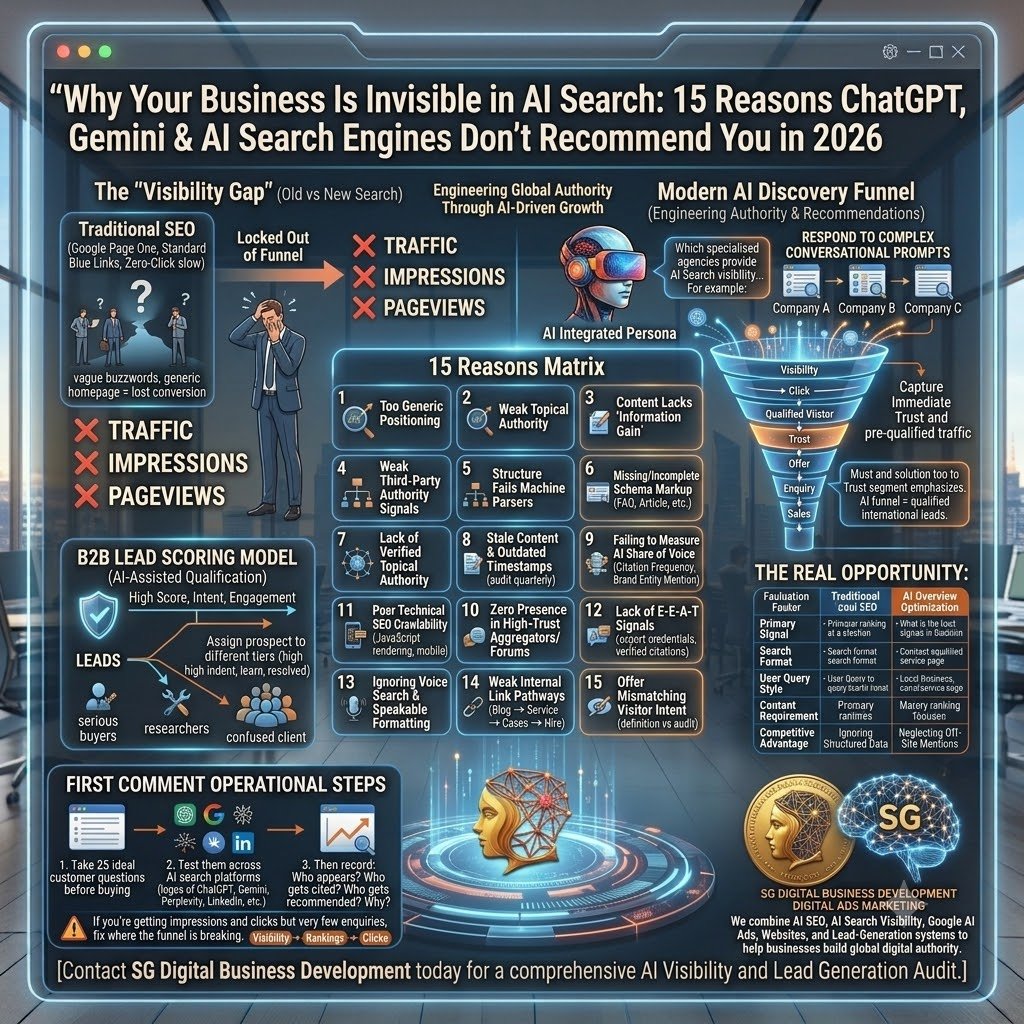
Business Is Invisible in AI Search
AI Growth Engine

Why Your Business Is Invisible in AI Search: 15 Reasons ChatGPT, Gemini & AI Search Engines Don’t Recommend You in 2026.

Introduction: The New Reality of Digital Discovery Your business may already have a functional website. You may have invested heavily in traditional SEO campaigns over the years. You may publish insightful blog posts every single week. Your Google Search Console dashboard may consistently show thousands of organic impressions. Your corporate LinkedIn profile may be active and engaging. You may even rank comfortably for important keyword variations on traditional search engines. Yet, despite all these legacy metrics looking healthy, a potential enterprise customer can open an advanced conversational search platform and ask: “Which companies can help a B2B business generate qualified leads using advanced frameworks?” and your company may completely fail to appear in the generated output. This is becoming one of the most disruptive and expensive digital marketing problems business leaders must solve in 2026. Traditional search engine optimization and modern AI Search Visibility are fundamentally connected, but they operate on completely different technological principles. Traditional SEO focuses heavily on helping specific web pages rank higher within static keyword-based search engine results pages. In stark contrast, Business Is Invisible in AI Search focuses on whether your corporate entity, domain authority, executive expertise, service architectures, and brand signals are recognized, ingested, and surfaced when conversational AI systems generate synthesized answers, market summaries, and vendor recommendations. A modern B2B buyer may no longer search only for a flat list of competing blue links. Instead, they type complex, multi-layered queries and expect the artificial intelligence system to evaluate the entire market, synthesize options, identify credible service providers, and explain why specific businesses are relevant to their exact operational needs. That means your modern business needs significantly more than vanity traffic. It requires absolute digital clarity, verifiable authority, semantic relevance, and structural trust. At SG Digital Business Development, we approach Business Is Invisible in AI Search not as a separate tactical checklist, but as a core component of an integrated AI-driven growth ecosystem that seamlessly connects traditional SEO, deep content hubs, digital authority, website conversion engineering, lead generation pipelines, and precise business positioning. The ultimate objective is straightforward: Become entirely discoverable, mathematically understandable, deeply credible, and universally recommendable across all modern search touchpoints. What Is Business Is Invisible in AI Search and How Do LLMs Evaluate Brands? Business Is Invisible in AI Search problems usually stem from a fundamental misunderstanding of how large language models (LLMs) and generative retrieval engines process information. Unlike traditional search crawlers that scan meta tags and keyword strings to rank individual pages, AI search platforms utilize Retrieval-Augmented Generation (RAG), vector embeddings, and knowledge graphs to understand entities and concepts. When an AI engine constructs an answer, it doesn’t just look for a matching keyword. It evaluates semantic relationships across the entire web. Traditional search engines might display: Meanwhile, AI-driven conversational search experiences produce entirely different output formats: This structural shift transforms how forward-thinking brands approach digital visibility. For instance, a junior researcher might type a short, high-volume query such as: “AI SEO agency.” Conversely, an enterprise decision-maker with an active budget will ask a context-heavy prompt: “Which specialized agencies can help a B2B company improve its visibility across Google and conversational AI search while simultaneously generating qualified pipeline leads?” A business with strong Business Is Invisible in AI Search prevention strategies has a vastly superior opportunity to be understood within that complex contextual web. Achieving this requires building a dense, cross-referenced digital footprint around your brand identity, proprietary methodology, service definitions, target audience, geographic operations, historical case studies, and industry authority. Why AI Search Visibility Dictates Enterprise Success in 2026 The modern B2B buying journey has evolved far beyond simple keyword searches and direct landing page visits. A typical corporate buyer discovers, evaluates, and validates a vendor through an intricate, multi-channel discovery loop: $$\text{Google Discovery} \rightarrow \text{Professional LinkedIn Feed} \rightarrow \text{Conversational AI Search} \rightarrow \text{Industry Publication Review} \rightarrow \text{Verified Case Study} \rightarrow \text{Company Website Verification} \rightarrow \text{Sales Conversation}$$ Advanced AI platforms act as a powerful preliminary discovery and filtering layer. If your direct competitors are repeatedly mentioned and recommended in answers to critical industry questions while your brand remains entirely absent, those competitors capture the buyer’s attention before your team ever gets an opportunity to pitch. That is why maintaining strong Business Is Invisible in AI Search monitoring is no longer optional—it is a core pillar of corporate survival. Modern businesses must stop treating digital channels in isolation and adopt an integrated framework: $$\text{Traditional SEO} + \text{AI Search Visibility} + \text{Brand Authority} + \text{Conversion Architecture}$$ 15 Reasons Your Business Is Invisible in AI Search 1. Your Business Positioning Is Too Generic One of the primary root causes of why your Business Is Invisible in AI Search metrics remain poor is vague, corporate positioning. Consider a typical generic statement found on thousands of agency websites: “We provide innovative digital solutions for modern businesses.” What does that statement actually communicate to a semantic search engine or an AI model? Does the company provide enterprise SEO, cloud software, paid advertising, management consulting, custom web development, lead generation, or generative AI integration? The sentence sounds professional, but it contains zero commercial specificity. Business Is Invisible in AI Search. A powerful, AI-optimized positioning statement explicitly defines the relationship between the entity and its market: “We help B2B companies generate qualified sales leads through specialized AI SEO, conversational AI Search Visibility, Google Ads, and high-converting website architectures.” When your website clearly maps $\text{company} \rightarrow \text{target audience} \rightarrow \text{core services} \rightarrow \text{measurable outcome}$, AI algorithms can categorize and recommend your business with absolute precision. 2. Your Website Has Weak Topical Authority Publishing a single standalone blog post will never establish the deep topical authority required to dominate competitive generative search queries. If your company wants AI engines to recommend your services, you must build an interconnected topic ecosystem. For example, rather than writing a single article, your domain should feature comprehensive clusters covering: These articles must link to one another in a structured hierarchy, creating the dense topical depth that LLMs look for when determining

B2B Search Intent
AI Growth Engine

Why Your SEO Traffic Is Not Turning Into Sales: 15 B2B Search Intent Mistakes to Fix in 2026.

Introduction: The Real Reason Your Traffic Isn’t Converting Into Revenue Your SEO dashboard may look exceptionally good on paper. Your website receives daily impressions across dozens of queries. Your pages generate consistent clicks. Your blogs continue to rank on search engine results pages, and your overall organic traffic graph is climbing higher every single month. Yet, despite all these vanity metrics looking healthy, your sales pipeline isn’t growing at the same speed, and your bottom-line revenue remains stubbornly stagnant. This creates a frustrating, expensive question that keeps B2B founders and corporate directors awake at night: If people are finding my website every day, why aren’t they becoming paying clients? The core reason for this costly disconnect is a fundamental failure to master B2B Search Intent. Too many digital marketing strategies operate under the false assumption that organic traffic is automatically valuable simply because it comes from Google. In reality, a visitor searching for information about a broad problem is completely different from someone actively comparing enterprise solutions or looking to hire an agency immediately. Consider the massive gulf in commercial value between these two distinct queries: The first user is typically a student, a junior employee, or an independent researcher looking for basic educational definitions. The second user is a decision-maker with an active corporate budget, an urgent operational problem, and high B2B Search Intent who is ready to sign a high-ticket contract. If your SEO strategy treats all traffic equally, you will generate thousands of meaningless visits without capturing enough qualified opportunities. Modern digital growth requires aligning your entire content architecture with precise B2B Search Intent to ensure every single visitor has a clear, frictionless pathway to becoming a high-value client. Your SEO dashboard may look good. Your website receives impressions. Your pages generate clicks. Your blogs continue to rank. Organic traffic is increasing. Yet your sales pipeline isn’t growing at the same speed. This creates a frustrating question: If people are finding my website, why aren’t they becoming customers? One major reason is B2B Search Intent. SEO traffic is not automatically valuable simply because it comes from Google. A visitor searching for information about a problem is not necessarily ready to buy. A visitor comparing providers is different from someone searching for a definition. And someone searching for: “hire B2B lead generation agency” has a very different commercial intent from someone searching: “what is B2B lead generation?” If your SEO strategy treats all traffic equally, you may generate thousands of visits without generating enough qualified opportunities. This is why modern B2B SEO must focus on intent, relevance and conversion, not traffic alone. What Is B2B Search Intent? B2B Search Intent is the underlying psychological reason, operational objective, and commercial motivation that drives a business professional to perform a specific search query. Understanding this precise intent allows companies to stop blindly chasing traffic and start creating content that maps directly to the exact stage of the complex corporate buying journey. An enterprise buyer might search with varying degrees of B2B Search Intent, including: Although these searches may revolve around the same broad industry topic, they represent completely different commercial outcomes. Ignoring B2B Search Intent means you end up serving basic educational definitions to buyers who are ready to buy, or aggressively hard-selling to casual readers who only want a quick answer. Both mistakes destroy your conversion rates. Why B2B Search Intent Matters for Your Bottom Line Imagine your website receives 10,000 organic visitors every month, but most of those visitors land on basic blog posts looking for free information. Meanwhile, your competitor receives only 2,000 visitors, but their entire digital architecture is built entirely around high-converting B2B Search Intent. Because their web pages specifically target decision-makers with acute commercial needs, that competitor generates significantly more revenue and closed contracts despite receiving a fraction of your traffic. That is why digital success cannot be measured by traffic volume alone. True business success requires measuring: $$\text{Qualified Traffic} \rightarrow \text{Intent-Matched Content} \rightarrow \text{High-Value Conversions} \rightarrow \text{Closed Revenue}$$ When you master B2B Search Intent, you stop wasting ad and SEO budgets on empty clicks and start building a predictable machine for client acquisition. 15 B2B Search Intent Mistakes Killing Your Pipeline 1. You Optimize for High Search Volume Instead of Buyer Intent A generic keyword with 20,000 monthly searches may look attractive on a spreadsheet, but if none of those users are potential corporate buyers, that traffic has zero commercial value. Conversely, a niche keyword with only 300 monthly searches can generate massive enterprise revenue if those searches come directly from executives influenced by accurate B2B Search Intent mapping. Stop optimizing for vanity numbers; start optimizing for corporate wallets. 2. You Treat Informational and Commercial Keywords the Same Not every page on your domain should lead to a generic service pitch. Informational queries require deep educational frameworks, while commercial investigations demand proof, case studies, and comparison tables. Matching your content format precisely to the visitor’s underlying B2B Search Intent eliminates friction and builds instant trust with prospective clients. 3. Your Blog Targets People Who Will Never Buy A poorly targeted blog naturally attracts students, junior freelancers, job seekers, and direct competitors. If your business sells high-ticket enterprise services to CEOs, marketing directors, and founders, your content strategy must intentionally filter out irrelevant traffic and cater strictly to high-value B2B Search Intent. If your blog reads like a free textbook for college students, you will never attract paying clients. 4. Your Content Doesn’t Identify the Core Business Problem B2B buyers rarely browse for fun; they search because something is broken in their current operations. When they type problem-based queries into search engines, your content must immediately connect their operational headache to your proprietary solution using targeted B2B Search Intent signals. Show them you understand their pain better than they do, and they will trust you to fix it. 5. Your Articles Don’t Include Commercial Next Steps An educational blog post should never leave the reader stranded at a dead end. It must guide

invisible in AI search
AI Growth Engine

Why Your Business Is Invisible in AI Search: 15 Reasons ChatGPT, Gemini & AI Search Engines Don’t Recommend You in 2026.

Introduction: The New Search Reality Traditional search engine optimization (SEO) built empires on a simple premise: rank among the top ten blue links, capture the click, and convert the visitor. For over two decades, digital marketers played a familiar game of matching keywords, building inbound links, and tweaking meta descriptions to please algorithmic crawlers. Today, that playbook is fundamentally shifting. With generative AI platforms like ChatGPT, Google Gemini, Perplexity, and Microsoft Copilot handling millions of high-intent B2B discovery sessions every single hour, users are no longer browsing pages of links. Instead, they are asking direct, multi-part questions and receiving synthesized, definitive answers instantly. If your business lacks strong invisible in AI search, you are not just losing traffic; you are completely locked out of the modern decision-making funnel. When a chief technology officer, procurement director, or corporate founder asks an AI assistant to recommend the top three software vendors, service providers, or digital agencies for a complex corporate migration, the AI does not offer them a ten-page results list. It delivers a curated, authoritative shortlist of immediate recommendations. Why do some brands dominate these AI recommendations while others remain entirely invisible? The answer lies in how large language models (LLMs) process, verify, and value data. In this comprehensive, deep-dive breakdown, we examine the 15 core reasons your business is missing from AI-generated answers in 2026, and how a rigorous data-driven feedback loop can transform your poor AI search visibility into a primary, cited authority that generates predictable, high-value B2B clients. 1. You Are Optimizing for Keywords Instead of Entities Traditional SEO trained marketers to obsess over exact-match keywords, search volume, and rigid keyword density ratios. While these metrics still hold baseline value for legacy crawlers, modern AI search engines operate on an entirely different cognitive plane. They do not match isolated strings of text; they map entities, attributes, and semantic relationships within knowledge graphs to determine invisible in AI search. 2. Absence of a Generative Engine Optimization (GEO) Strategy Most digital marketers are still deploying outdated strategies, focusing entirely on traditional Google rankings while completely ignoring how generative platforms retrieve and synthesize information. There is a massive operational chasm between classic SEO and Generative Engine Optimization (GEO). 3. Your Content Lacks “Information Gain” AI aggregators and large language models are remarkably efficient at spotting redundancy. If your corporate blog posts simply rehash what twenty other competitors have already published with minor wording variations, large language models have zero incentive to reference your site. 4. Weak Digital Authority Signals Across Third-Party Ecosystems AI models do not evaluate your website in a vacuum. When a user asks Gemini or Claude to recommend a service provider, the model cross-references your website’s claims with the sentiment, reviews, and discussions happening across the rest of the web. 5. Your Content Structure Fails Machine-Reading Parsers Human readers love narrative flair, creative introductions, and buried conclusions. AI scrapers and tokenizers despise them. If your content forces an algorithm to dig through layers of prose to find a core answer, it will look elsewhere. 6. Missing or Incomplete Schema Markup Search engines and AI models rely heavily on machine-readable code to understand the structural context, authorship, pricing, and relationships embedded within your web pages. 7. You Lack Verified Topical Authority Publishing one great article on B2B lead generation or enterprise software does not make your domain an authority in the eyes of an AI engine. Topical authority is accumulated through depth, breadth, and consistency. 8. Failure to Optimize for Conversational and Multi-Part Queries Users rarely type robotic, fragmented keywords into ChatGPT, Claude, or Perplexity. Instead, they speak and prompt conversationally, often asking complex, multi-layered questions that require nuanced, comparative answers. 9. Stale Content and Outdated Timestamps AI platforms—particularly real-time retrieval systems like Perplexity, ChatGPT Search, and Gemini with live web access—heavily weight content recency, freshness, and active maintenance when selecting sources. 10. Zero Presence in High-Trust Aggregators and Forums When enterprise buyers ask AI tools for software, agency, or service recommendations, LLMs frequently pull from massive user-generated knowledge bases, review platforms, and professional discussion communities. 11. Poor Technical SEO and Crawlability Bottlenecks Even the most brilliant piece of long-form content is useless if automated AI scrapers and web crawlers cannot efficiently crawl, render, and index your site infrastructure. 12. Lack of E-E-A-T Signals (Experience, Expertise, Authoritativeness, Trustworthiness) AI search engines are programmed to filter out low-credibility information aggressively to protect users from hallucinations, misinformation, and low-quality advisory content. 13. You Are Ignoring Voice Search and Speakable Formatting With a massive percentage of AI-assisted searches leveraging voice interfaces, smart assistants, and conversational audio outputs, formatting matters more than ever for auditory comprehension. 14. Failing to Measure AI Share of Voice (SOV) You cannot fix what you do not measure. Most businesses obsess over Google Search Console impressions and traditional rankings while remaining completely blind to their actual AI visibility and citation frequency. 15. The Absence of a Continuous Data-Driven Feedback Loop SEO, GEO, and AI visibility are not static, one-and-done implementation tasks; they require constant adaptation, performance tracking, and iterative refinement based on real-world data. AI Search Visibility vs Traditional SEO Traditional SEO asks: “Where does my page rank?” AI Search Visibility asks: “Does the AI system recognize my business as a relevant answer?” Both matter. A modern B2B strategy should therefore include: Google SEO AI SEO Brand Authority Entity Optimization Conversion Optimization The New B2B Discovery Journey The buyer journey is becoming more complicated. A potential customer may: Ask AI ↓ Receive recommendations ↓ Visit your website ↓ Verify your expertise ↓ Read case studies ↓ Check LinkedIn ↓ Compare competitors ↓ Request an audit ↓ Book a call Your website therefore has to do more than rank. It has to validate the recommendation. How SG Digital Business Development Approaches AI Search Visibility At SG Digital Business Development, AI Search Visibility should not be treated as a single technical trick. It is part of a broader digital authority system. That system can include: The objective is to

B2B Lead Generation Funnel
AI Growth Engine

Mastering B2B Lead Generation Funnel Architecture: How to Turn Enterprise Traffic Into High-Value Enquiries in 2026.

Introduction Most B2B companies are trapped in a persistent and frustrating cycle. They invest heavily in search engine optimization, content creation, and multi-channel campaigns, watching their web traffic metrics climb month after month. Yet, when leadership checks the CRM or the sales inbox, the pipeline remains quiet. The immediate corporate reaction is almost always: “We need more traffic.” B2B Lead Generation Funnel Sometimes, scaling traffic is indeed necessary. But more often than not, the root cause is entirely different. If your website is already attracting relevant industry visitors, but those visitors are leaving without taking action, your problem is conversion friction, not visitor volume. A B2B enterprise website has one primary responsibility: to help the right visitor understand the business model, establish deep corporate trust, and initiate a qualified dialogue. Without a systematic B2B Lead Generation Funnel Architecture, even the most qualified organic traffic will experience dead ends and migrate to competitors. At SG Digital Business Development, we approach web growth as an integrated, interconnected system. Traffic is simply the raw fuel; your funnel architecture is the precision refinery that transforms that raw attention into qualified, high-ticket business opportunities. In this comprehensive blueprint, we will explore how to design, audit, and scale a high-performance B2B Lead Generation Funnel Architecture that consistently converts enterprise visitors into valuable sales enquiries. What Is B2B Lead Generation Funnel Architecture? B2B Lead Generation Funnel Architecture refers to the strategic design, technical alignment, and psychological mapping of every digital touchpoint a potential client experiences from their initial search query to the final conversion action. Unlike B2C funnels, which often capitalize on emotional triggers and rapid impulse purchases, B2B funnels must account for extended sales cycles, multiple decision-makers, stringent risk aversion, and rigorous evaluation criteria. A sophisticated B2B Lead Generation Funnel Architecture maps out distinct progression layers: awareness, consideration, evaluation, and conversion. Every single page across your domain—from educational blog posts to service landing pages and technical resource hubs—must occupy a calculated position within this pipeline. Without intentional B2B Lead Generation Funnel Architecture, visitors face friction, ambiguity, and structural dead ends. The Core Stages of A High-Performance B2B Funnel To diagnose why traffic fails to turn into pipeline revenue, you must examine how enterprise buyers navigate your digital space. A robust B2B Lead Generation Funnel Architecture comprises four foundational layers: 1. The Awareness Layer (Top of Funnel – ToFu) At this initial stage, prospective buyers are searching for answers to operational challenges, industry bottlenecks, or strategic roadblocks. They are reading educational blogs, searching for technical definitions, or exploring LinkedIn insights. Your objective here is not to hard-sell your services, but to capture intent and establish authority through structured content. 2. The Consideration Layer (Middle of Funnel – MoFu) Once buyers recognize their specific problem space, they begin evaluating potential categories of solutions. They look at whitepapers, case studies, comparison guides, and service breakdowns. A well-designed B2B Lead Generation Funnel Architecture ensures that educational visitors are smoothly guided toward commercial consideration pages without feeling forced or manipulated. 3. The Decision Layer (Bottom of Funnel – BoFu) This is where high-ticket deals are won or lost. The buyer knows what they need and is actively evaluating vendor credibility, implementation timelines, and ROI metrics. Your service pages, pricing structures, ROI calculators, and client testimonials must eliminate all lingering doubts. 4. The Conversion Layer (Action Stage) This is the final micro-moment where interest turns into an enquiry. Whether it is a discovery call booking, a custom proposal request, or a technical audit submission, this layer must offer absolute friction-free execution. 12 Critical Flaws That Break Your Funnel Even with strong search visibility, several structural errors can sabotage your pipeline. Let us explore the most common vulnerabilities within an unoptimized web setup. 1. Your Value Proposition Is Buried in Jargon Enterprise buyers have seconds to decide whether your website solves their problem. If your headline uses abstract buzzwords instead of direct outcomes, they will leave immediately. 2. Disconnected Search Intent and Landing Pages If a user arrives via a high-intent technical query but lands on a generic homepage instead of a specialized solution page, engagement drops drastically. 3. Weak and Ambiguous Call-to-Action Elements Using a generic “Contact Us” button creates unnecessary cognitive load. Modern buyers respond better to low-friction, high-value calls-to-action like “Request a Technical Growth Audit” or “Book a Discovery Call.” 4. Friction-Heavy Lead Capture Forms Asking for unnecessary corporate details on initial contact forms kills conversion rates. Keep initial fields to a bare minimum—name, business email, and core requirement. 5. Absence of Verifiable Social Proof B2B buyers are risk-averse. A lack of detailed case studies, verifiable metrics, and real-world client outcomes leaves a massive trust deficit. 6. Hidden Case Studies and Success Stories Do not hide your best work deep inside a blog archive. Success metrics should be embedded directly into relevant service pages. 7. Complex and Unintuitive Site Navigation If a decision-maker cannot find your core service offering within three clicks, your architecture has failed. 8. Poor Mobile Responsiveness for Enterprise Users Executives frequently review vendors on tablets and mobile devices during transit or off-hours. A broken mobile layout instantly destroys credibility. 9. Sub-Optimal Page Speed Performance Slow-loading servers, bloated scripts, and uncompressed media cause immediate drop-offs before the visitor even reads your headline. 10. Lack of Clear Post-Submission Expectations When a user submits an enquiry, what happens next? Leaving them with a generic confirmation screen without clear timelines creates anxiety. 11. Ignoring Technical Objections on Service Pages Enterprise software and digital solutions invite skepticism regarding security, integration, and scalability. Addressing these upfront is essential. 12. Measuring Vanity Metrics Instead of Pipeline Revenue Focusing purely on raw traffic volume blinds you to actual conversion leaks. Your analytics must track revenue-aligned enquiries. How to Build and Refine Your Funnel System Fixing these vulnerabilities requires a deliberate engineering mindset. Implementing a powerful B2B Lead Generation Funnel Architecture involves systematic auditing, technical cleanup, and continuous refinement. Step 1: Conduct a Complete Content and Page Audit Review every high-traffic page in Google

B2B website conversion optimization
AI Growth Engine

Why Your B2B Website Gets Traffic but No Qualified Leads: 17 Conversion Problems to Fix in 2026.

Introduction Your website gets visitors. Google Search Console shows impressions. Google Analytics shows sessions. Your blogs are being published. Your LinkedIn content is getting visibility. But the sales inbox is still quiet. This is one of the most frustrating problems for B2B businesses. And the immediate reaction is usually: B2B website conversion optimization “We need more traffic.” Sometimes that’s true. But often, it isn’t. If your website is already attracting relevant visitors but those visitors are not becoming enquiries, the problem may be conversion, not traffic. A B2B website has one major job: Help the right visitor understand the business, trust the company, and take the next logical step. That step could be: If your website makes that process difficult, more traffic can simply create more wasted opportunities. This is why B2B website conversion optimization should be treated as an essential part of your SEO and lead-generation strategy. At SG Digital Business Development, we approach website growth as a connected system: Search visibility + authority + website experience + conversion + lead generation. The objective is not simply to attract visitors. It is to turn the right visitors into qualified business opportunities. What Is B2B Website Conversion Optimization? B2B website conversion optimization is the process of improving a website so that a greater percentage of relevant visitors take a valuable business action. B2B website conversion optimization That action might be: The important word here is relevant. The goal isn’t to force every visitor to convert. A student researching a marketing concept, a competitor checking your website, and a decision-maker looking for an agency are not equally valuable visitors. Effective B2B website conversion optimization focuses on helping the right visitor move forward. Conversion optimization involves much more than changing a button. It can include: A successful B2B website conversion optimization should therefore answer four questions quickly: Who is this for? What problem does this business solve? Why should I trust it? What should I do next? If those answers are unclear, visitors can leave even when the website receives substantial traffic. Why Traffic Alone Doesn’t Produce Leads Imagine two websites. Website A 10,000 visitors 100 enquiries Conversion rate: 1% Website B 2,000 visitors 100 enquiries Conversion rate: 5% Website B receives 80% less traffic but generates the same number of enquiries. Now imagine the visitors are also more qualified. Website B could actually be more valuable commercially. The lesson is simple: More traffic is not always the fastest path to more leads. Sometimes improving the percentage of visitors who convert produces a much larger business impact. This is one of the reasons B2B website conversion optimization need to look beyond traffic reports. A website can have: and still produce very few qualified opportunities. The missing piece can be conversion. This is where B2B website conversion optimization becomes important. Instead of asking only: “How many people visited our website?” ask: “How many relevant visitors understood our offer and took the next step?” That question connects marketing activity to revenue. 17 Conversion Problems That Can Stop Qualified Leads 1. Your Homepage Doesn’t Clearly Explain What You Do Your homepage is often the first serious interaction a potential customer has with your company. A visitor should understand your business quickly. Within seconds, they should know: Who you help What problem you solve What outcome you provide What they should do next Weak: “Transforming businesses through innovative digital solutions.” This sounds professional but says very little. A potential customer may still wonder: A stronger message would be: AI-Driven Growth for B2B Companies We help B2B website conversion optimization increase qualified leads through AI SEO, AI Search Visibility, Google Ads and conversion-focused websites. The second version creates immediate clarity. Your headline doesn’t need to explain everything. Its job is to make the visitor understand that they are in the right place. This is one of the first areas to review during B2B website conversion optimization. What to improve Review your homepage headline, subheading and first CTA. Ask: If a decision-maker sees only the first screen of this website, will they understand what the company does and who it helps? If the answer is no, fix the message before worrying about advanced CRO experiments. 2. Your Website Talks About Services Instead of Outcomes Businesses often list: But the buyer is thinking: “What will this do for my business?” This is a fundamental difference between service language and outcome language. Instead of: SEO Services consider: Increase Qualified Organic Leads Instead of: Website Development consider: Build a Website Designed to Convert More Visitors Instead of: Google Ads Management consider: Turn Paid Search Into Qualified Sales Opportunities The service still needs to be explained. But the outcome should be obvious. A B2B decision-maker isn’t purchasing “SEO” simply because SEO exists. They are investing because they want: Your website should connect the service to that business objective. A simple framework Use: Problem → Solution → Outcome For example: Problem: Your B2B website receives traffic but produces few qualified enquiries. Solution: Conversion-focused messaging, landing pages, trust signals and lead capture improvements. Outcome: More relevant visitors move from website discovery to sales conversation. That makes your positioning much easier to understand. 3. Your CTA Is Too Generic “Contact Us” is one of the most common CTAs on business websites. It isn’t always wrong. But it is often weak. Compare: Contact Us with: Request Your AI Search Visibility Audit or: Book a B2B Growth Strategy Call The second CTA tells the visitor exactly what happens next. Good CTAs reduce uncertainty. A visitor should understand: Instead of simply saying: Get Started you could say: Request a B2B website conversion optimization Audit Instead of: Talk to Us you could say: Book Your Growth Strategy Call The CTA should match the visitor’s stage in the buying journey. A person reading an informational article may not be ready for a sales call. An executive visiting your pricing or service page may be much closer to conversion. Therefore, B2B website conversion optimization should consider CTA intent, not simply

AI SEO Agency
AI Growth Engine

AI SEO Agency for B2B Companies: Pricing, Services, ROI & How to Choose the Right Partner in 2026.

Introduction: The Structural Evolution of Modern B2B Search Discovery B2B search behavior is undergoing the most radical, permanent transformation in the entire history of digital marketing. For over two decades, businesses invested heavily in traditional SEO with one clear, singular objective: rank higher on Google for valuable keyword strings, capture raw organic traffic, and convert website visitors through standard landing page funnels. That foundational objective still matters. However, in 2026, relying solely on traditional keyword rankings is no longer sufficient for sustainable enterprise growth. Enterprise buyers, procurement officers, IT directors, and growing business founders are increasingly bypassing traditional search engine results pages entirely. Instead, they rely on advanced AI-powered search and conversational platforms to research complex business problems, compare software solutions, evaluate vendor credentials, understand technical capabilities, and decide which service providers deserve a spot on their evaluation shortlist. Consider how conversational discovery has fundamentally evolved. Instead of executing a narrow, fragmented query like: “best B2B marketing agency” A modern decision-maker types or speaks a highly specific, multi-layered prompt into an advanced AI assistant such as ChatGPT, Claude, Gemini, or Perplexity: “Which specialized agencies provide AI Search visibility and Generative Engine Optimization strategies for B2B companies, and what criteria should we evaluate when hiring them?” Or: “What specific operational standards define a top-tier AI SEO agency, and how do their modern service frameworks differ from traditional digital marketing firms?” That paradigm shift creates an unprecedented operational challenge for modern B2B enterprises. You are no longer competing only for a static position among ten blue links on Google page one. You are competing for visibility, semantic authority, and brand recommendations across an entire multi-platform search and conversational discovery ecosystem. This is precisely where partnering with a specialized AI SEO agency becomes a critical growth catalyst. At SG Digital Business Development, our proprietary methodology combines advanced AI-driven SEO, Generative Engine Optimization (GEO), website conversion optimization, targeted multi-channel advertising, lead generation, structured content architecture, and digital authority building into a unified, high-performance growth engine. The ultimate objective is not simply publishing endless volumes of generic content. The objective is to engineer an authoritative digital presence that makes your enterprise discoverable, credible, and conversion-ready across every single channel your ideal clients use to research enterprise solutions. What Is an AI SEO Agency and How Does It Actually Operate? An AI SEO agency utilizes artificial intelligence, real-time search data mining, structured content frameworks, advanced machine automation, and rigorous traditional SEO principles to improve how an enterprise is discovered across modern, multi-platform search environments. To fully understand the immense strategic value of an AI SEO agency, it helps to contrast traditional optimization frameworks with modern AI-driven strategies: Traditional SEO Focuses Primarily On: An AI SEO Agency Expands That Framework to Include: The critical distinction is that a professional AI SEO agency does not discard traditional SEO fundamentals; rather, it builds directly upon them. A technically flawed website with poor user experience and weak foundational code will not suddenly become an industry authority simply because artificial intelligence tools are deployed to generate blog posts at scale. AI is a powerful execution capability, but rigorous SEO strategy remains the structural system. Why B2B Companies Need a Specialized SEO Strategy in 2026 B2B search engine optimization is fundamentally different from consumer retail searches, local service advertising, or high-volume e-commerce marketing. A high-value B2B buyer or enterprise procurement committee typically requires: Because the enterprise sales cycle can span weeks, months, or even quarters, a specialized AI SEO agency must structure content and visibility campaigns to support the buyer through every distinct stage of their complex evaluation journey: Without mapping your content ecosystem to this multi-stage conversational journey, your enterprise risks losing high-intent prospects before your sales team ever knows an opportunity exists. The Hidden Mechanics of Modern Algorithmic Discovery and Entity Graphs To truly comprehend why modern brands require an AI SEO agency, one must examine how search algorithms and large language models process information beneath the surface. Traditional search optimization relied heavily on exact-match keywords, string matching, and direct backlink counts. Modern search, however, operates on entity recognition and semantic vectors. When an AI engine processes a user query regarding enterprise software or digital services, it does not merely look for a webpage containing a specific keyword phrase. Instead, it queries a vast knowledge graph of interconnected entities—people, organizations, concepts, locations, and products. If your enterprise website lacks clear entity definition, structured schema markups, and verified digital citations across external industry platforms, conversational AI models will simply overlook your brand when generating recommendations for potential buyers. An advanced AI SEO agency maps your entire corporate entity across the web, ensuring that every subsidiary service, founder profile, case study, and technical whitepaper is accurately indexed, cross-referenced, and understood by both traditional crawlers and generative neural networks. This meticulous structural alignment creates a compounding competitive advantage that basic keyword optimization can never replicate. 11 Core Services Every Advanced AI SEO Agency Should Provide Not every digital marketing firm offering AI-related services delivers a comprehensive scope. Before entering into a formal contract with an AI SEO agency, you must evaluate whether their service model covers the complete modern search ecosystem: 1. AI Search Visibility Auditing The first objective for any modern AI SEO agency is evaluating how your brand appears—or fails to appear—in conversational AI search environments like ChatGPT, Google AI Overviews, Gemini, Claude, and Perplexity. The goal is to maximize the accuracy, frequency, and consistency of brand information across all models. 2. Generative Engine Optimization (GEO) Generative Engine Optimization focuses on improving the probability that your business is represented accurately and credibly within generative text answers. A premier AI SEO agency implements clear entity signals, structured data, expert citations, and authoritative third-party references. 3. Traditional Technical SEO Foundation Advanced AI search engines do not eliminate technical requirements. Your B2B website must feature crawlable pages, indexable content, logical information architecture, clean URL structures, mobile optimization, and fast page experience metrics. 4. Topical Authority Building Publishing isolated articles rarely establishes meaningful market

Competitors Appear in ChatGPT
AI Growth Engine

Why Your Competitors Appear in ChatGPT but Your Business Doesn’t: 15 Reasons and How to Fix It in 2026.

The Evolving Landscape of Modern Digital Discovery A few years ago, assessing your competitive standing in the digital marketplace was a relatively straightforward exercise. Marketing directors and agency owners could comfortably log into a few standard SEO dashboards to gauge their market position, track organic traffic growth, and evaluate competitor performance. Back then, standard tracking checklists looked like this: Competitors Appear in ChatGPT. While these foundational metrics continue to play a supporting role in modern digital marketing, consumer behavior and enterprise buyer journeys have undergone a massive, structural evolution. Today, when a high-value B2B buyer, enterprise procurement officer, or growing business owner needs specialized services, they rarely spend time scrolling through ten standard blue links on a traditional search engine page.Competitors Appear in ChatGPT. Instead, they open an advanced conversational interface. They type or speak natural, complex questions such as: “What are the absolute best AI SEO and digital growth agencies for international B2B companies with proven case studies in 2026?” They might completely bypass traditional search engines and consult ChatGPT for a synthesized recommendation. They might rely on Gemini to cross-reference multiple industry reports. They might examine Google AI Overviews or prompt Perplexity to compile a curated, verified shortlist of top-tier service providers. When a prospective client executes that query, your company will inevitably land in one of several distinct operational states: This creates an entirely new operational marketing dilemma that traditional web analytics tools are entirely blind to: What is artificial intelligence saying about your business when your internal growth team isn’t actively watching? That exact visibility gap is what defines modern conversational optimization. Understanding why your competitors appear in ChatGPT while your own enterprise remains invisible is the single most important diagnostic step you can take to protect your market share, scale your lead generation, and future-proof your digital agency. What Does It Mean When a Competitor Appears in ChatGPT? When ChatGPT, Gemini, or another advanced generative search system recommends a specific company during a buyer research session, it is not making a random choice. That recommendation is the calculated result of complex semantic processing, entity mapping, and multi-source data synthesis. The system evaluates information about that company from a vast web ecosystem, including:Competitors Appear in ChatGPT. The critical realization for modern agency owners and brand builders is that AI visibility is not simply a carbon copy of traditional Google rankings. Citations, recommendations, and semantic inclusion are the direct outcome of a deeply rooted brand footprint built on interconnected web entities, brand mentions, and third-party authority signals. That fundamental truth explains why an enterprise can possess a technically sound website with clean on-page code and still experience total invisibility inside generative AI answers. If the machine cannot verify your entity across the broader web, it will not recommend you. Why Competitors Appear When You Don’t: 15 Core Reasons To fix your conversational visibility, you must first diagnose the precise mechanical reasons why rival businesses capture top recommendations while your brand is left out. Below are the 15 primary reasons behind this visibility disparity and how to address them systematically.Competitors Appear in ChatGPT. 1. Your Competitor Has Stronger Brand Recognition and Entity Association AI systems need to clearly map and understand what an enterprise represents in the real world. If a competitor is consistently associated with core services—such as AI SEO , B2B growth marketing, or advanced web development—across hundreds of external web pages, that semantic association becomes heavily reinforced. If your company offers the exact same high-value services but your digital footprint is fragmented or vague, AI models will exhibit lower confidence when deciding whether to include you in a recommended shortlist. 2. Your Competitor Has More Authoritative Third-Party Mentions Many growing businesses focus their entire marketing budget almost exclusively on optimizing their own home domain. However, large language models heavily ingest information from the broader web ecosystem to cross-verify claims. Recent digital audits indicate that major AI citation sources frequently include community discussion platforms, video networks, industry aggregators, and third-party publications—with brand-owned websites sometimes appearing much further down in overall citation share. 3. Your Content Talks About Services—Not Buyer Problems A classic, recurring content mistake is publishing generic, self-serving service pages like “Our AI SEO Services” or “Our Digital Marketing Services” while high-value buyers are actively typing complex problem statements into chat interfaces, such as “Why isn’t my business appearing in ChatGPT?” Your competitors are capturing conversational visibility because they directly answer real-world buyer pain points. 4. Your Competitor Has Better Commercial-Intent Content Informational content is fantastic for building top-of-funnel reach, but commercial-intent content drives shortlisting and vendor selection. Consider the queries that sit right at the edge of purchase decisions: If your competitors publish thorough, objective comparative breakdowns answering these commercial questions and your website remains silent on the topic, they hold an insurmountable advantage during AI-assisted evaluation.Competitors Appear in ChatGPT. 5. Your Website Doesn’t Clearly Explain Who You Serve Generative search models require immediate, unambiguous context to evaluate relevance and brand positioning. If your homepage relies on vague corporate buzzwords like “We are a full-service digital agency offering innovative solutions for modern brands,” algorithms will struggle to categorize your specific expertise.Competitors Appear in ChatGPT. 6. Your Brand Has Weak Digital Entity Signals Think of your enterprise as a distinct digital entity within the global web graph. AI models need to reliably connect your foundational nodes: Company $\rightarrow$ Core Services $\rightarrow$ Key Personnel $\rightarrow$ Official Website $\rightarrow$ Physical Location $\rightarrow$ Industry Expertise. If these connections are contradictory, outdated, or missing across different web properties, machine comprehension breaks down completely.Competitors Appear in ChatGPT. 7. Your Competitor Has Better Client Reviews and Sentiment Profiles Customer reviews are no longer confined to local map packs or review site widgets; they feed directly into broader brand sentiment profiles ingested by AI crawlers. Look closely at what clients say about competing agencies in public spaces. Are they repeatedly associated with specialized technical knowledge, execution speed, and measurable revenue growth? 8. Your Competitor Has More Specific Niche Expertise Broad positioning

AI Search Visibility
AI Growth Engine

AI Search Visibility: Track ChatGPT, Gemini & Google AI in 2026

The Silent Shift in Digital Discovery A few years ago, monitoring your digital footprint was relatively straightforward. Marketing teams could comfortably rely on a standard set of tracking mechanisms to gauge visibility, audience engagement, and market share. Back then, you checked: AI Search Visibility While these traditional metrics remain foundational, digital discovery has undergone a profound structural evolution. Today, when a high-value B2B buyer or enterprise decision-maker needs a vendor, they rarely browse through ten standard blue links on a search engine results page. Instead, they open an advanced conversational interface. They might ask: “What are the absolute best AI SEO agencies for international B2B companies with proven case studies?” They may bypass Google entirely and consult ChatGPT. They may rely on Gemini to synthesize multiple industry reports. They might examine Google AI Overviews or prompt Perplexity to compile a curated list of top-tier service providers. When a prospective client executes that query, your company will land in one of several states: This creates an entirely new marketing problem that traditional analytics cannot solve: What is AI saying about your business when your internal marketing team isn’t actively watching? That exact gap is filled by AI Search Visibility—the ongoing, systematic process of tracking, auditing, and optimizing how AI-powered search engines and conversational answer engines mention, describe, recommend, cite, and evaluate your business. What Is AI Search Visibility? At its core, AI Search Visibility means systematically auditing how generative AI models represent your brand across various conversational environments. Unlike traditional rank tracking, which focuses exclusively on static keyword positions on a web page, AI monitoring evaluates the dynamic, synthesized context in which your company name appears. A comprehensive monitoring framework tracks multiple qualitative and quantitative dimensions: The Real-World Impact of Conversational Accuracy Imagine a prospective client prompts an AI engine: “Which boutique agencies specialize in AI search optimization for B2B enterprises?” These nuances dictate modern market share. Traditional rank tracking tools are fundamentally blind to these narrative layers, making dedicated monitoring an absolute necessity for modern B2B growth agencies. Why AI Search Visibility Matters in 2026 AI Search Visibility:The way enterprise buyers conduct vendor research has permanently shifted. Industry data from G2 highlights that 71% of B2B software buyers utilize AI chatbots during their initial software research phase, while 51% state they initiate their product discovery with an AI chatbot more frequently than traditional search engines. Similarly, enterprise research from Forrester indicates that modern buying groups rely heavily on AI-driven summaries, automated syntheses, and curated third-party sources during the early stages of vendor evaluation. This behavioral shift completely rewrites the visibility equation. Your organization might possess: …and yet remain completely invisible or poorly represented inside AI-generated answers. That is the modern blind spot. If your brand is not engineered to be understood and recommended by conversational engines, your traditional SEO wins will matter less and less as buyers migrate entirely to AI-first research workflows. Traditional Brand Monitoring vs. AI Search Visibility To build an effective measurement stack, you must understand how traditional reputation management differs from modern conversational auditing. Dimension Traditional Brand Monitoring AI Search Visibility Core Question “Where is our company being mentioned across the web?” “How does AI represent our company when buyers ask real-world commercial questions?” Primary Metric Keyword rankings, social tags, and backlink volume AI answer visibility, citation rates, and recommendation share Data Source Standard SERPs, social media feeds, and news outlets Conversational LLMs, AI Overviews, and generative search tools Competitor Scope SERP domain competitors and local map pack rivals AI-recommended market leaders and algorithmic alternatives Content Focus Optimizing metadata, keyword density, and link equity Engineering contextual clarity, structured data, and third-party authority Action Outcome Improving link acquisition and on-page keyword targeting Closing informational gaps, correcting hallucinations, and building verifiable brand entities It is crucial to recognize that these two systems are not mutually exclusive. AI Search Visibility tracking is not a replacement for traditional reputation tracking; rather, it is an advanced, high-level operational layer built specifically for the era of generative discovery. The 22-Step Operating System for AI Search Visibility Achieving consistent visibility inside generative search engines requires a structured, repeatable operational cadence. A sporadic, 10-minute manual check once a quarter will not protect your brand reputation. Below is a complete 22-step framework to operationalize your monitoring strategy. 1. Monitor Core Brand Mentions The foundational metric is simple: Does conversational AI know your brand exists? Compile a core list of natural language prompts that your target audience types into chat interfaces. Examples include: Run these exact prompts on a fixed schedule and log whether your brand appeared, where it ranked in the response block, and which competitors surfaced alongside you. 2. Track Citation Visibility A mere brand mention builds top-of-funnel awareness, but a direct citation provides deep institutional credibility. Many advanced AI search models append footnotes, source links, or inline citations to validate their outputs. Monitor whether the AI links directly to your domain, an industry publication, a verified review profile, or a LinkedIn case study. Knowing which specific asset influenced the AI’s output makes your optimization efforts actionable. 3. Monitor Competitors Brand monitoring must never happen in an isolated vacuum. If you query “Best AI SEO agencies for B2B companies” and your brand appears in only 2 out of 10 tracked tests while a competitor dominates 8, you possess immediate competitive intelligence. Investigate what content they published, which third-party websites reference them, and how they structured their entity authority. 4. Track Share of Voice Calculate your AI Search Share of Voice across a standardized set of 100 relevant commercial prompts. If your brand is included in 22 outputs, Competitor A in 38, and Competitor B in 27, you establish a reliable quantitative baseline. Track this trend over consecutive months—watching your share scale from 10% to 17% to 24%—to empirically validate your AI Search Visibility strategies. 5. Monitor Sentiment and Context Being mentioned is only half the equation; the qualitative tone matters immensely. AI models can describe an agency as highly specialized, premium, innovative, expensive,

AI Lead Generation B2B 2026
AI Growth Engine

AI Lead Generation for B2B Companies: 13 Strategies to Generate More Qualified Leads in 2026.

Introduction: The Core Challenge of Modern B2B Pipeline Growth Generating consistent, high-quality AI Lead Generation B2B 2026 has always been a complex operational challenge. Companies invest substantial budgets across search engine optimization, Google Ads, social media channels, content marketing, LinkedIn, targeted email campaigns, and custom websites—yet many still struggle to build a reliable, predictable pipeline of qualified prospects. The root problem is rarely a lack of raw visibility. A business can capture impressive web traffic metrics and still encounter severe structural friction: This is where AI Lead Generation B2B 2026 becomes vital to sustainable growth. Artificial intelligence allows modern enterprises to identify potential customers with pinpoint precision, decode buying intent, personalize messaging at scale, optimize website conversion architecture, qualify inbound inquiries, automate follow-up sequences, and empower sales teams with deep operational intelligence. However, artificial intelligence should never replace strategic thinking. The strongest AI Lead Generation B2B 2026 systems combine: $$\text{AI Automation} + \text{Human Expertise} + \text{Strategic Content} + \text{Search Visibility} + \text{Conversion Architecture} + \text{Sales Execution}$$ In 2026, businesses that build this complete, synchronized ecosystem secure an insurmountable competitive advantage over companies that treat lead generation as a simple “traffic-gathering” exercise. At SG Digital Business Development, our integrated approach connects AI SEO, AI Search Visibility, Google AI Ads, high-performance websites, AI Website Conversion Optimization, and intelligent lead systems into a unified growth machine. Engineering Global Authority Through AI-Driven Growth. What Is AI Lead Generation B2B 2026 ? AI Lead Generation B2B 2026 is the strategic application of artificial intelligence, machine learning, and behavioral automation to optimize how businesses attract, identify, qualify, nurture, and convert potential commercial clients. Rather than treating every website visitor identically, AI supports every distinct phase of the modern sales funnel: 1. Attraction AI assists businesses in optimizing AI SEO, refining search visibility, analyzing target audience behaviors, structuring social campaigns, and testing landing page variations. 2. Qualification AI evaluates incoming firmographic data, corporate inquiry details, visitor engagement patterns, budget signals, and specific service requirements instantly. 3. Nurturing AI streamlines automated follow-up emails, dynamic messaging, educational resource distribution, lead segmentation, and re-engagement campaigns. 4. Conversion & Sales AI supports sales rep prioritization, dynamic offer personalization, automated meeting scheduling, CRM synchronization, and predictive sales intelligence. The ultimate objective is not simply to generate a higher volume of raw contacts, but to produce a steady stream of relevant, high-value business opportunities. Why Traditional B2B Lead Generation Is Changing The traditional B2B sales funnel historically operated on a rigid, linear model: $$\text{Advertisement} \rightarrow \text{Landing Page} \rightarrow \text{Contact Form} \rightarrow \text{Sales Outreach}$$ Today, this linear model is obsolete because modern AI Lead Generation B2B 2026 buyers are remarkably self-directed and well-informed. Before an executive or procurement director ever submits a contact form or speaks with a sales representative, they undergo an extensive independent research phase: This means modern lead generation begins long before a user reaches your website contact form. The modern buyer journey follows a sophisticated path: $$\text{Discovery} \rightarrow \text{Research} \rightarrow \text{Trust} \rightarrow \text{Engagement} \rightarrow \text{Conversion} \rightarrow \text{Qualification} \rightarrow \text{Sales}$$ AI-powered systems provide the exact infrastructure needed to capture, nurture, and convert prospects across every single stage of this expanded journey. 13 AI Lead Generation Strategies for B2B Companies in 2026 1. Use AI to Identify High-Intent Audiences Not every website visitor represents the same commercial opportunity. A user searching for basic definitions is in an early informational mindset. A buyer searching for specialised agency services has high commercial intent.AI Lead Generation B2B 2026. AI-powered behavioral analytics categorize visitors into precise intent tiers. This allows your marketing and sales teams to prioritize high-value corporate accounts rather than wasting resources on low-intent traffic.AI Lead Generation B2B 2026. 2. Build AI-Ready Search Content Modern B2B lead generation begins with discoverability. Your potential client must find you when searching for answers to complex business problems. AI Lead Generation B2B 2026, By integrating comprehensive AI SEO and optimizing for AI Search Visibility, you ensure your brand appears across traditional search engines, Google AI Overviews, and conversational LLMs. 3. Create Dedicated, High-Converting Landing Pages Never route all incoming traffic to a generic homepage. Deploy dedicated landing pages for specific core services—such as AI SEO, Google AI Ads, AI Lead Generation B2B 2026, and custom web development. Each page must clearly articulate the problem, your solution, tangible benefits, verified delivery processes, and a compelling call to action. 4. Use AI to Improve Lead Qualification and Scoring Receiving fifty inquiries means little if forty-five lack the proper budget, authority, or timeline. AI-driven lead scoring automatically evaluates incoming prospects against your Ideal Customer Profile (ICP), analyzing firmographic fit, behavioral intent, and engagement depth so sales teams focus exclusively on top-tier opportunities. AI Lead Generation B2B 2026. 5. Personalize B2B Outreach Without Spammers’ Tactics Generic cold outreach is routinely ignored by busy executives. Instead of blasting templated scripts, use AI research tools to analyze target accounts and craft hyper-relevant messages tied to their current business growth objectives, recent market shifts, or search visibility challenges. 6. Leverage LinkedIn for B2B Authority and Lead Gen LinkedIn remains the premier B2B social network. A robust organic presence combining founder thought leadership, educational case studies, and strategic engagement builds immense trust. AI tools can assist with content repurposing and account research while keeping human relationships at the core. 7. Turn Detailed Case Studies Into Lead Assets Generic marketing claims carry little weight with sophisticated buyers. Publishing comprehensive, structured AI Business Growth Case Studies provides concrete proof of capability, answering unspoken client questions about your industry expertise and delivery framework. 8. Create High-Value Lead Magnets Around Real Problems AI Lead Generation B2B 2026 ,Offer actionable resources—such as specialized AI SEO checklists, conversion audit frameworks, or strategic growth guides—in exchange for business contact details, establishing an immediate, mutually beneficial value exchange. 9. Automate Intelligent Lead Follow-Up Speed to lead is critical in B2B commerce. A prospect who submits an inquiry today will often evaluate multiple competitors simultaneously. Automated acknowledgment sequences ensure immediate engagement while scheduling consultative follow-ups. 10. Connect AI Lead Generation B2B 2026 With

Scroll to Top