
B2B Sales Pipeline Management: Build a Healthier Pipeline and Close More Deals.
Introduction
A busy sales team can have hundreds of contacts, dozens of open opportunities, and a full calendar without having a dependable path to revenue. Activity is not the same as progress. Some deals are poorly qualified, others have no confirmed next step, and many remain in the forecast long after the buyer has stopped engaging. The result is an unpredictable pipeline that makes planning difficult and wastes time that should be spent with suitable prospects.
B2B Sales Pipeline Management gives a business a consistent way to organize opportunities from first qualification through decision and handover. It combines clear stages, useful customer information, realistic exit criteria, disciplined follow-up, and regular review. The purpose is not to pressure buyers or make every deal move faster. It is to understand where each opportunity stands, identify what the buyer needs next, and focus effort where there is a credible path to a good commercial outcome.
A reliable process helps marketing, sales, leadership, and delivery teams work from shared definitions. It can reveal whether the business needs more qualified demand, better discovery, stronger proposals, improved follow-up, or a different offer. This guide explains how to build that process, measure it responsibly, and improve it without turning selling into an administrative exercise. B2B Sales Pipeline Management starts with evidence.
What Is B2B Sales Pipeline Management?
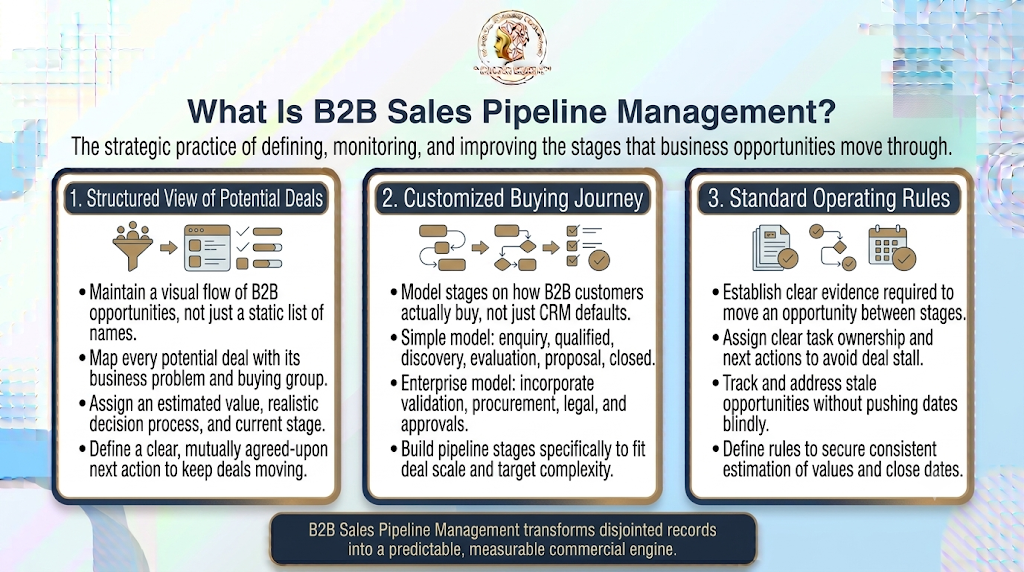
B2B Sales Pipeline Management is the practice of defining, monitoring, and improving the stages that business opportunities move through before becoming customers. A pipeline is a structured view of potential deals, not simply a list of names. Each opportunity should have a business problem, an identifiable buying group, an estimated value, a realistic decision process, a current stage, and an agreed next action.
The exact stages differ by company. A simple model might include new enquiry, qualified, discovery, solution evaluation, proposal, negotiation, closed won, and closed lost. A complex enterprise sale may require additional stages for technical validation, security review, procurement, legal approval, or executive sponsorship. The right model reflects how customers actually buy rather than how a CRM happens to label its default stages. B2B Sales Pipeline Management needs shared rules.
Pipeline management also includes the operating rules around the stages. Teams need to know what evidence allows an opportunity to enter or leave a stage, who owns the next action, how stale deals are handled, and how values and close dates are estimated. Without these rules, reports can look precise while describing inconsistent opinions.
Why a Well-Managed Pipeline Matters
A healthy pipeline improves focus. Salespeople can distinguish active buying projects from early research, prioritize accounts with a real need, and plan follow-up around the buyer’s decision process. Managers can spot bottlenecks before a quarter ends rather than discovering too late that several large opportunities have stalled.
It also improves coordination. Marketing can see which sources produce opportunities that progress, not just form submissions. Sales can explain which segments are a good fit and where prospects struggle to understand the offer. Delivery teams can prepare for likely demand without treating an unqualified enquiry as guaranteed work. B2B Sales Pipeline Management reflects buyer progress.
Good B2B Sales Pipeline Management supports more credible forecasting, but it does not eliminate uncertainty. Buyers change priorities, budgets move, competitors enter, and approvals take longer than expected. A disciplined process makes assumptions visible so leaders can respond to new evidence instead of relying on optimism. B2B Sales Pipeline Management improves team focus.
1. Define Your Ideal Customer Profile
Start by describing the organizations that are most likely to benefit from your product or service. Consider industry, company size, geography, operating model, technology, growth stage, budget range, and the problems that create a reason to act. Include disqualifiers such as unsupported requirements, unrealistic timeframes, or needs that sit outside your delivery capability.
Use actual customer evidence. Review profitable accounts, successful projects, retention, referrals, sales-cycle length, and reasons deals were lost. Ask which customers understood the value, had access to decision-makers, supplied information on time, and achieved outcomes that your business can repeat. Do not assume that the largest account or highest contract value represents the best fit.
An ideal customer profile should guide qualification, messaging, and prioritization. It should not become a rigid rule that prevents a salesperson from exploring a promising exception. Record why an exception is worth pursuing and review the result later. B2B Sales Pipeline Management makes risks visible.
2. Create Clear Pipeline Stages
Each stage should describe a meaningful change in the buyer’s progress. Avoid labels that simply record salesperson activity, such as “sent email” or “called twice.” Those are tasks, not evidence that an opportunity has advanced.
Write a short definition for every stage. For example, an opportunity may be considered qualified when the company fits the target profile, a relevant problem has been confirmed, a contact is willing to explore a solution, and there is a plausible path to a decision. A proposal stage may require an agreed scope, known evaluation criteria, and confirmation that the proposal will be reviewed.
B2B Sales Pipeline Management becomes more consistent when stage entry and exit rules are visible to everyone. Keep the model simple enough that salespeople can use it during real conversations. Add a stage only when it represents a distinct buyer milestone or a decision that requires different management attention. B2B Sales Pipeline Management needs customer context.
3. Qualify Need, Fit, Timing, and Access
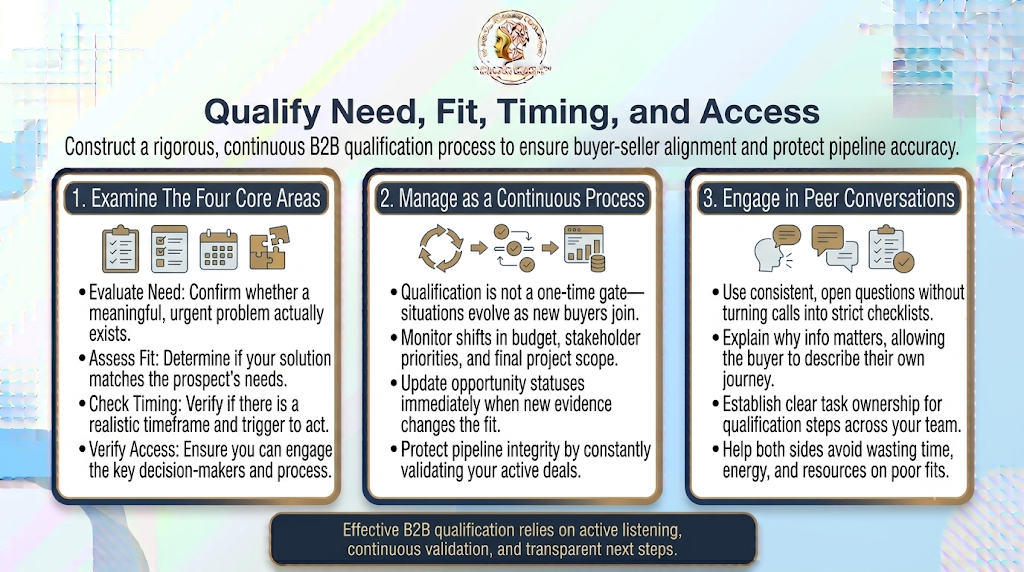
A useful qualification framework examines four areas. Need asks whether a meaningful problem exists. Fit asks whether your offer and delivery model can address it. Timing asks whether there is a reason to act within a realistic period. Access asks whether the team can engage the people and process required to make a decision.
Qualification is not a one-time gate. Circumstances change as more stakeholders join, budgets are reviewed, or the project scope becomes clearer. Update the opportunity when new evidence changes the assessment. B2B Sales Pipeline Management supports relevant follow-up.
Use a consistent set of questions without turning the conversation into a checklist recital. Ask open questions, explain why the information matters, and allow the buyer to describe their own process. A good qualification conversation helps both sides avoid spending time on a poor fit. B2B Sales Pipeline Management needs clear ownership.
4. Review Pipeline Health Every Week
A weekly review should focus on changes, decisions, and obstacles rather than reading every CRM record aloud. Start with new qualified opportunities, stage movement, high-value deals, stalled opportunities, upcoming decisions, and changes to expected close dates. Ask what evidence supports the current stage and what action is needed.
Managers should coach the deal, not take over every conversation. Useful questions include: What has the buyer confirmed? Who else needs to be involved? What could prevent the decision? What is the next buyer commitment? What would make us close this opportunity as lost?
Keep reviews proportionate. A small team may need a short meeting and a shared dashboard. A larger organization may use segment reviews and focused deal clinics. Consistency matters more than meeting length. B2B Sales Pipeline Management improves through coaching.
5. Align Marketing and Sales on Lead Handoffs
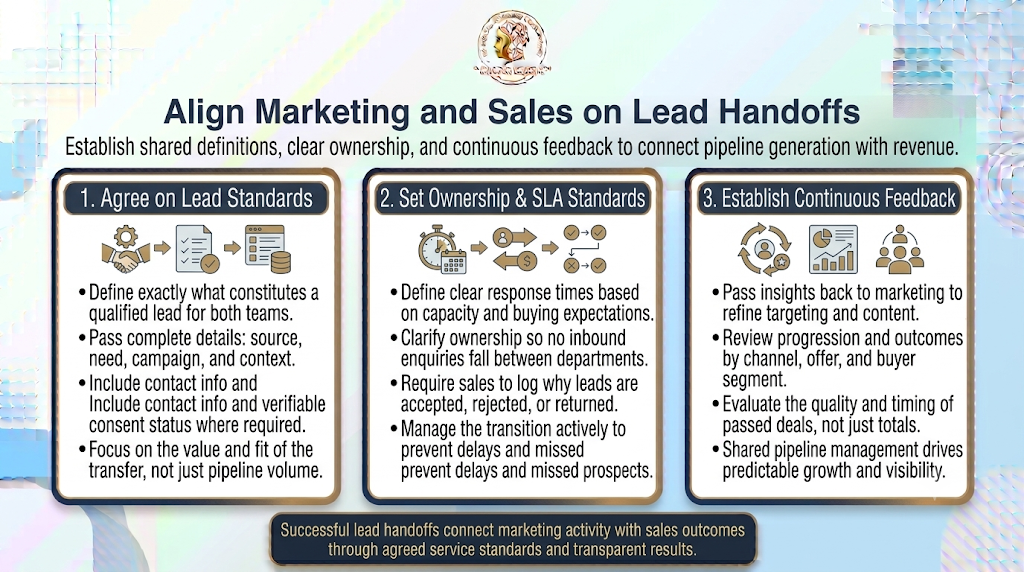
Marketing and sales should agree on what constitutes a qualified lead, what information is passed, who responds, and how feedback is recorded. A handoff should include the source, relevant content or campaign, stated need, contact details, consent status where applicable, and any context the prospect supplied.
Set a practical response standard based on team capacity and buyer expectations. Make ownership clear so enquiries are not left between departments. Sales should record why leads are accepted, rejected, or returned for nurturing. Marketing can use that feedback to improve targeting and content.
Review outcomes by source, segment, and offer. Do not judge marketing solely on the number of enquiries or sales solely on closed deals without considering the quality and timing of the opportunities passed between them. Shared definitions create better decisions across the funnel. B2B Sales Pipeline Management aligns sales teams.
6. Create a 30-Day Improvement Plan
In the first week, document the current stages, definitions, required fields, ownership, and review rhythm. Interview salespeople about where the process slows down and compare their feedback with CRM data. Choose one or two problems rather than attempting a complete redesign.
In the second week, simplify stage criteria, standardize key fields, and agree on the definition of a qualified opportunity. Create a short guide with examples of evidence for stage changes. Remove fields that do not support a real decision.
In the third week, introduce a focused pipeline review. Examine next-step coverage, stalled opportunities, forecast changes, and the quality of qualification. Coach managers to ask evidence-based questions and record agreed actions.
In the fourth week, review early results and gather feedback. Check whether records are more consistent, whether the team can identify stalled deals faster, and whether the review produces useful actions. Set the next improvement based on evidence. Do not claim revenue impact from a short pilot unless the data supports that conclusion. B2B Sales Pipeline Management needs realistic dates.
Common Pipeline Management Mistakes
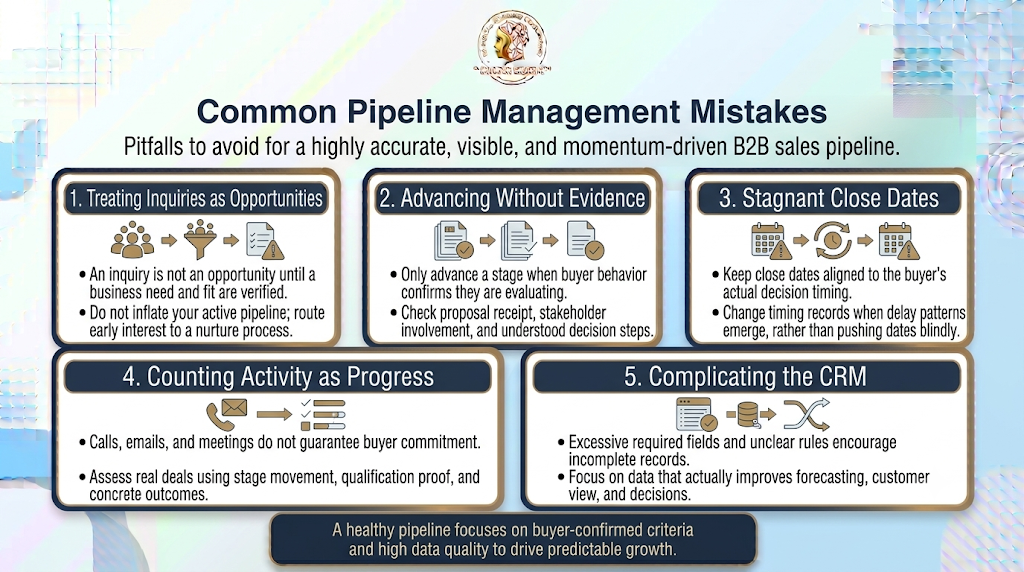
Treating every enquiry as an opportunity
An enquiry becomes an opportunity only when there is a plausible business need and a fit worth exploring. Keeping every contact in the active pipeline inflates coverage and distracts from real buying projects. Use a separate nurture process for early interest.
Advancing deals without buyer evidence
A proposal sent does not mean the buyer is evaluating it. Confirm that the proposal was received, the relevant people are involved, and the next decision step is understood. Update the stage only when its criteria are met.
Leaving close dates unchanged
Close dates should reflect the buyer’s current decision process. When timing changes, record why and agree on the next milestone. Repeatedly moving a date forward without new evidence is a sign that the opportunity needs review.
Measuring activity instead of progress
Calls, emails, and meetings are useful operational measures, but they do not prove buyer commitment. Combine activity data with stage movement, qualification evidence, next steps, and outcomes. B2B Sales Pipeline Management reveals stalled deals.
Making the CRM too complicated
Excessive fields and unclear rules encourage incomplete records. Keep the process focused on information that improves qualification, customer experience, forecasting, or management decisions. Review field usage and remove unnecessary friction.
Frequently Asked Questions
What is a B2B sales pipeline?
A B2B sales pipeline is a structured view of potential business opportunities as they move through defined stages, from initial qualification to a final decision. It should show the buyer’s situation, current stage, value, owner, risks, and next action.
How many stages should a sales pipeline have?
There is no universal number. Use enough stages to represent meaningful buyer milestones and management decisions, but not so many that the process becomes difficult to maintain. A small business may need five or six stages, while a complex enterprise sale may require more.
What is the difference between a sales pipeline and a sales funnel?
A pipeline usually tracks individual opportunities and their current stage. A funnel summarizes how groups of prospects move through a process and how many progress or drop out. The two views complement each other.
How often should a sales pipeline be reviewed?
Many B2B teams review active opportunities weekly and examine broader conversion, cycle-time, and forecast trends monthly or quarterly. The schedule should match deal complexity and the speed of the sales cycle.
Which metrics matter most?
Useful measures include qualified pipeline value, stage conversion, win rate, average deal size, sales-cycle length, forecast accuracy, and the percentage of active opportunities with a meaningful next step. Choose measures that support decisions rather than reporting for its own sake. B2B Sales Pipeline Management protects buyer trust.
How can a company improve pipeline accuracy?
Use consistent qualification criteria, require evidence for stage changes, keep close dates current, record buyer-confirmed next steps, and compare forecasts with actual outcomes. Review the reasons for variance and improve assumptions over time.
Does CRM software guarantee better pipeline management?
No. A CRM can organize information and automate routine tasks, but it cannot replace clear definitions, good discovery, accurate records, management coaching, or buyer understanding. Choose tools that support a process the team can realistically follow.
Conclusion: Make Every Opportunity Easier to Understand
A healthy pipeline is not simply a large number of open deals. It is a reliable view of real buying projects, supported by evidence, clear ownership, and useful next actions. When teams agree on qualification, stage definitions, customer needs, and reporting rules, they can spend more time helping suitable buyers and less time debating inconsistent records.
Start with the fundamentals: define your ideal customer, map the buying group, set practical stage criteria, improve discovery, and keep CRM information accurate. Then build a regular review that identifies stalled opportunities, risks, and coaching needs. Measure conversion and cycle time carefully, and use closed-lost feedback to improve the process.
B2B Sales Pipeline Management should make the buying journey clearer for customers and the revenue process more understandable for the business. It is an ongoing operating discipline, not a one-time CRM setup. Review the system as your market, offer, team, and customer expectations change.
At SG Digital Business Development, stronger growth comes from connecting visibility, relevant enquiries, conversion, and business development. If your team needs a clearer process for managing opportunities and improving sales consistency, contact us to discuss your goals and current challenges. B2B Sales Pipeline Management needs clear evidence.
Mandatory Implementation Checklist
- Define the ideal customer profile and disqualifiers.
- Map buying roles and decision-makers for important accounts.
- Document pipeline stages with practical entry and exit criteria.
- Agree on what qualifies as a genuine sales opportunity.
- Use discovery to confirm the buyer’s problem, impact, and priorities.
- Record a specific next step, owner, and date for every active deal.
- Standardize essential CRM fields, values, and source labels.
- Prioritize opportunities using fit, evidence, value, and timing.
- Review stalled deals, risks, and close-date changes weekly.
- Track stage conversion, win rate, cycle time, and forecast accuracy.
- Align marketing and sales on handoff definitions and feedback.
- Review closed-lost reasons and use findings to improve the process.
- Protect customer information and follow applicable privacy rules.
- Assign owners to process changes and review progress regularly.
Let’s build your digital future together. Contact SG Digital Business Development today and let’s engineer your global authority!