
Build Buyer Trust Before the First Sales Call
Introduction
Business buyers rarely make important decisions from a single advertisement or sales conversation. They search for a provider, compare websites, read reviews, ask colleagues, inspect case studies, and look for signs that a company will deliver what it promises. A strong reputation can help a business enter the shortlist before a salesperson ever makes contact. A weak or inconsistent reputation can create doubt even when the service itself is capable. B2B Reputation Management deserves a clear executive owner.
B2B Reputation Management is the deliberate process of monitoring, protecting, strengthening, and communicating how a business is perceived by customers, prospects, partners, employees, and the wider market. It includes more than responding to negative reviews. It involves reliable delivery, transparent communication, accurate public information, credible proof, consistent leadership, and a plan for handling concerns.
The objective is not to manufacture praise or hide criticism. It is to earn trust through real customer experiences and make that evidence easy to evaluate. This guide explains how to build a practical reputation system that supports buyer confidence, reduces avoidable risk, and strengthens long-term business development. B2B Reputation Management improves when service standards hold.
1. Define the Reputation You Want to Earn
Start by deciding what you want the market to associate with your company. Broad claims such as “best quality” or “excellent service” are difficult to prove and easy for competitors to repeat. More useful reputation attributes are specific: dependable implementation, clear communication, specialist expertise, transparent pricing, responsive support, or measurable business understanding. B2B Reputation Management benefits from honest customer feedback.
B2B Reputation Management should connect these attributes with customer expectations and the actual experience your team can consistently deliver. Interview current customers and ask what they value, what surprised them, and what they would tell another buyer. Compare those answers with your website, proposals, sales messages, and public profiles. If the promise and experience differ, fix the operating process before promoting the claim.
Create a short reputation statement that describes the value you want to be known for. Support it with examples, standards, and evidence rather than slogans. Review the statement when your services, target markets, or customer expectations change. B2B Reputation Management should reflect actual delivery quality.
2. Understand Every Audience That Shapes Perception
A B2B reputation is formed by several groups, not only paying customers. Prospects assess public information before engaging. Existing clients judge delivery and support. Former clients may share their experiences. Employees influence service quality and employer perception. Partners evaluate reliability, while industry peers may amplify or challenge claims. B2B Reputation Management needs evidence, not exaggerated claims.
Map these audiences and identify what each needs to trust your business. A procurement team may want evidence of compliance, financial stability, and delivery controls. A marketing leader may care about expertise, communication, and campaign outcomes. A technical evaluator may need clear documentation and realistic implementation details. A partner may value responsiveness and fair commercial practices. B2B Reputation Management should shape public response standards.
B2B Reputation Management should not treat all feedback as interchangeable. Segment feedback by audience, relationship, service line, and stage of the customer journey. This helps the team distinguish a product issue from a communication problem or a mismatch between the offer and the buyer’s expectations.
3. Audit Your Existing Reputation
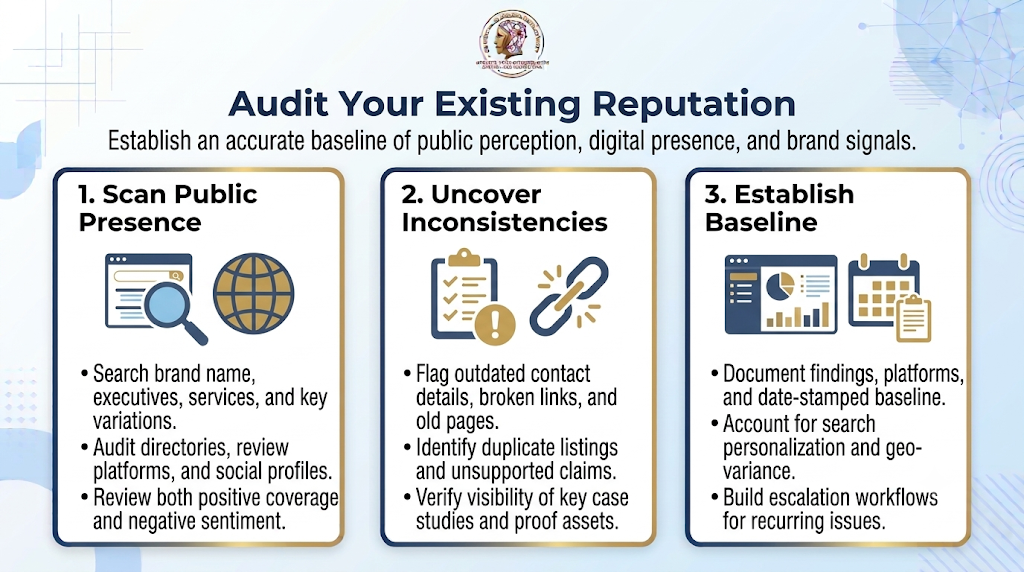
Before launching new activity, establish what people can already see. Search the company name, key executives, major services, and common brand variations. Review the homepage, service pages, contact details, business listings, review platforms, social profiles, industry directories, press mentions, and relevant discussion forums. Check both positive and negative results. B2B Reputation Management requires a documented escalation process.
Record what is accurate, outdated, incomplete, or inconsistent. Look for old phone numbers, abandoned profiles, duplicated listings, unsupported claims, broken links, and pages that describe services you no longer provide. Note whether important reviews or case studies are visible to a buyer researching your company. B2B Reputation Management benefits from consistent leadership communication.
B2B Reputation Management begins with a baseline. Save the date, search terms, platforms reviewed, and findings so future reviews can be compared. Do not assume that one search from an employee’s browser represents what every prospect sees. Search results can vary by location, personalization, and time, so use the audit as a practical snapshot rather than a universal ranking report.
4. Build Reputation Around Customer Experience
Public messaging cannot permanently compensate for poor delivery. The most durable reputation signal is the experience customers receive after signing an agreement. Set clear expectations about scope, responsibilities, timing, communication, approvals, and what success means. When a project changes, explain the impact and agree on the next step. B2B Reputation Management depends on accurate business information.
B2B Reputation Management works best when service standards are operational, not merely promotional. Define response expectations, escalation paths, meeting cadence, quality checks, and ownership for unresolved issues. Make sure customers know whom to contact and what information they should provide when something goes wrong.
Review the customer journey from initial enquiry to onboarding, delivery, renewal, and exit. Identify moments that commonly create frustration: unclear proposals, missed updates, unexpected costs, slow support, or weak handovers. Fix the recurring causes, then communicate the improvement accurately. A reliable process creates more credible advocacy than a large collection of generic testimonials. B2B Reputation Management grows through useful expert content.
5. Make Expertise Visible With Useful Content
Expertise is easier to trust when a company explains how it thinks and works. Publish articles that answer real buyer questions, practical guides that clarify complex decisions, and case studies that show the process behind an outcome. A useful resource should help a reader make a better decision even if they do not immediately become a customer. B2B Reputation Management needs permission before publishing testimonials.
Choose subjects from sales conversations, project reviews, customer support questions, and market research. Explain trade-offs, common mistakes, limitations, and the conditions under which a recommendation may not apply. This is more credible than repeating broad claims about being innovative or customer-focused. B2B Reputation Management improves when complaints receive attention.
B2B Reputation Management can use content to demonstrate competence before a sales meeting. Make author information clear, check factual claims, update outdated resources, and link to relevant services only where the next step genuinely helps the reader. Do not invent client examples or present hypothetical outcomes as actual results.
6. Collect Genuine Customer Reviews
Reviews can help buyers understand what working with a provider is like, but only when they are genuine and presented responsibly. Ask customers for feedback after a meaningful milestone or completed engagement. Explain that honest feedback is welcome and that participation is optional. Do not pressure customers to provide positive wording or offer incentives in ways that violate platform rules or applicable law. B2B Reputation Management supports trust during complex purchases.
Make the request simple. Provide the correct review destination, explain what kind of detail may help other buyers, and allow the customer to describe their experience in their own words. Never write a review for a customer to post as if it were their own independent statement. B2B Reputation Management becomes measurable through clear indicators.
B2B Reputation Management should track review volume, recency, themes, and response quality, not only average ratings. A small number of detailed, relevant reviews may provide more useful insight than a large volume of vague praise. Obtain permission before reusing a review in advertisements, proposals, or case studies.
7. Respond to Negative Feedback Professionally
Negative feedback should be treated as information that needs investigation, not as an attack that must be defeated. Acknowledge the concern, avoid arguing publicly, and invite the person to a suitable private channel when personal or confidential details are involved. Do not disclose account information, contract terms, or private correspondence in a public response. B2B Reputation Management gives sales teams credible proof.
Investigate the facts before making promises. If the company made a mistake, accept responsibility and explain the corrective action. If the concern appears inaccurate, respond calmly with verifiable context while protecting privacy. Avoid threats, sarcasm, blame, or copy-paste replies that make the customer feel ignored. B2B Reputation Management requires regular review and refinement.
B2B Reputation Management requires a clear escalation process. Define who can respond, when legal or senior review is needed, how urgent issues are handled, and how the resolution is recorded. A thoughtful response can show prospective customers that the business listens and takes accountability, even when the original experience was imperfect.
8. Use Case Studies as Verifiable Proof
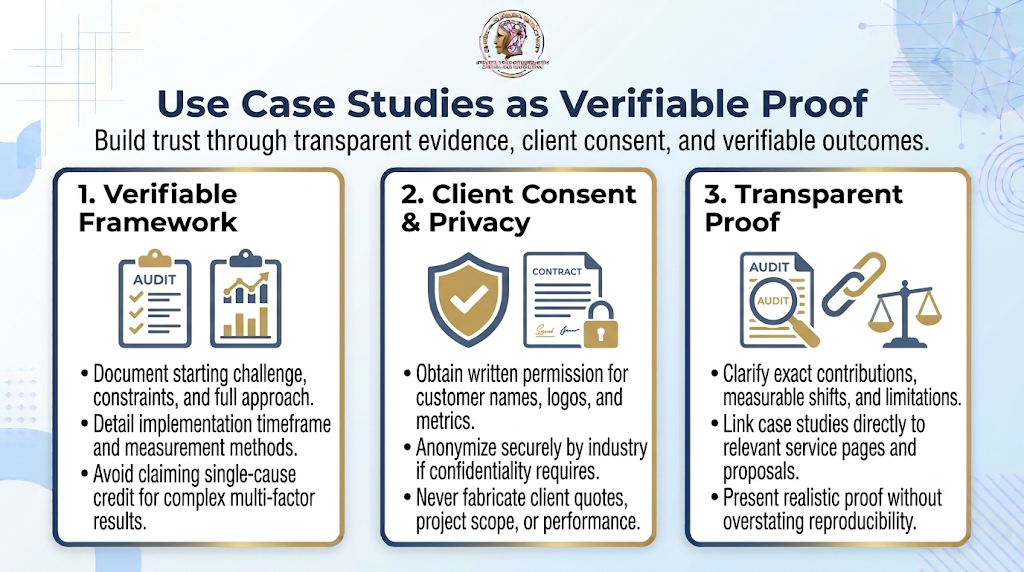
A case study should explain a real customer situation, the work performed, and the outcome that can be supported. Include the starting challenge, relevant constraints, approach, implementation, and results. State the timeframe and measurement method for any figures. If multiple factors contributed to the outcome, avoid claiming that one activity caused everything.
Obtain written permission before publishing a customer’s name, logo, quote, screenshots, or performance information. If confidentiality requires anonymization, explain the industry and context without revealing details that could identify the client indirectly. Never invent a customer, quote, metric, or project.
B2B Reputation Management becomes stronger when proof is specific and transparent. A buyer should be able to understand what the company did, what the client contributed, what changed, and what limitations remain. Make case studies easy to find from relevant service pages and proposals, but do not overstate how broadly one result can be repeated.
9. Measure Reputation With Meaningful Indicators
Reputation is not one number. Ratings, review volume, response time, complaint themes, customer retention, referral activity, branded search demand, and sentiment can each provide partial evidence. None should be treated as a complete measure of trust on its own.
Create a small scorecard with definitions and review dates. For example, measure the share of reviews receiving a response, the time taken to acknowledge a complaint, the number of recurring service issues, and the percentage of customers willing to act as references. Pair these indicators with qualitative feedback and customer interviews.
B2B Reputation Management measurement should lead to decisions. If review sentiment declines, investigate service themes. If brand searches rise but qualified enquiries do not, examine the website and offer. If complaints cluster around onboarding, improve that process. Avoid setting targets that encourage staff to manipulate ratings or discourage honest feedback.
10. Connect Reputation With Sales Enablement
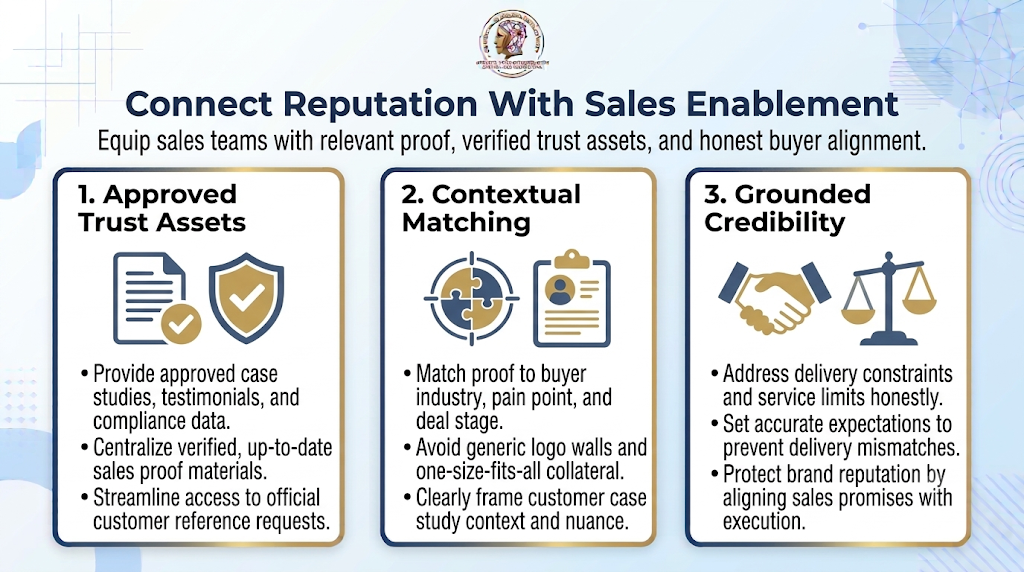
Sales teams need accurate proof and clear answers when buyers ask whether the company can be trusted. Give them approved case studies, relevant testimonials, service explanations, security or compliance information where applicable, and a process for requesting references. Keep assets current and make it easy to find the version approved for external use.
Do not send every prospect the same collection of logos and testimonials. Choose evidence that matches the buyer’s industry, problem, service requirement, and decision stage. Explain the context of each example and avoid suggesting that a customer’s results are guaranteed for another organization.
B2B Reputation Management supports sales when it reduces uncertainty without creating unrealistic expectations. Train representatives to discuss limitations honestly, explain how concerns are handled, and avoid promising features or outcomes that delivery teams cannot support. Sales credibility depends on the consistency between what is promised and what is delivered.
11. Handle Search Results and Public Information
When a buyer searches a company name, the results may include the website, business profiles, reviews, news, social posts, directories, and older pages. You cannot control every result, and attempts to manipulate search visibility can create additional risk. Focus on accurate information, useful owned resources, and legitimate corrections.
Keep important pages current and make company identity, services, leadership, contact details, and policies easy to verify. If a page contains false information, use the publisher’s correction process where appropriate. If content violates a platform policy or law, follow the formal reporting route and obtain advice when needed. Do not threaten reviewers simply because their feedback is negative.
B2B Reputation Management in search is a long-term effort. B2B Reputation Management should guide search reputation activity. Publish helpful resources, maintain trustworthy profiles, earn legitimate mentions, and address underlying customer issues. Search visibility can help buyers find accurate context, but it cannot guarantee that every result will be positive or that a negative page will disappear.
12. Build a 90-Day Reputation Improvement Plan
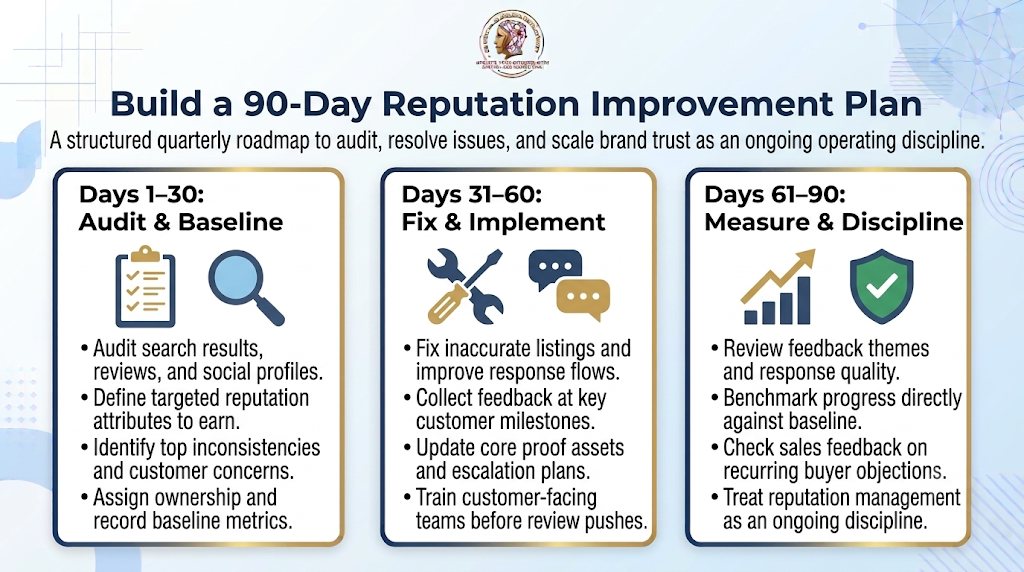
During the first 30 days, audit search results, listings, reviews, social profiles, customer feedback, and sales materials. Define the reputation attributes the company wants to earn. Identify the most urgent inconsistencies and recurring customer concerns. Assign an owner and record the baseline.
During days 31 to 60, fix inaccurate business information, improve response processes, collect feedback at suitable customer milestones, update key proof assets, and create a simple issue-escalation plan. Train the teams that communicate with customers and prospects. Do not launch a large review campaign before service problems are understood.
During days 61 to 90, review feedback themes, response quality, customer references, brand mentions, and progress against the baseline. Ask sales whether buyers raise fewer recurring concerns and ask customer teams whether issue resolution has improved. B2B Reputation Management should develop as an ongoing operating discipline, not a one-time public relations campaign.
Frequently Asked Questions
What is B2B reputation management?
It is the ongoing work of monitoring, protecting, and improving how a business is perceived by customers, prospects, employees, partners, and the market. It includes customer experience, reviews, public information, communication, proof, and issue response.
Why does reputation matter in B2B?
Business purchases can involve high costs, long commitments, and several decision-makers. Buyers use reputation signals to reduce uncertainty and assess whether a provider is credible, dependable, and suitable for their needs.
How should a company respond to a negative review?
Acknowledge the concern calmly, avoid arguing, investigate the facts, and offer an appropriate next step. Do not disclose private information publicly. If the company made a mistake, explain the corrective action and follow through.
Can a business remove negative reviews?
A business generally cannot remove a genuine review simply because it is negative. It can respond professionally and report content that violates the platform’s rules. Do not buy fake positive reviews or threaten reviewers.
How often should reputation be monitored?
Review major profiles and feedback channels regularly. High-volume businesses may need daily monitoring, while smaller firms may use a weekly routine with alerts for urgent mentions. Review the overall reputation baseline monthly or quarterly.
What metrics should a B2B company track?
Useful indicators include review themes, response time, complaint resolution, customer references, retention signals, brand mentions, and customer feedback. Interpret these together rather than treating one rating as the complete measure.
Does content marketing improve reputation?
Useful content can demonstrate expertise and help buyers understand a company’s approach. It supports reputation when claims are accurate, authorship is clear, and the advice reflects genuine experience. Publishing volume alone does not create trust.
Conclusion
A strong business reputation is earned through the consistency of what a company promises, what it delivers, and how it responds when things go wrong. Reviews and public visibility matter, but they are only part of the picture. Customer experience, leadership credibility, accurate information, useful expertise, and responsible communication all contribute to buyer confidence.
Start with an honest audit. Identify the reputation attributes that matter to your customers, fix the operational problems that create repeated complaints, and make genuine proof easier to evaluate. Give teams clear ownership, monitor important conversations, and review progress using evidence rather than vanity metrics.
B2B Reputation Management becomes a lasting business advantage when it is built into delivery, marketing, sales, and leadership practices. It cannot guarantee every prospect will choose your company, but it can reduce avoidable doubt and make the decision to engage easier.
SG Digital Business Development helps businesses strengthen digital visibility, communicate expertise, and create clearer paths from discovery to qualified enquiries. If you want to improve how buyers find, evaluate, and trust your business, contact SG Digital Business Development to discuss a practical growth plan.
Let’s build your digital future together. Contact SG Digital Business Development today and let’s engineer your global authority!