
B2B Competitive Intelligence: 25 Ways to Outsmart Your Competitors
Introduction
Your competitors are not standing still. They are changing their services, adjusting prices, publishing new content, targeting different industries, improving customer experiences, and experimenting with new ways to attract buyers. If your business does not pay attention to these changes, you may miss opportunities or discover a competitive threat only after it affects your sales.
That is why B2B Competitive Intelligence should be a regular business activity rather than an occasional research project. It helps a company understand the market, recognize competitor movements, identify customer expectations, and make better strategic decisions.
Competitive intelligence does not mean copying another company’s website, pricing, advertisements, or services. It means collecting information from legitimate sources, interpreting what that information reveals, and using the findings to improve your own decisions. The objective is to understand where competitors are strong, where customers remain underserved, and how your business can create a more valuable position.
For B2B companies, this work is especially important because buying decisions often involve multiple stakeholders, longer sales cycles, detailed evaluations, and significant financial commitments. A competitor may win a deal because its implementation process appears safer, its expertise is easier to understand, or its proposal addresses a concern that your team overlooked.
This guide explains 25 practical ways to build a useful intelligence process, turn market observations into business actions, and create a stronger competitive position.
Review B2B Competitive Intelligence findings with delivery teams before committing to new promises.
1. Identify Your Real Competitors
Begin by identifying the businesses buyers actually compare with your company. Your direct competitors offer similar services to similar customers. Indirect competitors solve the same problem through a different method. Emerging competitors may be smaller businesses, new platforms, or specialist providers entering your market.
Create a competitor list with company names, websites, core services, target industries, geographic markets, and the type of competition each represents. This gives your B2B Competitive Intelligence process a defined starting point and prevents the team from monitoring every business in the industry without a clear reason.
Regular B2B Competitive Intelligence helps distinguish genuine market threats from ordinary competitor activity.
2. Understand Competitor Positioning
A competitor’s positioning explains how it wants potential customers to understand its business. One provider may emphasize low prices, another may promote specialist expertise, and another may focus on speed, reliability, or complete service delivery.
Use these observations to sharpen your own message. Effective B2B Competitive Intelligence should help your company communicate its real strengths, not imitate another brand’s language.
Use B2B Competitive Intelligence to confirm which alternatives buyers actually consider before changing your positioning.
3. Compare Service Offerings
Create a structured comparison of competitor services. Include the main deliverables, optional services, support arrangements, implementation approach, target customers, and any publicly stated limitations.
Use the findings to identify missing capabilities, confusing packages, or opportunities to combine services in a more useful way. Your goal is to make your offer easier to understand and more relevant to the customers you want to attract.
A focused B2B Competitive Intelligence review reveals whether service differences matter to your ideal customers.
4. Monitor Competitor Pricing Signals
Pricing information can reveal how competitors package their services and communicate value. Some companies publish fixed packages, while others use custom proposals, subscription plans, project fees, or performance-based arrangements.
B2B Competitive Intelligence should inform pricing decisions, but your company should never change its prices simply because another provider charges less.
Use B2B Competitive Intelligence to compare value, not simply the lowest advertised price.
5. Analyse Competitor Websites
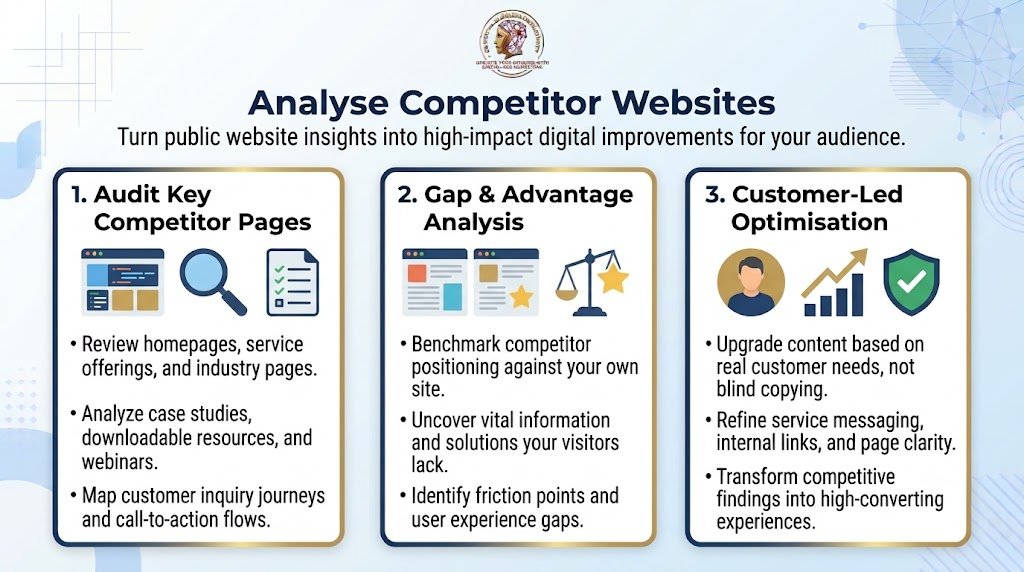
A competitor’s website is a public source of information about its market approach. Review its homepage, service pages, industry pages, resources, case studies, contact process, and calls to action.
Compare these observations with your own website. Identify useful information your visitors may be missing and improve your pages based on customer needs rather than copying competitor layouts.
Website observations become useful B2B Competitive Intelligence when they lead to specific improvements for your visitors.
6. Study Competitor SEO Visibility
Search visibility can show which topics and services competitors are prioritizing. Search for the commercial terms relevant to your business and note which providers appear consistently.
A useful intelligence report should distinguish between visibility, qualified traffic, and business outcomes. Ranking for a term is only one part of the picture.
Combine search rankings with B2B Competitive Intelligence to understand which topics influence commercial decisions.
7. Track Competitor Content Publishing
Competitor content can reveal the subjects businesses believe their audiences care about. Monitor new articles, guides, webinars, reports, videos, and downloadable resources.
Use B2B Competitive Intelligence to discover useful content opportunities, then create original resources based on your expertise and customer experience.
Consistent B2B Competitive Intelligence can uncover content gaps that your expertise is well suited to fill.
8. Review Customer Reviews and Testimonials
Public reviews can help you understand what customers appreciate and where they experience frustration. Review platforms, testimonials, public comments, and industry communities may reveal recurring themes.
Never treat an individual review as proof that an entire competitor performs poorly. Use public feedback as one source among several, and verify patterns before making strategic decisions.
Customer feedback strengthens B2B Competitive Intelligence when recurring themes are checked across several independent sources.
9. Learn from Competitor Case Studies
Case studies show how competitors present their work and demonstrate business outcomes. Examine the customer’s original problem, the solution provided, the implementation process, and the results claimed.
Use these findings to improve your own proof. Build customer stories around real challenges, clear actions, and accurately documented results. Obtain permission before using client names, logos, quotations, or confidential information.
Use B2B Competitive Intelligence to assess how competitors substantiate their customer success claims.
10. Monitor Competitor Advertising
Public advertisements can provide clues about competitor audiences, offers, messages, and campaign priorities. Review the advertising libraries and public ad transparency resources available on relevant platforms.
The useful question is not simply what competitors advertise. It is what customer need they are trying to address and whether your business can communicate a more relevant or better-supported solution.
Advertising observations add context to B2B Competitive Intelligence, but they do not reveal campaign profitability.
11. Understand Competitor Target Audiences
A competitor may serve a broad market but prioritize a smaller group of customers. Review its industry pages, service packages, case studies, job descriptions, partnerships, and public communications to understand its likely focus.
Avoid making assumptions based on one marketing page. Combine several public signals and validate your interpretation through customer conversations and sales data.
Good B2B Competitive Intelligence separates a competitor’s apparent audience from its confirmed customer base.
12. Analyse Competitor Sales Messages
Sales messaging can influence how buyers understand a provider’s value. Review publicly available sales materials, webinar presentations, product demonstrations, and service explanations.
Use these lessons to improve your own discovery calls and proposals. A clear explanation of business impact can be more persuasive than a long list of technical capabilities.
Sales teams can use B2B Competitive Intelligence to prepare relevant questions without criticizing rival providers.
13. Monitor Competitor Hiring Activity
Recruitment activity can provide public signals about a company’s priorities. New roles in sales, technology, customer support, marketing, or regional management may indicate an area of investment.
Treat recruitment information as a clue rather than a confirmed strategic announcement. Combine it with other observations before changing your own plans.
Treat hiring patterns as one signal within a wider B2B Competitive Intelligence assessment.
14. Track Partnerships and Technology Choices
Partnership announcements, integrations, certifications, and public technology references can reveal how competitors are developing their services.
Do not assume that a listed partnership is active or commercially significant. Verify the relationship through reliable public information and avoid overstating what it means.
Partnership research makes B2B Competitive Intelligence more useful when relationships are independently confirmed.
15. Build a Competitor Comparison Matrix
A comparison matrix turns scattered observations into a practical decision-making tool. Create columns for competitor name, target audience, positioning, services, pricing signals, proof, website quality, content focus, and visible strengths.
Review the matrix when significant market changes occur and remove outdated information. B2B Competitive Intelligence becomes more valuable when the team can trace a conclusion back to its evidence.
A shared matrix gives B2B Competitive Intelligence a consistent format across marketing and sales teams.
16. Identify Market Gaps
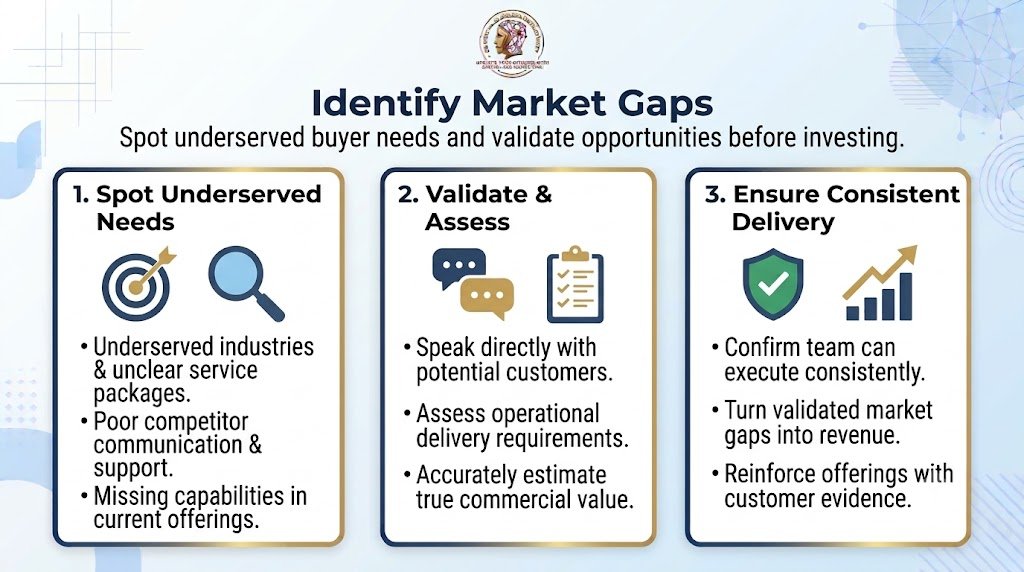
A market gap exists when customer needs are not being addressed adequately by current providers. It may involve an underserved industry, an unclear service package, poor customer communication, limited implementation support, or a missing capability.
Validate the opportunity before investing. Speak with potential customers, assess delivery requirements, estimate commercial value, and check whether your team can deliver the promised outcome consistently.
Customer interviews help validate opportunities first identified through B2B Competitive Intelligence research.
17. Examine Competitor Customer Experience
The customer experience includes every interaction before, during, and after a purchase. Public information may reveal how competitors handle enquiries, onboarding, support, communication, and ongoing service.
Improving these areas can create differentiation even when service features appear similar. Buyers often remember how confidently and consistently a provider manages the relationship.
Use B2B Competitive Intelligence to compare the full customer journey, not isolated service features.
18. Monitor Competitor Brand Reputation
Brand reputation influences trust, especially when buyers are evaluating providers for important projects. Track public mentions, media coverage, industry discussions, event participation, and customer feedback.
Use reputation research to understand what the market associates with each competitor. Then build your own credibility through transparent communication, reliable delivery, relevant expertise, and genuine customer evidence.
Reputation signals should be verified before they influence B2B Competitive Intelligence recommendations.
19. Create a Competitor News Monitoring Routine
Important competitor developments can happen between quarterly reviews. Set up a manageable monitoring routine using company news pages, public newsletters, search alerts, industry publications, and relevant professional networks.
Assign an owner to review the findings and decide whether an observation requires action. A short, relevant update is more useful than a large collection of links that nobody reads.
A simple monitoring routine keeps B2B Competitive Intelligence current without overwhelming the team.
20. Use Ethical and Reliable Information Sources
Competitive research should be based on lawful, ethical, and appropriately accessible information. Useful sources include company websites, public filings, published reports, advertisements, job listings, industry events, customer interviews, and authorized sales feedback.
Trustworthy research is not only a compliance requirement. It improves decision quality because leaders can distinguish what is known from what is merely suspected.
Ethical sourcing protects the credibility and long-term value of B2B Competitive Intelligence.
21. Turn Research into Sales Enablement
Research becomes commercially useful when sales teams can apply it in real conversations. Convert relevant findings into short competitor briefs that explain the competitor’s public positioning, likely strengths, known differences, and questions buyers may ask.
A useful sales brief helps representatives explain genuine differentiation while remaining professional and accurate.
Turn B2B Competitive Intelligence findings into concise sales guidance with dated supporting evidence.
22. Improve Your Own Value Proposition
Competitor research should eventually lead to a clearer explanation of why customers should choose your business. Compare what your company promises with the priorities buyers repeatedly express.
Avoid claiming that your company is the best without defining what that means. Specific, credible differentiation is more persuasive than broad promotional language.
Use B2B Competitive Intelligence to explain the strengths your business can genuinely demonstrate.
23. Build a Competitive Response Framework
Not every competitor action requires a response. A competitor lowering prices, publishing a new article, or hiring a senior employee does not automatically mean your company should change its strategy.
This prevents reactive decisions and helps leaders focus on changes that could genuinely affect customers, revenue, or market position.
Prioritize responses when B2B Competitive Intelligence identifies a material risk to customer choice.
24. Measure Competitive Intelligence Performance
Measure the quality and usefulness of your research process, not just the volume of information collected.
Review the measures regularly and remove metrics that do not support decisions.
Connect B2B Competitive Intelligence measures to business outcomes rather than research volume alone.
25. Create a Repeatable Intelligence Operating System
The strongest process is one that the company can maintain. Assign clear responsibilities for collecting information, validating observations, analysing implications, and communicating findings.
B2B Competitive Intelligence should connect market research with marketing, sales, product, customer experience, and leadership decisions. When the process becomes part of normal business planning, the company can respond to market changes with greater confidence.
An assigned owner makes B2B Competitive Intelligence a repeatable part of business planning.
Common Competitive Intelligence Mistakes to Avoid
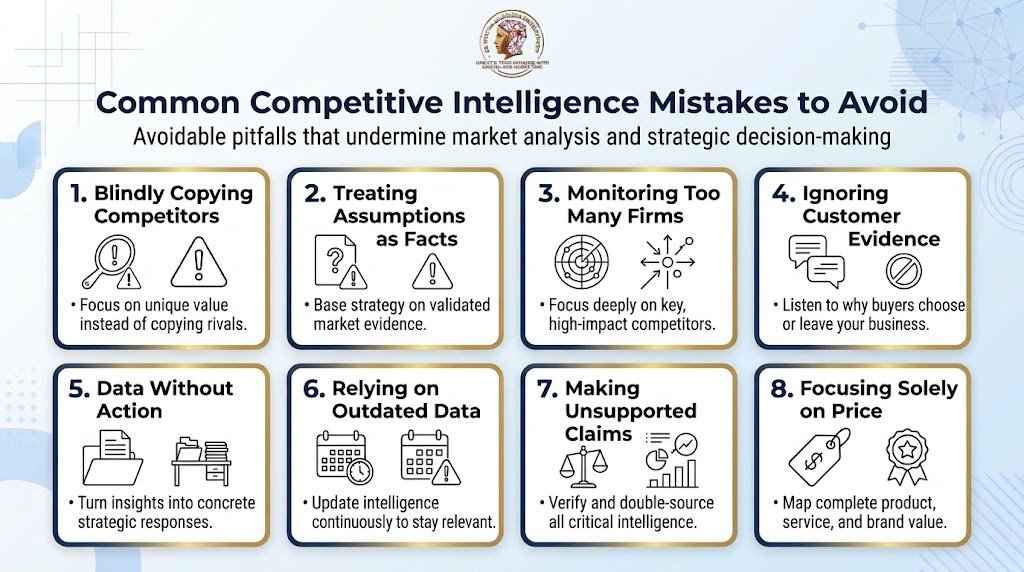
Even a well-designed research process can produce poor decisions if the team interprets information carelessly. Avoid these common mistakes:
- Copying competitors: Their strategy may suit a different audience, budget, or operating model. Learn from the market without automatically reproducing another company’s approach.
- Treating assumptions as facts: Label estimates and unknown information clearly. Verify important observations before making commercial decisions.
- Monitoring too many companies: Focus on direct competitors, meaningful alternatives, and emerging threats rather than tracking every business in the industry.
- Ignoring customer evidence: Public competitor activity cannot replace conversations with your own customers and prospects.
- Collecting information without action: Every major insight should lead to a decision, an experiment, or a documented reason for taking no action.
- Using outdated research: Add collection dates and review important findings regularly.
- Making unsupported claims: Never use competitor comparisons in marketing or sales materials unless the information is accurate, relevant, and appropriately supported.
- Focusing only on price: Service quality, expertise, implementation, communication, and business outcomes also influence B2B buying decisions.
A Practical 30-Day Implementation Plan
You do not need a large research department to establish a useful process. Start with a focused month of work.
Week 1: Establish the Baseline
Identify five to eight relevant competitors. Separate direct competitors from indirect alternatives. Record their websites, target audiences, service categories, and visible positioning.
Ask sales and customer-facing teams which competitors appear most frequently in conversations. Compare their feedback with public search results and customer references.
Deliverable: A priority competitor list and a basic comparison matrix.
Week 2: Research the Market
Review competitor service pages, content, public pricing information, case studies, advertisements, reviews, and visible partnerships. Record sources and collection dates.
Identify recurring customer concerns and areas where competitors appear to provide limited information. Separate confirmed findings from possible opportunities.
Deliverable: A short research report with evidence, gaps, and open questions.
Week 3: Select Strategic Actions
Choose two or three findings with the strongest potential business impact. These might involve improving a service page, clarifying pricing, creating a customer resource, strengthening proof, or refining sales messaging.
Discuss the findings with the teams responsible for delivery and sales. Confirm that the proposed response is commercially sensible and operationally achievable.
Deliverable: A prioritized action plan with owners and deadlines.
Week 4: Implement and Review
Complete the selected improvements. Update relevant sales materials, website pages, or internal guidance. Establish a recurring schedule for reviewing competitor developments.
Record what changed and how the team will evaluate the result. Do not assume that an improvement worked simply because it was implemented.
Deliverable: A completed first action cycle and a schedule for the next review.
Quick B2B Competitive Intelligence Checklist
Use this checklist to keep the process practical:
- Identify direct, indirect, and emerging competitors.
- Document each competitor’s target audience and positioning.
- Compare services, packages, and publicly available pricing.
- Review competitor websites and customer journeys.
- Monitor relevant search visibility and published content.
- Examine public reviews and customer case studies.
- Track advertising messages and visible campaign offers.
- Review public hiring, partnership, and company announcements.
- Record information sources and collection dates.
- Separate confirmed facts from assumptions.
- Identify underserved customer needs and market gaps.
- Prepare accurate competitor briefs for sales teams.
- Improve your own positioning using genuine strengths.
- Assign owners to important competitive responses.
- Measure whether research leads to useful business action.
Frequently Asked Questions
What is B2B competitive intelligence?
B2B competitive intelligence is the structured collection and analysis of relevant information about competitors, customers, and market developments. It helps businesses understand their competitive environment and make informed decisions about positioning, services, pricing, marketing, and sales.
Why is competitive intelligence important for B2B companies?
B2B companies often compete for high-value contracts involving multiple decision-makers and detailed evaluations. Understanding competitor positioning, customer expectations, and market changes helps businesses communicate their value more clearly and respond to opportunities more effectively.
How often should a business conduct competitor research?
The frequency depends on the market and the resources available. A monthly review may be sufficient for a stable market, while rapidly changing industries may require weekly monitoring of significant developments. The important point is to maintain a consistent process.
What tools can help with competitor research?
Businesses can use search engines, website analytics, SEO research platforms, advertising transparency libraries, social listening tools, public company announcements, review platforms, and spreadsheets. Choose tools based on the questions being investigated rather than collecting software without a defined purpose.
Is competitive intelligence the same as competitor spying?
No. Responsible competitive intelligence relies on lawful, ethical, and appropriately accessible information. It does not involve unauthorized access, deception to obtain restricted information, or misuse of confidential material.
How can small businesses use competitive intelligence?
Small businesses can begin with a shortlist of important competitors, public website research, customer interviews, review analysis, and regular sales feedback. A simple spreadsheet and a monthly review can provide a useful foundation without requiring an expensive research system.
How does competitive intelligence improve sales?
It helps sales teams understand the alternatives buyers may consider, prepare for relevant questions, explain genuine differences, and avoid unsupported competitor claims. It can also reveal customer concerns that should be addressed earlier in the buying process.
What should a competitor analysis report include?
A practical report should include competitor profiles, target audiences, positioning, services, pricing signals, public proof, customer feedback themes, market changes, evidence sources, potential opportunities, and recommended actions. It should also identify information that remains unknown.
Conclusion
Winning in a competitive B2B market requires more than offering a good service. Businesses need to understand how buyers evaluate providers, what alternatives are available, where customer expectations are changing, and how competitors communicate their value.
A consistent research process helps turn public information and customer feedback into practical business decisions. Start by identifying the right competitors, compare their offers, study customer needs, and look for genuine gaps in the market. Then use the findings to improve your positioning, website, sales conversations, and customer experience.
The purpose of B2B Competitive Intelligence is not to follow every competitor move. It is to make better decisions about where your company should compete and how it can deliver meaningful value.
If your business wants to improve its digital visibility, communicate its strengths, and build a more effective growth strategy, SG Digital Business Development can help you identify opportunities and connect marketing with business development.
Contact SG Digital Business Development to discuss a practical growth strategy for your business.
Effective B2B Competitive Intelligence supports better decisions while keeping customer value at the centre.
Review findings quarterly.
Let’s build your digital future together. Contact SG Digital Business Development today and let’s engineer your global authority!