
International SEO Strategy for B2B.
Introduction
Selling to customers in more than one country creates a search challenge that is easy to underestimate. A business may have a strong website, useful service pages, and steady organic visibility in its home market, yet remain difficult to discover among buyers in the United States, United Kingdom, Australia, Singapore, or other target regions. The reason is rarely a single technical setting. International growth depends on understanding where demand exists, how buyers describe their problems, which pages deserve to be localized, and how search engines can identify the right version of each page.
An effective international SEO strategy connects market research, search intent, website architecture, localized content, technical signals, and conversion experience. It does not mean translating every page or creating a country folder for every place on a map. It means choosing markets deliberately and building pages that genuinely help the people in those markets evaluate a supplier.
For B2B companies, the decision is especially important because buying journeys are often longer and involve several stakeholders. A procurement manager, technical evaluator, founder, and finance lead may all search differently before a conversation begins. A global search plan should therefore support discovery, evaluation, and enquiry—not just impressions.
This guide explains how to plan that work, what to check before expanding, how to avoid common technical mistakes, and how to measure whether international organic visibility is creating relevant business opportunities.
1. Understand the difference between international and multilingual SEO
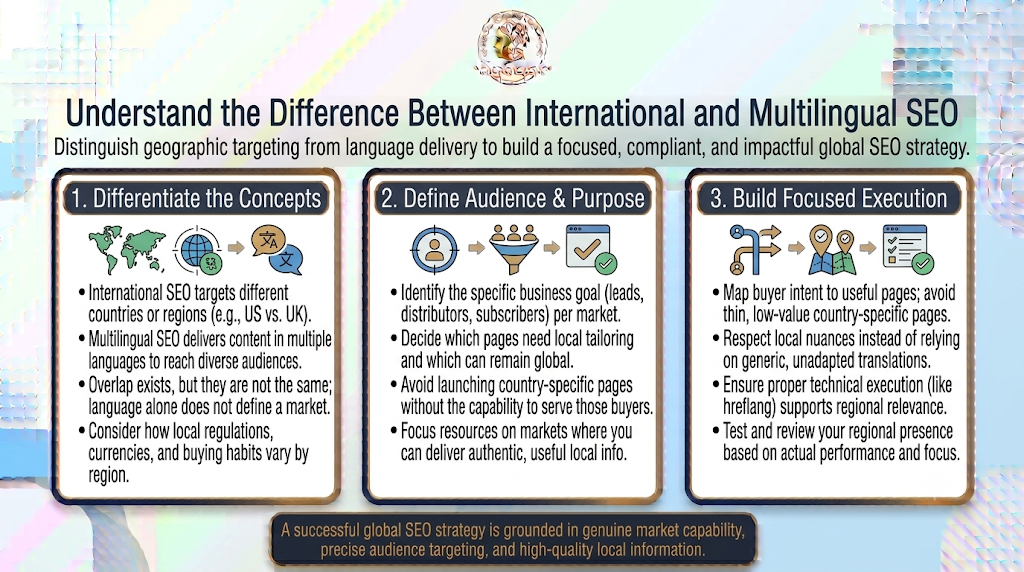
International SEO is the broader practice of making a website relevant and accessible to audiences in different countries or regions. Multilingual SEO focuses on serving content in more than one language. These activities can overlap, but they are not identical.
A company based in India may target buyers in the United States and United Kingdom using English-language pages. That is international targeting without necessarily being multilingual. A company may also serve English- and German-speaking customers in several countries. That is multilingual, and it may also be multi-regional if the offer, pricing, compliance details, or customer experience differs by market.
The distinction matters because language alone does not define a market. Two countries can use English but have different terminology, regulations, expectations, currencies, buying processes, and proof requirements. Conversely, a single language may be used across several markets without requiring separate versions of every page.
An international SEO strategy begins by identifying the audience and business purpose behind each target market. Ask whether the goal is to attract leads, support distributors, sell subscriptions, recruit partners, or help existing customers. The answer determines which pages need regional relevance and which can remain global.
Avoid creating separate country pages simply because a country is commercially attractive. First establish that the company can serve buyers there and that the page can provide meaningful local information.
An international SEO strategy maps buyer intent to useful pages. A sound international SEO strategy avoids creating thin country pages.
International SEO strategy needs focus.
2. Choose target markets using evidence
Market selection should combine commercial feasibility with search opportunity. A country with large search demand may not be a good priority if the company cannot deliver there, support local time zones, meet relevant requirements, or compete on price. A smaller market may be more attractive if the service is specialized and the company already has strong customer fit.
Start with first-party evidence. Review enquiry locations, customer records, sales conversations, existing contracts, and website analytics. Search Console can reveal the countries generating impressions and clicks, but those figures should be interpreted carefully. Impressions do not prove that visitors are qualified, and a small number of relevant enquiries may be more valuable than a large volume of low-intent visits.
Next, assess market fit. Consider the size and maturity of the target industry, the language used by decision-makers, local competitors, service delivery requirements, payment preferences, and the credibility signals buyers expect. Speak with sales and delivery teams before selecting the first markets.
Build a simple prioritization model. Score each market for customer fit, achievable delivery, search demand, competition, expected deal value, and available proof. Use consistent criteria rather than choosing markets based on assumptions or one keyword tool estimate.
The purpose of an international SEO strategy is not to target as many countries as possible. It is to focus resources on markets where the business can provide a strong solution and where search visibility can support a realistic commercial objective.
The international SEO strategy needs a URL structure the team can maintain. A maintainable international SEO strategy has clear technical ownership.
3. Research how buyers search in each market
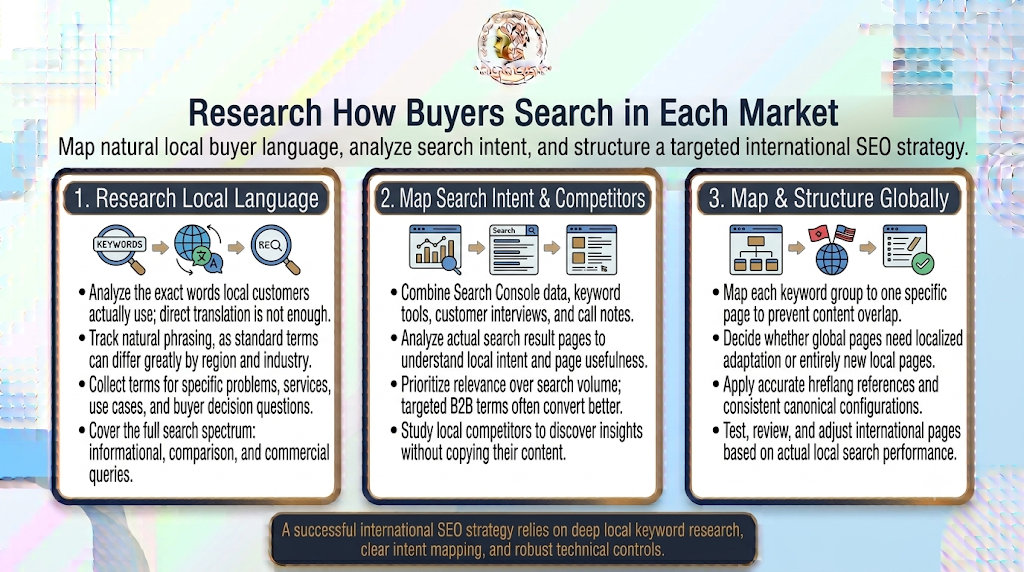
Keyword research should reflect the words customers actually use. Direct translation is not enough. A phrase that sounds natural in one country may be uncommon, overly broad, or commercially misleading in another. Even within English-speaking markets, terms can differ by industry, role, and buying stage.
Build research around problems, services, use cases, and decision questions. For each target market, collect phrases that describe the category, the problem, the desired outcome, and the type of provider being considered. Include informational searches such as definitions and guides, comparison searches such as alternatives and provider evaluations, and commercial searches that indicate readiness to speak with a supplier.
Use Search Console data, keyword research platforms, customer interviews, sales call notes, competitor pages, and search result reviews. Examine the actual results for each query. If the results show local directories, government resources, comparison sites, or product pages, that reveals something about search intent and the type of page likely to be useful.
Do not assume that a high-volume phrase is automatically the best target. A specialized B2B term may have limited volume but stronger relevance to the company’s offer. Review the language used by local competitors, but do not copy their claims or structure without evaluating accuracy.
An international SEO strategy should map each keyword group to one suitable page. This reduces overlap and helps teams decide whether a global page needs adaptation or a genuinely different local page.
An international SEO strategy requires accurate, reciprocal hreflang references. The international SEO strategy keeps canonical choices consistent across versions.
International SEO strategy needs testing.
4. Decide which pages should be localized
Not every page needs a country-specific version. Start with pages that influence discovery and buying decisions: core service pages, industry pages, pricing or engagement information, case studies, contact information, and high-value educational resources.
A page deserves localization when the target audience needs different information. Examples include local terminology, market-specific service availability, local regulations, regional examples, pricing currency, delivery arrangements, support hours, or locally relevant proof. If none of these factors changes, a single well-written global page may be clearer than several nearly identical versions.
Create a page inventory with columns for URL, current audience, target market, search intent, business value, localization requirement, owner, and review date. Mark each page as global, adapt, translate, create, or do not expand. This turns an abstract expansion plan into a manageable work queue.
When adapting a page, preserve the core value proposition but make the context useful. A United States page may need different terminology and evidence from a United Kingdom page. A page for Singapore-based buyers may need to explain regional service coverage without implying that the company has a physical office there if it does not.
A disciplined international SEO strategy prioritizes a small set of high-value pages before translating the entire website. This keeps quality, maintenance, and review effort under control.
A useful international SEO strategy localizes pages only when context changes. The international SEO strategy should reflect local terminology and buyer questions.
5. Select a URL structure that the team can maintain
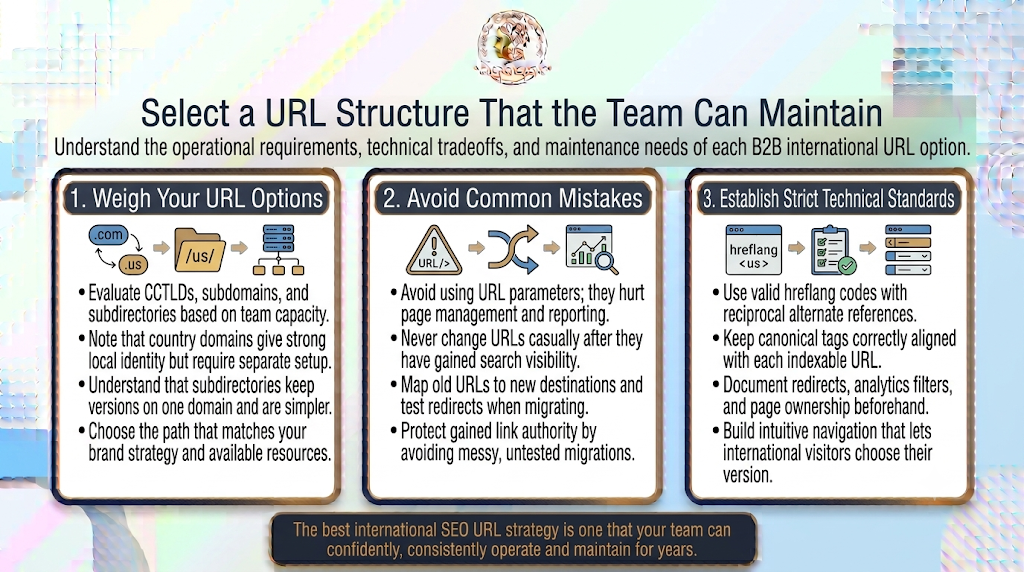
Common URL structures include country-code top-level domains, subdomains, and subdirectories. Each has operational consequences. A country-specific domain can provide a clear local identity, but it may require separate hosting, analytics configuration, authority development, and content maintenance. A subdomain can separate market experiences, while still requiring clear technical and organizational ownership. A subdirectory keeps versions under one main domain and is often simpler to manage.
For example, a business might use /us/, /uk/, or /de/ folders for regional or language versions. These are illustrative structures, not a universal recommendation. The right choice depends on the number of markets, content management setup, legal requirements, brand strategy, and available resources.
Avoid using URL parameters as the main way to distinguish country versions. Parameters can make page management and reporting harder, and they are less transparent to users. Also avoid changing URLs casually after pages have gained links or search visibility. If a migration is necessary, map old URLs to the most relevant new destinations and test redirects.
The best international SEO strategy is one the business can operate consistently for years. Use valid hreflang codes for regions, include reciprocal alternate references, and keep canonical tags aligned with each indexable URL. Document redirects, analytics filters, and ownership before launching new folders or domains.
An international SEO strategy connects regional pages with relevant internal links. The international SEO strategy needs navigation that lets visitors choose.
6. Make regional content genuinely useful
Localization is more than replacing a few words. Useful regional content reflects the needs, vocabulary, buying expectations, and practical questions of the audience. It should explain what the business offers in that market, how delivery works, what support is available, and what a prospective customer should expect after making contact.
Use local examples only when they are accurate and relevant. Do not invent offices, client logos, awards, certifications, case studies, local partnerships, or performance results. If the company serves a market remotely, explain that clearly. Trust is damaged when a page implies a local presence that does not exist.
Review currency, date formats, measurement units, spelling, contact methods, and terminology. For regulated industries, ask qualified reviewers to check local claims. A translated disclaimer or generic legal paragraph should not be treated as legal advice. Keep product and service details consistent with what the company can actually deliver.
For B2B buyers, content should answer questions about implementation, onboarding, integrations, service scope, risk, timelines, and commercial terms. Include region-specific details only where they improve the decision. If a claim cannot be substantiated, remove it or qualify it.
A thoughtful international SEO strategy combines local relevance with consistent brand positioning. The goal is not to make every page look different; it is to make each page feel appropriate to the audience it serves.
A careful international SEO strategy avoids unsupported local claims. The international SEO strategy should be reviewed as services and markets change.
Frequently asked questions
1. What is international SEO?
International SEO is the process of improving a website so that search engines and users can identify the pages relevant to different countries, regions, or language audiences. It can involve market research, localized content, URL structures, hreflang, technical SEO, and region-appropriate conversion paths.
2. Is international SEO different from multilingual SEO?
Yes. Multilingual SEO focuses on content in different languages. International SEO can also target different countries that use the same language. A business may need regional adaptations without translating the entire website, or it may need both language and country-specific versions.
3. Does a B2B company need a separate website for every country?
No. Separate country domains are only one option. Subdirectories or subdomains may be more manageable, depending on the business and its technical resources. Choose a structure that supports clear targeting and can be maintained consistently.
4. What is hreflang used for?
Hreflang annotations identify alternate versions of a page intended for different languages or regional audiences. They help search engines understand the relationship between those versions. They do not translate content or guarantee that a particular page will rank.
5. Should I create separate pages for the United States and United Kingdom?
Only when there is a meaningful reason, such as different service availability, terminology, pricing, regulations, examples, or buyer expectations. If the content and offer are genuinely the same, one clear page may be better than two near-duplicates.
6. How long does international SEO take to show results?
There is no guaranteed timeline. Discovery, crawling, indexing, competition, website authority, content quality, and technical conditions all influence performance. Establish a baseline, monitor progress, and use early data to improve the plan rather than promising a fixed ranking date.
7. Can one English page target several countries?
It can, especially when the offer and content are suitable for those audiences. However, if buyers in different countries need distinct information, create useful regional adaptations. Do not split pages merely to repeat keywords or country names.
8. How should a business measure international SEO success?
Measure organic visibility by market and page, then connect it to relevant visits, enquiries, qualified leads, meetings, and sales opportunities where tracking allows. Rankings and traffic are useful diagnostics, but commercial relevance is the more important outcome.
9. Is translating content enough to rank in another country?
No. Translation may make content readable, but it does not automatically make it locally relevant or technically discoverable. Research local search intent, adapt examples and service information, implement appropriate technical signals, and make sure the page satisfies the audience’s needs.
10. What should a company do before targeting a new country?
Confirm that it can serve customers there, review market demand and competition, understand buyer language, select priority pages, plan the URL structure, and prepare a reliable conversion process. Start with a focused market rather than launching many low-quality pages at once.
An international SEO strategy can begin with one carefully selected market. The international SEO strategy should never promise a fixed ranking date.
International SEO strategy needs ownership.
Conclusion: Build international visibility around real buyer needs
Expanding into new markets requires more than translating a website or adding country names to page titles. It requires a clear understanding of customer fit, search behaviour, local expectations, technical requirements, and the path from discovery to enquiry.
Start with markets where the business can deliver a credible service. Research the language buyers use, localize only the pages that need meaningful differences, choose a maintainable URL structure, and validate canonical and hreflang implementation. Connect regional pages through helpful internal links and make the contact experience clear for every audience.
Then measure the results in context. Review search visibility alongside relevant visits, enquiries, and lead quality. Use the evidence to decide what to improve and where expansion makes sense.
A well-planned international SEO strategy helps a B2B company build a more understandable, accessible, and useful presence across markets. It cannot guarantee rankings or enquiries, but it can create a stronger foundation for reaching the right buyers.
Ready to plan your next market? Contact SG Digital Business Development to discuss your website, target countries, and practical opportunities for international search growth.
A focused international SEO strategy supports specific commercial priorities. The international SEO strategy needs an accountable owner and review process. A sustainable international SEO strategy improves through evidence and iteration.
International SEO strategy serves qualified global buyers.
Related reading
Explore our B2B SEO strategy, SEO audit checklist, B2B AI SEO, content gap analysis, and SEO reporting.
Let’s build your digital future together. Contact SG Digital Business Development today and let’s engineer your global authority!