
B2B Sales Negotiation Strategy: Protect Value and Win Better Deals
Introduction
A promising B2B opportunity can lose momentum when commercial discussions begin. The buyer may ask for a discount, request additional services, challenge the timeline, compare competing proposals, or seek contract terms that shift too much risk to the supplier. Sales teams that respond without preparation can reduce margins, create delivery problems, or agree to commitments that the business cannot sustain.
A B2B Sales Negotiation Strategy gives the team a disciplined way to prepare, understand buyer priorities, communicate value, trade concessions, and reach agreements that work for both sides. A B2B Sales Negotiation Strategy sets measurable standards. It is not about winning every point or pressuring a buyer into a quick signature. It is about discovering what matters, protecting the value of the offer, managing risk, and creating a commercial relationship that can succeed after the contract is signed.
B2B negotiations often involve several stakeholders, longer decision cycles, technical requirements, procurement processes, budgets, and legal review. A discussion about price may actually be a discussion about risk, internal approval, implementation confidence, or cash flow. Strong negotiators look beneath the first request and ask what problem the buyer is trying to solve.
This guide explains how to prepare, conduct, and review B2B negotiations. A B2B Sales Negotiation Strategy connects each stage. It covers value, pricing, concessions, stakeholder alignment, contract terms, communication, and practical steps that help sales teams negotiate with clarity and confidence.
1. Set the outcome before the conversation
Start by defining what a successful agreement should achieve for both parties. Identify the commercial objective, minimum acceptable terms, preferred outcome, and issues that require approval. Consider revenue, margin, payment timing, delivery effort, implementation risk, customer fit, and long-term potential. A deal that looks attractive on headline value may become unprofitable if it includes excessive support, unrealistic deadlines, or unlimited revisions. A B2B Sales Negotiation Strategy tests the full economics.
A useful B2B Sales Negotiation Strategy separates essential requirements from preferences. Essential requirements might include a minimum margin, data protection obligations, payment security, or a delivery scope the team can realistically fulfill. Preferences may include a particular start date, contract length, or payment schedule that can be adjusted in exchange for something valuable.
Write down the objective in plain language. For example: secure a profitable engagement with an agreed scope, realistic milestones, and payment terms that support delivery. This gives the team a reference point when discussions become difficult. Without a defined outcome, negotiators can become focused on closing the deal rather than deciding whether the deal is worth accepting. A B2B Sales Negotiation Strategy keeps the decision grounded.
2. Research the buyer and buying environment
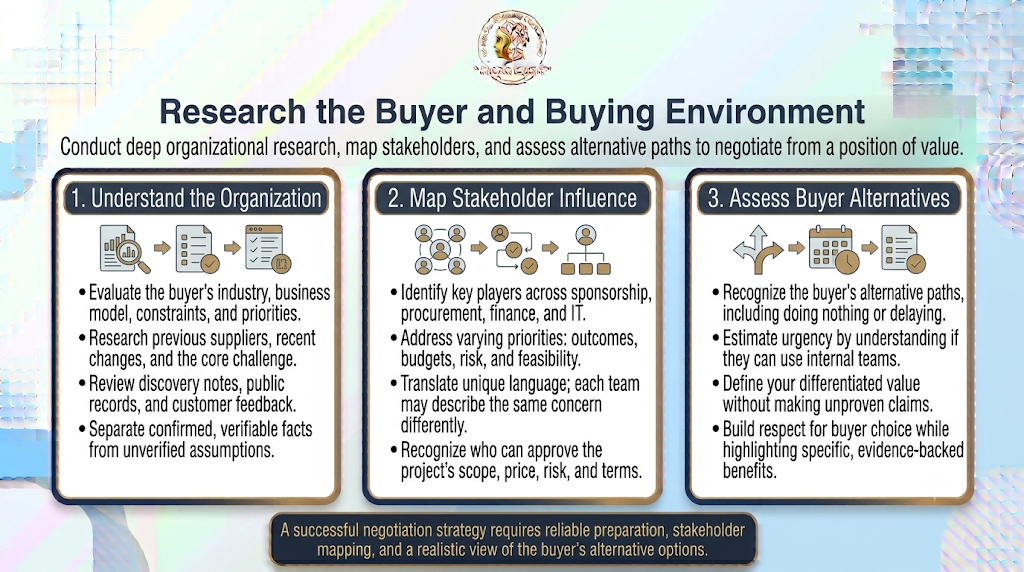
Preparation begins with understanding the organization, its goals, constraints, and decision process. Review the buyer’s industry, business model, current priorities, existing suppliers, recent changes, and the problem that created the opportunity. Use discovery notes, public information, previous conversations, and relevant customer feedback. Distinguish confirmed facts from assumptions. A B2B Sales Negotiation Strategy depends on reliable preparation.
Identify the stakeholders involved. A business sponsor may care about outcomes, procurement may focus on process and comparability, finance may examine budget and payment terms, and technical teams may assess feasibility or security. Each person may use different language to describe the same concern. Map their influence and identify who can approve scope, price, risk, and contract terms.
A B2B Sales Negotiation Strategy should also consider the buyer’s alternatives. They may choose another supplier, use an internal team, delay the project, reduce the scope, or do nothing. Understanding these alternatives helps the seller assess urgency and explain differentiated value without making unsupported claims about competitors. A B2B Sales Negotiation Strategy must respect buyer choice.
3. Establish value before discussing discounts
Price is easier to defend when the buyer understands what the offer is intended to achieve. Connect services, products, and deliverables to the buyer’s stated priorities. Explain the process, expertise, resources, risk reduction, and support included. Use evidence such as relevant examples, documented capabilities, transparent methods, and realistic performance measures.
Do not promise a specific financial result unless there is reliable evidence and the conditions are clear. If outcomes depend on customer participation, market conditions, data quality, or implementation decisions, explain those dependencies. Credibility is more valuable than an impressive but unsupported forecast. A B2B Sales Negotiation Strategy must stay evidence-led.
A B2B Sales Negotiation Strategy should make value concrete. Instead of saying a service is high quality, explain what quality means in the engagement: defined deliverables, experienced staff, review checkpoints, response expectations, reporting, or documented acceptance criteria. Help the buyer compare the full offer rather than one line in a price table. A B2B Sales Negotiation Strategy makes value easier to assess.
4. Understand the reason behind an objection
A request for a lower price may signal a real budget limit, a procurement benchmark, uncertainty about value, a desire to test flexibility, or a mismatch between scope and expectations. Do not assume the reason. Ask open questions and listen carefully before proposing a response.
Useful questions include: “Which part of the investment is hardest to justify internally?”, “Is the concern the total budget or the timing of payment?”, and “What would need to be clearer for your team to approve the proposal?” These questions reveal whether the issue is price, risk, scope, timing, or internal alignment.
The B2B Sales Negotiation Strategy should treat objections as information. A buyer who asks for a discount may accept a phased scope, a different start date, or a shorter initial commitment if the real constraint is cash flow or approval timing. A buyer who is unsure about implementation may need a clearer plan rather than a lower price. A B2B Sales Negotiation Strategy asks before it answers.
5. Prepare a negotiation range and approval rules
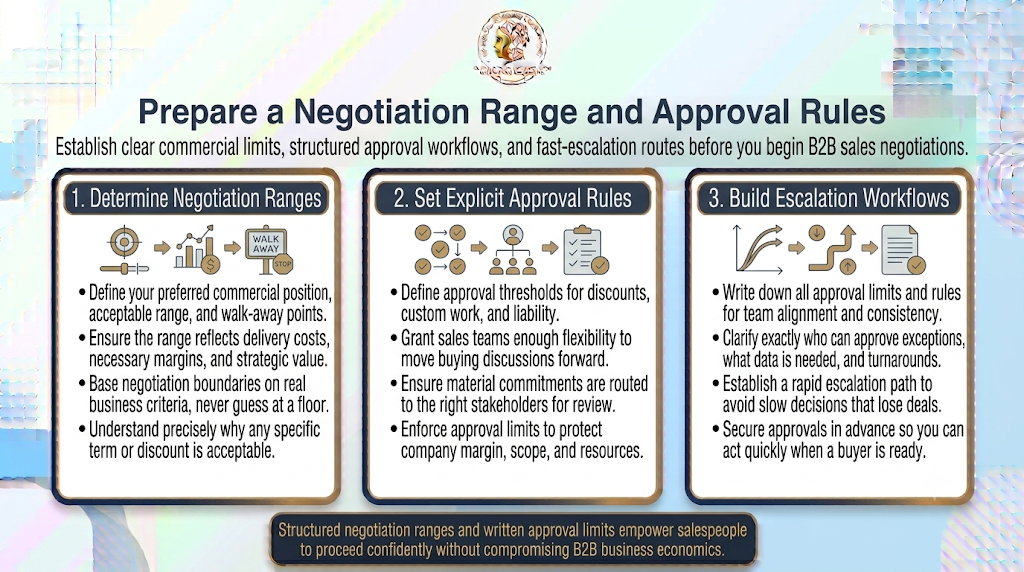
Before the meeting, identify the preferred commercial position, acceptable range, and walk-away conditions. The range should reflect cost to deliver, required margin, market positioning, strategic value, and risk. Avoid inventing a precise floor simply to create a negotiating game. The business should understand why a term is acceptable or unacceptable.
Set approval rules for discounts, free work, extended payment terms, custom development, service-level commitments, liability, exclusivity, and contract duration. Salespeople need enough flexibility to move a discussion forward, but material commitments should be reviewed by the right people.
A B2B Sales Negotiation Strategy becomes more consistent when approval limits are written down. Clarify who can approve an exception, what information is required, and how quickly a decision can be made. Slow internal approvals can weaken credibility, so establish a practical escalation route before the buyer asks for a decision. A B2B Sales Negotiation Strategy prepares approvals in advance.
6. Trade concessions instead of giving them away
A concession is a change to the original offer. It may involve price, scope, timing, payment terms, onboarding, support, contract length, or additional deliverables. Avoid making concessions without receiving something in return. If the buyer requests a lower price, explore a smaller scope, longer commitment, faster payment, reduced customization, or a mutually workable start date.
Use conditional language. For example: “If we reduce the initial scope to the priority workstreams, we can review the investment at that level.” This connects the change to a clear adjustment rather than implying that the original price was arbitrary.
A B2B Sales Negotiation Strategy should keep concessions proportional and documented. Multiple small concessions can accumulate into a large commercial loss. Track what has changed, why it changed, and what the buyer has agreed to provide in return. Do not rely on memory after a long series of calls. A B2B Sales Negotiation Strategy records every material trade.
7. Discuss price with confidence and clarity
Present price in the context of scope, resources, timing, and expected work. Explain what is included and what would require a separate agreement. If the buyer compares your proposal with a lower-priced alternative, clarify whether the scope, experience, implementation, support, and risk are comparable.
Avoid immediately filling silence after stating the price. Give the buyer time to consider the proposal. If they challenge the amount, ask which element they want to examine. You may discover that the buyer is comparing different deliverables or has misunderstood the assumptions.
A B2B Sales Negotiation Strategy does not require refusing every discount. It requires knowing what a discount changes and whether the resulting deal remains commercially sound. If a lower price is appropriate, document the reason and adjust the scope or terms where necessary. A B2B Sales Negotiation Strategy protects deal quality.
8. Manage multiple stakeholders
B2B decisions rarely involve only one person. The contact who likes the proposal may not control the budget, while procurement may have a formal process that begins after the business sponsor has selected a preferred supplier. Technical and legal reviewers may raise concerns late if they were not included early.
Ask about the approval process before the final negotiation. Find out who must review the proposal, what criteria they use, what documentation they need, and when the decision is expected. Provide relevant information in a format that helps the internal champion explain the recommendation.
The B2B Sales Negotiation Strategy should support the buyer’s internal decision-making. Provide a clear summary of the problem, recommended approach, scope, investment, assumptions, risks, and next steps. Do not encourage one stakeholder to bypass legitimate review processes. A transparent process reduces surprises and improves trust. A B2B Sales Negotiation Strategy supports internal alignment.
9. Negotiate scope, timing, and delivery risk
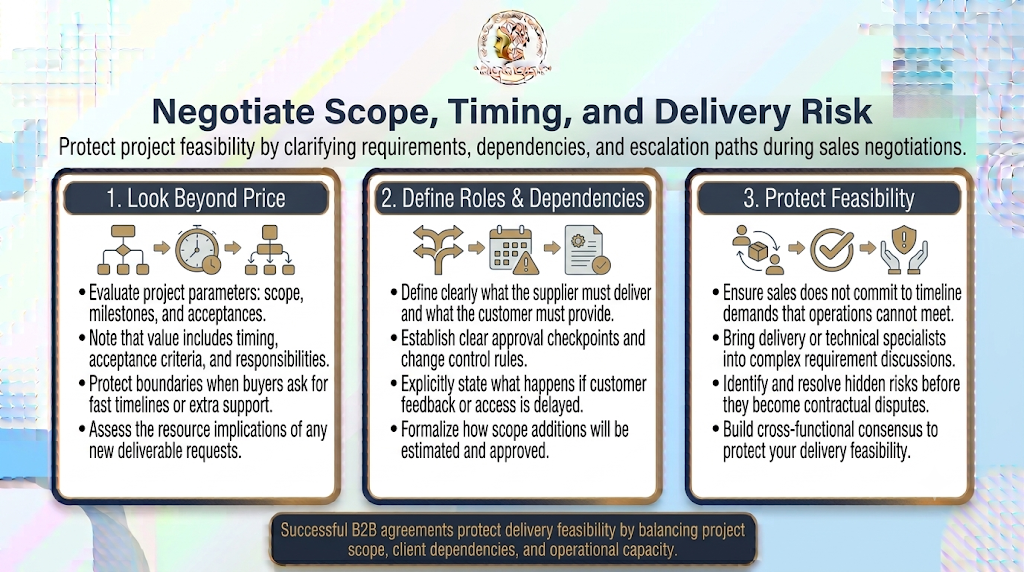
Commercial value is not limited to the price. Scope, milestones, responsibilities, dependencies, acceptance criteria, and change control can determine whether a deal succeeds. A buyer may ask for an earlier launch, more deliverables, or additional support without recognizing the resource implications.
Clarify what the supplier will deliver, what the customer must provide, how approvals work, and what happens if dependencies are delayed. Define how changes will be requested, estimated, approved, and scheduled. If a deadline depends on customer access or feedback, state that clearly.
A B2B Sales Negotiation Strategy should prevent the sales team from promising delivery conditions that operations cannot meet. A B2B Sales Negotiation Strategy protects delivery feasibility. Bring delivery or technical specialists into discussions when the agreement includes complex requirements. Their input can identify hidden risks before they become contractual disputes.
10. Confirm the agreement in writing
After the discussion, summarize the agreed commercial points promptly. Include scope, deliverables, price, payment schedule, dates, responsibilities, assumptions, dependencies, service expectations, change process, and any open items. Make sure the written summary matches what was actually approved.
Do not treat verbal agreement as a substitute for the required contract or internal approval. Involve legal, finance, security, and delivery teams as appropriate. Check that the final document does not introduce terms that were never discussed or remove protections that were important to the business.
A B2B Sales Negotiation Strategy should create a clean handoff from sales to delivery. A B2B Sales Negotiation Strategy protects the customer experience. The people responsible for fulfilling the agreement need to understand what was promised and what conditions apply. A clear record reduces confusion, rework, and disputes after signature. A B2B Sales Negotiation Strategy finishes with clarity.
A Practical Negotiation Preparation Checklist
- Confirm the buyer’s problem, desired outcome, and reason for acting.
- Identify stakeholders, decision-makers, influencers, and approval steps.
- Separate verified facts from assumptions.
- Review the buyer’s alternatives and likely decision criteria.
- Define the preferred outcome and minimum acceptable terms.
- Confirm delivery costs, margin requirements, and commercial risks.
- Identify terms that require management, finance, legal, or delivery approval.
- Prepare evidence that supports the value of the offer.
- Anticipate objections about price, scope, timing, risk, and competition.
- Decide which concessions may be offered and what must be received in return.
- Clarify scope, dependencies, responsibilities, and acceptance criteria.
- Prepare questions that reveal the reason behind buyer requests.
- Agree on who will lead the meeting and who can approve changes.
- Record the outcome and assign follow-up actions.
- Confirm all agreed terms in writing before delivery begins.
Frequently Asked Questions
What does a commercial negotiation strategy involve?
It is a structured approach to preparing for and conducting commercial discussions between businesses. It helps sellers understand buyer priorities, communicate value, manage price and scope, exchange concessions, assess risk, and reach agreements that can be delivered profitably.
Should a B2B company always negotiate on price?
No. Price is only one part of the agreement. Scope, timing, payment terms, service levels, risk allocation, and contract duration may be more important. If a price adjustment is appropriate, connect it to a change in scope or another meaningful term rather than discounting automatically.
How can sales teams respond to discount requests?
First, ask why the buyer needs a lower price. The reason may be budget, perceived value, procurement policy, timing, or a comparison with another offer. Then explore options such as phased work, reduced scope, different payment timing, or a longer commitment. Do not offer a concession without understanding its impact.
How should a company handle several decision-makers?
Identify their roles and concerns early. Provide the business sponsor with a clear summary they can share internally, and give technical, finance, procurement, and legal stakeholders the information relevant to their review. Confirm the approval process rather than assuming one contact can make every decision.
How SG Digital Business Development Can Support Better B2B Growth

A B2B Sales Negotiation Strategy starts before the sales meeting. If the wrong prospects enter the pipeline or the offer is difficult to understand, negotiation becomes harder than it needs to be.
SG Digital Business Development works across digital marketing, SEO, website development, and business development to help companies improve how they attract, inform, and convert potential customers. A stronger digital foundation can help prospects understand the service before a sales conversation begins.
Explore the B2B SEO strategy guide and B2B lead generation strategy for related guidance. For help reviewing your digital growth priorities, contact SG Digital Business Development. Discuss your target market, offer, and commercial goals to identify practical opportunities for improvement.
Final Thoughts
Strong B2B negotiations are built on preparation, curiosity, clear value, and disciplined decision-making. Understand what the buyer needs, identify who is involved, and establish the commercial boundaries before discussing concessions. When objections arise, investigate the reason rather than reacting automatically. When terms change, record the trade and assess its effect on delivery and profitability.
A repeatable B2B Sales Negotiation Strategy helps sales teams protect value while remaining flexible about how an agreement is structured. It supports better conversations, clearer approvals, and smoother handoffs after signature. The goal is not simply to close more deals. It is to reach agreements that solve real buyer problems and create sustainable value for both organizations.
Make negotiation a shared capability. Review outcomes, train with realistic scenarios, and update the playbook when buyer expectations or market conditions change. With consistent preparation and transparent communication, your team can approach difficult commercial discussions with greater confidence and make decisions that support long-term business relationships with mutual confidence.
Let’s build your digital future together. Contact SG Digital Business Development today and let’s engineer your global authority!